
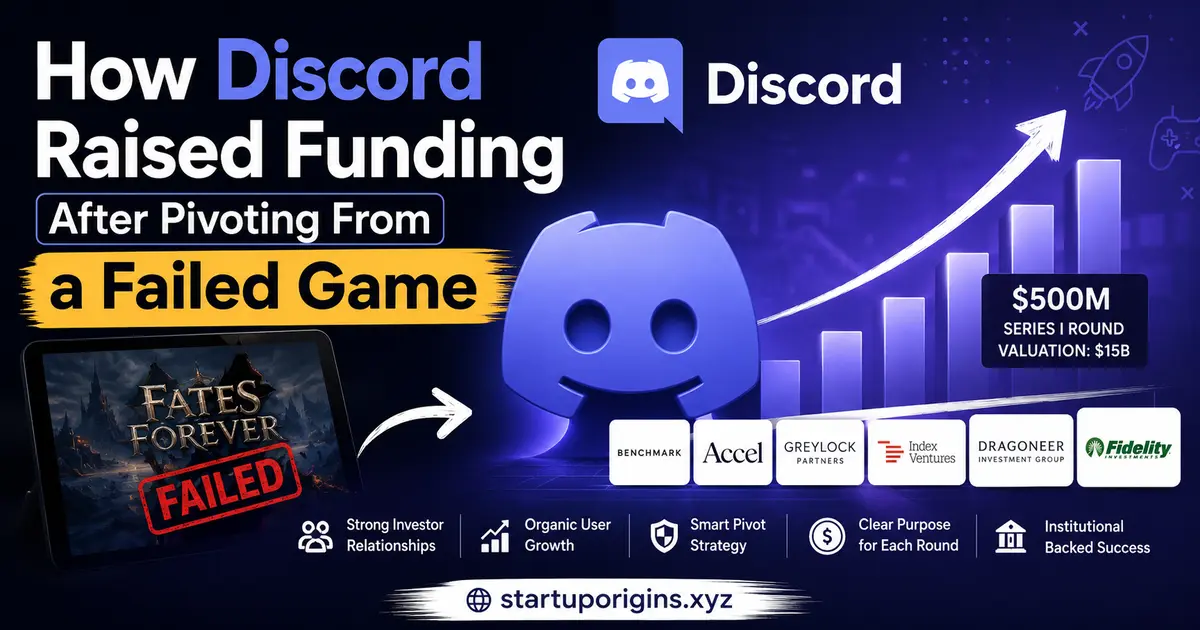
Published: June 2026 | StartupOrigins | Category: Funding Stories
Introduction
Picture a Series A pitch deck from late 2013. It describes a tablet-exclusive multiplayer battle arena, built by a team that has already had one big exit, backed by an investor who’d funded League of Legends. Everything about it reads like a credible bet on the next big gaming category.
Now picture that same team, fifteen months later, sitting across from investors again—except this time the pitch is completely different. The tablet MOBA hasn’t worked. A third of the company is gone. What’s left is a small communication tool nobody asked them to build, with maybe ten active users, that the founders are now insisting is the real business.
That is, almost word for word, what happened to Jason Citron, Stanislav Vishnevskiy, and the team at Hammer & Chisel in early 2015. The product investors had funded had failed. What replaced it wasn’t proven, wasn’t requested, and wasn’t even fully built yet. By any normal startup logic, that’s the moment capital dries up—when the original thesis collapses and the founders are left holding a half-finished alternative with no traction.
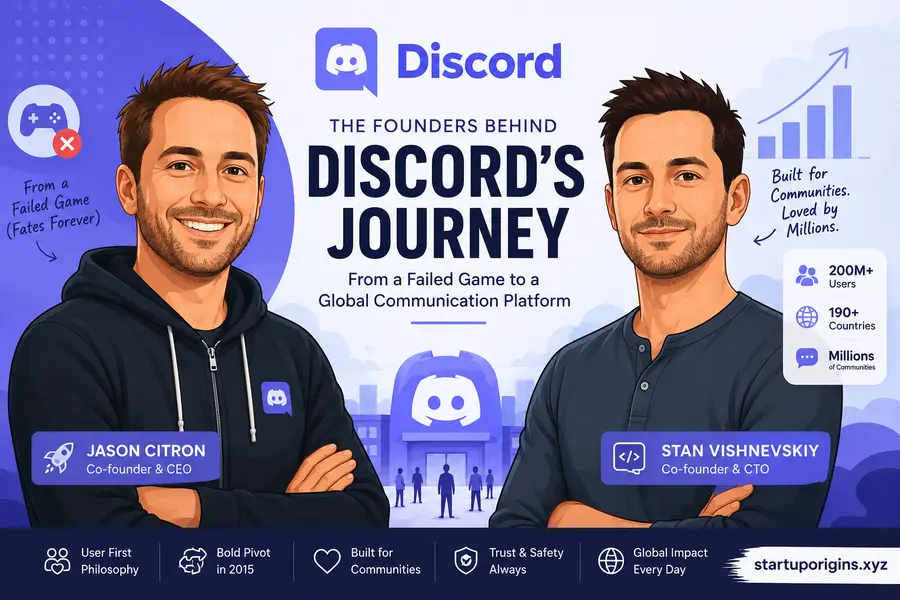
Instead, Discord went on to raise just under $1 billion in venture capital over the following decade, reach a $15 billion valuation, and file confidentially for a U.S. IPO in 2026. Understanding how that happened—how a team that had just watched its funded product fail convinced investors to back something else entirely—says less about luck and more about how venture capital actually evaluates risk once a founder has shown they can read the evidence honestly and act on it.
This is the story of that fundraising journey: not a list of rounds and dollar figures, but an explanation of why investors kept saying yes to a company that began by saying no to its own original plan.
Why Investors Were Skeptical of Hammer & Chisel
To understand why Discord’s fundraising story is unusual, it helps to look at what came before it.
Hammer & Chisel—originally named Phoenix Guild—was founded by Citron in April 2012 with a specific, ambitious thesis: bring the kind of deep, competitive multiplayer gaming that had made League of Legends one of the biggest titles in the world to tablets, which were, at the time, the fastest-growing computing category on the planet.
It wasn’t a fringe bet. In November 2013, the company closed an $8.2 million Series A led by Benchmark’s Mitch Lasky—the same investor who had backed Riot Games. Additional capital came from Accel Partners, IDG Global Solutions, and Time Warner. This was serious, credible early-stage validation from investors who understood competitive gaming better than almost anyone in venture capital.
But the underlying market thesis was harder to defend than it looked on paper. Tablet sales were strong, but the audience buying tablets skewed casual—not the hardcore, competitive players a MOBA needed to sustain itself. Pulling PC gamers, who already had a mature ecosystem of multiplayer games and communication tools, onto a touchscreen was a much bigger behavioral shift than the pitch deck implied. Raising additional capital on the strength of “we believe tablets will become the dominant gaming platform” was a thesis that got harder to defend with each passing quarter that tablet gaming failed to produce a hit on the scale of PC esports.
The Failed Game That Changed Everything
The product built on that Series A was Fates Forever, a tablet-exclusive MOBA that launched in the summer of 2014. It included built-in voice and text chat—genuinely unusual for a mobile game at the time—designed to help teammates coordinate during matches.
Reviews were respectable. The mechanics worked. The chat features, specifically, drew real praise from critics who noted the multiplayer experience felt more alive than most mobile games managed. None of that translated into the user growth the company needed to justify its next round.
By early 2015, the numbers were clear enough that there was no comfortable way to interpret them. The tablet gaming boom the company’s entire fundraising thesis depended on hadn’t materialized at the scale investors had underwritten. Hammer & Chisel was not going to grow into the company its Series A had been priced for.
The Pivot Investors Didn’t Expect
What made the situation survivable, rather than fatal, was a detail buried inside the failure. Players who did find Fates Forever were using its voice and text chat features with real intensity—frequently more than they were playing the actual game.
Citron and Vishnevskiy had also lived this problem personally. Coordinating with friends across games like League of Legends and Final Fantasy XIV meant relying on Skype, built for one-on-one professional calls and prone to dropping connections, or TeamSpeak, more stable but requiring server setup that scared off casual users. Vishnevskiy’s prior experience building Guildwork, a social platform for Final Fantasy XIV players, gave the team a detailed understanding of exactly how a demanding gaming community organized itself and where existing tools failed them.
Internally, the conversation shifted from “how do we save the game” to “what if the game was never the product.” That conversation led to one of the harder decisions in the company’s history: shutting down game development entirely and laying off roughly a third of the staff to focus the remaining team on the communication tool. According to Citron, the resulting product, Discord, made no specific effort to target a particular audience when it launched—but gaming-related subreddits quickly began replacing their IRC links with Discord links, and the platform became widely used by esports and LAN tournament communities.
This is the part of the story that matters most for understanding the fundraising journey that followed. Hammer & Chisel didn’t go to investors with a hypothesis about communication software. They went with early, if extremely small, evidence that a different product than the one they’d been funded to build was generating real engagement on its own.
Why Investors Finally Believed in Discord
Venture investors back founders as much as products, and the team’s willingness to act decisively on disappointing data—rather than dragging out a dying thesis to protect their original story—was itself a signal worth something to investors who had already backed Citron once.
But belief alone didn’t raise capital. What did was speed of adoption once the product found its first real audience. Discord publicly launched on May 13, 2015, after a Final Fantasy XIV subreddit post about the game’s upcoming Heavensward expansion drove the first wave of organic signups. From there, growth compounded in a way that’s rare for early-stage communication products: by January 2016, Hammer & Chisel reported Discord had been used by 3 million people, growing by roughly 1 million per month, and reached 11 million users by that July. By December 2016, the company reported 25 million users worldwide.

That curve—steep, consistent, and driven almost entirely by word of mouth inside gaming communities rather than paid acquisition—is exactly the kind of organic network effect venture investors look for as evidence of genuine product-market fit. To develop Discord, Hammer & Chisel secured additional funding from YouWeb’s 9+ business incubator, which had also backed the original Hammer & Chisel startup, along with capital from Benchmark and Tencent. The same investors who had funded the failed game thesis were now seeing, in real numbers, that the team’s pivot had found something the original plan never had: a product growing on its own.
How Discord Raised Its Early Funding
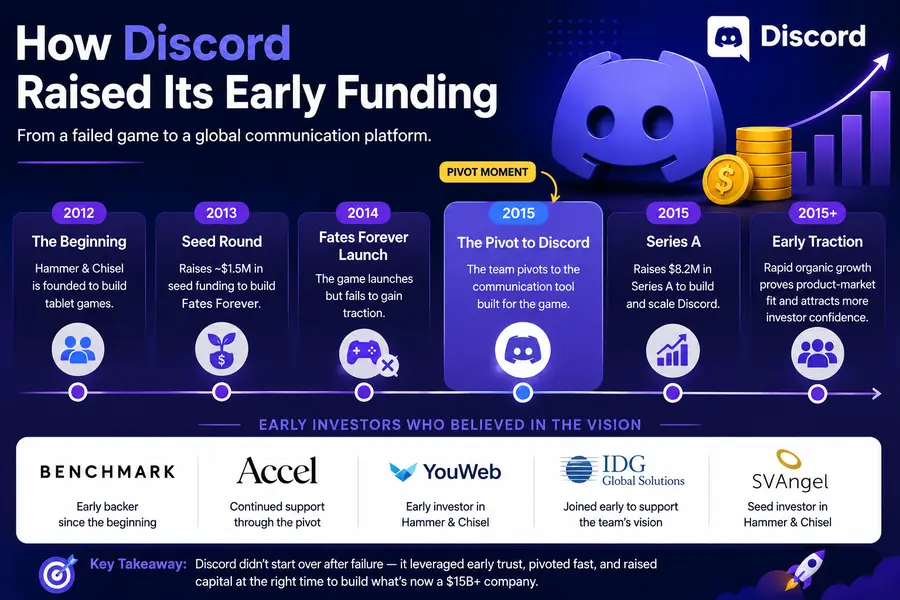
The earliest capital that carried Discord through its first year came from a mix of existing relationships and conviction rather than a conventional pitch process. YouWeb made its first direct investment in Discord in February 2015, in what is recorded as the company’s Series B round, alongside continued backing from existing investors including IDG Global Solutions and Accel, who had been part of the original Series A in November 2013.
By January 2016, with the user growth curve now visible and accelerating, Discord raised a $20 million round, with Tencent and WarnerMedia among the strategic backers—capital that allowed the team to begin scaling infrastructure ahead of the explosive growth that followed through 2016 and 2017. By the end of 2017, the service had drawn nearly 90 million users, adding roughly 1.5 million new users every week, and by its third anniversary the company reported 130 million unique registered users.
What’s notable about this stretch of fundraising is how little of it required Discord to argue for its own existence. The company wasn’t selling investors on a vision anymore—it was showing them a usage curve that very few consumer products achieve without significant paid marketing spend, and asking for capital to keep up with demand rather than to create it.
Discord Funding Timeline
| Year | Round | Lead / Key Investors | Valuation (if disclosed) | Milestone |
|---|---|---|---|---|
| 2013 | Series A ($8.2M) | Benchmark (Mitch Lasky), Accel, IDG Global Solutions, Time Warner | — | Capital raised for Fates Forever, the tablet MOBA that preceded Discord |
| Feb 2015 | Series B | YouWeb, Accel, IDG Global Solutions | — | Bridge funding during the pivot from Fates Forever to Discord |
| May 2015 | — | — | — | Discord launches publicly |
| Jan 2016 | Series C ($20M) | Benchmark, Tencent, WarnerMedia, YouWeb | — | 3M users and climbing roughly 1M/month |
| Jun 2017 | Series D ($50M) | Greylock, Tencent | — | Nearly 90M users by end of 2017 |
| Apr 2018 | Series E ($50M) | Greylock, IVP, Spark Capital | $1.6B | 130M registered users at third anniversary |
| Dec 2018 | Series F ($150M) | Greenoaks Capital, with Firstmark, Tencent, IVP, Index Ventures | $2B | Continued scaling of infrastructure and team |
| Jun 2020 | Series G ($100M) | Index Ventures (Danny Rimer) | $3.5B | Platform repositions beyond gaming with “Your place to talk” |
| Dec 2020 | Series H ($100M+) | Various existing investors | $7B | Pandemic-driven growth; 2020 revenue triples to $130M |
| Sep 2021 | Series I ($500M) | Dragoneer Investment Group, with Baillie Gifford, Coatue Management, Fidelity, Franklin Templeton, and Sony Interactive Entertainment | $15B | Largest single round in company history |
| Mar 2022 | Series I extension | Flat Capital, Dragoneer | $15B | Continued late-stage backing |
| Apr 2025 | — | — | — | Jason Citron steps down as CEO; Humam Sakhnini (ex-Activision Blizzard, ex-King) named successor with explicit mandate to prepare for a public listing |
| Mar 2026 | — | — | — | Discord confidentially files S-1 registration with the SEC, with Goldman Sachs and JPMorgan advising |
Figures reflect publicly disclosed amounts. Some smaller or undisclosed rounds may not be reflected individually in this table.
How Funding Helped Discord Scale
Each major round mapped to a specific operational need rather than abstract growth-for-growth’s-sake spending, which is itself part of why investors kept returning.
The earliest rounds, through the Series C in 2016, went almost entirely toward infrastructure and hiring—keeping the voice and text systems stable as the user base compounded by a million people a month. By 2018, that infrastructure investment had paid off enough that the company described its growth as “not just more, better and efficient tools for gamers, but for people online at large,” a shift in framing that previewed the platform’s eventual expansion well beyond its gaming roots.
The Series F in December 2018, at a $2 billion valuation, came as the company was visibly outgrowing its original niche; the round funded continued infrastructure work alongside the beginning of product expansion into non-gaming use cases. By 2020, with the Series G, led by Index Ventures, that expansion became explicit. In June 2020, Discord announced it was shifting focus away from video gaming specifically toward a more all-purpose communication client, adopting the slogan “Your place to talk” and revising its website to reduce gaming-specific in-jokes and improve onboarding for non-gaming users.
The pandemic-era rounds—the Series H in December 2020 and the massive $500 million Series I in September 2021—funded a different kind of scaling entirely: international growth, trust and safety infrastructure as the user base swelled with younger and more diverse communities, and continued platform development as Discord absorbed millions of new users whose numbers doubled in 2020, with users aged 13 to 24 flocking to the platform in particular as annual revenue tripled to $130 million. The Series I round included a minority investment from Sony Interactive Entertainment, signaling a strategic relationship with the gaming industry’s largest hardware players even as Discord’s user base diversified well beyond gaming.
By the time the company was preparing for its IPO process in 2025 and 2026, the use of capital had shifted again—funding the operational and governance infrastructure required of a public company, alongside continued product investment in areas like AI communities, which had become one of the platform’s fastest-growing segments.
Why Investors Continued Supporting Discord
Several threads run through a decade of consistent investor confidence, and none of them are about hype.
User engagement metrics stayed unusually strong relative to user count, round after round. A platform people use briefly and abandon doesn’t justify nine-figure late-stage rounds; a platform where users return daily, often for hours, to spaces they’ve built themselves does. Discord’s voice-channel model—persistent, low-friction, opt-in—produced exactly that kind of engagement, and investors who track usage data closely could see it directly.
The business model also matured in a way that reassured later-stage investors specifically. Rather than building around advertising or data monetization, Discord built its primary revenue line around Nitro, a premium subscription offering enhanced features, alongside more recent additions like server monetization tools and a “Quests” advertising format. That model produced steady, accelerating revenue—from roughly $45 million in 2018 to $130 million in 2020, $937.6 million in 2023, and $1.1 billion in 2024—a trajectory that gave late-stage and pre-IPO investors a clear, durable monetization story rather than a bet on engagement alone eventually converting to revenue.
Leadership credibility mattered throughout, and not only in the obvious sense. Citron and Vishnevskiy’s willingness to walk away from Fates Forever early, rather than burning capital trying to save a failing thesis, established a pattern investors could reasonably expect to continue—and it did, most visibly in April 2021, when the company turned down a reported $12 billion acquisition offer from Microsoft in favor of continuing to raise capital and grow independently. Investors backing a company whose founders had already shown they’d rather change course than protect a sunk cost were underwriting a specific kind of discipline, not just a product.
Conclusion
Discord didn’t raise nearly a billion dollars in venture capital because its first idea succeeded. It raised that capital because, when the first idea clearly failed, the founders did something harder than holding the course: they read the evidence honestly, acted on it immediately, and then spent the next decade proving that the product hiding inside their failure deserved the investment their original plan had received.
That distinction matters for how this story should actually be read. It’s tempting to tell it as a lucky discovery—a game that accidentally produced a better business. But luck doesn’t explain why investors who’d already lost money on the original thesis chose to stay in for the pivot, or why a string of increasingly sophisticated institutional investors kept committing capital across a decade, through a pandemic, through a rejected $12 billion acquisition offer, and into an eventual IPO filing. Capital follows execution, and Discord’s fundraising history is, more than anything, a decade-long record of a team that did what it said it would do with the money it was given.
The original $8.2 million Series A bought a tablet game that failed. Every dollar raised after that bought something the founders had to earn the right to build: trust, first from a small handful of existing investors willing to follow them through a pivot, and then from an entire ecosystem of late-stage capital that doesn’t typically bet on companies without durable evidence behind them.
Discord’s funding story isn’t really about the rounds, the valuations, or the investor logos. It’s about what happens when founders treat a failure as data rather than as a verdict—and have the discipline to keep proving, round after round, that the new direction was worth everyone’s continued belief.
For more on the company and people behind this fundraising journey, see also: [How Discord Started as a Failed Gaming Startup], [Jason Citron: The Founder Who Turned a Failed Game Into Discord], and [What Discord Teaches Every Startup Founder].
Disclaimer
This article is for informational purposes only. All funding figures, valuations, and investor details referenced are based on publicly available information and verified sources accurate as of June 2026. StartupOrigins is not affiliated with Discord Inc., Hammer & Chisel, or any individuals or investment firms mentioned in this article. Funding amounts and valuations are sourced from public reports, press disclosures, and company statements, and may not reflect real-time or complete data, as some round details remain undisclosed by the company. This article does not constitute financial, investment, or legal advice.

Anup Kumar Yadav is the founder of StartupOrigins.xyz, where he researches and publishes detailed stories about the world’s most successful startups. His work explores founder journeys, funding milestones, growth strategies, and the lessons entrepreneurs can learn from them.