
Published: July 2026 | StartupOrigins | Category: Startup Lessons
Introduction
Most people encounter Discord as a finished product: a polished communication platform with over 200 million monthly active users, 656 million registered accounts, and communities covering everything from AI research to competitive gaming to indie finance. From that vantage point, it looks like a company that always knew what it was.
It didn’t.
Discord was built by a team that spent two years making a tablet game nobody wanted, then laid off a third of the company to chase a chat feature nobody had asked them to build. Its public launch happened because a stranger posted a link in a gaming subreddit. Its first meaningful user base came from a community the founders hadn’t specifically targeted. For the first several weeks after launch, the product barely worked.
The reason Discord is worth studying isn’t that it succeeded. Plenty of companies succeed. What makes Discord worth examining closely is how it failed first—and what the team did with that failure. Every major decision that produced the company we now know was preceded by a moment where the founders had to choose between the comfortable interpretation of their data and the honest one. They kept choosing the honest one, even when it was expensive.
That discipline, more than any single product feature or market insight, is what What Discord Teaches Every Startup Founder. Not the pivot, not the community strategy, not the voice quality—but the underlying habit of acting on evidence rather than defending an original plan. The rest of the lessons are downstream from that.
There are ten of them. Each comes directly from something that actually happened.
Lesson 1: Solve Real Problems, Not Just Interesting Ideas
Before Fates Forever existed, the communication problem it tried to solve already existed. Every gamer who’d tried to coordinate a raid on Skype knew the frustration of calls that dropped at critical moments, of group setups that required five minutes of configuration before anyone could speak, of audio quality so bad that teammates miscommunicated calls. Vishnevskiy had spent years watching it happen firsthand through Guildwork, his social platform for Final Fantasy XIV players. Citron had experienced it personally every time he tried to play League of Legends with friends and had to fight Skype to do it.
This wasn’t a problem someone had to research. It was a problem you felt the moment you tried to play a team game with people who weren’t in the same room as you. Skype was built for professional calls, not combat coordination. TeamSpeak worked better technically but required server setup that immediately excluded casual users. IRC was a relic. Mumble existed but was never designed for the kind of spontaneous, always-on communication gaming communities actually needed.
The communication gap in gaming wasn’t subtle. It was constant, visible, and shared by millions of people. The reason Discord worked immediately with the communities that found it in 2015 wasn’t marketing or timing. It was that the product solved a problem those communities had been tolerating for years. The speed of adoption reflected the depth of the unmet need.
The lesson isn’t “find product-market fit.” It’s more specific: problems that people are already living with and working around—tolerating rather than loving their current solution—are the most receptive markets for new products. The bar for switching is low when the existing option genuinely frustrates people every time they use it.
Lesson 2: Your Biggest Failure Might Hide Your Best Opportunity
Fates Forever failed commercially. That’s the clean version. The more useful version is that Fates Forever failed at being a game while quietly succeeding at something the team hadn’t intended to build: a communication tool that players preferred to anything else available.
The players who found Fates Forever weren’t staying because of the combat. They were staying because the chat made them feel like they were actually in the same space as the people they were playing with. And when the rest of the game didn’t hold their interest, some of them were still using the chat.
That data pattern—the wrong product succeeding in the wrong dimension—is one of the harder things to notice when you’re inside a failure. The natural response is to look for what’s not working, not what is. Citron and Vishnevskiy looked at both. The game wasn’t working. The chat was. Those were two separate facts, and they led in two completely different directions.
The practical implication isn’t that every failing startup has a better business hiding inside it. Most don’t. But it does mean that the habit of asking “what specifically is working, even if the whole thing isn’t” is worth building before you’re in a crisis—because in a crisis, you’re least likely to have the mental space to ask it.
For more on how this insight emerged, see [How Discord Started as a Failed Gaming Startup].
Lesson 3: Listen to User Behaviour More Than Your Original Plan
Jason Citron and Stanislav Vishnevskiy didn’t decide to build a communication platform because they thought the market opportunity was large. They decided because they kept watching users do something with their product that nobody had designed the product to do.
That’s a different kind of insight from most market research. It’s behavioral rather than hypothetical. Users were voting with their attention—spending more time in the chat than in the game—and that vote was more honest than any survey or focus group would have been. Paying attention to that behavior, rather than dismissing it as noise or treating it as a symptom of the game’s failure, was what made the pivot possible.
This lesson extends beyond Discord’s specific situation. Almost every major product pivot in startup history involves a founder noticing that users are doing something unexpected with a product—using it differently than designed, or using a secondary feature more than the primary one. That unexpected behavior is almost always more valuable than the designed behavior, precisely because it wasn’t planned. It emerged from actual need rather than from what the founders thought the need would be.
The habit that makes this lesson actionable is regular, granular attention to how people actually use your product—not the way you expect them to use it, or the way you hope they use it, but the way they actually do. Usage patterns that don’t match the product’s intended design aren’t bugs to be explained away. They’re often the most important data in the system.
Lesson 4: Product-Market Fit Changes Everything
Before Discord found product-market fit, raising capital required arguing for a vision. After it found product-market fit, raising capital required showing a curve.
The difference is not subtle. In January 2016, roughly eight months after launch, Discord reported 3 million users growing by approximately 1 million per month—entirely through word of mouth, inside gaming communities, with virtually no paid acquisition. By July 2016, it was at 11 million. By December, 25 million. By the end of 2017, nearly 90 million, with roughly 1.5 million new users arriving every week.
That growth curve didn’t require a better pitch deck. Investors who could see it didn’t need to be convinced—they needed to decide how much to allocate before the valuation moved further. The Series C in January 2016, the Series D in June 2017, the Series E in April 2018: each round closed faster and at higher valuations than the previous one, not because the founders became better at fundraising but because the product was pulling users in on its own.
Product-market fit is often discussed as a qualitative feeling—”you’ll know it when you have it.” Discord’s early numbers make it quantitative and visible: when a product is growing by a million users a month through word of mouth alone, that’s what the feeling looks like in data. The practical lesson is that the effort founders spend pitching before product-market fit is fundamentally different from the effort they spend after it. Finding the fit first changes the fundraising dynamic entirely.
Lesson 5: Great Products Feel Simple
Discord launched with a deliberately minimal feature set. You could create a server, add voice and text channels, and invite people in. There were no follower counts, no algorithmic feeds, no notifications engineered to pull you back in, no content discovery system, no badge mechanics. It was, compared to almost every other social product available in 2015, extremely simple.
That simplicity was partly circumstantial—the team was small, the pivot was recent, and building features takes time they didn’t have. But it turned out to be a genuine advantage, not just a constraint.
Gaming communities in 2015 were living in tools that either had too little functionality (IRC, with no native voice) or required too much configuration to use casually (TeamSpeak, with its server setup requirements). Discord sat exactly in between: enough structure to organize a community, simple enough that setup took minutes. The server could be live before anyone got bored of the onboarding process.
Vishnevskiy’s description of the product as feeling like “a neighborhood, or like a house where you can move between rooms” captures what the simplicity was actually doing: making the infrastructure of communication feel as natural as physical space. You don’t initiate a call in your house. You walk into the room where people are. Discord replicated that by keeping voice channels passively available—present but not demanding. The design removed friction so completely that using the product felt less like using software and more like just being somewhere.
By June 2026, Discord has added substantial functionality—AI moderation tools, conversation summaries, server monetization through the Server Shop, end-to-end encryption for all voice and video calls, and Social SDK integrations for major game developers including Riot Games and EA. What hasn’t changed is the underlying simplicity of the core experience: open the app, see where your people are, join them in one click.
Lesson 6: Communities Can Become Your Greatest Competitive Advantage
Discord’s moat isn’t the voice infrastructure, though the quality has always mattered. It isn’t the server architecture, though that’s genuinely differentiated. The moat is the communities that have built themselves inside those structures—and how much those communities have invested in the platform.
A Discord server isn’t just a chat room. It’s a configured environment with custom roles, moderation rules, channel structures, bots, and culture that has often taken months or years to develop. Moving a mature Discord community to a competing platform doesn’t just require convincing users to switch. It requires convincing an entire ecosystem—moderators, bots, established norms, shared history—to start over. That friction is enormous, and it grows with every month a community stays.
This is what makes Discord’s community strategy more durable than most network effects. Twitter’s network effect is about following people. Discord’s is about belonging to places. Places are harder to leave than feeds.
The expansion beyond gaming followed this logic exactly. Midjourney launched its early AI image generation tool inside a Discord server in 2022, not because Discord was the technically optimal delivery mechanism but because it gave Midjourney an immediate community infrastructure to build around. By June 2026, the Midjourney server has nearly 20 million members—the largest single server on the platform—making Discord the world’s largest decentralized marketplace for generative AI interaction, a category that didn’t exist when Discord launched. The communities pulled the platform into that territory; the platform didn’t push them there.
Lesson 7: The Right Pivot Can Be More Valuable Than the Original Idea
Pivots are discussed in startup culture as though they’re common and relatively straightforward—you change direction, you keep going. Discord’s pivot from Fates Forever to communication software was neither.
It meant shutting down game development entirely. It meant laying off roughly a third of the staff. It meant going back to investors who had funded a game studio and telling them the game studio was done. It meant starting over with a product that had ten users and voice calls that dropped regularly.
What made the pivot possible wasn’t courage in the abstract. It was a specific belief, supported by actual data from the Fates Forever chat feature, that the new direction was solving a real problem for real users. The pivot wasn’t a hunch. It was a decision made because the evidence pointed somewhere different from the original plan, and the founders were willing to follow the evidence even when following it was expensive.
The lesson isn’t “pivot when things get hard.” Things were hard throughout. The lesson is that pivots grounded in actual user behavior—in something that was working even while the rest wasn’t—have a materially different success rate than pivots driven by abstract market reasoning or investor pressure. Discord didn’t pivot to communication software because someone told them the communication market was large. They pivoted because players were using their chat feature more than their game, and they’d lived the problem themselves every time they tried to play together over Skype.
Lesson 8: Great Founders Adapt Faster Than Markets Change
In 2012, the tablet gaming market looked like an obvious opportunity. By 2015, it was clear it hadn’t developed the way anyone expected. That three-year window is roughly the speed at which markets can move from plausible thesis to demonstrated failure—and the founders who survive that movement are the ones who respond to the data rather than defending the original thesis.
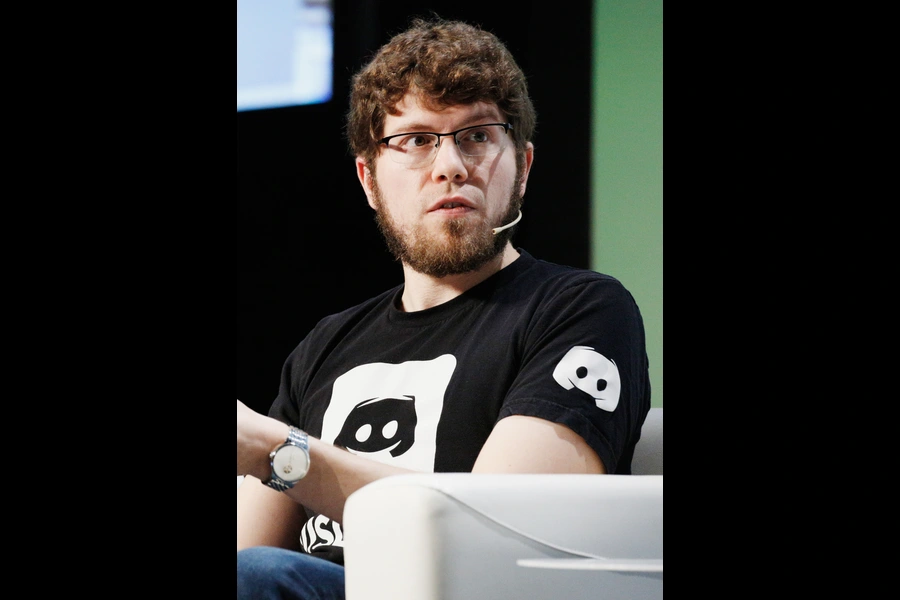
Citron’s pattern across his entire career reflects this kind of adaptation. He built OpenFeint because he noticed a gap in mobile gaming social infrastructure and moved quickly to fill it. He sold it—accepting that GREE could take it further than he could at the time. He founded Hammer & Chisel on a tablet gaming thesis that looked reasonable and turned out to be wrong. He abandoned that thesis, at real cost, when the evidence justified it. He declined a $12 billion acquisition offer from Microsoft in 2021 because the evidence—a product growing by tens of millions of users, a revenue line accelerating toward $1 billion—supported a different outcome than selling. He stepped down as CEO in April 2025 because he concluded someone with a specific operational background, namely Humam Sakhnini’s experience taking gaming companies public, was better positioned for Discord’s next chapter than he was.
Each of those decisions required reading the current evidence rather than defending a previous decision. None of them were obviously right at the time. The discipline of doing that consistently, across more than a decade, is what adaptation actually looks like from the inside—not a single pivot, but a repeated willingness to update.
Lesson 9: Build for the Long Term
In 2015, Discord’s voice infrastructure was rebuilt from scratch three times in its first few months. Not because the team had the time or wanted to. Because the quality wasn’t good enough to earn the switching behavior they needed from users who already had alternatives.
That decision—to keep rebuilding rather than ship something they knew was below standard—established a pattern the company carried forward. The $500 million Series I round in September 2021 was used, by Citron’s account, to expand the workforce and “invest in new features and tools”—not to accelerate user acquisition through paid marketing. Revenue grew from $130 million in 2020 to $937.6 million in 2023 and $1.1 billion in 2024, almost entirely through product improvement and community growth rather than advertising spend.
By March 2026, Discord had completed the rollout of end-to-end encryption across all voice and video calls—a technical investment that took years of engineering work across multiple platforms including web browsers, gaming consoles, and their Social SDK, with no immediate revenue impact. The same month, they launched Social SDK integrations for Roblox games, extending Discord’s community infrastructure to thousands of independently built games and their player bases. Neither of these was a feature that would move a quarterly number. Both were investments in the platform’s long-term reliability and reach.
For startup founders accustomed to thinking in 90-day cycles, this is a hard kind of discipline to maintain. But Discord’s trajectory suggests a clear relationship: long-term product investment produces the kind of user trust that generates sustainable revenue more reliably than growth tactics do.
Lesson 10: Success Is Often Hidden Inside Failure
Jason Citron’s career contains four chapters, and each one sets up the next in ways that weren’t obvious in advance.
OpenFeint, the mobile gaming social platform he founded in 2009, gave him a direct understanding of network effects, developer ecosystems, and what it felt like to build infrastructure that millions of people depended on. The sale to GREE in 2011, and GREE’s subsequent shutdown of the platform in 2012, taught him what it meant to lose control of something he’d built—a lesson he’d apply a decade later when he declined to sell Discord.
Hammer & Chisel, the studio that followed, gave him and Vishnevskiy the specific experience of building a communication feature inside a game—the exact experience that produced the insight Discord was built on. If Fates Forever had never been built, the chat feature that became Discord would never have existed. The failure was a prerequisite for the success that followed it.
Discord itself, in its first year, looked like it might not survive. The voice infrastructure kept breaking. Growth was initially slow. The product had to be explained to investors whose previous investment had just failed. And yet it was in that fragile early period that the company established the community relationships—with FFXIV players, with League of Legends guilds, with early streaming communities on Twitch—that gave it the organic growth curve that made everything else possible.
The pattern across these four chapters is consistent: each failure produced the specific conditions that made the next thing possible. That’s not survivorship bias or a neat narrative imposed on messy history. It’s a consequence of a founder who treated each failure as information rather than as a verdict.
What Most Founders Misunderstand About Discord
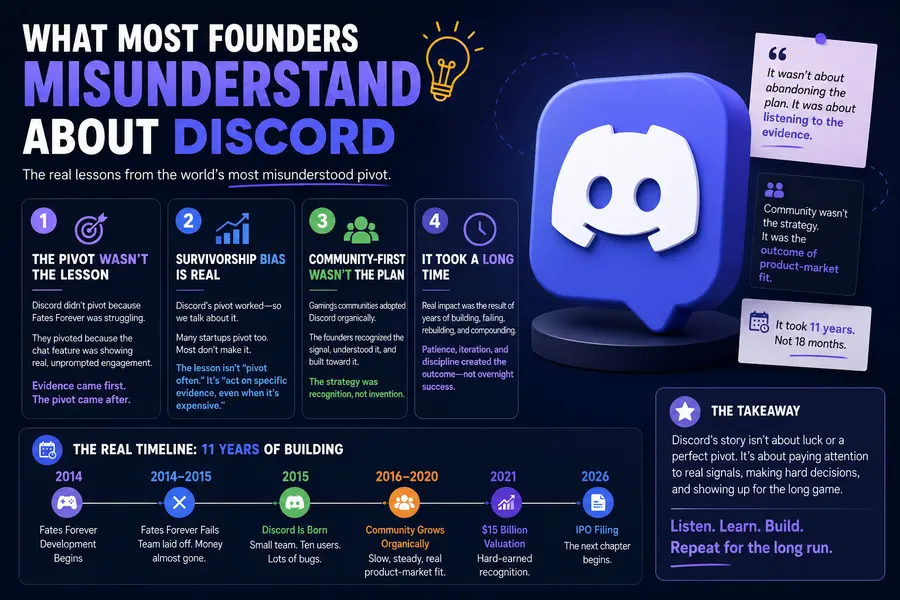
The most common misreading of Discord’s story is also the most dangerous one: that the pivot was the lesson. That if you’re in a startup that’s struggling, the thing to do is abandon what you’re building and find the product hiding inside your failure.
That misses almost everything important about what actually happened.
Discord didn’t pivot because Fates Forever was struggling. Struggling products pivot to all kinds of things and most of them fail. Discord pivoted because a specific part of the failing product—the chat feature—was generating genuine, unprompted engagement. The pivot was downstream of evidence, not upstream of it. Without that evidence, a pivot to communication software would have been a random guess with a better story.
The survivorship bias problem is real here. Discord’s story is told because it worked. For every startup that pivots from a failing product to something better, many more pivot to something equally or more unsuccessful. The discipline Discord demonstrates isn’t “pivot often” or “pivot boldly.” It’s “act on specific evidence, even when acting on it is expensive.”
There’s also a tendency to read the community-first framing as a strategy Discord chose deliberately. It wasn’t, initially. Discord became community-first because gaming communities adopted it organically—because the product solved a real problem for them—and the founders paid close enough attention to that adoption to understand what it meant and build toward it. The strategy was recognition, not invention.
The last thing most founders misunderstand about Discord is the simplest: it took a long time. The Fates Forever failure happened in 2014 and 2015. The $15 billion valuation happened in 2021. The IPO filing happened in 2026. Eleven years of building, failing, rebuilding, and compounding. Most startup narratives compress that timeline into something that sounds like eighteen months of decisive action. The actual timeline is humbling and far more instructive.
Conclusion
There’s a version of Discord’s lessons that sounds like: if you’re building something that’s failing, look harder, pivot smarter, and you’ll find the billion-dollar product hiding inside your failure. That version is seductive and largely useless. It treats the outcome as evidence of a strategy, when the strategy was evidence-based decision-making that happened to produce the outcome.
What Discord actually teaches is harder to summarize and harder to apply. It’s that the founders, repeatedly, across more than a decade, chose to act on what the data was telling them rather than what they wanted the data to say. When Fates Forever’s chat feature outperformed the game, they didn’t explain it away. When the voice infrastructure wasn’t good enough, they rebuilt it three times rather than ship something they knew was below standard. When Microsoft offered $12 billion, they declined because the evidence suggested the company was worth continuing to build. When Jason Citron concluded that leading Discord through its IPO required operational experience he didn’t have, he brought in someone who did.
None of those decisions were costless. Laying off a third of the company has a human cost that doesn’t disappear because the pivot worked out. Turning down $12 billion is not a comfortable decision, regardless of how justified it was. Voluntarily handing the CEO role of the company you’ve spent thirteen years building to someone else is not nothing.
The reason those decisions produced the outcomes they did is that they were grounded in evidence rather than wishful thinking—and that discipline turned out to be more durable than any particular product feature or market insight.
By June 2026, Discord hosts over 32 million servers. More than half its users have nothing to do with gaming. The Roblox integration launched this month extends its community infrastructure to thousands of independently built games. Its IPO filing is underway. All of that traces back to a communication feature built inside a failing tablet game—and two founders who looked at what was actually happening rather than what they’d hoped would happen.
That’s the lesson. Not the pivot. The honesty that made the pivot possible.
For the full story of how Discord got here, see: [How Discord Started as a Failed Gaming Startup], [Jason Citron: The Founder Who Turned a Failed Game Into Discord], and [How Discord Raised Funding After Pivoting From a Failed Game].
Disclaimer
This article is for informational purposes only. All facts, events, and statistics referenced are based on publicly available and verified sources accurate as of June 2026. StartupOrigins is not affiliated with Discord Inc., Hammer & Chisel, or any individuals mentioned in this article. This article does not constitute financial, investment, or legal advice.

Anup Kumar Yadav is the founder of StartupOrigins.xyz, where he researches and publishes detailed stories about the world’s most successful startups. His work explores founder journeys, funding milestones, growth strategies, and the lessons entrepreneurs can learn from them.