
Published: June 2026 | StartupOrigins | Category: Founder Journeys
By 2012, Jason Citron had already done the thing most founders spend their entire careers chasing. He had built a company from nothing, grown it to over 100 million users, and sold it for $104 million before turning twenty-seven. He could have stopped there. Plenty of people would have. A successful exit in your mid-twenties buys options most founders never get—the freedom to angel invest, advise, write a book, disappear to a beach somewhere and call it a career.
Citron started another company instead.
That decision alone tells you something about how he’s wired. But what makes his story worth telling isn’t that second act—it’s what happened inside it. The company he started after OpenFeint was not Discord. It was a tablet game studio with a vision for the next League of Legends, a Series A from one of Silicon Valley’s most respected investors, and a product that, by almost every external measure, did not work.
Most founders who build something that fails this completely don’t get a third act. The money runs out. The team scatters. The story ends as a cautionary tale at the bottom of someone else’s pitch deck. Citron’s story didn’t end there, and the reason it didn’t has less to do with luck than with a specific, repeatable instinct: the willingness to look directly at a failure and ask what it’s actually telling you, rather than what you wanted it to say.
That instinct is why Discord exists. It’s also, arguably, the central thread of Citron’s entire career—from a thirteen-year-old teaching himself to code in Florida, to a CEO who voluntarily handed over the keys to the company he’d run for thirteen years because he believed someone else could take it further.
This is the story of how he got there.
Who Is Jason Citron?
Jason Citron was born in San Francisco in 1984 and grew up largely in South Florida. The interest in technology arrived early and stayed obsessive. By the time he was thirteen, he had taught himself to program in QBasic well enough to build a text-based role-playing game from scratch—not for a class, not for a competition, just because he wanted to see if he could make something a computer would run.
That early pattern—learning a skill not because it was required but because it unlocked something he wanted to build—shows up again and again across his career. He went on to study Game Design and Development at Full Sail University in Florida, graduating in 2004, and worked in the industry afterward, including a stint at Double Fine Productions, the studio founded by Tim Schafer known for narrative-driven games like Psychonauts.
What distinguishes Citron from a lot of technically skilled engineers who never start companies is that he was drawn to the systems underneath games as much as the games themselves—the social mechanics, the matchmaking, the infrastructure that let strangers find each other and play together. That fascination with the connective tissue of gaming, rather than gaming content itself, is the thread that runs from his teenage QBasic experiments all the way to Discord.
Building OpenFeint and the First Taste of Success
In 2009, Citron founded OpenFeint. The timing mattered enormously. The App Store had opened only the year before, and the entire infrastructure layer of mobile gaming was still unbuilt. Developers could make games, but they had no easy way to add the social features—leaderboards, achievements, friend systems, multiplayer matchmaking—that made games sticky. Citron saw the gap and built the plumbing.
It worked faster than almost anyone expected. By 2011, OpenFeint had more than 100 million users and was integrated into over 7,000 games. That April, Japanese gaming company GREE acquired it for $104 million in cash. Citron was twenty-six.
The acquisition gave him something more valuable than the payout: a fully formed understanding of what it actually takes to build a platform people rely on at scale. He had seen network effects compound in real time. He understood the mechanics of what makes a developer ecosystem actually function, rather than just look good in a deck.
He also learned something harder, watching GREE shut OpenFeint down in December 2012. Selling a company means losing the right to decide what happens to it next. That lesson would resurface nearly a decade later, in a very different form, when Citron faced his own decision about whether to sell the company he’d build next.
After the acquisition, he spent time as an entrepreneur-in-residence at YouWeb, the incubator that had helped fund OpenFeint’s earliest days. He wasn’t interested in coasting. He was already circling the next problem.
Starting Over With Hammer & Chisel
In April 2012, Citron founded a new studio, initially named Phoenix Guild before it became Hammer & Chisel. The vision was specific: bring deep, competitive multiplayer gaming—the kind that had made League of Legends one of the biggest games on the planet—to tablets.
It wasn’t a reckless bet. In 2012, tablet sales were genuinely exploding, and serious analysts were projecting tablets would eclipse traditional PCs within a few years. No one had successfully translated the MOBA genre, with its deep mechanics and team coordination, onto a touchscreen. Citron wanted to be first.
In November 2013, Hammer & Chisel closed an $8.2 million Series A led by Benchmark‘s Mitch Lasky—the same investor who had backed Riot Games, the studio behind League of Legends. That detail mattered. Lasky wasn’t just writing a check; he was signaling that he saw in Citron’s new company the same kind of category-defining potential he’d recognized in Riot years earlier. Additional investors included Accel Partners, IDG Capital Partners, and Time Warner.
Stanislav Vishnevskiy joined the company in April 2013. He brought something specific: he had built Guildwork, a social platform for Final Fantasy XIV players, and understood deeply how gaming communities organized themselves outside the games they played. Citron and Vishnevskiy would build the next several years together, first on a game, and then on something neither of them had originally set out to make.
The Dream of Creating Fates Forever
The game was called Fates Forever—a tablet-exclusive multiplayer online battle arena, built specifically for the touchscreen, with the kind of team-based combat and strategic depth that had made League of Legends and Dota 2 into global phenomena.
It launched in the summer of 2014, and it included something that, at the time, set it apart from almost every other mobile game on the market: built-in voice and text chat, designed to let teammates coordinate in real time the way PC gamers already did through third-party tools.
Critics were not unkind. The mechanics held up. The visuals were competent for the format. The communication features, in particular, drew genuine praise—reviewers noted that the voice chat made the multiplayer experience feel more alive than most mobile games managed.
None of that translated into the user numbers Hammer & Chisel needed to survive.
When the Plan Stopped Working
The tablet gaming boom that had justified the company’s entire founding thesis simply didn’t materialize the way the market had expected in 2012 and 2013. Serious competitive gamers—the exact audience Fates Forever needed—were still anchored to their PCs, where the genre had been built and refined for years. The people who did own tablets skewed toward casual use: puzzle games, social games, quick sessions between other activities. The overlap between “wants a deep competitive MOBA” and “wants to play it on a tablet” turned out to be a much smaller circle than anyone on the team had modeled.
By early 2015, the data wasn’t ambiguous. Fates Forever wasn’t going to reach the scale the company needed. For Citron, this wasn’t an abstract business problem. It was personal. He had recruited a team around a specific vision. He had raised money from investors who trusted that vision. The pressure of watching that thesis fail, in real time, with other people’s careers and capital attached to it, is not something interviews or press coverage tend to fully capture—but it’s the backdrop against which everything that happened next took place.
The Insight That Changed Everything
Here is the detail that makes this story more than a standard failure-to-pivot narrative: even as Fates Forever was struggling commercially, one specific part of the product kept generating evidence that something inside it was working. Players who found the game were using its voice and text chat with real intensity—often more than they were playing the game itself.
In a worse frame of mind, that pattern reads as just another symptom of decline. Citron read it differently. He’d lived the underlying problem himself. Coordinating with friends across League of Legends and Final Fantasy XIV meant fighting tools that weren’t built for the job—Skype, designed for one-on-one professional calls, prone to dropped connections and clunky setup; TeamSpeak, more reliable but requiring server configuration that scared off casual users. Neither tool had been designed with gamers’ actual behavior in mind. Both were tolerated, not loved.
Vishnevskiy’s years building Guildwork gave the team something rare: direct, granular knowledge of how a specific, demanding gaming community organized itself, communicated, and what existing tools failed to give them.
The realization wasn’t a single dramatic moment. It built gradually, as more evidence accumulated, until it crossed a threshold: the problem they had backed into while building a doomed tablet game was bigger, and more valuable, than the game itself.
The Decision to Pivot
Deciding to pivot and actually pivoting are different things, and the gap between them is where a lot of founders lose their nerve. For Citron, the pivot meant shutting down the game development team entirely—not a quiet reallocation of resources, but the end of the thing the company had been built to do. Roughly a third of the staff was let go. These were people who had joined to build a game, who had trusted the vision enough to sign on, and who were now being told that vision was over.
Citron has been candid in later interviews about how difficult that period was. There’s a tendency in startup retrospectives to compress hard decisions into clean narrative beats—”we pivoted”—in a way that erases the actual weight of telling people their jobs and their belief in the mission no longer had a place in the company.
What remained afterward was a skeleton team, a rough communication product, and very little proof it would work. “When we decided to go all in on Discord, we had maybe ten users,” Citron later said. One League of Legends group. One World of Warcraft guild. Friends who tried the product, said it looked interesting, and then never opened it again. Voice calls failed. Quality was inconsistent. The uncomfortable question wasn’t whether Discord might eventually succeed—it was why anyone would abandon tools they already tolerated for a new tool that, in its current state, gave them no clear reason to switch.
Citron and the team answered that question by rebuilding rather than rationalizing. The voice infrastructure was torn down and reconstructed from scratch three separate times in Discord’s first few months. Each iteration measurably improved quality. When the team added real community management tools—roles, permissions, moderation, the ability for a server owner to actually govern their own space—the product crossed a threshold. Early testers stopped tolerating it and started preferring it.
The name itself came together between February and March 2015—chosen, by Citron’s account, because it sounded distinctive, related to communication, was easy to say and spell, and happened to be available to register. Practical reasoning more than poetic inspiration. It fit anyway.
Building Discord
Discord launched publicly on May 13, 2015, though “launch” overstates how planned the moment actually was. Someone posted a link to a Discord server in the Final Fantasy XIV subreddit, tied to community excitement around the game’s upcoming Heavensward expansion. People clicked through. Citron, watching the server fill with strangers in real time, jumped in and started talking with them directly—answering questions, taking feedback, behaving less like an executive monitoring a dashboard and more like someone genuinely curious what these specific users thought.
A few hundred people joined that day. It was the first real signal that the product had legs.
What followed was a period of unusually direct founder involvement. Citron participated in Reddit AMAs—at one point under the username “illumina,” before users realized they were talking to the CEO—fielding detailed product and policy questions in public. Vishnevskiy would personally create servers to help individual users troubleshoot issues. Between 2015 and 2016, the team released a new feature video roughly every three weeks, often with genuine humor: a custom rap accompanying a keybinds feature, a miniature fictional love story told entirely through message edits. Those videos averaged close to 500,000 views each on YouTube.
It wasn’t a conventional growth strategy. It was closer to a founder treating every early user as someone worth talking to directly, at a scale that wouldn’t remain possible for long but that built a foundation of trust the company carried for years afterward.
How Jason Citron Led Discord’s Growth
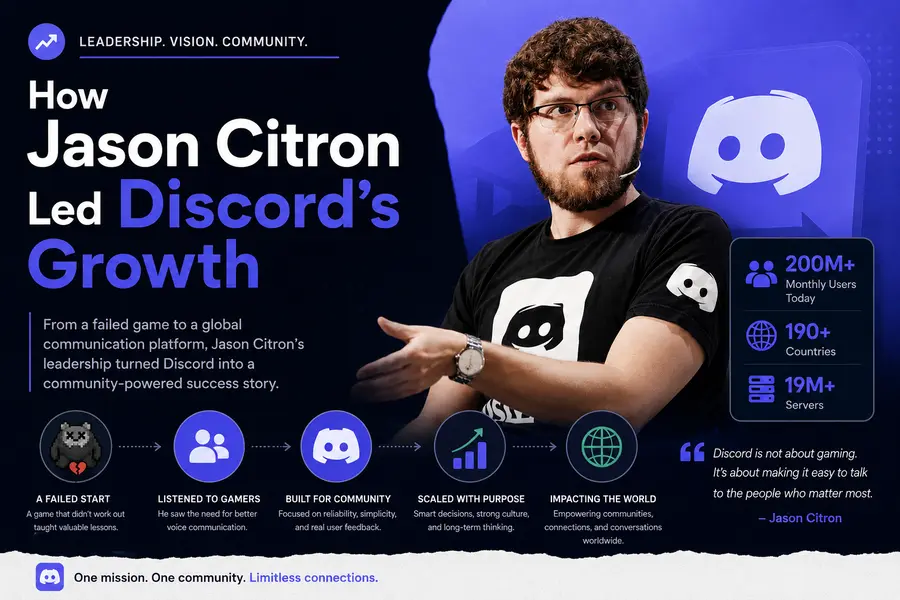
What’s notable about Citron’s leadership through Discord’s growth years isn’t any single masterstroke. It’s the consistency of a specific instinct: build the thing that removes friction, and resist the features that would make the product look more impressive without making it more useful.
Discord’s server structure—persistent spaces, always-on voice channels you could simply join without “calling” anyone, channels organized by topic rather than by feed—reflected a deliberate philosophy. Vishnevskiy described it as feeling like “a neighborhood, or like a house where you can move between rooms.” Citron’s own description was similar: a place where it felt like your friends were just around, where you could run into them without orchestrating it.
That philosophy showed up in what the product didn’t have as much as what it did. No follower counts. No algorithmic feed deciding what you saw first. No engagement mechanics nudging you to post more. At a moment when nearly every other major platform was investing heavily in exactly those systems, Citron’s product moved in the opposite direction—not initially as an ideological stance, but because the core use case never needed them. That restraint turned out to matter enormously as users grew exhausted with the performance dynamics of mainstream social media elsewhere.
The clearest test of his leadership came in April 2021, when Microsoft reportedly offered to acquire Discord for around $12 billion—nearly double the company’s $7.3 billion valuation at the time. It was the kind of offer that ends most companies’ independent stories. Citron and the team talked it through and declined. Most of the team, by his account, wanted to keep building. So they did.
The decision echoed the lesson from OpenFeint a decade earlier, except inverted. Where selling OpenFeint had taught him what it felt like to lose control of something he’d built, declining Microsoft’s offer was him choosing, deliberately, not to repeat that outcome with Discord.
The final major test of his leadership arrived in April 2025, when Citron announced he was stepping down as CEO after thirteen years running the company, handing the role to Humam Sakhnini, the former vice chairman of Activision Blizzard and past head of King, the studio behind Candy Crush. Citron remained on Discord’s board and moved into an advisory role to the new CEO, while Vishnevskiy stayed on as Chief Technology Officer to maintain technical continuity.
In his message to employees, Citron framed the decision plainly: “From this position of strength, it feels like the right time to transition from CEO to Board Member and Advisor.” He told staff it “feels like the right time” to move on from the executive role, citing the company’s clear strategy and new business lines as reasons the timing made sense. He described Sakhnini’s hiring as a step toward leading Discord “through our next chapter of growth and someday becoming a public company.”
It was, in its own way, the same instinct that had defined his career from the start: recognizing what a moment actually required, even when that meant stepping back from the thing he’d spent over a decade building. Citron credited Sakhnini’s experience steering major gaming franchises as the kind of leadership Discord needed for the company’s next phase—the IPO era.
Jason Citron’s Leadership Style
Patterns repeat across Citron’s career in a way that’s hard to dismiss as coincidence.
He moves toward problems he’s personally living through, not abstractions identified through market research. OpenFeint emerged from his own frustration as a developer with no easy way to add social features to a game. Discord emerged from his own frustration trying to coordinate with friends over Skype and TeamSpeak. Both of his major companies started from the same place: a problem he felt firsthand, intensely enough to build the solution himself.
He treats failing evidence as information rather than as something to explain away. The numbers on Fates Forever weren’t ambiguous by early 2015, and rather than searching for a more favorable interpretation, Citron let the data redirect the company entirely—even though that redirection cost him a third of his team and the original reason investors had backed him.
He’s comfortable making decisions that cost him personally in the short term if he believes they’re right for the long term. Laying off a third of the company during the pivot. Declining a $12 billion acquisition offer that would have made him enormously wealthy with far less risk. Voluntarily stepping down as CEO of a company he’d led for thirteen years, at a moment when the business was healthier than it had ever been, because he believed someone else could take it further than he could.
None of that fits a tidy “visionary founder” narrative. It looks more like a specific discipline: separate your ego from the evidence, and act on the evidence even when it’s uncomfortable.
🚀 5 Lessons Entrepreneurs Can Learn From Jason Citron
The leadership, resilience, and strategic decisions behind Discord’s remarkable success.
Success Doesn’t Make You Failure-Proof
After selling OpenFeint for $104 million, Jason Citron’s next startup failed in its original mission. His story reminds founders that previous wins create opportunities—not guarantees. What matters is the ability to adapt when reality challenges your assumptions.
Build From Personal Experience
Discord was born because Citron personally struggled with existing communication tools while gaming. Instead of chasing trends, he solved a problem he experienced firsthand.
Follow the Data, Not Your Ego
The data showed Fates Forever wasn’t succeeding, while Discord’s communication features were thriving. Accepting that reality required abandoning years of effort, but it ultimately led to a billion-dollar company.
Know When to Say No
Discord reportedly rejected Microsoft’s $12 billion acquisition offer because leadership believed the company still had greater potential ahead.
Leadership Includes Letting Go
After leading Discord for over a decade, Citron stepped aside and handed the CEO role to a leader better suited for the company’s next growth phase.
💡 Final Lesson
Jason Citron’s journey from startup failures to building Discord demonstrates that entrepreneurship is rarely about getting everything right the first time. It’s about listening to users, recognizing opportunities hidden inside setbacks, making difficult decisions, and continuously evolving as a leader.
🙋 Frequently Asked Questions
Everything you need to know about Jason Citron, Discord, and the story behind one of the world’s most successful communication platforms.
👤 Who is Jason Citron?
Jason Citron is an American entrepreneur and software engineer best known as the co-founder of Discord. Before building Discord, he founded OpenFeint, a mobile gaming social network acquired by GREE in 2011, and later launched Hammer & Chisel, the game studio whose failed title Fates Forever inspired Discord’s creation.
🚀 Who founded Discord?
Discord was founded by Jason Citron and Stanislav Vishnevskiy in 2015. The duo worked together at Hammer & Chisel before pivoting the company from game development to communication software.
🎮 What did Jason Citron do before Discord?
Before Discord, Citron founded OpenFeint in 2009, helping mobile game developers add social features to their apps. The platform grew to more than 100 million users before being acquired for $104 million. He later founded Hammer & Chisel and developed the multiplayer game Fates Forever.
💡 Why did Jason Citron create Discord?
Jason Citron created Discord after realizing that players were spending more time using Fates Forever’s voice and text chat features than actually playing the game. Combined with his frustrations using Skype and TeamSpeak, this insight inspired him to build a dedicated communication platform for online communities.
🎯 What game led to Discord?
The game that led to Discord was Fates Forever, a multiplayer online battle arena (MOBA) game released by Hammer & Chisel in 2014. Although the game failed commercially, its communication tools revealed a much larger opportunity that eventually became Discord.
📈 How successful is Discord today?
As of late 2025, Discord serves more than 200 million monthly active users across gaming, software development, education, AI, and creative communities. The company confidentially filed for a U.S. IPO in January 2026, while Jason Citron continues to serve as a board member and advisor.
⭐ Quick Fact
Discord exists because Jason Citron was willing to pivot from a failed game. What started as a gaming communication tool has evolved into one of the world’s largest community platforms, serving millions of users far beyond gaming.
Conclusion
Jason Citron didn’t create Discord by following a plan that worked. He created it by recognizing, in the middle of a plan that had clearly failed, that something more valuable had been hiding inside it the entire time.
That distinction matters more than it might first appear. The popular mythology around founders tends to celebrate vision—the ability to see, with unusual clarity, exactly what the world will need before anyone else does. Citron’s story complicates that mythology. His vision for Fates Forever was wrong. The market he’d built a company around didn’t materialize the way he expected. What saved the company wasn’t foresight. It was the willingness to look honestly at what was actually happening, even when that meant admitting the original thesis had failed, and to act on what he found there instead of defending what he’d already built.
That willingness showed up again at the other end of his career at Discord, in a very different form. Stepping down as CEO in 2025, after thirteen years, wasn’t forced on him. The company was healthier than it had ever been—over 200 million users, a clear path toward an IPO, a business that had outgrown almost every prediction made about it in 2015. Citron handed it off anyway, because he believed the next chapter required something he wasn’t best positioned to provide.
Adaptability gets talked about constantly in startup culture, usually as a vague virtue—stay flexible, embrace change, pivot when necessary. Citron’s career suggests something more specific and more demanding: adaptability isn’t a personality trait. It’s a discipline you practice by repeatedly choosing the uncomfortable, evidence-based decision over the comfortable, ego-protecting one. He practiced it when he let a third of his company go to chase a chat feature nobody had planned to build a business around. He practiced it again when he declined $12 billion to keep building. And he practiced it once more when he stepped back from the company that bears the clearest mark of his entire career.
The game failed. The founder didn’t stop reading the evidence. Everything that followed traces back to that.
For more on the company Jason Citron built, see also: [How Discord Started as a Failed Gaming Startup], [How Discord Raised Funding Before Becoming a Gaming Giant], and [What Discord Teaches Every Startup Founder].
Disclaimer
This article is for informational purposes only. All facts, figures, and milestones referenced are based on publicly available information and verified sources accurate as of June 2026. StartupOrigins is not affiliated with Discord Inc., Hammer & Chisel, or any individuals mentioned in this article. Company valuations, user statistics, and funding figures are sourced from public reports and may not reflect real-time data. This article does not constitute financial, investment, or legal advice.

Anup Kumar Yadav is the founder of StartupOrigins.xyz, where he researches and publishes detailed stories about the world’s most successful startups. His work explores founder journeys, funding milestones, growth strategies, and the lessons entrepreneurs can learn from them.