
Introduction
If you grew up online in the late 1990s or early 2000s, you probably remember the sound. That little door creak. Or the “Buzz” that shook your entire chat window.
That was Yahoo Messenger — and for a while, it felt like it would never go away.
Understanding why Yahoo Messenger died is really about understanding how the internet itself changed underneath a company that didn’t change fast enough. Before smartphones existed, before “chat apps” was even a category, Yahoo Messenger was how a huge slice of the world talked to each other online.
- Introduction
- The Beginning of Yahoo
- Birth of Yahoo Messenger
- Why Yahoo Messenger Became So Popular
- Timeline of Success
- The Beginning of the Decline
- How WhatsApp Changed Everything
- Facebook Messenger’s Growth
- Why Yahoo Could Never Catch Up
- Shutdown of Yahoo Messenger
- What Happened to Yahoo?
- Where Are the Founders Now?
- Biggest Startup Mistakes Yahoo Made
- Startup Lessons
- Why This Story Still Matters in 2026
- Conclusion
- ❓ FAQ
- Disclaimer
Cyber cafés were full of it. College dorm rooms ran on it. Families separated by oceans used it to feel close.
Then, over roughly a decade, it quietly faded. In 2018, Yahoo made it official and pulled the plug for good.
📌 In this story, you’ll discover:
- Why Yahoo Messenger really failed
- The biggest mistakes Yahoo made along the way
- Why WhatsApp and Facebook Messenger won the war for mobile chat
- What startup founders can learn from a 20-year rise and fall
Grab a coffee. This one’s a journey. ☕
The Beginning of Yahoo
To understand Yahoo Messenger, you first have to understand Yahoo itself — because the messenger app was never really planned. It grew out of something much smaller and much weirder: two grad students avoiding their PhD dissertations.
👥 Founder History: David Filo & Jerry Yang
| Jerry Yang Born in Taipei, Taiwan. Moved to San Jose, California as a child, arriving with only one English word: “shoe.” Studied electrical engineering at Stanford, finishing a bachelor’s and master’s degree in four years. | David Filo Raised in Moss Bluff, Louisiana, in a small semi-communal household. Studied computer engineering at Tulane, then headed to Stanford for a master’s in electrical engineering — where he met Yang. |

The two were assigned to the same academic project — chip-design software neither of them found very exciting. What did excite them was the newly emerging World Wide Web, still a chaotic, uncatalogued mess of pages with no real way to search them.
So, mostly to avoid their dissertations, they started keeping a personal list of interesting websites: “Jerry and David’s Guide to the World Wide Web.” It was meant to be a hobby.
It didn’t stay one for long.
💡 By fall 1994, their list was getting over a million hits a day. Stanford’s servers buckled. The university asked them to leave. They renamed the project Yahoo! — supposedly short for “Yet Another Hierarchical Officious Oracle,” though both founders admitted they just liked the word.
By early 1995, they had funding from Sequoia Capital and an outside CEO. Yahoo went public in April 1996. Within a few years, it was one of the most visited destinations on the internet — a home page for millions logging on for the very first time.
Birth of Yahoo Messenger
Yahoo’s first step into real-time communication wasn’t called Messenger at all. It launched as Yahoo Pager on March 9, 1998 — Yahoo’s answer to the wildly popular ICQ. In 1999, it was rebranded Yahoo Messenger.
From there, it grew into something much bigger than a chat window:
| Feature | What It Did |
|---|---|
| 🔊 Buzz | A shaking, sound-blasting alert to grab someone’s attention |
| 💬 Chat Rooms | Public spaces organized by topic, hobby, or city |
| 📞 Voice Calls | Free internet calling, years before VoIP was mainstream |
| 📁 File Sharing | Send photos, docs, and music directly to a contact |
| 🙂 Emoticons | Simple icons that made typed chat feel warmer |
| 🎮 Gaming | Java-based games like checkers, playable mid-conversation |
| 🧑🎨 Avatars | Customizable cartoon versions of yourself |
None of this was entirely unique to Yahoo. But bundled together, tied to a Yahoo ID that already unlocked email and a personalized homepage, it created something sticky. You didn’t just use Yahoo Messenger — you lived inside it for hours at a time.
Why Yahoo Messenger Became So Popular
Yahoo Messenger’s rise wasn’t an accident of good timing alone — though timing mattered enormously.
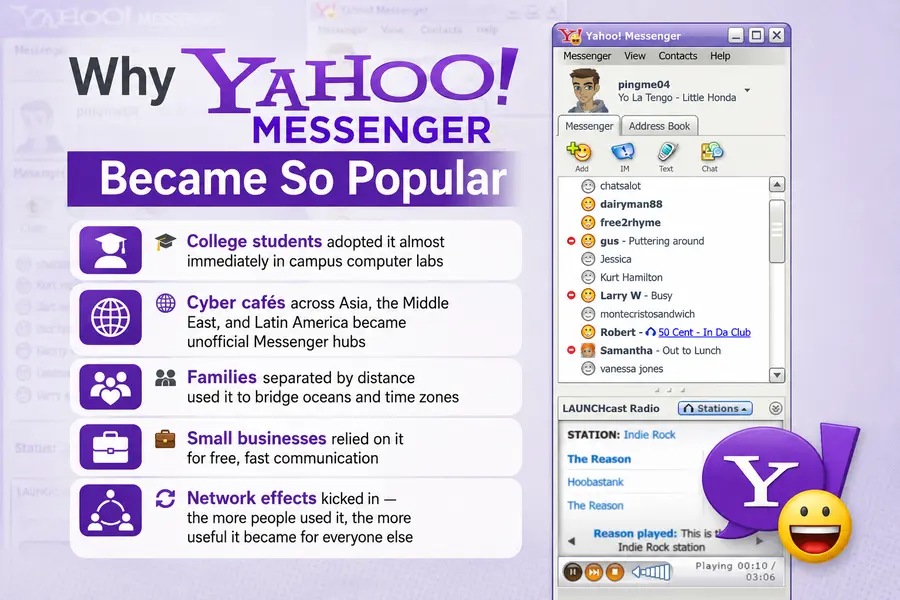
- 🎓 College students adopted it almost immediately in campus computer labs
- 🌐 Cyber cafés across Asia, the Middle East, and Latin America became unofficial Messenger hubs
- 👨👩👧 Families separated by distance used it to bridge oceans and time zones
- 💼 Small businesses relied on it for free, fast communication
- 🔁 Network effects kicked in — the more people used it, the more useful it became for everyone else
By the mid-2000s, Yahoo Messenger was one of the most recognized instant messaging brands on Earth, standing shoulder to shoulder with AOL Instant Messenger and MSN Messenger.
Timeline of Success
| Year | Major Event |
|---|---|
| 1994 | Yang and Filo create “Jerry and David’s Guide to the World Wide Web” |
| 1995 | Renamed Yahoo!; Sequoia Capital funding secured; Yahoo Inc. incorporated |
| 1996 | Yahoo goes public |
| 1998 | Yahoo Pager launches March 9 |
| 1999 | Renamed Yahoo Messenger |
| 2000 | Yahoo’s market cap peaks above $125 billion |
| 2001 | Available for Verizon Wireless customers |
| 2004 | Launches for the T-Mobile Sidekick II |
| 2009 | Arrives on the iOS App Store |
| 2012 | Public chat rooms discontinued |
| 2015 | Completely rebuilt version launches |
| 2016 | Legacy desktop version discontinued |
| 2017 | Verizon acquires Yahoo’s core business; Oath is formed |
| 2018 | 🔻 Yahoo Messenger shuts down for good — July 17 |
This timeline tells a two-part story: nearly 15 years of expansion and dominance, followed by a much shorter, much rockier stretch of decline. What happened in between is where the real lessons live.
The Beginning of the Decline
No product dies from a single mistake. Yahoo Messenger’s decline came from several problems compounding quietly, over the better part of a decade.
📱 Rise of Smartphones
When the iPhone launched in 2007, it changed the basic unit of internet access from “a computer you sit down at” to “a phone in your pocket.” Yahoo Messenger was born as a desktop product, and it showed.
🐌 Failure to Innovate
For years, Messenger’s core experience barely changed while competitors reimagined what messaging could be — read receipts, typing indicators, seamless media.
🎯 Poor Product Strategy
Was it a chat client? A social network? A gaming hub? Trying to be everything made it hard to be excellent at anything.
🔄 Too Many Redesigns
Yahoo repeatedly redesigned Messenger, sometimes stripping out beloved features (like chat rooms) without offering something clearly better.
📶 Weak Mobile Experience
Even after landing on iOS in 2009, the mobile version often felt bolted on rather than designed from the ground up.
🧭 Lack of Clear Vision
Where WhatsApp had a stubborn focus on simple, reliable messaging, Yahoo’s broader identity crisis bled into Messenger itself.
🛠️ Internal Yahoo Problems
Yahoo dealt with major internal turmoil, including well-documented security breaches affecting billions of accounts — damaging trust in the whole ecosystem.
🪑 Leadership Instability
Yahoo cycled through multiple CEOs during the 2000s and 2010s, making it nearly impossible to sustain one product vision.
👂 Ignoring Changing User Behavior
As mobile-first, always-on messaging became the norm, users expected instant delivery and phone-number identity — areas Yahoo was retrofitted for, not built for.
⚔️ Competition
By the early 2010s, Yahoo wasn’t competing with AOL and MSN anymore. It was competing with an entirely new generation of purpose-built mobile messengers.
How WhatsApp Changed Everything
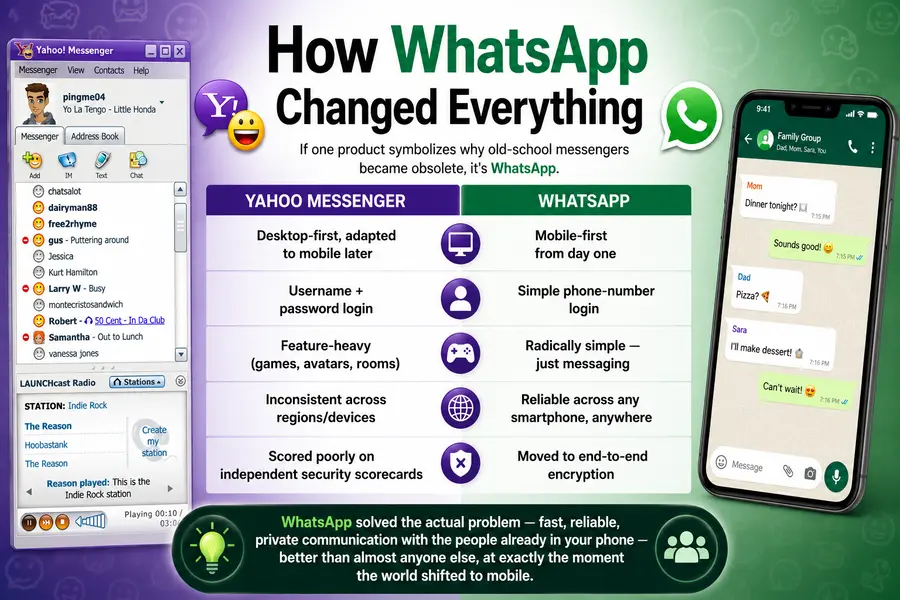
If one product symbolizes why old-school messengers became obsolete, it’s WhatsApp.
| Yahoo Messenger | |
|---|---|
| Desktop-first, adapted to mobile later | Mobile-first from day one |
| Username + password login | Simple phone-number login |
| Feature-heavy (games, avatars, rooms) | Radically simple — just messaging |
| Inconsistent across regions/devices | Reliable across any smartphone, anywhere |
| Scored poorly on independent security scorecards | Moved to end-to-end encryption |
WhatsApp solved the actual problem — fast, reliable, private communication with the people already in your phone — better than almost anyone else, at exactly the moment the world shifted to mobile.
Facebook Messenger’s Growth
Facebook took a different but equally effective path. Rather than building an audience from scratch, it leveraged one it already had: over a billion existing users with real names, real friend networks, and real reasons to keep coming back.
By spinning messaging into its own dedicated app, Facebook Messenger focused specifically on speed and features for chat — while inheriting Facebook’s built-in social graph.
Yahoo, by comparison, had a large user base too. But it was a fragmented one — spread across email, search, and news — without the tight social graph binding people together.
Why Yahoo Could Never Catch Up
Once WhatsApp and Facebook Messenger had momentum, Yahoo Messenger faced an uphill battle that went far beyond “adding better features.”
- Structural: Messenger was tied to a broader Yahoo identity that was itself losing ground to Google and mobile-native products everywhere
- Strategic: Yahoo treated Messenger as one piece of a sprawling portal, not a focused, standalone mission
- Momentum: Once users left because friends were leaving, the same network effect that built Yahoo Messenger began working against it
By the time Yahoo tried to respond, the moment had already passed.
Shutdown of Yahoo Messenger
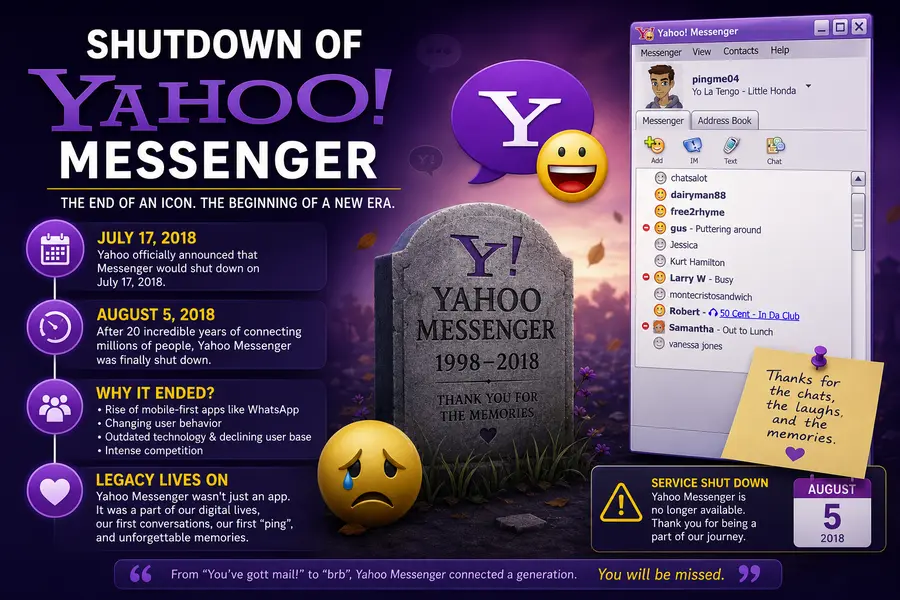
The end came in stages.
Yahoo’s legacy desktop client was discontinued in 2016, and a rebuilt version tried to carry the brand forward. It didn’t gain the traction Yahoo hoped for.
On June 8, 2018, Yahoo’s then-parent company, Oath — formed after Verizon acquired Yahoo’s core business in 2017 — announced that Yahoo Messenger would shut down completely on July 17, 2018, exactly 20 years after it first launched as Yahoo Pager.
Users were given a window to download their chat history. Yahoo pointed people toward a new, invite-only group chat app called Yahoo Squirrel, later renamed Yahoo Together — which itself shut down less than a year after launch.
There was no dramatic announcement. Just a quiet company blog post confirming what long-time users already suspected: the era of Yahoo Messenger was over.
What Happened to Yahoo?
Yahoo’s story after Messenger’s shutdown is really a story about a company being sold, restructured, and sold again.
2017 → Verizon acquires Yahoo's core business → merged with AOL → becomes "Oath"
2021 → Apollo Global Management acquires 90% of Yahoo → Verizon retains 10%
Today → Yahoo operates as a standalone private company under Apollo
Today, Yahoo still runs products many people use without thinking of them as “Yahoo” — Yahoo Mail, Yahoo Finance, Yahoo Sports, Yahoo News. The instant messaging chapter, however, has permanently closed.
Where Are the Founders Now?
| Jerry Yang Left Yahoo entirely in 2012. Now runs venture capital firm AME Cloud Ventures, which has invested in 50+ startups spanning data and cloud computing. Active in philanthropy, including major gifts to Stanford and the Asian Art Museum, and co-founded The Asian American Foundation in 2021. | David Filo Has kept a lower public profile than Yang, consistent with the quieter, behind-the-scenes role he played even during Yahoo’s biggest years. Focused on philanthropy, including significant gifts to both Tulane University and Stanford. |
Both founders remain widely respected figures in Silicon Valley’s history — not just for building one of the internet’s first major companies, but for decades of mentorship and investment that followed.
Biggest Startup Mistakes Yahoo Made
1. Treating Messenger as a feature, not a mission
Folded into Yahoo’s broader portal strategy instead of run as a focused product.
✅ Fix: Give core products dedicated ownership and resources.
2. Being slow to go mobile-first
Built for desktop, adapted to mobile later — while competitors were mobile-native.
✅ Fix: Build for where users are heading, not just where they already are.
3. Redesigning without listening
Removed beloved features without clearly improving the core experience.
✅ Fix: Validate major changes with real user data before rolling them out.
4. Letting leadership instability disrupt vision
Frequent CEO changes made consistent direction nearly impossible.
✅ Fix: Protect key products from constant strategic whiplash.
5. Underestimating simplicity as an advantage
Kept adding features while WhatsApp won by doing one thing extremely well.
✅ Fix: Resist adding features just because you can.
6. Ignoring network effects working in reverse
Once users started leaving, the same effect that built Messenger began dismantling it.
✅ Fix: Watch for early signs of user migration — by the time it’s obvious, it’s too late.
Startup Lessons
Yahoo Messenger’s story isn’t just internet trivia. It’s a genuine case study in the forces that make or break long-running products.
| Lesson | Why It Matters |
|---|---|
| Innovation | Standing still gives faster competitors room to overtake you |
| Timing | Right in 1998. Wrong for the mobile shift a decade later |
| Product-Market Fit | Can erode as user behavior and technology change |
| Mobile-First Thinking | No longer optional — it has to be foundational |
| Leadership | Stability gives products room to execute long-term vision |
| Execution | Ideas matter less than the ability to ship them well |
| Listening to Users | Should shape redesigns, not just internal debates |
| Competition | Track it constantly — especially from startups that don’t look threatening yet |
| Network Effects | Build fast, but can dismantle just as fast |
| Culture | Shapes how quickly a company adapts when the market shifts |
| Decision Making | Needs clear ownership in fast-changing categories |
| Long-Term Vision | Must survive leadership changes and short-term pressure |
Why This Story Still Matters in 2026
It would be easy to file Yahoo Messenger away as a nostalgic artifact. But founders building products today face the exact same forces that shaped its rise and fall, just in a different technological era.
AI-powered products are experiencing their own version of Yahoo Messenger’s early boom right now — massive early adoption, intense hype, and a wide-open field of competitors racing to define the category.
The question isn’t just who wins first. It’s who can keep innovating, stay genuinely useful, and adapt as expectations shift — the same question Yahoo ultimately answered the wrong way.
That’s exactly why this story still belongs on every founder’s reading list.
Conclusion
So, why did Yahoo Messenger die?
Not because of one bad decision, and not overnight. It died because a company that once defined an entire era of the internet failed to move as fast as the internet itself kept moving — through smartphones, through simpler competitors, through changing user expectations it didn’t fully see coming until it was too late.
Yahoo Messenger’s 20-year run is proof that even the most dominant products can fade if innovation stalls. It’s also proof that the lessons from failure are often more valuable than the lessons from success.
If you’re building something today, let this story be a reminder: stay close to your users, stay fast, and never assume the throne you’re sitting on today is permanent.
📚 Want more stories like this one? Explore more Failed Startups on StartupOrigins.xyz and learn from the mistakes before you build your own success.
❓ FAQ
Why did Yahoo Messenger shut down?
Yahoo Messenger shut down because it failed to keep pace with mobile-first competitors like WhatsApp and Facebook Messenger, combined with years of internal instability and slow innovation at Yahoo.
Who created Yahoo Messenger?
Yahoo Messenger was created by Yahoo, the company founded by Jerry Yang and David Filo, originally launching as Yahoo Pager in 1998.
When was Yahoo Messenger launched?
Yahoo Messenger originally launched as Yahoo Pager on March 9, 1998, and was renamed Yahoo Messenger in 1999.
Could Yahoo Messenger have survived?
It’s possible, if Yahoo had prioritized a faster, more focused mobile-first strategy earlier and treated Messenger as a standalone core product rather than one piece of a larger portal.
Why did WhatsApp replace Yahoo Messenger?
WhatsApp replaced Yahoo Messenger by offering a simpler, faster, and more reliable mobile-first experience, along with easy phone-number-based signup and strong privacy protections.
Disclaimer
This article is based on publicly available information and is intended for educational and informational purposes only. While every effort has been made to ensure accuracy, some details may be subject to change or interpretation. Yahoo, Verizon, Oath, and Apollo Global Management are trademarks of their respective owners, and this post is not affiliated with or endorsed by any of them.
Don’t Miss These Startup Lessons
Discover how billion-dollar startups solved impossible problems before becoming global brands.
What Discord Teaches Every Startup Founder
Discover the surprising lessons behind Discord’s journey from a failed game to a multi-billion-dollar company.
Startup Lessons From Notion’s Success Story
See how Notion survived near bankruptcy, rebuilt from scratch, and became one of the world’s most loved productivity apps.
What Canva Teaches Every Startup Founder
Learn the powerful growth strategies, persistence, and product decisions that transformed Canva into a global design giant.

Anup Kumar Yadav is the founder of StartupOrigins.xyz, where he researches and publishes detailed stories about the world’s most successful startups. His work explores founder journeys, funding milestones, growth strategies, and the lessons entrepreneurs can learn from them.