

There is a version of this story that gets told at conferences, in pitch decks, and in a thousand “lessons from successful founders” listicles. It goes like this: a guy couldn’t find good software to sell snowboards, so he built his own, and it became a $150 billion company. True, as far as it goes. But it skips the part that actually matters — the eighteen months in between, when a twenty-four-year-old German immigrant with no college degree and no work permit had to decide whether he was running a snowboard shop or something else entirely. Understanding how Shopify started means understanding that decision, not just the punchline that followed it.
- A Snowboarder Who Couldn’t Get a Job
- The Software That Refused to Be Simple
- The Wrong Kind of Emails
- Choosing the Software Over the Snowboards
- From Tool to Platform
- Bridging the Register and the Browser
- Going Public
- The Fulfillment Bet, and the Retreat
- The Pandemic, and What Came After
- What the Numbers Don’t Explain
- Disclaimer
That decision is the whole story. Everything Shopify became — the app store, the payments network, the point-of-sale hardware sitting on countertops in five million stores, the IPO, the $300-billion-a-year river of merchandise now flowing through its servers — traces back to a moment in a coffee shop on Elgin Street in Ottawa, when Tobias Lütke realized the business he’d built by accident was more valuable than the business he’d set out to build on purpose.
A Snowboarder Who Couldn’t Get a Job
Tobias “Tobi” Lütke grew up in Koblenz, Germany, obsessed with two things: computers and snowboarding. He was not a conventional student. He’d dropped out of formal schooling in the traditional sense and instead worked his way through an apprenticeship as a programmer, learning the craft the way old-world tradesmen learn theirs — by doing it, badly at first, under someone more experienced.
In 2002, he moved to Ottawa, Canada. The reason wasn’t career ambition. It was love — he’d met his future wife, Fiona McKean, online, and followed her across an ocean. What he found on arrival was a problem nobody puts in the highlight reel: without a Canadian degree or a work visa lined up, he couldn’t get hired anywhere. A talented programmer, freshly relocated, effectively unemployable through no fault of his own.

So he did what people with more skill than options often do. He started a business.
Through his in-laws, he met Scott Lake, and the two of them, along with Daniel Weinand, decided to sell something Tobi actually loved: snowboards. In 2004 they launched an online store called Snowdevil, funded with roughly $200,000 pulled together from friends and family. The plan was straightforward — buy boards, list them online, ship them to customers. Nothing about it was meant to be complicated.
The Software That Refused to Be Simple
It turned out that building an online snowboard shop in 2004 was its own small nightmare. The tools available — Yahoo! Stores, osCommerce, and a handful of similar platforms — were the kind of software built by people who had never actually run a store. Lütke has since described them, more or less, as user-hostile database editors dressed up as storefronts. They weren’t built around how a merchant thinks. They were built around how a database schema thinks, which is a very different thing.
Most founders in that position would have gritted their teeth and used the bad tool anyway. Lütke didn’t. He had the one skill that let him route around the problem entirely: he could write software. Using Ruby on Rails — then a brand-new, largely unproven framework from a Danish programmer named David Heinemeier Hansson — Lütke spent roughly two and a half months building an e-commerce engine from scratch, just to sell his own snowboards.
There’s a small, telling detail buried in this part of the story. Getting approved to accept credit card payments required Lütke to mail notarized copies of his passport to a payment processor in American Fork, Utah. It was slow, bureaucratic, and mildly absurd — exactly the kind of friction that makes a certain type of engineer say, out loud, there has to be a better way to do this. That instinct, more than any single feature, is the seed every part of Shopify’s later empire grew out of.
By late 2004, Snowdevil was live. It sold snowboards. It was not, by any conventional measure, a hit.
The Wrong Kind of Emails
What happened next is the hinge point of the entire company, and it happened quietly, over ordinary emails, not in some dramatic boardroom pitch.
People started writing to Lütke — not about snowboards. A retailer in Massachusetts asked if he could buy the software running the site. A developer in Toronto wanted to know what framework it was built on. Someone in Indiana asked if he could license the whole thing outright. Nobody was emailing about bindings or board flex patterns. They were emailing about the machinery behind the storefront.
It’s worth sitting with how strange this must have felt. Lütke and Lake had set out to solve one problem — how do we sell snowboards online — and discovered, almost as a side effect, that they’d stumbled onto a much bigger and much less obvious one: a huge number of small merchants had the exact same problem, and none of them could solve it either.
Snowdevil, as a snowboard company, never really took off. It didn’t need to. It had already done its job. It existed just long enough to expose a gap in the market and hand its founders unmistakable proof that people would pay for the fix.
Choosing the Software Over the Snowboards

Here is where a lot of founders would have hedged. Keep the snowboard shop running as the “real” business, sell the software as a side project, wait and see. Lütke and his partners didn’t hedge. Between 2004 and 2006, instead of rushing a product to market to capture the moment, they spent nearly two years rebuilding what had been a one-off tool for Snowdevil into something general-purpose — a platform any merchant could use, not just the one Lütke happened to run.
In 2006, they shut down Snowdevil and launched the company under a new name: Shopify.
The early version of Shopify was, by every account, modest. It handled the essentials — storefront, inventory, checkout — without the sprawling feature set the platform carries today. But it solved the one problem that mattered most: it made building a professional-looking online store possible for someone who had never written a line of code and never wanted to. Shopify introduced a subscription pricing model in 2007, trading the unpredictable economics of a retail business for the boring, compounding reliability of monthly recurring revenue. It was, at that point, generating a few thousand dollars a month. Nobody would have mistaken it for the future of e-commerce.
[Related: Founder Journey: Tobias Lütke: The Programmer Who Accidentally Built Shopify]
From Tool to Platform
The next real inflection point came in 2009, and it followed a pattern Lütke would repeat throughout his career: look at what’s working somewhere else, and ask what it would mean for commerce.
Apple’s App Store had shown, in a very short time, what happens when a strong core platform is opened up to outside developers. In June 2009, Shopify launched its own API and App Store, letting third-party developers build tools — for shipping, marketing, accounting, SEO — that plugged directly into merchant stores. It was a quiet decision with an enormous compounding effect. Shopify no longer had to anticipate every feature a merchant might want. It just had to build the rails and let a growing ecosystem of developers fill in the rest. What began as a few dozen apps would eventually grow into a marketplace of more than ten thousand.
This is the moment Shopify stopped being a product and became infrastructure — and it’s also the moment its growth stopped being linear. A mobile app followed in 2010, giving merchants a way to run their stores from a phone. Venture money started arriving in earnest around the same period, with Series A and Series B rounds funding the hiring and engineering work an expanding platform required.
[Related: Funding Story: How Shopify Raised Funding Before Becoming an E-commerce Giant]
Bridging the Register and the Browser
By 2013, Shopify had a new problem worth solving: the internet wasn’t the only place merchants sold things. That August, the company launched Shopify Payments, in partnership with Stripe, removing the need for merchants to bolt on a separate third-party payment gateway. In the same stretch, it introduced Shopify POS, a point-of-sale system that let a physical storefront and an online store share one inventory, one customer list, one set of sales data. A boutique could sell a jacket at a pop-up market and watch the online inventory count update in real time.
That December, Shopify raised $100 million in a Series C round, a clear signal that investors saw it as something bigger than a website builder. Revenue reflected it: by 2014, the company was generating roughly $105 million a year, serving around 120,000 merchants — double what it had raised the year before, and a sign of just how quickly recurring subscriptions and payments revenue were compounding on top of each other.
In February 2014, Shopify launched Shopify Plus, a version of the platform built for large, high-volume brands that needed more bandwidth, more customization, and a level of dedicated support small merchants didn’t require. It marked something important: Shopify was no longer positioning itself only as a tool for scrappy independent sellers. It wanted the largest brands in the world using the same underlying commerce engine as a teenager’s side hustle.
Going Public
Shopify filed for its initial public offering in April 2015 and began trading on both the New York Stock Exchange and the Toronto Stock Exchange on May 21, 2015, under the ticker SHOP. Priced at $17 a share, the stock opened well above that and closed its first day up more than 60%, raising over $131 million for the company.
Later that same year, Amazon closed its Amazon Webstore service — a hosted storefront product for merchants — and pointed the displaced businesses toward Shopify as its recommended migration partner. For a five-year-old company that had started as a snowboard shop, having Amazon effectively hand over a wave of merchants was a strange and pointed kind of validation.
The years right after the IPO were about deepening what Shopify already did well rather than chasing something entirely new. Shopify Capital arrived in 2016, offering merchants cash advances based on their sales history — a lending product only a platform sitting on top of that much transaction data could responsibly build. By 2019, Shopify had crossed one million merchants and roughly $1.6 billion in annual revenue, with GMV — the total value of goods sold through the platform — topping $61 billion for the year.
The Fulfillment Bet, and the Retreat
Not every chapter of this story is a straight line up and to the right. In 2019, Shopify launched the Shopify Fulfillment Network, an ambitious attempt to build its own warehousing and shipping infrastructure so merchants could offer fast delivery without managing logistics themselves. It acquired robotics company 6 River Systems the same year in a deal worth roughly $450 million, aiming to automate the warehouse side of that promise.
It was a capital-intensive bet, and logistics is a brutally difficult business to run well from scratch — even for a company as flush with cash as Shopify was after several years of hypergrowth. When the pandemic-era e-commerce boom cooled, the company faced its most public reckoning. In July 2022, Shopify laid off roughly 1,000 people, about 10% of its workforce, and Lütke explained the decision to staff in unusually direct terms: the company had wagered that pandemic-era shopping habits would pull forward five or even ten years of the shift toward e-commerce and permanently reset the balance between physical and online retail. That bet, in his own words, hadn’t held — the surge had partly reversed, and Shopify had built and staffed for a future that arrived, then didn’t stay.
By 2023, Shopify had sold its logistics businesses to Flexport, shifting from owning the warehouses and trucks itself to an asset-light model that let it focus on software and payments — the parts of the business it had always been genuinely good at. It was, in its own way, a second version of the same lesson Lütke learned in 2004: build what you’re uniquely positioned to build, and don’t confuse a necessary capability with your actual business.
[Related: Startup Lessons: What Shopify Teaches Every Startup Founder]
The Pandemic, and What Came After
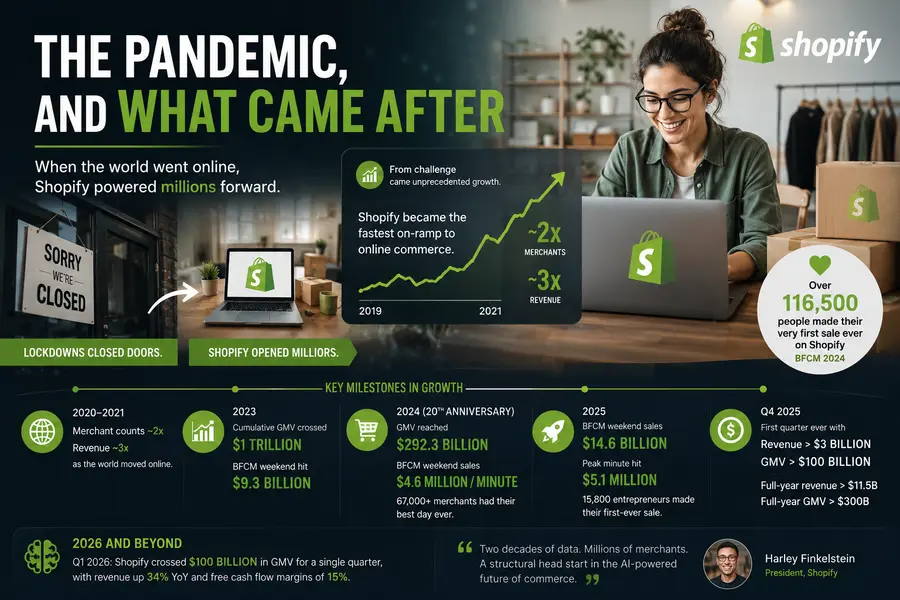
For all the difficulty of the fulfillment retreat, 2020 was the moment the broader world discovered what Shopify had spent sixteen years building. When lockdowns forced small businesses to either sell online or stop selling, Shopify became the fastest available on-ramp. Merchant counts roughly doubled, revenue nearly tripled between 2019 and 2021, and Shopify — a company most consumers had never directly interacted with — became, almost overnight, one of the load-bearing pillars of the pandemic-era economy.
The growth that followed wasn’t a straight continuation of that spike, but it also didn’t collapse the way some pandemic winners’ did. By 2023, cumulative GMV processed through Shopify since its founding had crossed $1 trillion, and that November, merchants pushed $9.3 billion through the platform over the Black Friday–Cyber Monday weekend alone — a moment so intense that Shopify’s own systems handled nearly a million requests per second at the peak.
In 2024 — the company’s 20th anniversary year, marked with a company-wide Shopify Summit — annual GMV reached $292.3 billion, up 24% year-over-year and the platform’s strongest GMV growth in three years, with revenue of $8.88 billion. That year’s BFCM weekend produced its own small folklore: shoppers spent $4.6 million a minute at the stroke of noon on Black Friday, more than 67,000 individual merchants had the best-selling day of their existence, and roughly 116,500 people made their very first sale ever on the internet, on a Shopify store, that weekend. It’s easy to lose that number in a press release. It’s harder to lose it once you picture it: over a hundred thousand people, somewhere, watching a phone light up with the first sale of a business they’d just started.
Growth accelerated further into 2025. Merchants ranging from newly launched brands to household names like Aldo, BarkBox, On Running, SKIMS, and Supreme drove that November’s BFCM weekend to $14.6 billion in sales — up 27% year-over-year, with the platform’s peak minute hitting $5.1 million and 15,800 entrepreneurs making their first-ever sale in that single weekend. By the fourth quarter of the year, Shopify posted its first quarter ever with revenue above $3 billion and GMV above $100 billion, pushing full-year revenue past $11.5 billion and full-year GMV past $300 billion.
Momentum carried into 2026. In the first quarter of the year, Shopify crossed $100 billion in GMV for a single quarter, with revenue growth accelerating to 34% year-over-year and free cash flow margins of 15%. President Harley Finkelstein framed the company’s position heading deeper into 2026 around a straightforward claim: two decades of accumulated commerce data, paired with the platform’s existing merchant base, gave Shopify a structural head start as AI reshapes how people discover and buy things online — a bet the company backed with new AI-driven merchandising and merchant-support tools built directly into the platform through 2024 and 2025.
What the Numbers Don’t Explain
None of this happened because Shopify predicted a trillion-dollar e-commerce wave in 2004. It happened because a small team kept making the same core decision, over and over, in different forms: solve the real problem in front of you, notice when the tool becomes more valuable than the original goal, and don’t be too attached to the original plan.
That’s the part the “sold snowboards, built a platform, got rich” summary tends to flatten out. The actual discipline was in the two years between discovering the software had value and actually launching Shopify — the founders could have rushed a half-built product to market the moment the licensing emails started arriving. They didn’t. They built it properly first, and only then let it replace the business it had been built to serve.
Lütke has talked about this instinct in blunter terms over the years, describing Shopify’s mission as arming independent merchants against the largest platforms in commerce rather than trying to out-compete them directly. Whether or not you buy the framing, the pattern underneath it is consistent with everything from the Snowdevil pivot to the 2023 exit from logistics: figure out what you’re actually built to do well, and stop doing the rest.
Twenty years after that first notarized passport got mailed to Utah just to accept a credit card, the throughline hasn’t changed. Somewhere this weekend, another first-time seller will watch a phone buzz with a sale they weren’t sure would ever come — one of hundreds of thousands who now get to have that moment because a snowboard shop in Ottawa didn’t work out.
Frequently Asked Questions
Looking for quick answers about how Shopify started? Here are the most common questions about Shopify’s founders, Snowdevil, IPO, growth, and success story.
How did Shopify actually start?
Shopify started as Snowdevil, an online snowboard store founded in 2004 by Tobias Lütke, Daniel Weinand, and Scott Lake. Unable to find e-commerce software that met their needs, Lütke built a custom platform using Ruby on Rails. As other entrepreneurs became interested in the software, the founders pivoted and launched Shopify as a standalone e-commerce platform in 2006.
Who founded Shopify?
Shopify was founded by Tobias Lütke, Daniel Weinand, and Scott Lake. Tobias Lütke developed the original software that evolved into Shopify and continues to serve as the company’s CEO.
Why did Shopify stop selling snowboards?
The founders realized that the software they had built solved a much bigger problem than selling snowboards. Instead of focusing on retail, they transformed their custom software into Shopify, allowing millions of entrepreneurs to create online stores.
What was Snowdevil?
Snowdevil was the founders’ online snowboard shop launched in 2004. Although it never became a large retail business, it inspired the creation of Shopify because existing e-commerce software wasn’t flexible enough for their needs.
When did Shopify officially launch?
After nearly two years of development, Shopify officially launched in June 2006, giving merchants an easier way to build and manage online stores.
When did Shopify go public?
Shopify became a publicly traded company on May 21, 2015, listing on both the New York Stock Exchange (NYSE) and Toronto Stock Exchange (TSX) at an IPO price of $17 per share.
How big is Shopify today?
As of 2025, Shopify powers approximately 5–6 million merchants across more than 175 countries, processes over $300 billion in annual Gross Merchandise Volume (GMV), and generates more than $11.5 billion in annual revenue.
What can entrepreneurs learn from Shopify’s success?
Shopify demonstrates that solving your own problem can lead to a billion-dollar company. Instead of accepting poor software, the founders built a better solution for themselves—and eventually for millions of businesses worldwide.
Disclaimer
This article is based on publicly available sources, including SEC filings, Shopify’s official newsroom, and reputable news outlets, and is accurate as of publication. Figures and statistics are subject to change; readers should verify current data directly with Shopify’s investor relations for financial or investment decisions.
Discover More Startup Origin Stories
Every successful startup began with one bold idea. Read more inspiring founder journeys, startup failures, funding stories, and business lessons.

Anup Kumar Yadav is the founder of StartupOrigins.xyz, where he researches and publishes detailed stories about the world’s most successful startups. His work explores founder journeys, funding milestones, growth strategies, and the lessons entrepreneurs can learn from them.