
Published: July 2026 | StartupOrigins | Category: Founder Journeys
In the spring of 2025, Shopify’s CEO posted something on X that made a lot of executives uncomfortable. He said he’d shipped more code in three weeks than he had in the previous decade — and it wasn’t a boast about his own talent. It was a memo, meant for his own employees, telling them that using AI was no longer optional, that it would show up in performance reviews, and that before any team asked for more headcount, they’d need to prove a machine couldn’t do the job first.
- A Kid Who Rewrote His Own Games
- Following Love to a Country Where He Couldn’t Get Hired
- The Decision That Changed Everything
- Building a Company the Way He’d Build Software
- Why Tobias Lütke Thinks Like a Programmer, Not a Traditional CEO
- An Immigrant to More Than One Country
- Full Circle
- Frequently Asked Questions
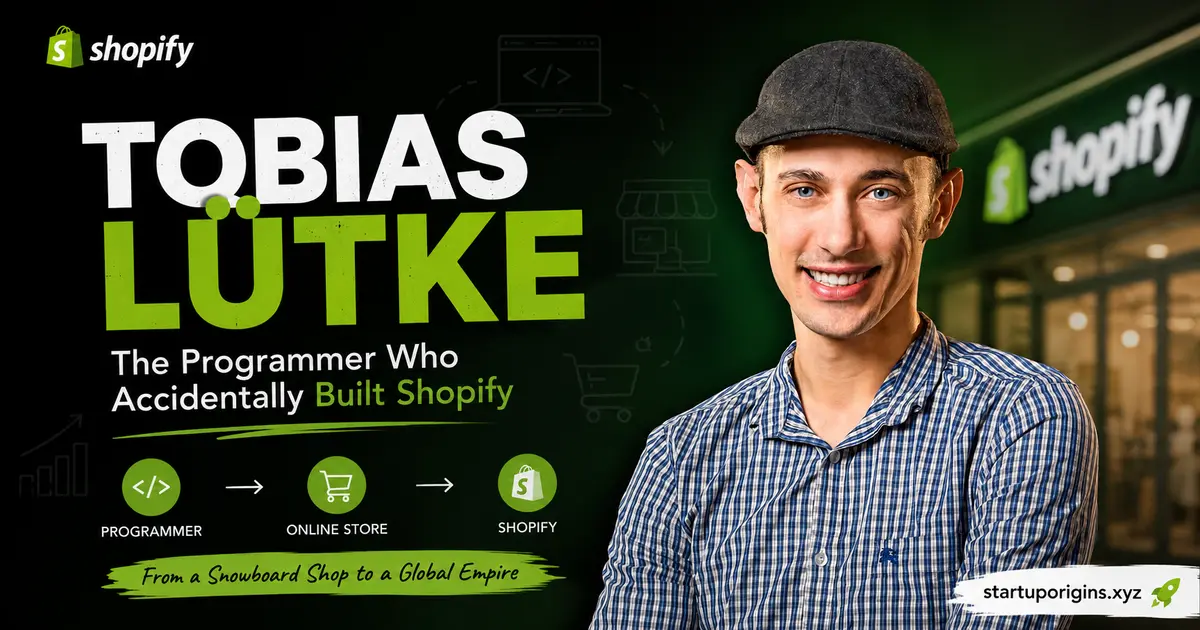
Most CEOs don’t write memos like that. Most CEOs don’t write code at all. But Tobias Lütke isn’t running Shopify the way most CEOs run companies, and he never really has. Two decades before that memo, he was a twenty-something immigrant in Ottawa with no work permit, writing his own e-commerce software because he couldn’t find any that didn’t insult his intelligence. The line between those two moments — one an obscure personal frustration, the other a directive to a public company with a hundred billion dollars in quarterly sales flowing through it — is really just one long story about a person who never stopped thinking like a programmer, even after the whole world started calling him a CEO.
A Kid Who Rewrote His Own Games
Tobias “Tobi” Lütke was born in 1981 in Koblenz, Germany, and got his first computer at six years old. By eleven or twelve, he wasn’t just playing games on it — he was opening them up and rewriting their code, the way some kids take apart a radio just to see what’s inside. It wasn’t a hobby that led anywhere obvious. It was closer to an obsession that happened to have a future attached to it, though nobody around him could have known that at the time.

At sixteen, he made a decision that would sound reckless in most countries and completely unremarkable in his own: he dropped out of high school. Germany’s dual education system meant this wasn’t a dead end — it was a different, and in some ways more direct, path into a trade. Lütke apprenticed as a Fachinformatiker, a professional computer programmer, at BOG Koblenz, a Siemens subsidiary in his hometown. He’s written about that period himself, describing an apprenticeship system built on the idea that some skills are better learned by doing the work than by studying the theory behind it. By the time most of his former classmates were finishing university, he’d already spent a decade being paid to build production software.
The apprenticeship gave him more than technical skill. It gave him a mentor named Jürgen — an unconventional, motorcycle-riding manager who had a habit of putting Lütke into situations just slightly beyond what he was ready for, then stepping back to let him figure it out. Sending a teenage apprentice alone to install software at a car dealership, a day’s drive from the office, was the kind of thing Jürgen did without much warning. Lütke later called it one of the most formative professional relationships of his life, and has said he’s spent years trying to recreate that same environment — one where people get a decade of growth packed into a single year — inside Shopify itself.
Following Love to a Country Where He Couldn’t Get Hired
In 2002, at twenty-two, Lütke moved to Ottawa, Canada. The decision wasn’t strategic. He’d met Fiona McKean, his future wife, and followed her across the Atlantic. What greeted him on arrival was a mismatch nobody plans for: a skilled programmer with real, paid experience, and no Canadian degree or work visa that would let anyone legally hire him.
Rather than wait the problem out, he and a handful of collaborators did something available to almost anyone regardless of visa status — they started a business. Through family connections, Lütke met Scott Lake, and together with Daniel Weinand, the three decided to sell snowboards online, launching a store called Snowdevil in 2004. It was funded modestly, through friends and family, and the plan had nothing to do with software. It was retail. Buy boards, list them, ship them out.
The Decision That Changed Everything

Here is the pivot point almost every retelling of Shopify’s founding rushes past, and it’s worth slowing down on, because the decision itself is more interesting than its outcome.
Building Snowdevil’s online store meant choosing e-commerce software, and in 2004 the available options — Yahoo! Stores, osCommerce, and similar tools — were, in Lütke’s own description, little more than user-hostile database editors. Nobody who had built the software, he’s said, seemed to have ever actually run a retail business.
A founder without Lütke’s background would have had exactly one option: grit your teeth and use what exists. Lütke had a second option that almost nobody else in his position had — he could simply build the thing himself. Using Ruby on Rails, a framework barely out of infancy at the time, he spent roughly two and a half months writing a custom e-commerce engine just to sell his own snowboards. Getting approved to accept credit cards required mailing notarized copies of his own passport to a payment processor in American Fork, Utah — a process that alone took months, and the kind of bureaucratic friction that plants a very specific idea in an engineer’s head: this entire category of problem needs to not exist.
This is where the real risk enters the story. Snowdevil was already a fragile, undercapitalized retail venture. Every week Lütke spent writing software instead of selling boards was a week the actual business wasn’t moving forward. There was no guarantee the software would ever be worth anything to anyone but him. The rational, defensible choice was to treat the software as a means to an end — finish it, sell some snowboards, move on.
He didn’t make that choice, and neither did his partners. When other merchants and developers started emailing to ask if they could license the platform instead of buying snowboards, the three of them faced a genuine fork: keep pushing the retail business they’d actually set out to build, or admit that the software — the thing they’d built only to solve their own problem — was the more valuable company. Between 2004 and 2006, they chose the software, wound down Snowdevil, and relaunched under a new name: Shopify.
It’s a decision that only makes sense in hindsight because it worked. At the time, it meant abandoning a real, if small, business for an unproven one with no confirmed customers and no evidence the licensing interest would turn into actual revenue. What made Lütke willing to make that trade wasn’t bravado — it was that he could see, as a programmer, exactly how much friction the existing tools were creating for people like him, and he trusted that removing that friction was worth more than any number of snowboards.
[Related: Startup Origins: How Shopify Started by Selling Snowboards Online]
Building a Company the Way He’d Build Software
Shopify’s early years were unglamorous. The platform launched in 2006 handling the basics — storefront, inventory, checkout — and adopted a subscription model in 2007 that, at the time, generated a few thousand dollars a month. But the way Lütke ran the company from the start looked less like traditional management and more like the discipline of a programmer debugging a system: watch where the friction is, remove it, repeat.
In 2009, Shopify opened an API and App Store, letting outside developers build on top of the platform the way iPhone developers were beginning to build on Apple’s App Store. It was a decision that came naturally to someone who’d spent his early career contributing to open-source projects — Lütke no longer had to personally anticipate every feature a merchant might need. He just had to build reliable infrastructure and let a growing developer ecosystem fill in the rest. Payments followed in 2013, letting merchants take credit cards without the same bureaucratic slog Lütke had gone through with Snowdevil almost a decade earlier. A point-of-sale system arrived the same year, and Shopify Plus in 2014 gave the biggest brands their own version of the same engine. None of it required Lütke to personally solve any one merchant’s problem — the same instinct that built the App Store just kept getting applied, one layer at a time: build the platform, then get out of the way.
Why Tobias Lütke Thinks Like a Programmer, Not a Traditional CEO

This is the part of Lütke’s story that rarely makes it past the biography-and-milestones version of events, and it may be the most important thing to understand about how he actually runs Shopify.
By his own account, Lütke didn’t set out to become a CEO. He’s said in interviews that he spent time actively looking for someone else to take the role, until an early investor eventually told him, bluntly, that he was the CEO — whether he’d chosen the title or not. That reluctance is telling. Lütke has described his early management record with unusual candor, saying flatly that nobody in Shopify’s history committed more bugs to the codebase, or caused more downtime, than he did in the company’s first years. He’s called it “every managerial sin in the book” — the words of someone who backed into leadership through building software, not someone who studied to become an executive.
That programmer’s instinct shows up in the specific ways Shopify is run. Lütke coined the idea of the “trust battery” — the notion that trust between any two colleagues starts around 50% when they begin working together, then charges or drains based on what actually happens between them, much the way a battery in a piece of hardware behaves. It’s a systems thinker’s way of making an abstract, emotionally loaded concept like trust into something a team can actually observe, discuss, and manage — the same instinct that makes a good engineer turn a vague bug report into a reproducible test case.
The same pattern shows up in “GSD” — Shopify’s internal project-tracking system, whose name literally stands for “Get Shit Done” — which Lütke has used for years to review every active project inside the company roughly once a month. In a 2025 conversation with the Acquired podcast, he described personally reviewing that internal ledger and talking directly with engineering teams whenever something was stuck, the same hands-on habit that defined how he ran the company in its earliest days, long before Shopify had a market capitalization measured in the hundreds of billions.
That instinct became explicit company policy in early 2025, when Lütke circulated an internal memo — later shared publicly after he said it was at risk of being leaked out of context — declaring that effective AI use was now a baseline expectation for every employee at Shopify, himself included. Teams would need to demonstrate that AI genuinely couldn’t do a job before requesting more headcount to do it. AI usage would become part of performance reviews. It’s the kind of mandate that could read as cold if it came from a typical corporate executive. From Lütke, it reads more like an engineer’s memo to his own team: here’s the new tool, here’s why it changes what “good” looks like, and no, leadership isn’t exempt.
What separates this from ordinary tech-executive enthusiasm for AI is the framing. Lütke has talked about Shopify’s mission in terms of lowering the barrier to entrepreneurship — describing the company, in one memorable phrase, as arming the rebels rather than building an empire, a pointed contrast with the way he’s characterized Amazon’s approach to commerce. Every major architectural decision at Shopify — the App Store, Shopify Payments, Shopify Plus, and now the aggressive push into AI tooling — follows the same underlying logic: build leverage into the platform itself, so that a much smaller amount of individual effort produces a much larger outcome for the person actually running the store.
[Related: Startup Lessons: What Shopify Teaches Every Startup Founder]
An Immigrant to More Than One Country
Lütke has occasionally described himself, half-jokingly, as an immigrant to the human condition itself — a comment that captures something real about how he approaches leadership. He’s spoken openly about learning as much from video games and systems thinking as from any traditional management book, and about needing years to grow into a role he never sought out in the first place. That kind of self-awareness is unusual in a founder who has, by any conventional measure, succeeded enormously. It also explains why Shopify’s internal culture reads less like a typical corporate hierarchy and more like an engineering team that happens to have five to six million merchants depending on it.
The same instinct that built Shopify’s platform also, at least once, misjudged the size of the problem it was solving. In 2019, Shopify launched its own Fulfillment Network and acquired the warehouse robotics company 6 River Systems — an attempt to engineer away the friction of shipping and logistics the same way Lütke had engineered away the friction of accepting credit cards back in 2004. Logistics, though, isn’t a problem you can solve once and walk away from the way you can with software; it’s a business with its own physical constraints, and pandemic-era demand made the bet look prescient for a while. When that demand cooled, Shopify laid off roughly 1,000 people in July 2022, and Lütke told employees directly that the company had wagered pandemic shopping habits would permanently pull forward years of e-commerce growth — a wager that hadn’t held. By 2023, Shopify had sold the logistics business to Flexport. It’s a rare instance of the programmer’s habit of building his way out of a problem running into a problem that couldn’t actually be built away, only bought back down to size — and Lütke has been unusually candid, both then and since, about naming it as a miscalculation rather than reframing it as a strategic exit.
Full Circle
Twenty-one years after mailing a notarized passport to Utah just to accept a single credit card, Lütke sat down in 2025 to write another memo — this one telling his own employees that a tool had gotten good enough to change what a day of work looked like, and that nobody, including him, got to opt out of learning it. Somewhere between those two memos is the whole arc of a person who never really stopped being the guy who couldn’t find good enough software and decided, instead of complaining about it, to go build the thing himself. He still runs Shopify like that guy. He just has a few hundred billion dollars in merchant sales riding on the software now, instead of a garage full of unsold snowboards.
Frequently Asked Questions
Who is Tobias Lütke?
Tobias “Tobi” Lütke is the German-Canadian programmer and entrepreneur who co-founded Shopify. Born in Koblenz, Germany, in 1981, he apprenticed as a programmer at a Siemens subsidiary before moving to Canada in 2002, where he later built the e-commerce software that became Shopify.
How did Tobias Lütke build Shopify?
Lütke built the original Shopify software to solve a personal problem: existing e-commerce tools were inadequate for the online snowboard shop, Snowdevil, that he launched with co-founders Scott Lake and Daniel Weinand in 2004. When other merchants asked to license the software itself, the team relaunched it as Shopify in 2006.
Why did Tobias Lütke drop out of school?
Lütke left high school at sixteen to pursue a formal programming apprenticeship through Germany’s dual education system, which combines vocational training with hands-on paid work rather than requiring a university degree.
What is the “trust battery” concept?
It’s a leadership metaphor coined by Lütke describing trust between colleagues as starting around 50% and charging or draining based on their actions over time, rather than functioning as a simple binary of trust or distrust.
What is Tobias Lütke’s leadership philosophy?
Lütke leads with an engineering mindset — staying directly involved in product decisions, reviewing internal projects personally, and building systems (like Shopify’s API platform and its AI usage mandates) that remove friction for both his own employees and Shopify’s merchants.
Disclaimer: This article is based on publicly available sources, including Shopify’s official channels, verified interviews, podcasts, and reputable business publications, and is accurate as of publication. Figures, quotes, and company policies are subject to change; readers should verify current information directly with Shopify’s official channels.


Anup Kumar Yadav is the founder of StartupOrigins.xyz, where he researches and publishes detailed stories about the world’s most successful startups. His work explores founder journeys, funding milestones, growth strategies, and the lessons entrepreneurs can learn from them.