
Most people encounter Canva’s story at the end of it.
They see the headline numbers — 220 million users, a $40 billion peak valuation, offices across four continents, a platform used by Fortune 500 companies and primary school teachers in the same week. They see Melanie Perkins on the covers of business magazines. They see the product, which is elegant and obvious and everywhere.
What they rarely see is the decade of work that preceded all of it. The tutoring sessions in a Perth classroom where the original observation was made. The school yearbook company that validated the thesis. The years of flying to San Francisco to hear no, over and over, from investors who had decided the opportunity wasn’t real. The kitesurfing lessons taken specifically to get access to a networking event. The careful, patient construction of a team, a product, and a culture that could sustain growth at a scale nobody involved had fully anticipated.
Canva is one of the most studied startup stories of the past decade. It is also one of the most misread. The version that gets passed around — young founder has big idea, battles through rejection, builds billion-dollar company — is technically accurate and practically useless. It describes the shape of the story without conveying anything about the texture of the decisions.
- Why Canva Is One of the Most Important Startup Case Studies Today
- Lesson #1: Solve a Problem You’ve Personally Experienced
- Lesson #2: Start With a Small Market
- Lesson #3: Rejection Doesn’t Mean You’re Wrong
- Lesson #4: Persistence Creates Opportunity
- Lesson #5: Great Products Remove Complexity
- Lesson #6: The Right Co-Founders Can Change Everything
- Lesson #7: Simplicity Can Be a Competitive Advantage
- Lesson #8: Build for the Long Term
- Lesson #9: Company Culture Matters More Than Most Founders Think
- Lesson #10: Innovation Never Stops
- What Founders Often Get Wrong About Canva
- Conclusion
- Disclaimer
The decisions are where the lessons actually live.
Not the lesson that persistence matters — every startup article says that. The lesson of what kind of persistence, applied where, in response to which specific problem, at which moment in the company’s development. The difference between useful instruction and motivational decoration is that level of specificity.
What Canva teaches every startup founder, examined closely, is exactly that — ten lessons, each grounded in a specific event, a real decision, and a consequence that shaped what the company became. For founders who are earlier in their own journeys, these are not abstract principles. They are documented case studies from one of the most instructive startup stories of the modern era.
Why Canva Is One of the Most Important Startup Case Studies Today
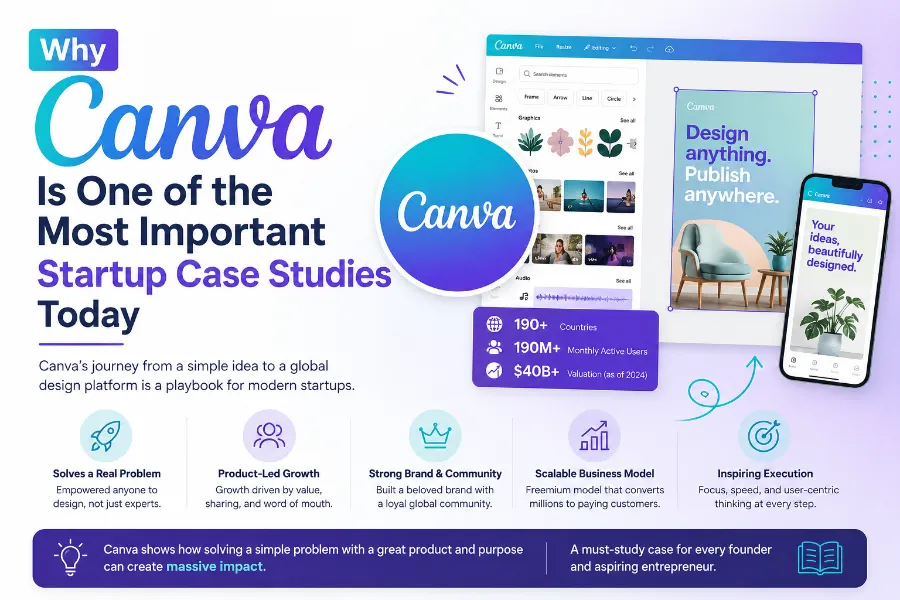
Not every successful company is worth studying. Some companies succeed because of timing so perfect it cannot be replicated. Some succeed because of capital advantages that aren’t available to most founders. Some succeed in spite of their strategy, carried by a product that happened to find a wave.
Canva is worth studying because its success was earned through decisions that were consistently correct — not lucky, not accidental, but the product of a founding team that understood their problem deeply and built toward it patiently.
The company democratized a category that had been professionally gated for decades. It built a freemium model that converted hundreds of millions of users before enterprise revenue became the primary growth driver. It maintained culture and product quality through extraordinary growth. It navigated the AI transition of 2023 to 2026 without losing the simplicity that defined its original value proposition.
Each of those outcomes involved specific choices. And behind each choice was a lesson that applies well beyond graphic design software, well beyond Australia, and well beyond the particular moment in which Canva made it.
That’s what makes it a genuinely useful case study rather than an inspiring anecdote.
Curious about how Melanie Perkins transformed a simple idea into one of the world’s most valuable design platforms? Discover Canva’s complete journey—from its early struggles and investor rejections to becoming a multi-billion-dollar startup used by millions worldwide.
👉 Read: How Canva StartedLesson #1: Solve a Problem You’ve Personally Experienced
In 2006, Melanie Perkins was nineteen and tutoring fellow students at the University of Western Australia in graphic design. The sessions kept hitting the same wall. Students who were capable and motivated would sit down with Adobe InDesign and immediately lose an hour to the interface before producing anything at all.
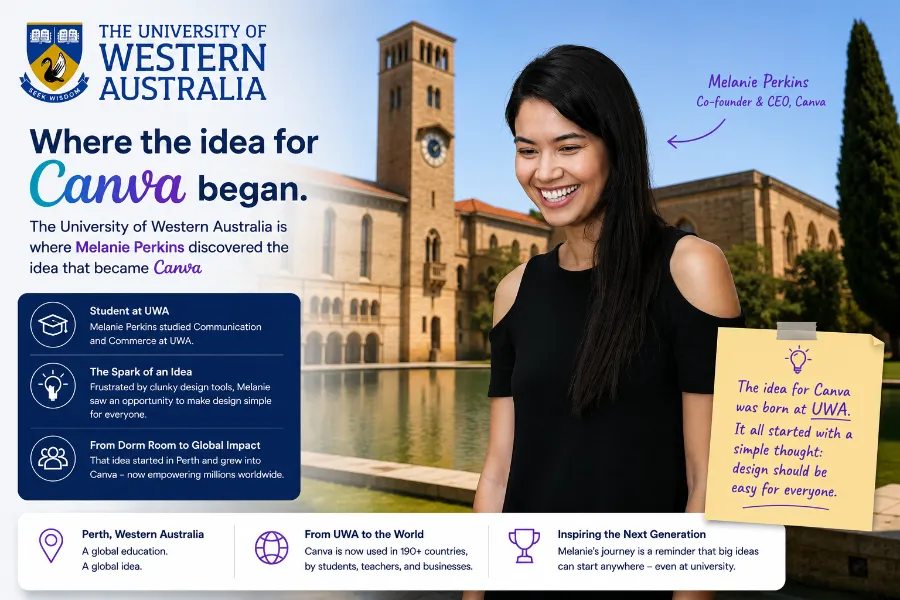
Perkins didn’t read about this problem in a market research report. She watched it happen, repeatedly, in real time. She understood exactly where the friction was — not because she had analyzed the market, but because she had been inside the experience. She knew which menus confused people. She knew which steps required explanation that shouldn’t have been necessary. She knew the specific distance between what students were trying to make and what the software demanded they learn before they could make it.
That proximity to the problem is why her solution was so precisely calibrated. She wasn’t guessing at what non-designers needed. She had spent hours watching them, explaining to them, working around limitations on their behalf.
The lesson is not “solve problems.” Every startup pitch claims to solve a problem. The lesson is about the quality of understanding that comes from having lived inside the problem yourself — the granular, specific, unsexy knowledge of exactly where the friction is and exactly what removing it would feel like. That kind of knowledge is very hard to acquire through market research. It is very easy to acquire through direct, personal, repeated experience.
Founders who are too far from the problem they’re solving tend to build solutions for a version of the problem that is slightly wrong. The product works, but not quite in the right place. The feature solves the issue, but not the specific issue that was actually causing the behavior. Perkins never had that problem with Canva, because she had watched the problem closely enough to know exactly what needed to change.
Lesson #2: Start With a Small Market
In 2007, Perkins and Cliff Obrecht did not launch Canva. They launched Fusion Books.
Fusion Books was an online platform that let schools design and order their own yearbooks using a drag-and-drop interface. The market was narrow — Australian schools needing yearbooks — and the ambition was deliberately constrained. They were not trying to democratize design for everyone. They were trying to democratize design for one very specific use case, in one very specific market, with one very specific deliverable.
The startup world has a complicated relationship with starting small. The dominant culture of venture-backed technology companies celebrates vision at scale — the ten-year roadmap, the total addressable market in the billions, the product that will change the way everyone does everything. Starting with school yearbooks in Perth is the opposite of that energy, and it’s exactly what made the eventual scale possible.
Fusion Books gave Perkins and Obrecht something that a broader launch would not have: a contained environment in which to discover whether the core thesis actually worked. Could non-designers produce professional-looking output when given the right tools? The yearbook format provided a clean test. Schools either produced good yearbooks or they didn’t. The feedback was immediate and concrete.
The answer, it turned out, was yes. Fusion Books grew to become Australia’s largest school yearbook company — a real business, generating real revenue, with real evidence that the drag-and-drop thesis held up in practice.
When Perkins began pitching investors on the broader Canva vision, she wasn’t asking them to believe an idea. She was showing them proof. The proof was narrow, but it was genuine. And in early-stage fundraising, the difference between a concept and demonstrated evidence is often the difference between a check and a polite decline.
Small markets, entered deliberately, are research environments. The founders who understand this treat their early product as a laboratory, not a limitation.
Lesson #3: Rejection Doesn’t Mean You’re Wrong
Perkins reportedly faced approximately 100 investor rejections before Canva secured its seed funding. That number has been repeated often enough that it risks becoming wallpaper — one of those startup statistics that signals perseverance without communicating what the experience actually involved.
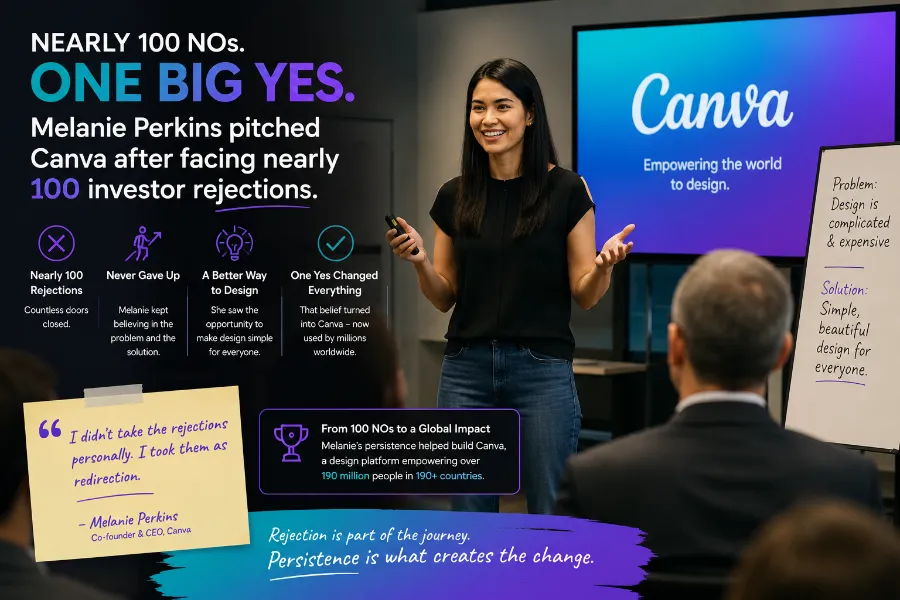
What it actually involved was years of consistent, informed, sophisticated people telling her the same thing: this doesn’t work. The market is too crowded. Adobe is too strong. The non-professional design user isn’t a real segment. The team doesn’t have the technical depth.
These weren’t uninformed opinions. The investors making them had pattern-matched across hundreds of companies. They had seen products like this before. They had backed some of them and watched them fail.
They were still wrong.
Not because investor rejection is meaningless — sometimes investors are right. But because there is a specific kind of rejection that reflects the limits of the evaluator’s framework rather than the limits of the idea. Venture capital is a consensus-driven industry operating under conditions of genuine uncertainty. Investors back things that fit their existing mental models of what success looks like. A young female founder from Perth, pitching a consumer design tool against Adobe’s entrenched position, did not fit those models cleanly.
The lesson is not that rejection should be ignored. It’s that rejection needs to be diagnosed. Is the investor wrong about the market size, or are they right? Is the execution concern legitimate, or is it a proxy for something they haven’t named? Is the objection about the idea, or about the team, or about the geography, or about the profile of the founder?
Perkins did not dismiss the objections. She addressed them. She built Fusion Books to answer the execution questions. She recruited Cameron Adams to answer the technical credibility questions. She built a network through Bill Tai to answer the access questions. She treated each objection as a specific problem to be solved rather than a verdict to be accepted or ignored.
That is a more sophisticated response to rejection than either stubbornness or capitulation.
Most startups fail to raise capital after a handful of investor meetings. Canva’s founders faced nearly 100 rejections before securing the funding that helped build a company valued in the billions. Discover how strategic networking, persistence, and unconventional fundraising tactics changed Canva’s future.
🚀 Read the Funding StoryLesson #4: Persistence Creates Opportunity
There is a moment in Canva’s fundraising story that has become its most retold detail: Melanie Perkins learned to kitesurf in order to attend networking events organized by venture capitalist Bill Tai in Maui.
It is an easy story to misread. The temptation is to frame it as a charming anecdote about going the extra mile — founder learns a sport to get in a room with an investor. Heartwarming. Slightly eccentric. Very on-brand for startup mythology.
The more accurate reading is structural. Perkins identified that the investors she needed to reach were not accessible through the conventional channels available to her. She was not a Stanford alumna. She was not based in San Francisco. She did not have a prior exit or a warm introduction from a well-known operator. The standard routes were blocked.
So she mapped the non-standard routes. Tai’s kitesurfing events were an access point. Getting to those events required learning to kitesurf. Learning to kitesurf was a logistics problem, not an identity challenge. She solved it.
The result was not just access to Tai. Through Tai, she reached Lars Rasmussen — the co-creator of Google Maps — who became a mentor and opened the doors that Tai’s introduction made reachable. A single non-standard route, pursued with specificity and follow-through, unlocked an entire layer of the network she needed.
Persistence, applied randomly, is just stubbornness. Persistence applied to a specific problem — in this case, the problem of access — is something more strategic. Perkins wasn’t grinding harder on the same approaches that weren’t working. She was identifying the actual constraint and removing it.
That distinction matters enormously. The founders who exhaust themselves repeating the same actions and calling it persistence are not doing what Perkins did. She was solving a problem. The problem just happened to require learning a water sport.
Lesson #5: Great Products Remove Complexity
The design software market that Canva entered in 2013 was not short of options. Adobe dominated the professional tier. A range of simpler tools existed for consumers. The category had been established for decades.
What didn’t exist — and what Canva built — was a product organized entirely around the outcome rather than the tool. Every other design application, professional or consumer-facing, started with capability: here are the tools, here are the features, here is what the software can do. Canva started with the question the user was actually asking: what are you trying to make?
The difference sounds philosophical. In product terms, it was total. Choosing a template first — a social media post, a presentation, a poster, a certificate — meant that every subsequent decision had a frame around it. The colors were already coordinated. The fonts were already paired. The proportions were already correct. The user was making choices within a system designed to keep the output looking professional, rather than making choices in a vacuum where every decision compounded the risk of the next one.
This is what the comparison with Adobe actually reveals. It’s not that Canva had fewer features — it did, deliberately. It’s that the features it had were organized around a different philosophy of what the user was trying to accomplish. Adobe optimized for maximum capability. Canva optimized for minimum friction on the path to a good outcome.
The lesson for founders extends well beyond design tools. Every product has a choice about where it places its organizational logic — around what the product can do, or around what the user is trying to get done. Products that organize around the user’s job tend to acquire users more easily, retain them more durably, and spread more naturally through word of mouth. Products that organize around capability tend to attract power users and lose everyone else.
Canva chose the user’s job. Two hundred and twenty million people later, that choice looks obvious. In 2013, when the professional design community was largely dismissive of the product’s simplicity, it required conviction to hold.
Lesson #6: The Right Co-Founders Can Change Everything
Cliff Obrecht was there from the beginning — present during the Fusion Books years, during the investor rejection years, during the long period when the company existed more as a commitment than as a business. His operational discipline was the organizational ground beneath Perkins’ product vision. Without him, the company’s day-to-day functioning during the high-pressure early years would have looked very different.
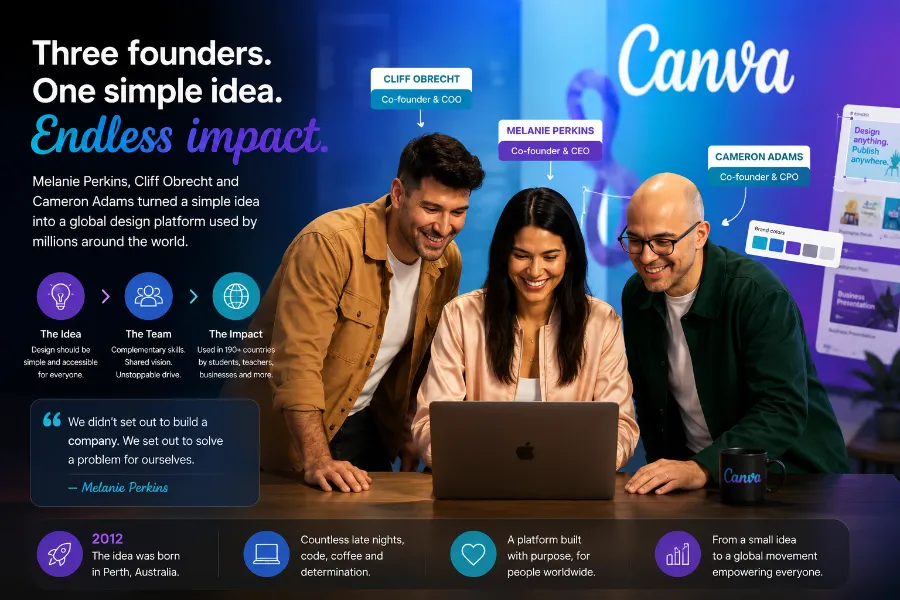
Cameron Adams arrived later, and his arrival changed the trajectory of the fundraising campaign almost immediately.
Adams had worked at Google on Google Wave — a product with genuine technical ambition, whatever its commercial fate. His background addressed the specific objection that had been quietly present in many of Perkins’ investor conversations: could this team actually build what they were describing? Canva’s vision required serious engineering. Before Adams, investors could reasonably wonder whether the founding team had the technical depth to execute at that level.
After Adams, the question had a different answer.
The lesson here is precise. It is not “hire great people” — that is universally acknowledged advice that doesn’t help anyone decide anything. The lesson is that co-founders should be chosen to address the specific gaps that are limiting the company at the stage it is actually in. Perkins understood, clearly, that the technical credibility gap was what was holding the fundraising back. She recruited the person who could close that specific gap. Not a generically talented engineer. Not a well-networked executive. The specific person whose background addressed the specific objection.
Co-founder decisions made that specifically tend to compound in the company’s favor. Co-founder decisions made generally — finding someone smart who seems like a good fit — tend to produce teams that are pleasant to work with and occasionally missing exactly the capability the company most needed.
Lesson #7: Simplicity Can Be a Competitive Advantage
Adobe has billions of dollars, decades of brand equity, and a professional user base deeply trained in its products. It also has thousands of engineers and the resources to build essentially any feature it decides to build.
Canva competed with Adobe and won — not by building more features, but by refusing to.
The decision to keep Canva simple was not a resource constraint. By the time Canva was at significant scale, it had the capital and engineering talent to add professional-grade complexity if it had chosen to. It chose not to, because adding complexity would have undermined the fundamental value proposition that had acquired the 220 million users in the first place.
This required resisting pressures that compound as a product grows. Power users ask for advanced features. Enterprise clients request customization. Internal product teams propose expansions. The gravitational pull of “more” is constant, and most products eventually yield to it — which is why so many products that launched simple end up, after years of development, looking like the complex tools they originally distinguished themselves from.
Canva has managed this tension more effectively than most. The product has expanded significantly — AI features, enterprise capabilities, expanded template libraries — but the core experience has remained organized around the same principle it launched with: start with what you’re making, not with what the software can do.
Simplicity maintained at scale is considerably harder than simplicity achieved at launch. It requires sustained organizational will and a clear understanding of why the simplicity exists — not as a feature, but as the foundational product philosophy that everything else is built around.
Lesson #8: Build for the Long Term
Canva launched in August 2013. Its first valuation above $1 billion came in 2018 — five years later.
Five years is a long time in the technology industry, where funding cycles, competitive pressure, and the attention spans of both investors and media have compressed dramatically. In those five years, Canva grew steadily, expanded internationally, developed its product, and built the organizational infrastructure required to support a global platform. None of it happened at the pace that makes for exciting press coverage.
Perkins has spoken consistently about building Canva for the long term rather than optimizing for short-term metrics. The freemium model — which acquired hundreds of millions of users before monetization pressure became central — was a long-term bet. The investment in culture and values, at stages of company growth when the return on those investments is hardest to measure, was a long-term bet. The decision not to rush toward an IPO, despite years of speculation about one, has been a long-term bet.
Long-term thinking is easy to endorse and hard to practice, because virtually everything about the environment in which startups operate — investor expectations, competitive dynamics, media coverage, hiring markets — creates pressure toward shorter horizons. The founders who actually manage it tend to share a specific characteristic: they have a clear enough vision of where they’re going that near-term turbulence doesn’t look as threatening as it might.
Perkins knew what Canva was supposed to become. That clarity made it easier to hold the long-term orientation when short-term pressures pushed in a different direction.
Lesson #9: Company Culture Matters More Than Most Founders Think
Canva’s stated mission — empowering the world to design — is the kind of language that appears in every corporate About page and means nothing in most of them. At Canva, it has functioned as an actual constraint on decision-making in ways that are observable from the outside.
The free tier of Canva’s product is genuinely useful. Not barely-useful-enough-to-upsell, but substantively useful in a way that reflects a decision to actually serve users who can’t afford the paid product. The Canva Education offering, which gives students and teachers access to premium features at no cost, is structurally unprofitable in the short term and consistent with a mission that means what it says.
Perkins and Obrecht have also signed the Giving What We Can pledge, committing the majority of their equity to charitable causes. This is not a publicity exercise — it is a structural commitment made before the company reached its current valuation, which shapes how both founders think about what the company is ultimately for.
Culture established at the top flows through the organization in ways that are difficult to manufacture or retrofit. The founders who treat culture as an HR function — something to be documented and maintained by a people team — tend to find that it drifts under pressure. The founders who treat it as a strategic asset — something they model, defend, and make real decisions based on — tend to find that it holds.
Canva has maintained unusual cultural coherence through a period of growth that has broken the cultures of many comparable companies. That coherence did not happen by accident. It reflects founders who built values into the company’s structure early, and who have maintained them as the company scaled.
Lesson #10: Innovation Never Stops
By 2023, Canva was a mature product with hundreds of millions of users and a well-established position in the market. It would have been reasonable, at that point, for the company to consolidate — to optimize the existing product, protect its market share, and manage growth efficiently.
Instead, Canva rebuilt significant portions of its platform around artificial intelligence.
Magic Write brought AI text generation into the design workflow. Magic Design introduced AI-generated layouts. Dream Lab added image generation. The 2025 platform overhaul embedded AI across virtually every user workflow, fundamentally changing how the product functioned without changing what it was for.
Crucially, Canva also announced its integration with Claude Design — Anthropic‘s AI-powered design experience — bringing Canva’s design infrastructure together with Claude’s AI capabilities. For a product built on the premise that design should feel as natural as a conversation, the integration was less a strategic pivot than a philosophical completion.
The lesson is not that companies should constantly reinvent themselves — that approach tends to destroy the consistency that makes products trustworthy. The lesson is more specific: the best companies remain students of their own core problem. Canva’s core problem has always been friction between a person and the visual output they’re trying to create. AI reduces friction. Therefore, AI belongs in Canva.
The companies that innovate successfully tend to innovate in the direction of their original insight, not away from it. They find new tools and new technologies that serve the same purpose more effectively, rather than chasing novelty for its own sake. Canva’s AI investment, examined this way, is not a departure from the product’s founding philosophy. It’s the most recent expression of it.
What Founders Often Get Wrong About Canva
The most common misreading of Canva’s story is the survivorship bias problem. Founders look at the outcome — the valuation, the users, the global recognition — and work backward to find the decisions that produced it. Everything Canva did, viewed through the lens of its eventual success, looks correct.
That’s not how it felt at the time.
When Perkins was pitching investors for the hundredth time, she did not know the next pitch would be different. When Fusion Books was growing steadily but slowly through Australian schools, it was not obvious that it would become the proof of concept for a global platform. When Cameron Adams joined in 2012, it was a significant bet on both sides — Perkins betting that she could recruit the right technical co-founder and Adams betting that this particular vision, from this particular team, was worth his time.
None of these decisions were made with the knowledge of how they would turn out. They were made under uncertainty, by people who had formed a view of what was likely to be true and were acting on that view before it was confirmed.
The founders who study Canva most carefully are not the ones looking for a blueprint. They’re the ones sitting with the genuine uncertainty of the early years — the years when the rejections kept coming and the timeline kept extending and the outcome remained genuinely unclear — and asking themselves what it would take to keep going anyway.
The answer, Canva’s story suggests, is not blind optimism. It’s the combination of a real observation, a working proof, a team assembled with specific intention, and a problem worth solving badly enough that the difficulty of solving it doesn’t change the fundamental calculation.
That combination is rare. When it exists, it tends to be durable.
Before Canva became a global design giant, Melanie Perkins was a university student in Australia with a bold idea: make design simple for everyone. Discover her entrepreneurial journey, early business ventures, fundraising struggles, and the leadership lessons that helped build one of the world’s most successful startups. :contentReference[oaicite:0]{index=0}
🚀 Read Melanie Perkins’ StoryConclusion
Here is what Canva actually teaches, stripped of the mythology.
It teaches that the clearest path to a large opportunity is usually through a small one. Fusion Books was not a compromise. It was the most direct route to the proof that Canva needed to exist.
It teaches that investor rejection, properly diagnosed, is a map. Each objection Perkins received identified something specific — the technical credibility gap, the network gap, the execution proof gap — and each of those specifics became a problem she could solve.
It teaches that simplicity is not a starting point that complexity inevitably replaces. It is a strategic position that requires active, sustained defense against the constant pressure to add more.
It teaches that culture is architecture, not atmosphere. Canva’s values have remained coherent through extraordinary growth because they were built into the company’s decision-making structures, not just its marketing language.
And it teaches something harder to articulate but perhaps most important: that the distance between a correct insight and a validated company is measured not just in time but in the specific, unglamorous work of closing every gap that stands between the two.
Perkins had the insight in 2006. She had the company in 2013. Between those two dates were seven years of building proof, building teams, building networks, and building the organizational capability required to make the insight real at scale.
That gap — between the idea and the thing — is where most startups fail. Not because the idea was wrong, but because the work required to close the gap turned out to be more specific, more patient, and more structural than a founding team had anticipated.
Canva closed the gap. Every lesson in its story is, in some form, an instruction for how.
Disclaimer
This article is published for informational and educational purposes only. The lessons and analysis presented reflect the author’s independent interpretation of publicly available information about Canva and are not endorsed by or affiliated with Canva, its founders, or any individuals mentioned herein. StartupOrigins is an independent publication with no official connection to Canva or any associated companies. All trademarks, company names, and personal names remain the property of their respective owners.

Anup Kumar Yadav is the founder of StartupOrigins.xyz, where he researches and publishes detailed stories about the world’s most successful startups. His work explores founder journeys, funding milestones, growth strategies, and the lessons entrepreneurs can learn from them.