
There is a version of this story where Notion never makes it.
In that version, the money runs out quietly, the product gets shelved, and Ivan Zhao moves on to something else — another job at a San Francisco startup, another attempt at a different idea. The world never learns that a better way to organize digital work was possible. Two young founders go home, a little wiser and a lot poorer, and the whole thing dissolves.
- Who Is Ivan Zhao?
- The Vision Behind Notion
- When Everything Started Falling Apart
- The Decision to Leave Silicon Valley
- Rebuilding Notion From Scratch
- The Launch That Changed Notion’s Future
- How Ivan Zhao Built One of the Most Loved Software Products
- Leading Notion Through Hypergrowth
- Ivan Zhao’s Leadership Style
- Ivan Zhao and Notion’s Future Vision
- Frequently Asked Questions
- The Founder Who Chose to Rebuild
- Disclaimer
That version came very close to being the real one.
By 2015, three years into building Notion, Ivan Zhao had run out of most of what a startup needs to survive. The angel funding — roughly $2 million raised from friends, family, and friends of friends — was nearly gone. The team had been laid off. The product, despite the genuine ambition behind it, didn’t work reliably enough for real people to depend on it. The codebase crashed constantly. Users lost their data. The framework holding it all together was the wrong one, and everyone involved knew it.
“It was kind of like despair, I would say,” Zhao recalled years later. “I almost never had that feeling before.”
For most founders in that position, the conversation shifts from “how do we fix this” to “how do we wind this down.” Zhao went somewhere else in his mind. He looked at what he had — a co-founder he trusted completely, a vision he still believed in, and enough remaining money to survive cheaply somewhere outside one of the world’s most expensive cities — and made a decision that would define everything that followed.
He was going to start over. Completely. Not patch the product. Not pivot the pitch. Start from nothing, in a foreign country, in a house he’d never seen, in a city where he couldn’t read the street signs.
What happened in that house in Kyoto eventually became one of the most successful software companies of the past decade. But understanding why requires starting much earlier — with a child in China who learned to code not because someone taught him to, but because he wanted to understand how video games worked.
Who Is Ivan Zhao?
Ivan Zhao was born in China and moved to Canada as a child. He arrived at the University of British Columbia already knowing how to code — he’d taught himself as a kid, taking apart games to see what was inside them. At UBC, he decided he already understood computer science well enough, so he studied something harder to learn on your own: cognitive science, the discipline that asks how minds work and how tools shape thinking. He minored in fine art, picked up photography in his senior year of high school, and spent his college years with an unusual mix of friends — engineers, filmmakers, fashion students — absorbing how each of them saw the world.
That cross-disciplinary education wasn’t incidental to what Notion would become. It was the foundation.
Zhao came to believe that most software was designed backwards — built around what the machine could do rather than what the human needed. His studies pointed him toward a different tradition. He became absorbed by the work of computing pioneers from the 1960s and 70s: Douglas Engelbart, Alan Kay, Ted Nelson. These were people who saw the computer not as a business tool but as an extension of human intelligence — a medium, like writing, that could let ordinary people do things that had previously required specialists.
Engelbart’s 1968 “Mother of All Demos” — in which he showed a working system of hyperlinks, collaborative documents, and interactive text, forty years before the mainstream would catch up — became something close to a sacred text for Zhao. A portrait of Engelbart hangs in Notion’s San Francisco office today, in a first-floor hallway where everyone who enters sees it.
After graduating, Zhao moved to San Francisco and took a job at Inkling, an education technology company where he worked as a product designer. He later said it was there he learned something important: how to make mistakes on other people’s money. The experience wasn’t glamorous, but it gave him a window into how products were built and shipped in the real world — and how rarely that process matched the idealism with which it started.
The gap between what computers were capable of and what they actually helped ordinary people do kept nagging at him. Only 0.34 percent of the global population were software developers, yet billions used computers every day. The other 99.66 percent were dependent on whatever tools developers chose to build for them. Zhao found that unacceptable. He wanted to change the ratio.
The Vision Behind Notion
The idea that became Notion grew out of a specific frustration Zhao had in 2012, just before graduating from UBC. Many of his friends needed online portfolios. As the programmer in his social circle, he started building websites for them. “There were no good tools,” he said. The existing options were either too rigid or too complex — capable for specialists, useless for everyone else.
The larger version of that problem was everywhere. People juggled dozens of applications — one for notes, one for tasks, one for wikis, one for databases, one for spreadsheets — none of which talked to each other properly and none of which could be reshaped to fit how a particular person actually thought.
Zhao’s answer was to build something modular. Not an app with fixed features, but a set of building blocks — like Lego — that users could assemble into whatever workspace their specific mind and workflow required. The vision was deliberately ambitious: he wanted to do for software creation what the printing press had done for writing. Before widespread literacy, only clergy and scribes could compose text. Zhao imagined a world where ordinary people could build their own tools, without writing a single line of code.
In 2013, he and Simon Last — an engineer who had worked at the Space Telescope Science Institute and shared Zhao’s frustration with fragmented digital tools — founded Notion Labs, Inc. in San Francisco. They raised roughly $2 million from angel investors and began building.
They called their vision “the Lego of productivity tools.” They believed it could eventually replace the dozens of specialized applications that companies and individuals paid for separately.
They were right. But it would take years of failure before they could prove it.
When Everything Started Falling Apart
The first version of Notion was built on a Google web framework called Web Components. At the time, it seemed like a reasonable choice. In practice, it turned out to be a foundation made of sand.
“Bugs came from everywhere,” Zhao later remembered. “It was unstable. People were losing their content.”
Users would open the product and find their work corrupted or missing. The application crashed without warning. No matter how quickly the team patched problems, new ones emerged. The framework couldn’t support the kind of reliability a real productivity tool needed. And beneath the technical problems was a more fundamental one: the product’s concept hadn’t been translated into something ordinary people would immediately understand.
Notion’s first version was built for what Zhao thought people wanted — the ability to create their own digital tools without coding. The problem was that most people didn’t wake up in the morning wanting to build software. They woke up wanting to write, to plan, to get work done. Zhao had built something intellectually compelling that solved a problem his users didn’t yet know they had.
“It was not really a product,” he said, with the clarity that only comes after enough distance from a failure. “It didn’t work because the product was not understandable for most people. It was more for nerdy tech crowds.”
By late 2015, the company had burned through most of its angel funding. Some early team members had already left. Retaining the rest was becoming impossible. Akshay Kothari, who had been one of Notion’s early angel investors and met with Zhao every few months, later said plainly: “I thought investing was a mistake, because the company didn’t go anywhere. It almost ran out of money.”
The weight of that period — the financial pressure, the shrinking team, the product that wouldn’t behave — pushed Zhao into a state he had never experienced before. “Despair” was the word he used. For someone who had spent his life approaching problems with intellectual curiosity rather than anxiety, that admission carries real weight.
Something had to change. Everything, as it turned out.
The Decision to Leave Silicon Valley

The decision to move to Japan wasn’t a strategy. It was, by Zhao’s own account, almost a whim.
With the team gone, just Zhao and Last remained. They needed to go somewhere cheaper than San Francisco — that part was arithmetic. They also wanted to go somewhere neither of them had been. Somewhere completely disconnected from the startup culture they’d been swimming in, with its events and introductions and status games and constant noise. They chose Kyoto, subleased their San Francisco spaces, packed what they needed, and left.
The cost calculation was simple: Kyoto was less than half as expensive as San Francisco. The rent on a small traditional house there cost a fraction of what even a modest apartment would in the Bay Area. That differential meant their remaining money could last significantly longer — long enough, potentially, to rebuild.
The isolation calculation was less obvious but equally important. In Kyoto, there were no investor meetings to prepare for. No networking events to attend. No peers to compare progress with. No English speakers to interrupt the silence. Zhao couldn’t read the street signs. He couldn’t navigate the menus alone — though being from China helped more than he expected, since roughly 70 percent of written Japanese shares roots with Chinese characters, enough to distinguish “beef” from “chicken.”
They rented a two-story house so compact that only a traditional Shoji screen separated their bedrooms. They stopped dressing properly. They stopped cooking. They woke up, opened their laptops, and coded. They broke to eat noodles from a nearby shop. They came back and coded more.
“We were just, code, code, code,” Zhao remembered. “Then, ‘Hey, let’s go out for food.’ Then, we go eat, go back to work, and do it again.”
Eighteen hours a day. For nearly a year.
“It was a lot of fun, some of the happiest times,” he said later, which is perhaps the most revealing thing about the man. What most people would remember as the most stressful period of their professional lives, Zhao recalled with something close to warmth. The simplicity appealed to him. The focus appealed to him. There was nothing left to manage except the code.
Rebuilding Notion From Scratch
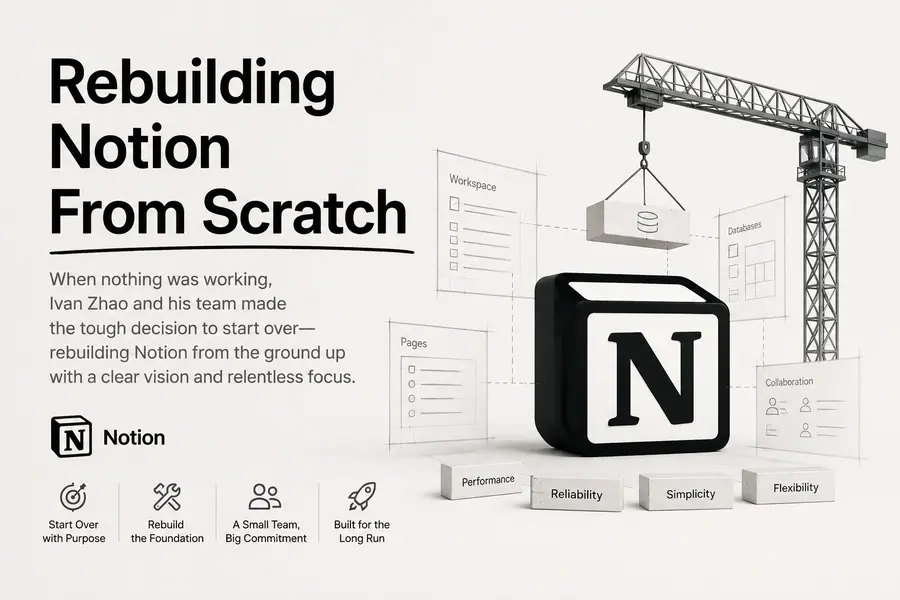
The rebuild was total. The old codebase — three years of work, every decision and argument and late night it represented — was scrapped. In its place, Zhao and Last built on React Libraries, the framework that had become the market standard and would prove far more stable than what they’d left behind.
But the technical reset was the easier part. The harder reset was philosophical.
Zhao understood now what he hadn’t understood before: he had built something he wanted to use, not something people already understood how to want. The new Notion would have to meet users where they were — in the everyday act of writing and organizing — and hide the deeper power beneath a surface that felt immediately familiar.
He articulated the insight with an analogy he would return to many times: sugar-coating broccoli. Nobody wakes up wanting to eat broccoli. But they’ll eat it if it’s wrapped in something appealing. Notion was the broccoli — a genuinely powerful, flexible tool-building platform. The sugar was an interface simple enough to use on the first day, without a tutorial, without needing to understand what was underneath.
The new architecture centered on blocks. Every element of a Notion page — a paragraph, an image, a to-do item, a database row — was a block that could be moved, nested, transformed, or combined with other blocks. It was the Lego metaphor made real, but in a form that required no technical knowledge to assemble.
Templates became central to the experience. Instead of arriving at a blank page and having to invent a structure, users could start with something that already worked — a project tracker, a meeting notes format, a personal journal — and customize from there. The flexibility remained. The initial barrier to entry had been dramatically reduced.
“A brand-new code base is always happy,” Zhao reflected. “There’s no legacy code. You don’t need to clean up the whole thing. It’s almost like you have a brand-new house — you can decorate however you want, versus the old house, you have to clean, repaint the walls and all that.”
In the silence of that Kyoto house, the product that would eventually reach 100 million users was quietly taking shape.
The Launch That Changed Notion’s Future
In March 2016, Zhao and Last had something ready to show. They launched Notion 1.0 on Product Hunt, the platform where technology enthusiasts discover and vote on new products. The launch was supported in part by Naval Ravikant, an early angel investor whose profile carried weight in the community.
The response arrived almost immediately — and it kept coming.
Notion 1.0 became Product of the Day. Then Product of the Week. Then Product of the Month. The Golden Kitty Award — Product Hunt’s annual recognition of the year’s most significant launches — followed. More than 2,500 upvotes. Thousands of comments from early adopters who felt, for the first time, that someone had built the tool they’d been describing to friends for years.
Zhao wrote about it later on Product Hunt, allowing himself a moment of visible emotion: “At that time, the company was just my co-founder Simon and I, and we were nearly running out of money (thanks mom for the bridge!) If not for the Product Hunt launch and the overwhelming support from this community, we wouldn’t have made it.”
That parenthetical — thanks mom for the bridge — is easy to skip past. It reveals that in the final stretch before the launch, even the reduced costs of Kyoto hadn’t been enough. Zhao had borrowed money from his own mother to keep the company alive until the product was ready. The launch that announced Notion to the world was made possible, at its most basic level, by a family loan.
The company achieved profitability after the launch. The team started growing again. The product that had been rebuilt from nothing had found its people.
How Ivan Zhao Built One of the Most Loved Software Products
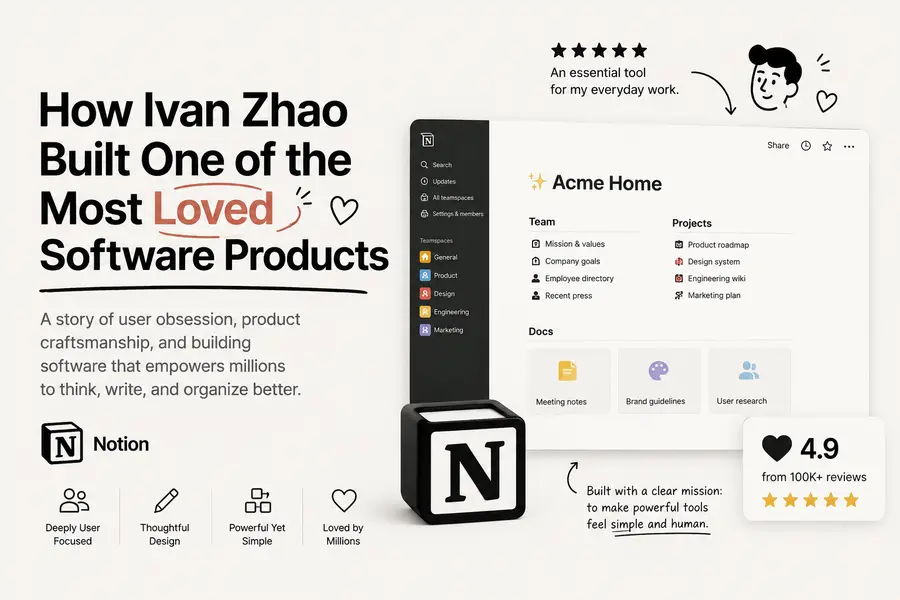
What distinguished Notion after the relaunch wasn’t just the product — it was the community that formed around it.
Zhao had always believed that good tools attract devoted users. What he didn’t fully anticipate was the degree to which Notion users would become makers and evangelists in their own right. People built template libraries and sold them online. YouTube channels emerged dedicated entirely to Notion workflows. Twitter threads spread tips and setups. Entire newsletters were built around the tool.
The community wasn’t manufactured. It emerged because the product was genuinely flexible enough to mean different things to different people — a student’s knowledge base, a writer’s research system, a team’s project tracker, a company’s internal wiki — while remaining coherent enough to have a recognizable identity.
Zhao’s design philosophy drove this. He believed, from his cognitive science training, that tools shape thought — that the environment you work in changes what you’re capable of thinking. Ugly, cluttered software creates what he called cognitive friction. Clean, harmonious design creates mental clarity. This wasn’t aesthetics for its own sake. It was function.
“Beauty isn’t decoration,” he said in a 2025 interview. “It’s fundamental to how the tool works. Software that’s visually harmonious creates mental clarity. Ugly software creates cognitive friction.”
In 2018, Notion 2.0 launched. It added databases to the platform — tables, Kanban boards, calendars, galleries — alongside the existing notes and document capabilities. Zhao described it as the version he’d always been building toward: the one that finally delivered on the original promise of a single tool that could handle most of the work that happened outside email.
The Wall Street Journal covered it. The community that had been quietly growing for two years suddenly became visible and vocal. Notion wasn’t just a product anymore. It was a movement.
Leading Notion Through Hypergrowth
The growth after 2018 was organic in a way that most software companies never experience. Notion didn’t have a sales team driving enterprise deals. It didn’t spend heavily on advertising. It grew because users converted their colleagues, their teams, their entire organizations — one demonstration at a time.
By late 2019, Notion had one million users and just eighteen people on the team. In July of that year, the company accepted its first institutional funding: a $10 million Series A led by Sequoia Capital at an $800 million valuation. Zhao and Last had resisted VC money for years, taking it only once they had leverage.
Then came 2020. The COVID-19 pandemic restructured work overnight, and the sudden global experiment in remote collaboration created demand for exactly the kind of flexible, centralized workspace Notion had become. Index Ventures invested $50 million at a $2 billion valuation in February 2020, reportedly closing the deal within 36 hours of Zhao initiating the conversation. By October 2021, a $275 million round led by Coatue and Sequoia valued Notion at $10 billion.
Akshay Kothari — the early investor who had once feared his check was a mistake — joined the company as COO and third co-founder during this period. His operational experience helped Notion scale without losing the product quality that had made it special.
Managing hypergrowth while preserving culture is among the hardest things a founder can do. Zhao’s approach was to stay close to the product and to keep the team lean relative to the company’s ambitions. In 2022, Notion generated $67 million in revenue. By 2023, that had grown to $250 million. By 2024, it reached $400 million — a 60 percent year-over-year increase. By September 2025, the company crossed $500 million in annual revenue.
The team remained deliberately smaller than the revenue would suggest. Zhao had learned in Kyoto that focus is a resource, and that headcount can dilute it as quickly as distraction can.
Ivan Zhao’s Leadership Style
Ivan Zhao does not talk like most successful tech founders.
He has no talking points. He doesn’t pitch or hype or perform conviction. He speaks in abstractions and book references. He treats business like a philosopher — as a thought experiment made real, full of uncertainty and first principles and lessons borrowed from fields that have nothing to do with software. In a 2024 Entrepreneur magazine profile, the writer noted that Zhao quotes books and speaks abstractly, treating his own company’s story as a case study rather than a triumph.
His reluctance extends to visibility. He is among the most camera-shy CEOs in Silicon Valley, rarely photographed, rarely sought out for keynotes, largely absent from the social media performances that have come to define many founder brands. The portrait of Douglas Engelbart in Notion’s hallway says more about his values than any conference appearance would.
Inside the company, Zhao is known for his emphasis on taste. He chose the furniture and finishes for Notion’s offices himself — sisal mats, curved Togo couches, wooden Artek stools — with the same deliberateness he brought to the product interface. He describes overhead fluorescent lighting as “hell.” The coherence between the physical space and the digital product isn’t coincidental. It reflects a belief that environment shapes thinking, and that the job of a leader is to design the conditions in which good thinking can happen.
His decision-making style is characterized by patience and directness. He held off venture capital until he had leverage. He rebuilt the product rather than pivoting the pitch. He moved to Kyoto rather than trying to fix the unfixable in San Francisco. Each of those decisions required resisting the obvious, faster path — and each of them turned out to be right.
In a June 2026 Sequoia podcast, Zhao was described as a “refounder” — someone who has not just started a company but restarted it, multiple times, with the same clarity about why it matters. The label fits.
Ivan Zhao and Notion’s Future Vision
In August 2025, appearing on the Decoder podcast with Nilay Patel, Zhao spoke about what he saw ahead. The productivity landscape, he said, was about to change more in the next five years than it had in the previous fifty. Artificial intelligence wasn’t a feature to be added to Notion — it was a fundamental reimagining of what a workspace could do.
“Many companies bolted AI onto existing products as a party trick,” he said. Notion took a different approach: integrating AI into the workspace at an architectural level, so that it could understand the context of a user’s work rather than just respond to prompts.
Notion AI launched publicly in early 2023. Notion Calendar arrived in January 2024 following the acquisition of Cron. Notion Mail launched in April 2025. Each product expansion reflected the same underlying logic: reduce the number of tools a person or team needs to manage, and build intelligence into the connective tissue between them.
Zhao described his vision for AI not as replacement but as augmentation — the same word Engelbart had used sixty years earlier. He sees AI teammates that work alongside humans, handling the cognitive overhead of organizing and retrieving information so that people can focus on the thinking that actually requires a human mind.
By June 2026, Notion was generating more than $500 million in annual revenue, with over 100 million users globally. The secondary market valued the company at approximately $11 billion. More than half of Fortune 500 companies used it in some capacity. The “Lego of productivity tools” that Zhao had described to angel investors in 2013 had, a decade later, become the default infrastructure for how a generation of workers organized their professional lives.
And Zhao, by all accounts, was thinking about what came next.
🚀 5 Lessons Entrepreneurs Can Learn From Ivan Zhao
Notion founder Ivan Zhao turned a failed startup into a multi-billion-dollar company by making difficult decisions, staying focused, and putting users first. Here are five powerful lessons every entrepreneur can apply.
1. Diagnose Before You Rebuild
When Notion’s first version failed, Zhao didn’t look for quick fixes. Instead, he identified the real problem—the product’s foundation. Entrepreneurs should focus on solving root causes rather than applying temporary patches.
2. Build for Real User Behavior
The original Notion was powerful but too complex. Zhao redesigned it around how people naturally write, organize, and collaborate. Successful businesses adapt to customer needs instead of expecting customers to adapt to them.
3. Focus Beats Constant Visibility
By moving to Kyoto, Zhao and his co-founder eliminated distractions and concentrated entirely on rebuilding Notion. Entrepreneurs often gain more from deep focus than endless networking and startup events.
4. Raise Funding From a Position of Strength
Notion waited until it had over one million users and a profitable business before raising major venture capital. Strong traction gives founders better negotiating power and greater control over their company.
5. Build a Community, Not Just a Product
Notion’s loyal community created templates, tutorials, newsletters, and recommendations that fueled organic growth. A passionate user base becomes a long-term competitive advantage that competitors struggle to copy.
Frequently Asked Questions
Who is Ivan Zhao?
Who founded Notion?
Why did Ivan Zhao move to Japan?
How did Ivan Zhao rebuild Notion?
What is Ivan Zhao known for?
How successful is Notion?
The Founder Who Chose to Rebuild
There is a quality in Ivan Zhao that is difficult to name precisely but easy to recognize once you encounter it: the willingness to be honest about failure without being destroyed by it.
Most founders, when they hit the wall Zhao hit in 2015, follow one of two patterns. Some double down on what they’ve built, certain that the market just hasn’t caught up yet. Others pivot hard — change the product, change the story, try to get ahead of the failure before anyone notices. Zhao did neither. He looked at what he had, called it clearly by its true name — a product that didn’t work, built on the wrong foundation, for a market he had misunderstood — and started again.
That is not the same thing as admitting defeat. It is, if anything, harder. Defeat requires no decisions. Starting over requires the willingness to discard years of work and believe, without certainty, that you’ll be able to build something better.
The move to Kyoto is often told as a story about frugality — founders cutting costs to extend the runway. That’s accurate, but it misses the deeper point. The move was about creating the conditions for clear thinking. In a city where he had no obligations, no status, no professional identity to maintain, Zhao became purely a person trying to solve a problem. And in that simplicity, the solution finally became visible.
How Notion Almost Died Before Rebuilding in Japan
Want to understand how Ivan Zhao transformed a struggling startup into one of the world’s most successful productivity platforms? Discover the complete story of Notion’s near-collapse, the bold move to Kyoto, and the rebuilding process that changed everything.
Read the Full Story →What makes Ivan Zhao’s journey different from many founder stories is not the scale of the eventual success. It’s the specific quality of the decision made at the lowest point. He didn’t look for a shortcut. He didn’t change the vision to fit the failure. He changed the execution to fit the vision — and he was willing to pay any cost to do it.
The Engelbart portrait in Notion’s hallway is not decorative. It is a statement of values: that the original vision — computers as tools for augmenting human intelligence, accessible to everyone — was right in 1968 and is still right today. Zhao has spent his professional life trying to make that vision real.
He got very close to failing. He chose not to. And then he built something that 100 million people use to think, work, and organize their lives.
Disclaimer
This article is intended for informational purposes only. While every effort has been made to ensure accuracy, all information is based on publicly available sources and may not reflect Notion’s complete or official account. StartupOrigins is not affiliated with Notion Labs, Inc., Ivan Zhao, or any associated individuals, investors, or partners. All trademarks and company names are the property of their respective owners.

Anup Kumar Yadav is the founder of StartupOrigins.xyz, where he researches and publishes detailed stories about the world’s most successful startups. His work explores founder journeys, funding milestones, growth strategies, and the lessons entrepreneurs can learn from them.