
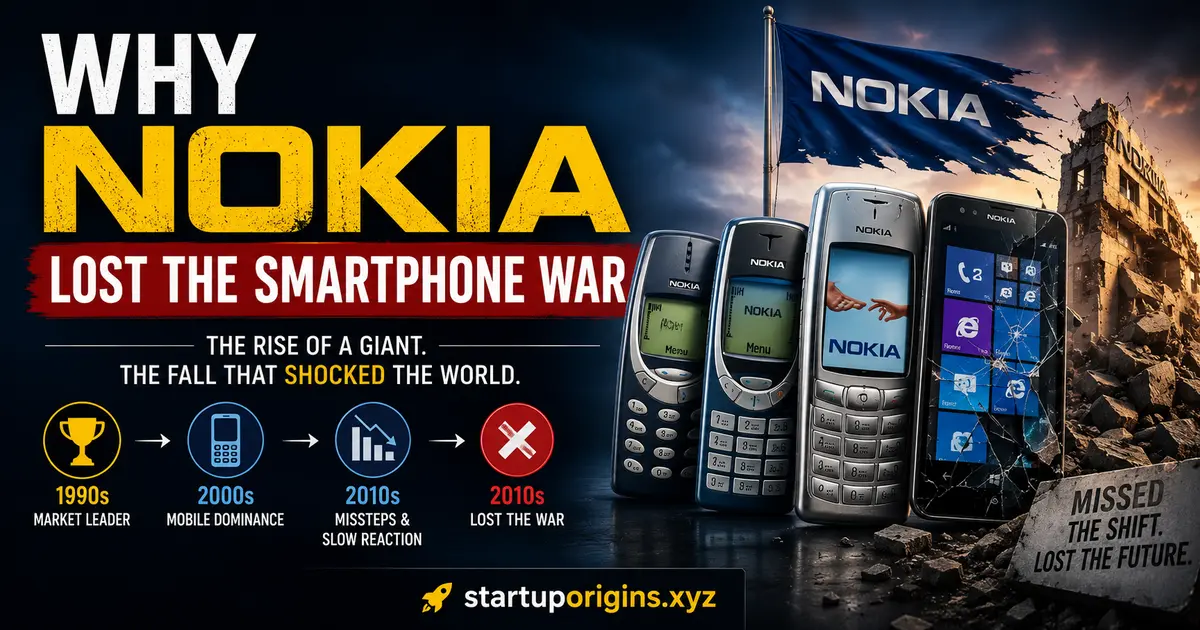
In 2007, Nokia controlled nearly half of the world’s mobile phone market. Walk into any city, on any continent, and the phone in most pockets carried that single word on the back: Nokia. It sold more handsets than its next four competitors combined. Its brand was stronger than Apple’s, Samsung’s, Motorola’s, or BlackBerry’s. Analysts called it unbeatable. Employees believed it too.
Six years later, Nokia sold its entire mobile phone business to Microsoft for a fraction of what the brand had once been worth.
- Nokia Before Smartphones: The Undisputed Mobile King
- The iPhone Changed Everything
- Why Nokia Lost the Smartphone War
- Stephen Elop and the Burning Platform Memo
- Why Choosing Windows Phone Was a Huge Gamble
- Market Share Collapse
- Microsoft’s Acquisition
- Biggest Strategic Mistakes Nokia Made
- Could Nokia Have Won?
- Conclusion
- Disclaimer
This is the story of why Nokia lost the smartphone war — not as a simple timeline of falling market share, but as a study in how the most dominant company in an industry can walk, decision by decision, into irrelevance. It’s a story about software versus hardware, about fear inside a company that had never known failure, and about a memo that told the truth at exactly the wrong moment. For founders, it’s one of the most instructive business failures of the last 30 years.
Nokia Before Smartphones: The Undisputed Mobile King
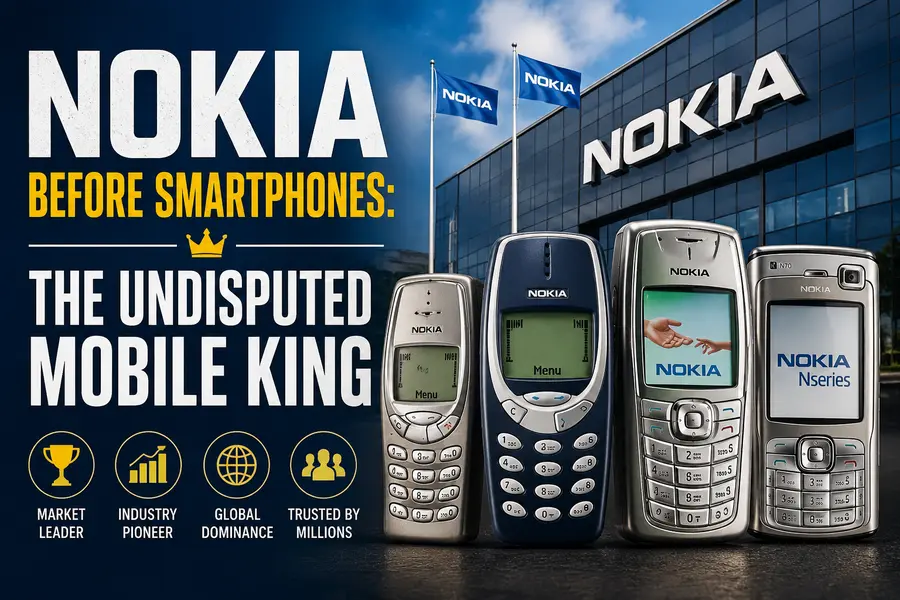
Nokia’s story doesn’t start with phones. It starts in 1865, as a Finnish paper mill on the banks of a river in southwestern Finland. Over the following century, the company moved through rubber, cables, and electronics before it found its real calling in the 1980s and 1990s: mobile communications.
By the time GSM — the digital standard that became the backbone of global mobile networks — took hold across Europe and then the world, Nokia was already positioned as the manufacturer that understood the technology better than anyone else. It didn’t just make phones. It helped write the standards those phones ran on.
That technical head start turned into commercial dominance. The Nokia 3310, released in 2000, became one of the best-selling phones ever made, prized for a battery that lasted days and a shell that survived drops concrete couldn’t. The Nokia 1100 sold in similarly staggering numbers across emerging markets, where reliability mattered more than features. These weren’t just products. They were proof that Nokia understood something rivals didn’t: durability and simplicity sell more phones than novelty.
Underneath the hardware sat Symbian, the operating system Nokia used across its higher-end devices. Symbian wasn’t glamorous, but through most of the 2000s it ran the majority of smartphones sold worldwide, long before the word “smartphone” meant what it means today.
Nokia’s manufacturing scale was another advantage rivals couldn’t easily replicate. It ran factories across Europe, Asia, and Latin America, giving it cost efficiencies and distribution reach that let it sell profitably in wealthy and poor markets alike. Carriers trusted Nokia because its phones simply worked, its supply chains never broke, and its volumes justified whatever shelf space a retailer gave it.
By 2007, this combination of engineering credibility, manufacturing muscle, and brand trust gave Nokia roughly 38% to 49% of the global handset market depending on how the quarter was measured, according to data compiled by Statista and Gartner, and closer to half of the smartphone segment specifically. Revenue that year touched €51 billion. Competing against Nokia at that point didn’t feel like competing against a company. It felt like competing against an entire industry standard.
The iPhone Changed Everything
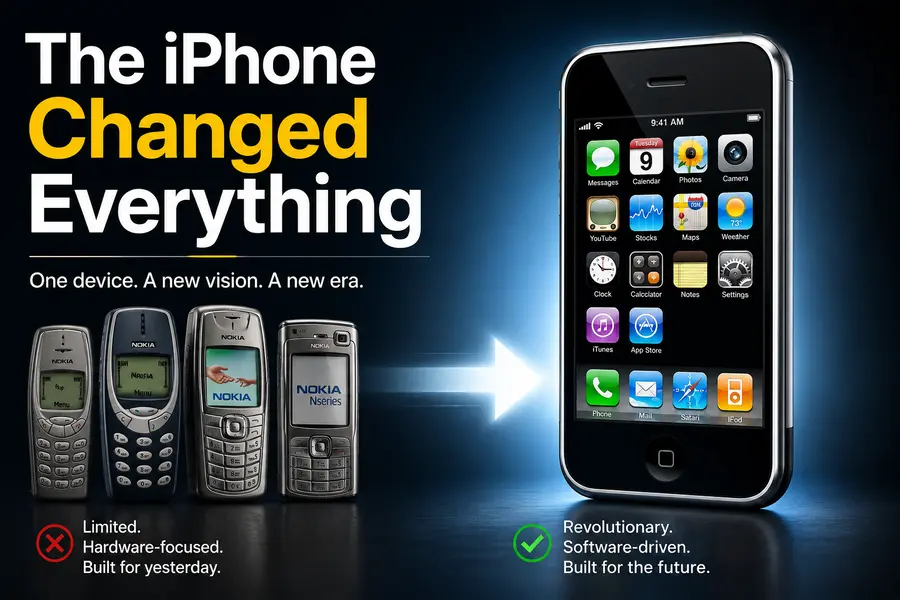
Then, in January 2007, Steve Jobs walked onto a stage in San Francisco and introduced the iPhone.
At the time, industry reporting on 2007 handset sales still showed Nokia extending its lead over Motorola and Samsung, which made the iPhone easy to write off as a side story rather than a threat. Nokia’s engineers watched the announcement closely — and, according to multiple later accounts from former executives, largely dismissed it. The first iPhone had no physical keyboard, a battery life that looked weak next to Nokia’s, no 3G radio, and a price tag that made it a luxury item rather than a mass-market phone. On paper, using Nokia’s own scorecards for what made a good phone, the iPhone lost on almost every spec that had mattered for the past decade.
That was exactly the problem. Nokia was still grading phones the way a hardware company grades hardware. Apple wasn’t competing on battery life or radios. It was competing on how the device felt to use, and on the idea that a phone could be a platform other companies would build for.
Inside Nokia, the touchscreen smartphone was treated as a niche product for a small slice of tech enthusiasts, not a replacement for the keypad phones that had made the company rich. That assumption wasn’t unreasonable at the time — touchscreens up to that point had been clumsy, and stylus-based phones from other manufacturers hadn’t gone anywhere. But Apple had solved the actual usability problem with capacitive touch and a coherent software experience, and Nokia’s leadership didn’t register how much that changed the calculus.
The iPhone’s real innovation, and the one Nokia underestimated most, was the App Store, which followed in 2008. It reframed the entire industry. A phone was no longer a device you bought once and used until it wore out. It was a platform you kept extending, one app at a time. That shift — from device to ecosystem — is the single biggest reason the smartphone war didn’t play out the way anyone at Nokia expected.
Why Nokia Lost the Smartphone War
To understand why Nokia lost the smartphone war, you have to separate the visible symptoms — falling sales, discontinued products, layoffs — from the underlying causes. Those causes built up over years, mostly out of public view, long before the market share charts started sliding.
Software vs Hardware
Nokia’s entire culture was built around hardware excellence: antenna design, battery efficiency, industrial durability, manufacturing precision. Those skills had made it the biggest phone company on Earth, and inside Nokia, they were treated as the core of the business.
Apple approached the problem from the opposite direction. It built the iPhone around software first, then designed hardware to serve that software. Google, watching Apple’s move, did something even more consequential: it gave Android away to any manufacturer willing to build phones around it, turning software into the layer that determined whether a device felt modern or outdated.
The result was that the competitive battleground moved from parts and assembly to code and apps. A phone’s camera resolution mattered less than whether Instagram, Gmail, or a banking app ran smoothly on it. Nokia kept optimizing the thing that used to win the war, while its competitors had already moved the war somewhere else.
Symbian Couldn’t Keep Up
Symbian’s biggest weakness wasn’t that it was old — it was that it had been designed for a different physical interface entirely. It was built assuming a keypad and small monochrome or low-resolution screens, not a full touchscreen with a browser people expected to behave like a desktop browser.
Retrofitting a touchscreen experience onto that foundation created what engineers call design debt: the accumulated cost of decisions that made sense at the time but become expensive to undo later. Every new feature had to work around Symbian’s original assumptions instead of building on modern ones. Development cycles stretched out. Simple features that Apple or Google could ship in weeks took Nokia months, because the underlying platform fought every change.
Developers noticed. Building an app for Symbian was widely considered harder and less rewarding than building for iOS or Android, so the best developers built there first — which made those platforms more attractive to users, which made them more attractive to developers. Nokia was on the losing end of a cycle it had no quick way to break.
Internal Politics
By the late 2000s, Nokia wasn’t running one operating system strategy. It was running several at once. Symbian powered its mainstream smartphones. Series 40 ran its high-volume feature phones. Maemo, and later MeeGo, were being developed as forward-looking, Linux-based platforms meant to eventually replace Symbian at the high end.
Each of these had its own engineering teams, its own roadmap, and its own internal champions arguing for resources and executive attention. Rather than one company moving in one direction, Nokia effectively ran multiple competing companies under a single roof, each convinced its platform was the future.
This is a familiar failure mode in large organizations: when no single person or team owns the whole direction, resources get split, timelines slip, and decisions that should take weeks take years. MeeGo, the platform many insiders believed had the most long-term potential, never got the sustained investment it needed to reach the market at scale, because Symbian still generated the bulk of Nokia’s revenue and couldn’t be starved without immediate financial pain.
Fear Inside the Company
Several former Nokia engineers and executives have described a culture where warning signs were visible internally years before they became public knowledge, but rarely reached the top of the organization in a form senior leadership could act on.
Middle management, evaluated on the performance of existing product lines, had every incentive to protect those product lines rather than champion the risky, unproven platforms that might one day replace them. Raising a hard truth about Symbian’s competitiveness meant admitting your own division’s flagship was falling behind — not a comfortable position in a company built on decades of being right.
This is a pattern worth understanding beyond Nokia specifically: when a company’s internal incentives reward defending the status quo over reporting uncomfortable truths, bad news slows down exactly when speed matters most. Innovation didn’t stall at Nokia because its engineers lacked ideas. It stalled because the organizational structure around them made those ideas expensive to pursue and risky to advocate for.
Stephen Elop and the Burning Platform Memo
Stephen Elop, a former Microsoft executive, became Nokia’s CEO in September 2010 — the company’s first non-Finnish chief executive. He inherited a business that was still profitable and still the world’s largest phone maker by volume, but one whose smartphone momentum had visibly stalled against Apple and a fast-rising Android.
In February 2011, just before announcing Nokia’s new strategic direction, Elop sent an internal memo to employees that became, in the words of the outlet that first reported it, one of the most striking CEO memos anyone in the industry had seen. It compared Nokia’s position to a man standing on a burning oil platform in the North Sea, forced to make an impossible choice between staying on a structure that’s on fire or jumping into freezing water. Elop noted that the first iPhone shipped in 2007 and Nokia still didn’t have a product close to matching its experience, and that Android, only a couple of years old, had just overtaken Nokia in smartphone volumes.
The memo was blunt in a way corporate communication almost never is. It stated plainly that competitors weren’t taking Nokia’s market share with individual devices — they were taking it with entire ecosystems, and that Nokia would have to decide whether to build, join, or catalyze one of its own. It was meant as an internal call to action ahead of a major strategy announcement. Instead, it leaked within days and became a public story, read by employees, competitors, and customers alike as an admission that Nokia’s own products were no longer trustworthy.
That leak illustrates a real phenomenon known as the Osborne Effect, named after a 1980s computer company that announced a next-generation product so far ahead of its release that customers stopped buying the current model — and the company collapsed waiting for a successor that arrived too late to save it. When Nokia’s leadership signaled, however indirectly, that Symbian was effectively dead before a replacement platform was ready for consumers, it gave existing and prospective Nokia customers a reason to look elsewhere immediately rather than wait.
The memo’s diagnosis of Nokia’s problems was largely accurate. Its timing and delivery, though, did real commercial damage on top of a wound that was already open.
Why Choosing Windows Phone Was a Huge Gamble
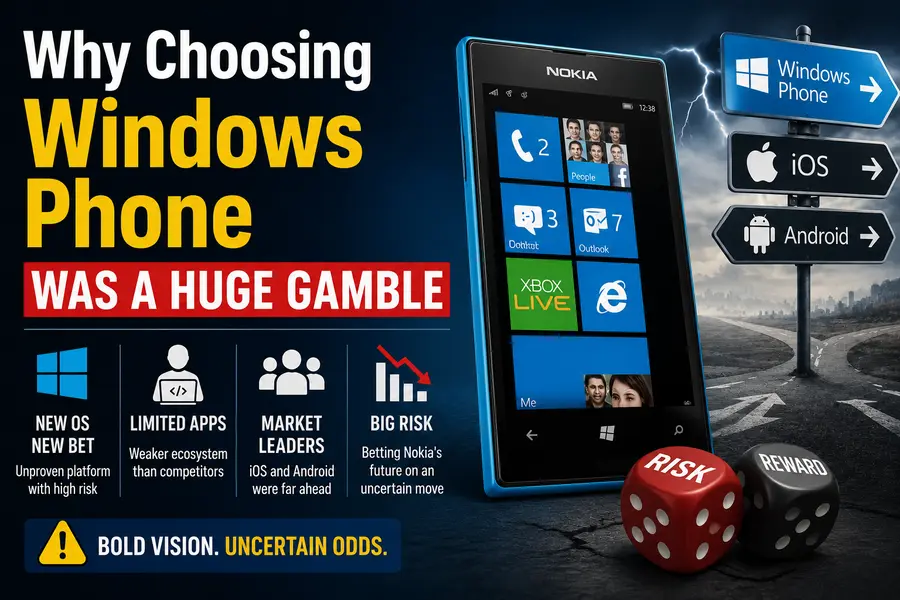
Days after the Burning Platform memo, Nokia announced its answer: it would abandon Symbian and MeeGo as its future and adopt Microsoft’s Windows Phone as its primary smartphone platform.
Android was the more obvious partner on paper. It was open, free to license, and already gaining massive developer and consumer momentum. But Nokia’s leadership — Elop in particular, given his Microsoft background — worried that adopting Android would turn Nokia into just another Android manufacturer, competing on hardware specs against Samsung, HTC, and a growing wave of cheaper Chinese brands, with no meaningful way to differentiate.
Windows Phone offered something Android couldn’t: exclusivity. Nokia would be Microsoft’s primary hardware partner, giving it a level of differentiation Android licensees couldn’t match. The bet was that Microsoft’s brand, resources, and enterprise relationships would help Windows Phone become a genuine third ecosystem alongside iOS and Android — and that Nokia, as its flagship hardware maker, would ride that wave to relevance.
It didn’t play out that way. Windows Phone’s app ecosystem never reached critical mass. Developers, already stretched building for iOS and Android, had limited incentive to build a third time for a platform with a fraction of the users. That thin app catalog made the phones a harder sell to consumers, which kept the user base small, which gave developers even less reason to invest — the same reinforcing cycle that had crippled Symbian, just with a different operating system’s name on it.
Nokia’s Lumia hardware, to its credit, was genuinely well built. Devices like the Lumia 920 earned strong reviews for camera quality and industrial design. But excellent hardware wrapped around a software platform consumers didn’t want wasn’t enough to move the needle against iOS and Android’s combined grip on the market.
Market Share Collapse
The numbers tell the story with brutal clarity.
| Year | Nokia Market Share (Overall Handsets) | Major Event | Apple | Samsung | Windows Phone |
|---|---|---|---|---|---|
| 2007 | 49.4% | iPhone launches | Entering market | Rising challenger | N/A |
| 2010 | 30.2% | Android overtakes Symbian in smartphone volume | Growing fast | Growing fast | Not yet launched |
| 2011 | Declining sharply | Burning Platform memo; Windows Phone deal announced | Gaining share | Gaining share | Just launched |
| 2013 | Around 3% | Microsoft acquisition announced | Market leader in profits | Global unit leader | Single-digit share |
| 2016 | Effectively exited | Windows Phone falls to roughly 0.8% share | Dominant | Dominant | Discontinued |
Different research firms — IDC, Gartner, Counterpoint, and Statista — have published slightly different figures for individual quarters, largely because they measure “market share” differently: some track units shipped to retailers, others track units sold to end users, and some separate smartphones from the broader handset category entirely. Gartner’s own quarterly data shows the erosion beginning as early as 2010, well before the Windows Phone bet was even in place. The direction, however, is identical across every source: a fall from near-majority control of the industry to a marginal player in under a decade.
Microsoft’s Acquisition
In September 2013, Microsoft officially announced it would acquire Nokia’s Devices and Services business. The deal covered Nokia’s mobile phone and smart device units along with its design and manufacturing operations, and roughly 32,000 Nokia employees were expected to transfer to Microsoft as part of the transaction. Microsoft agreed to pay €3.79 billion for the devices business and a further €1.65 billion to license Nokia’s patents, putting the total transaction at €5.44 billion in cash. By the time the deal closed in April 2014, currency shifts and additional terms pushed the total purchase price to roughly $9.4 billion, including $1.5 billion in cash Nokia already held.
Microsoft’s then-CEO Steve Ballmer pushed hard for the acquisition, betting that owning hardware directly would let Microsoft compete with Apple’s tightly integrated model. The decision faced real internal resistance — Satya Nadella, then heading Microsoft’s cloud business and soon to become CEO, reportedly voted against the deal, arguing Microsoft was chasing a market it had already lost.
The integration struggled from the outset. Within months of the deal closing, Nadella announced roughly 18,000 layoffs company-wide, with about 12,500 of those roles coming from the units acquired from Nokia. Windows Phone never gained the ecosystem traction Microsoft needed, and by mid-2015, the company acknowledged in an official filing with U.S. regulators that the deal outright hadn’t worked. Microsoft took a $7.6 billion impairment charge against the Nokia assets — its largest write-down ever — and cut a further 7,800 jobs, mostly in the phone hardware division. Roughly a year later, Microsoft sold off the remaining feature-phone business, which had carried the Nokia name, to a Taiwanese manufacturer and a private equity-backed firm for $350 million, effectively ending its handset ambitions — a sale later reported as the final chapter of what became roughly a $10 billion loss for Microsoft once every write-down and layoff cost was tallied.
Nokia the corporation, importantly, didn’t disappear. What sold in 2013 was the phone business specifically. The parent company retained Nokia Networks, its telecom infrastructure and equipment division, along with its patent portfolio. That business — later expanded through the acquisition of Alcatel-Lucent in 2016 — became Nokia’s actual future, supplying network equipment to carriers building out 4G and 5G infrastructure worldwide, a business with far less brand glamour but considerably more staying power.
Biggest Strategic Mistakes Nokia Made
| Mistake | Why It Happened | Business Impact | Founder Lesson |
|---|---|---|---|
| Ignoring the software shift | Culture built around hardware engineering excellence | Lost the ecosystem war to Apple and Google before really entering it | Build for the layer where the next battle will actually be fought |
| Delayed platform modernization | Symbian’s architecture wasn’t designed for touchscreens | Years of slow, expensive development while rivals shipped faster | Legacy systems carry hidden costs; budget for the rebuild before you’re forced into it |
| Internal fragmentation (Symbian, MeeGo, Maemo, Series 40) | No single owner for overall platform strategy | Resources split across competing internal projects | One clear direction beats several good ones pursued half-heartedly |
| Betting the company on Windows Phone | Fear of becoming an undifferentiated Android manufacturer | Committed to a platform with a thin app ecosystem and shrinking momentum | A differentiated position on a weak platform is still a weak position |
| The Burning Platform memo leak | Internal communication meant to drive urgent change | Triggered the Osborne Effect; customers avoided current products | Never signal the death of your product before its replacement is ready to ship |
| Slow internal decision-making | Large, siloed organization with competing power centers | Missed windows to respond to Apple and Android early | Speed of decision-making is itself a competitive advantage |
| Underestimating the app ecosystem | Believed hardware specs would keep mattering most | Developers built for iOS and Android first, starving Nokia’s platforms of the software users wanted | Customer loyalty follows the ecosystem, not just the device |
Could Nokia Have Won?
It’s tempting to imagine a version of this story where Nokia survives as a major smartphone player. The more useful exercise is asking which decisions, realistically, could have changed the outcome.
Choosing Android earlier — say, in 2009 or 2010, before Elop’s arrival — is the most plausible alternate path. Nokia’s manufacturing scale and global distribution were still intact at that point, and pairing them with an operating system that already had developer momentum could have preserved far more market share than Windows Phone ultimately did. Nokia’s own leadership reportedly considered this option and rejected it specifically because it didn’t want to compete as an undifferentiated Android vendor, a fear that in hindsight cost the company more than the differentiation it hoped to gain from Windows Phone.
A heavier, earlier investment in MeeGo is a second plausible path, though a riskier one. MeeGo shipped in only one device, the N9, released in 2011 to strong reviews just as Nokia was publicly abandoning it for Windows Phone. Had MeeGo received the resources Symbian consumed for years beforehand, it might have arrived early enough to matter — but building a competitive ecosystem from scratch, against Apple and Google’s head start, was never a guaranteed win even with more funding.
A modern app ecosystem built years before the iPhone’s launch is the least realistic alternative, mostly because the idea of a centralized app marketplace as a business model didn’t exist in a proven form before Apple built one. Nokia would have had to invent a category it had no evidence yet needed to exist.
Organizational restructuring before 2007 — consolidating Symbian, Maemo, and Series 40 development under one clear owner with one roadmap — is arguably the change that would have mattered most, because it would have made every other decision after 2007 faster and more coherent. Structural problems compound quietly for years before they become visible as product failures, and Nokia’s fragmented platform strategy was already years in the making by the time the iPhone arrived.
None of these paths guarantee Nokia keeps its throne. Apple and Google’s advantages went beyond any single decision Nokia could reverse. But several of these choices would very likely have slowed the collapse and given Nokia more time and leverage to adapt.
Conclusion
Why Nokia lost the smartphone war ultimately comes down to a company that kept winning the fight it knew how to fight, while the real battle had already moved somewhere else. Nokia built better phones than almost anyone on Earth. It just didn’t realize, quickly enough, that “better phone” had stopped being the question customers were asking.
The lesson isn’t really about phones. It’s about what happens to any market leader that mistakes its past advantages for permanent ones. Nokia’s fall from nearly half the world’s market to a footnote in Microsoft’s balance sheet remains one of the clearest reminders in modern business history that dominance is never guaranteed — it has to be defended, one honest decision at a time.
Disclaimer
This article is intended for informational and educational purposes only. Figures related to market share, revenue, and acquisition value are drawn from publicly available sources — including Gartner, IDC, Statista, and SEC filings — and may vary slightly depending on the reporting methodology used by each firm. Every effort has been made to ensure accuracy at the time of publication; readers seeking exact figures for research or investment purposes should verify against primary sources directly.

Anup Kumar Yadav is the founder of StartupOrigins.xyz, where he researches and publishes detailed stories about the world’s most successful startups. His work explores founder journeys, funding milestones, growth strategies, and the lessons entrepreneurs can learn from them.