
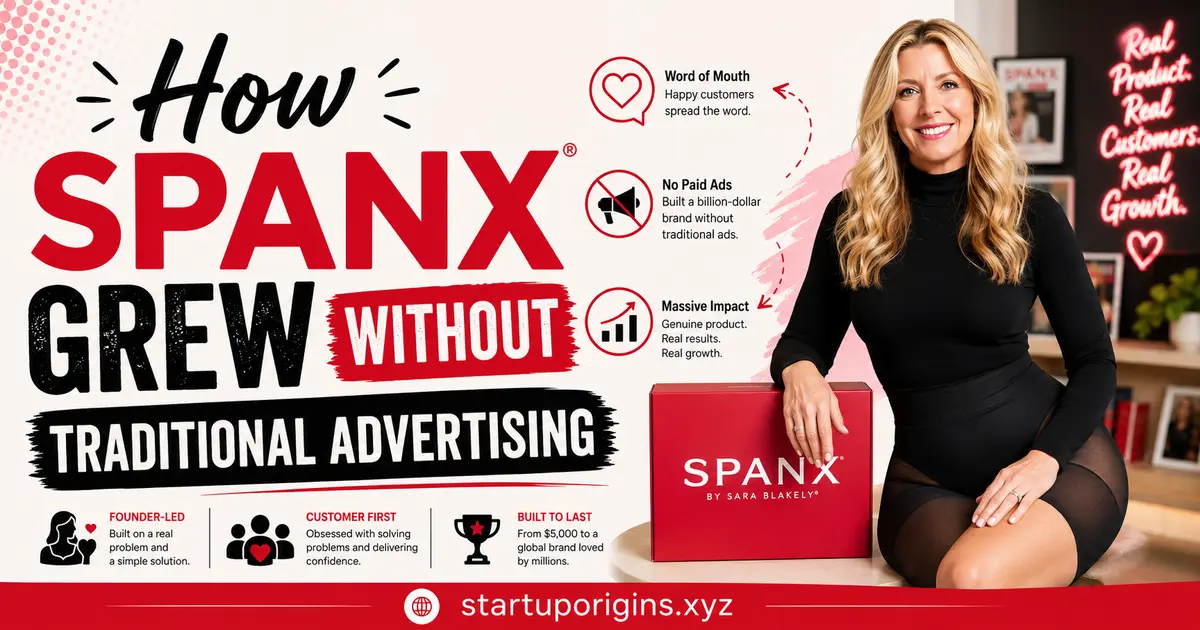
Spanx never bought an ad — it grew through retail trust, word-of-mouth, and one Oprah endorsement that made it a billion-dollar brand.
The Problem
First Yes
Momentum
Oprah
Word-of-Mouth
Numbers
Product
Retail
Evolution
The Moat
2021 Deal
Conclusion
FAQ
There is a particular kind of confidence that comes from solving your own problem so completely that you forget, for a moment, that you’re supposed to be selling something. That was Sara Blakely’s advantage in 2000, and it remains the through-line of one of the more unusual growth stories in modern retail. Spanx never ran a Super Bowl spot. It didn’t buy a wall of magazine pages or blanket daytime television with jingles. And yet it became one of the most recognized apparel brands on the planet, eventually commanding a $1.2 billion valuation when Blackstone acquired a majority stake in 2021.
The absence of a traditional ad budget wasn’t a marketing gimmick. For most of Spanx’s first decade, it was simply the truth: there wasn’t money for advertising, so the company had to grow by other means. What’s remarkable is that those other means — word-of-mouth, product obsession, and a founder who acted as her own customer-acquisition engine — didn’t just substitute for advertising. They built something advertising rarely can: a customer base that felt like it had discovered the brand rather than been sold to by it.
This is the story of how Spanx grew without traditional advertising, and why it still matters to anyone building a company today.
The Problem Before the Product
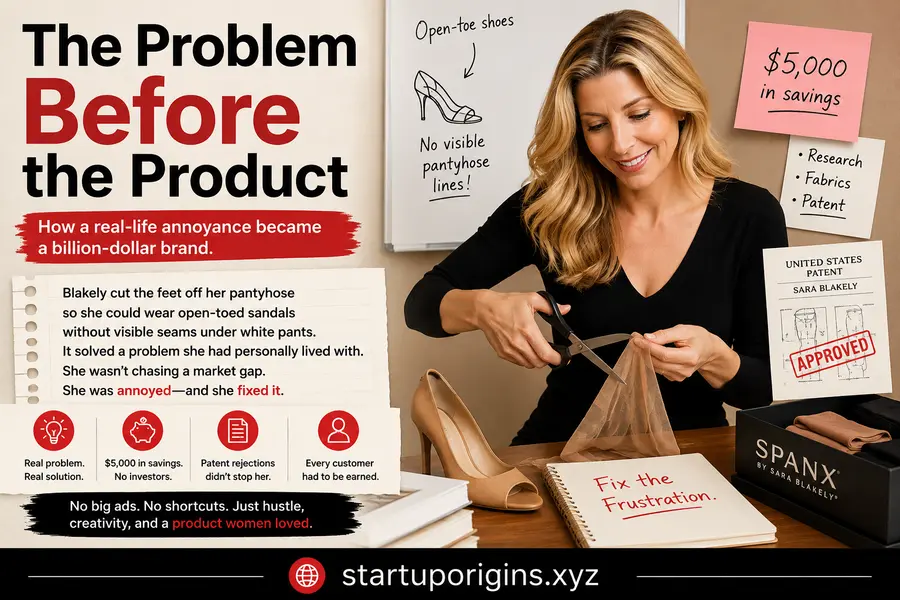
Blakely’s origin story has been told often enough that it risks sounding like folklore, but the mechanics of it are worth revisiting because they explain everything that came after. She was selling fax machines door-to-door in Florida, and one evening, getting dressed for a party, she cut the feet off a pair of pantyhose so she could wear open-toed sandals without visible seams under white pants. It solved a problem she had personally lived with. That detail matters more than it might seem: Blakely wasn’t identifying a market gap through research. She was annoyed, in real time, by something millions of women were quietly annoyed by too, and she happened to be stubborn enough to fix it. Her path from that moment to founder is its own story, one we trace in full in Sara Blakely: The Founder Who Turned a $5,000 Idea Into Spanx.
She spent roughly $5,000 in savings developing the idea, researching fabrics, and even filing her own patent after a string of rejections — a process our companion piece How Spanx Started With $5,000 and One Idea covers in more detail. What’s relevant to the growth story is this: because there was no outside capital, there was no advertising budget to fall back on. Every dollar had to be justified, and every early customer had to be earned individually. That constraint, uncomfortable as it was, forced a discipline that would define the brand’s growth strategy for the next two decades.
Getting the First Yes
For two years, retail buyers said no. Blakely has recounted cold-calling Neiman Marcus, being redirected to a buying office in Dallas, and eventually landing ten minutes with a buyer who wasn’t quite grasping the pitch from her description alone. So she did what verbal pitches couldn’t: she walked the buyer into a bathroom and showed her, side by side, what a pair of white pants looked like with and without the product underneath, a moment Blakely has recounted in detail in an interview with Inc. Magazine. The buyer got it immediately. Neiman Marcus placed an order for roughly seven thousand units across seven stores.
That single retail placement did something no advertisement could have. It put the product in a physical space where women already trusted the curation, surrounded by the kind of merchandise that signaled quality. Bloomingdale’s, Saks, and Bergdorf Goodman followed shortly after. This is worth sitting with for a moment, because it’s a detail that gets lost in the more mythologized versions of the story: Spanx’s first channel wasn’t the internet, and it wasn’t celebrity buzz. It was a careful, old-fashioned relationship with department store buyers who staked a bit of their own reputations on an unproven product from an unknown founder. Retail trust, in other words, was the first form of borrowed credibility the brand ever used — and it came before a single dollar was spent trying to manufacture that credibility artificially.
Manufacturing Momentum by Hand
The order landed, and then came the harder part: making sure it sold. Blakely was, by her own description, a one-woman operation at this stage — packing boxes, shipping orders, and effectively running customer service out of her apartment as semi-trucks pulled up outside. To make sure those first seven thousand units didn’t sit untouched on shelves, she called friends in cities with Neiman Marcus locations and asked them to go in, buy Spanx, and talk about it in front of other shoppers. It was scrappy, unglamorous, and by her own more recent account, a little “unhinged.” It also worked, because it created the appearance of demand at the exact moment demand needed a nudge to become real.
This is the piece of the Spanx story that’s easy to romanticize and harder to actually replicate: Blakely wasn’t running a controlled marketing campaign. She was doing whatever the moment required, with whatever resources she had, because the alternative was watching the product fail on the shelf. Founders who study this era of Spanx often miss that the hustle wasn’t strategic elegance — it was necessity translated into action. The strategy came later, once the pattern of what worked became visible. It’s a lesson that shows up repeatedly in What Spanx Teaches Every Startup Founder, our broader breakdown of the tactical playbook founders keep borrowing from this era of the company.
The Oprah Moment, in Context
No account of Spanx’s growth is complete without Oprah Winfrey, but it’s worth being precise about what actually happened, because the popular version tends to compress the timeline in ways that flatten the lesson. Blakely mailed Winfrey a handwritten note and a product sample. Winfrey’s stylist put it in her dressing room. She tried it, liked it, and in November 2000 — just a matter of weeks after the Neiman Marcus order went live — named Spanx one of her “Favorite Things” on her show, a milestone the National Inventors Hall of Fame cites as the turning point that let Blakely leave her sales job to run Spanx full-time.
Oprah’s endorsement worked because there was already a real product, already selling in real stores, already generating real word-of-mouth. She didn’t manufacture a hit out of nothing — she amplified something that was already gaining its own traction.
The effect was immediate and, by the standards of a bootstrapped startup, seismic. Orders on Spanx’s website reportedly surged by tens of thousands within a week or two, enough that Blakely and her small circle of helpers were packing and shipping through the night. But here is the part that matters for anyone trying to extract a repeatable lesson from this: Oprah’s endorsement worked because there was already a real product, already selling in real stores, already generating real word-of-mouth. A mediocre product placed in the same dressing room would have generated a single spike in sales and then silence. Spanx generated a spike and then a plateau at a permanently higher level, because the people who bought in that surge kept buying, and kept talking.
Spanx would go on to appear on Oprah’s Favorite Things list multiple times over the following two decades — most recently with pieces from its AirEssentials loungewear line — which says something on its own. Brands rarely get invited back onto a tastemaker’s list repeatedly unless the tastemaker’s own experience with the product remains genuinely good. That repetition is a data point about product quality as much as it is about publicity.
Oprah wasn’t a one-time event; she was the first entry in a pattern that repeated for years without Spanx ever paying for it. In 2001, Blakely brought the product to QVC, and sold roughly eight thousand pairs in her first few minutes on air — a channel that, notably, rewards products that perform immediately on camera rather than products propped up by a media budget. A decade later, Kim Kardashian told a UK television audience Spanx was “the greatest invention,” and Gwyneth Paltrow became a recurring, unpaid public fan of the brand in press interviews and style roundups. None of these moments were bought. Each one worked for the same reason the Oprah placement did: a real product performing in front of an audience that had no reason to lie about whether it worked.
Why Word-of-Mouth Outperformed Paid Media
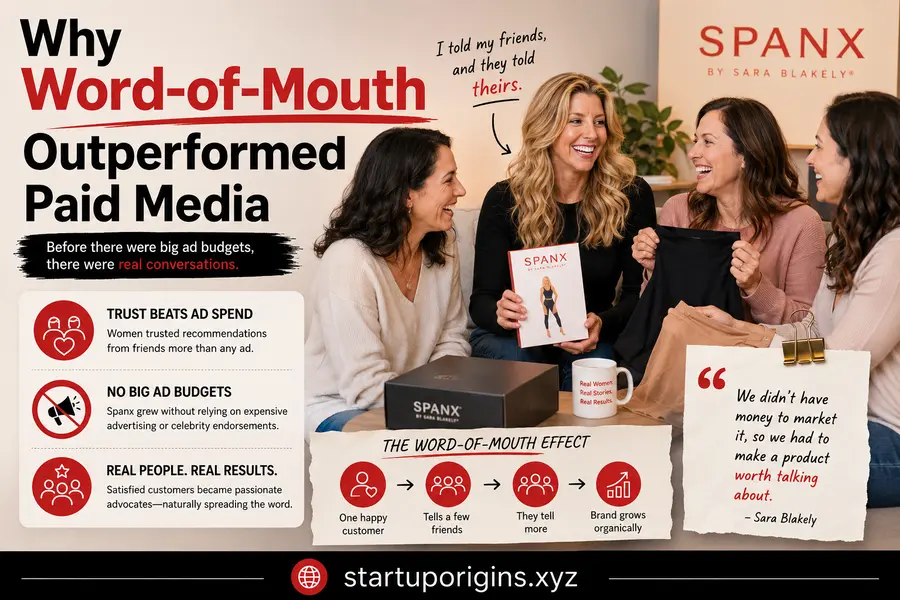
By the mid-2000s, Spanx had become something unusual in retail: a brand that customers actively evangelized rather than merely purchased. Women recommended it to sisters, coworkers, and strangers in dressing rooms. Fashion editors namechecked it in write-ups without being paid to. The brand became, in the language later used to describe it, “hosiery crack” — a phrase that stuck precisely because it captured a compulsive, personal enthusiasm that no tagline could manufacture on command.
This is where the story stops being a founder’s hustle and becomes a genuine growth mechanism worth analyzing.
Why Spanx Didn’t Need a Huge Advertising Budget
Advertising, at its core, is a substitute for trust the market doesn’t yet have. A company runs ads because it needs to manufacture familiarity and credibility faster than organic exposure would otherwise provide. Spanx sidestepped a large chunk of that need because the product did something advertising can’t reliably do on its own: it delivered on a promise the first time a customer tried it, in private, with no one watching. That private validation — the moment a woman put the product on and saw immediately that it worked exactly as claimed — became the seed of every recommendation that followed.
Trust that’s earned through direct experience travels differently than trust that’s purchased through media placement. When a friend tells you a product changed how her clothes fit, you weight that information more heavily than a thirty-second commercial, because you know she has no financial stake in the recommendation. Spanx effectively had an army of unpaid, highly credible sales reps distributed across every city where the product sold, and each one was more persuasive than a national ad campaign could have been, dollar for dollar.
There’s also a quieter mechanism at work: solving a genuine, previously unspoken problem creates its own distribution network. Before Spanx, many women had never articulated — even to themselves — exactly what bothered them about existing shapewear and hosiery. Blakely’s product gave language and form to a frustration that was widespread but undiscussed. Once women had the vocabulary and the solution, they wanted to pass both along. That is fundamentally different from advertising a preference into existence; it’s giving people the tool to solve something they already wanted solved, which makes advocacy feel less like promotion and more like a favor to a friend.
The long-term consequence is brand equity that compounds rather than depreciates. Paid advertising has to be renewed constantly, because its persuasive effect fades the moment the media buy stops. Organic advocacy, rooted in real product performance, tends to persist and even strengthen over time, because each new satisfied customer adds to the reservoir of trust rather than drawing down a rented supply of attention.
Growth by the Numbers
The scale of what word-of-mouth alone produced is easy to understate in the retelling. Pricing played a quiet role in that trajectory too: Blakely launched Spanx at roughly $38 a pair at a moment when ordinary pantyhose sold for closer to $10, a deliberate premium position that signaled the product was solving a different problem entirely, not simply competing on the same shelf.
That same instinct for organic growth didn’t disappear once Spanx matured into a larger company — it was formalized. In the 2010s and beyond, Spanx built a structured referral program that turned informal customer recommendations into a trackable digital channel, converting referred shoppers at roughly 15 percent, with average order values running about 8 percent higher than orders from non-referred customers, and targeted product-category referral campaigns lifting conversion by as much as 26 percent. In other words, the same mechanism that sold seven thousand units at Neiman Marcus in 2000 — a trusted person telling another person the product worked — didn’t get replaced by digital marketing. It got instrumented by it.
Product Obsession as a Growth Engine
If word-of-mouth was the distribution mechanism, product quality was the fuel that kept it running. Blakely stayed hands-on with product development, packaging, and positioning well past the point where most founders hand those functions off. That involvement showed up in details customers noticed even if they couldn’t articulate why: the packaging didn’t look clinical or medical the way older shapewear had; the naming was playful rather than embarrassed; the product itself was engineered to disappear under clothing rather than announce itself.
The Growth Decision That Changed Spanx Forever
Every founder eventually faces a fork in the road between spending on visibility and spending on quality, and rarely can afford both at once. Blakely’s version of that decision arrived early: with limited capital, she could either put money behind advertising to manufacture broader awareness faster, or she could keep reinvesting in product development, fit, and the in-store experience, and let awareness build at a slower, organic pace.
She chose the latter, and it was a genuinely risky call. The alternative path — the one most apparel companies took, and still take — was to buy attention aggressively in the earliest years, using debt or outside capital to accelerate visibility before the product itself had been fully proven. That approach can work, but it also means a company’s growth curve is only as strong as its ad spend, and it becomes vulnerable the moment budgets tighten or a competitor outspends it. Blakely instead bet that if the product itself were good enough, the market would do the advertising for her, more slowly but more durably.
The payoff of that bet is visible in the numbers that followed: by 2011, Spanx reported revenue approaching $250 million, built almost entirely on a foundation of retail relationships, repeat purchases, and reputation rather than media spend. Because the growth had been earned rather than bought, it proved sturdier during the moments that typically punish thinner brands — including the period when shapewear sales broadly declined during the pandemic, and newer, Instagram-native competitors like Skims entered the category with significant marketing budgets of their own. Spanx’s slower, quality-first build gave it a reservoir of loyalty that a faster, ad-driven ramp likely would not have produced.
This decision also explains why Spanx was able to expand into new categories over time — leggings, activewear, swimwear, loungewear like the AirEssentials line, and eventually a broader lifestyle positioning — without each new category needing to relaunch trust from zero. Customers who trusted the brand for shapewear were willing to try Spanx leggings, then Spanx joggers, then Spanx swimwear, because the underlying relationship had already been established. A brand built on rented attention would have had to re-earn credibility in every new category. A brand built on product trust could extend that trust across a growing catalog.
Retail Relationships as Distribution Infrastructure
It’s worth pausing on how much of Spanx’s early and mid-stage growth ran through physical retail rather than direct-to-consumer channels, because that’s easy to overlook in a media landscape that now assumes every scrappy brand starts online. Spanx grew alongside its department store partners, using in-store rallies, dedicated floor placement, and — as Blakely herself has since admitted with some humor — occasionally rearranging product displays herself to move Spanx from a back corner to a spot near the register. That kind of hands-on retail merchandising was, in its own way, a form of unpaid marketing: it was Blakely acting as her own in-store advocate in the absence of a marketing department that could pay for premium shelf placement.
As the company scaled, that retail-first foundation gave it something durable: physical distribution across department stores nationally and, eventually, in more than fifty countries, plus its own e-commerce operation and later brick-and-mortar stores starting in 2012. Retail partners had skin in the game because Spanx sold well and generated repeat traffic, which meant Spanx didn’t need to buy its way into prime placement the way a newer, unproven brand would have to.
Brand Evolution: From Shapewear to Lifestyle
A brand that stays static eventually becomes a nostalgia act. Spanx avoided that by expanding deliberately, and largely on the strength of the trust it had already banked. Leggings, bras, swimwear, and loungewear all followed, alongside continued innovation inside the original shapewear category itself — including newer lines like SPANXsupersculpt Transform and SPANXsupersmooth SheerSense, introduced in 2025 as part of the brand’s 25th-anniversary push to keep reinventing the category it created. Blakely herself has said the ambition goes well beyond shapewear; she told CNBC the brand intended to push “the magic of Spanx” into everyday categories like denim and activewear.
Leadership also evolved. Blakely served as CEO until 2021, becoming executive chairwoman after the Blackstone transaction, before the company brought in outside retail veterans to run day-to-day operations — Kim Jones as CEO starting in 2022, followed by Caroline “Cricket” Whitton stepping into the CEO role in 2024, with retail industry veteran Jeanne Jackson joining as executive chair. That leadership transition mattered for the growth story because it signaled Spanx was no longer treated purely as a founder’s personal project; it was being built out as an enduring “performance apparel business,” in Jackson’s words, that could stand on infrastructure beyond any single individual, Blakely included.
Notably, even the 2021 Blackstone deal reinforced the brand’s advocacy-driven DNA rather than replacing it: additional investors brought into the transaction included Oprah Winfrey, Reese Witherspoon, and Whitney Wolfe Herd — women who were, not coincidentally, also longtime public fans and users of the product. The company’s ownership structure, in other words, continued to be built from genuine users and admirers rather than purely financial sponsors, which is a subtle but real continuation of the same organic-trust playbook that built the brand in the first place.
Even Spanx’s first true global brand campaign, “We Live In Spanx,” didn’t arrive until 2024 — nearly a quarter-century after the company’s founding. That timing alone tells you something about sequencing. Traditional advertising, when it finally arrived, was layered on top of two decades of earned trust rather than used to manufacture trust from scratch.
Why Competitors Couldn’t Easily Copy Spanx’s Growth Strategy
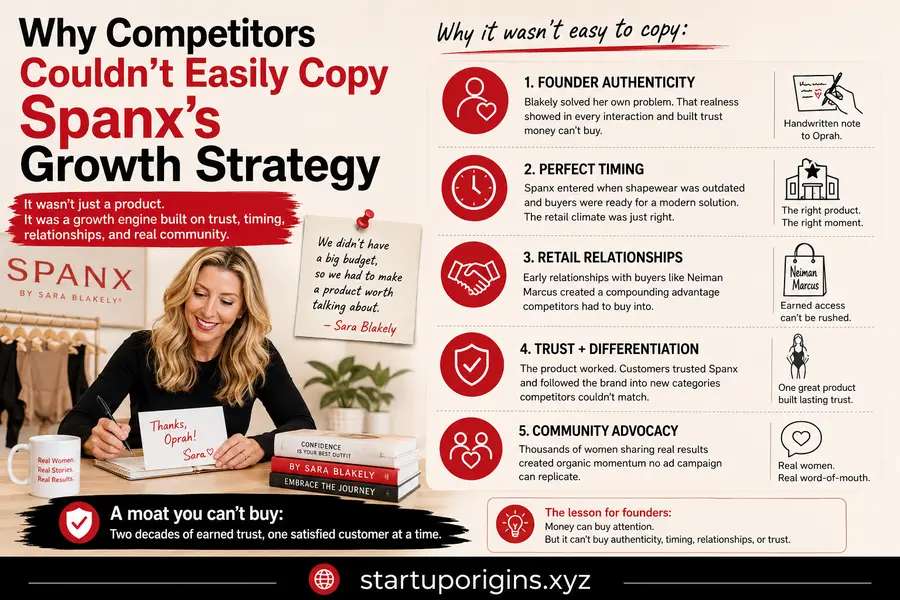
It would be a mistake to read this story and conclude that any founder could replicate it simply by skipping an ad budget and hoping word-of-mouth fills the gap. Several conditions had to align, and most of them are genuinely hard to copy.
A Moat Built From Timing, Trust, and Authenticity
Founder authenticity was foundational. Blakely wasn’t a fashion industry insider parachuting into shapewear because market research suggested an opportunity. She was solving her own problem, and that authenticity showed up in every early interaction — the handwritten note to Oprah, the personal store visits, the willingness to demonstrate the product in a bathroom rather than rely on a slide deck. Competitors entering the category later, even well-funded ones, couldn’t manufacture that same origin story after the fact.
Timing mattered enormously. Spanx arrived at a moment when shapewear was still associated with stiff, clinical, unflattering garments, and department store buyers were hungry for something that felt modern. A near-identical product launched five years earlier or later, into a different retail climate, might not have found the same open door at Neiman Marcus, and might not have caught Oprah’s attention in the same way.
Retail relationships built in the company’s first years compounded over time into a kind of infrastructure moat. Later entrants had to buy their way into placement and awareness that Spanx had earned gradually and, in many cases, personally.
Customer trust and product differentiation reinforced each other. Because the product worked as promised the first time, customers extended that trust to new categories, which meant Spanx’s expansion into leggings, activewear, and loungewear started from a position of credibility competitors entering those same categories cold did not have.
Community advocacy, finally, is nearly impossible to purchase directly. A competitor can buy media impressions, but it cannot buy the specific, cumulative effect of thousands of women independently telling friends a product genuinely worked for them. That kind of advocacy has to be earned one satisfied customer at a time, and by the time a fast-follower notices the pattern, the originator already has a multi-year head start.
Together, these advantages didn’t just make Spanx successful — they made its specific growth path difficult to reverse-engineer, even for brands with considerably larger marketing budgets. That’s the real definition of a durable competitive moat: not that competitors can’t spend money, but that money alone can’t buy what took Spanx two decades of earned trust to build. Founders studying this pattern often draw broader lessons from it, which is part of what we explore in What Spanx Teaches Every Startup Founder.
The 2021 Transaction and What Came After
By 2021, Spanx had grown into a business substantial enough to attract serious private equity interest, ultimately selling a majority stake to Blackstone in a deal valuing the company at $1.2 billion, as Forbes reported at the time. Blakely retained a significant equity stake and initially stepped into the role of executive chairwoman, while the deal’s structure — led by an all-female Blackstone investment team — was framed explicitly around accelerating the brand’s digital transformation and global expansion rather than replacing the organic growth engine that had built it, a point Bloomberg’s coverage of the deal also underscored. The transaction also made Blakely a billionaire again after a dip in her personal net worth during the pandemic-driven shapewear slowdown, underscoring how closely her financial fortunes had always tracked the brand’s underlying health rather than any marketing spend.
In the years since, Spanx has continued to broaden its footprint — expanding into more than fifty countries, deepening its e-commerce operations, launching category extensions like swimwear and the AirEssentials loungewear line, and, as of 2026, relaunching swimwear as a core pillar of what leadership describes as the brand’s “next chapter.” None of that expansion required abandoning the original playbook. It required scaling it.
Conclusion: The Real Lesson Behind the Growth
It’s tempting to reduce the Spanx story to a single anecdote — the Oprah moment, most often — because anecdotes are easier to retell than strategies. But the more useful lesson for founders, operators, and brand builders sits underneath the anecdotes: Spanx grew because it made trust the product of genuine performance rather than the product of media spend. Every stage of its growth, from the first Neiman Marcus order to the Blackstone transaction two decades later, reinforced the same idea. Solve a real problem completely enough that customers do your advertising for you, and a brand can grow into a global name without ever needing the advertising playbook everyone assumes is mandatory.
That is not a shortcut. It arguably took longer, and it certainly required more discipline in the lean years, than simply buying visibility would have. But it produced something advertising rarely can on its own: a brand that customers feel they discovered, championed, and — in a very real sense — helped build. For the fuller arc of how that discipline took shape from day one, see How Spanx Started With $5,000 and One Idea and Sara Blakely: The Founder Who Turned a $5,000 Idea Into Spanx.
Frequently Asked Questions
How did Spanx grow without traditional advertising?
Spanx grew primarily through word-of-mouth, retail partnerships with department stores like Neiman Marcus, founder-led grassroots promotion, and a pivotal endorsement from Oprah Winfrey in 2000 — all built on a product that delivered on its promise well enough that customers became unpaid advocates.
Did Oprah Winfrey really help make Spanx successful?
Yes. Oprah Winfrey named Spanx one of her “Favorite Things” in November 2000, shortly after the brand’s first retail placement at Neiman Marcus, which significantly accelerated demand and national awareness. The product has appeared on her list multiple times since.
Who owns Spanx today?
Blackstone acquired a majority stake in Spanx in 2021 in a deal valuing the company at $1.2 billion. Sara Blakely retained a significant equity stake, and additional investors in the transaction included Oprah Winfrey, Reese Witherspoon, and Whitney Wolfe Herd.
Is Sara Blakely still involved with Spanx?
Yes. Blakely remains the founder and a significant stakeholder in Spanx. She served as CEO until 2021 and as executive chairwoman afterward, while the company has since brought in outside leadership, including CEO Caroline “Cricket” Whitton, to run daily operations.
Why couldn’t competitors easily copy Spanx’s growth strategy?
Spanx’s advantages — founder authenticity, early retail relationships, favorable market timing, and years of organically earned customer trust — compounded over two decades in ways that are difficult to replicate quickly, even with a larger advertising budget.

Anup Kumar Yadav is the founder of StartupOrigins.xyz, where he researches and publishes detailed stories about the world’s most successful startups. His work explores founder journeys, funding milestones, growth strategies, and the lessons entrepreneurs can learn from them.