
Google+ was supposed to be Google’s answer to Facebook. Instead, it became one of the most expensive lessons in Silicon Valley about what happens when a company builds a product to defend its business rather than to serve its users.
Why did Google+ fail? In short: it entered the social networking race years too late, forced people into it rather than earning their attention, never built the kind of organic network effect that keeps a social platform alive, and was finally pushed out the door by a pair of data exposure incidents that made shutting it down the easier decision.
This article walks through the full story — how Google+ was born, what made it genuinely interesting at launch, why it never caught on the way Google hoped, and what happened in the months before its 2019 shutdown. Along the way, we’ll look at how Facebook won the war Google+ was built to fight, and what founders today can take from one of the biggest product failures in Google’s history.
The Birth of Google+
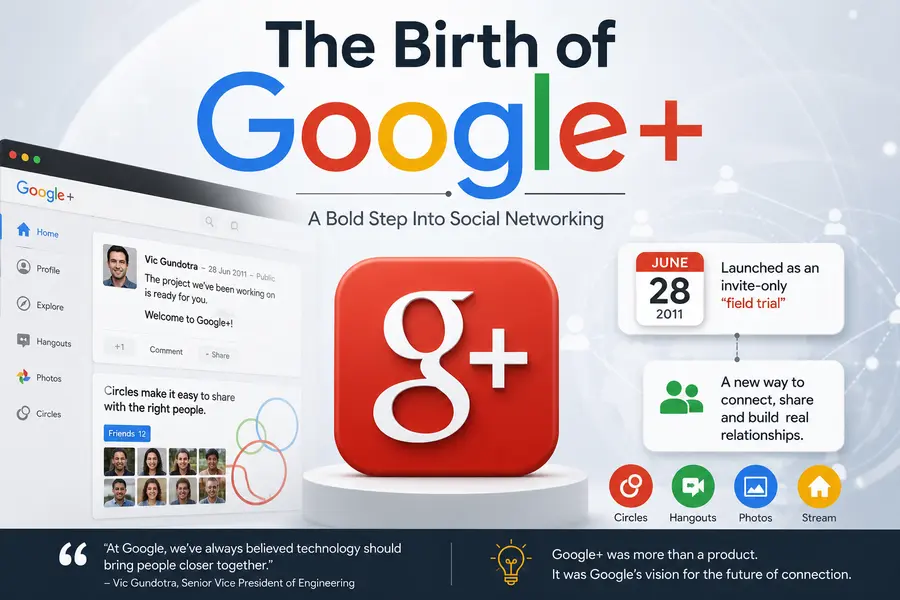
By 2011, Google had a problem. Facebook had crossed 500 million users and was becoming the place where people spent their time online — and, more importantly for Google, the place where a growing share of the internet’s clicks, referrals, and personal data lived. Google had no foothold there at all.
So on June 28, 2011, Google launched Google+ as an invite-only “field trial.” It was led by Vic Gundotra, Google’s Senior Vice President of Social, alongside Bradley Horowitz. The pitch was simple: online sharing had become flat and impersonal, and Google+ would bring back the nuance of real-world relationships — you don’t talk to your boss the way you talk to your college roommate, so why should one Facebook feed treat every “friend” the same?
The early excitement was real. Within weeks, invites were being traded like gold, and tech blogs were full of first-look posts. The platform reportedly reached around 10 million users within its first two weeks and 20 million within a month, largely because it was scarce — you needed an invite to get in, and Google is very good at making scarcity feel exclusive.
Three features anchored the initial experience:
- Circles — a drag-and-drop way to sort contacts into groups (family, coworkers, acquaintances) and control who saw what.
- Hangouts — group video chat, years before Zoom became a household name.
- Sparks (later dropped) and, soon after, Communities — interest-based groups similar to Facebook Groups or Reddit forums.
Google+ went public to anyone 18 and older on September 20, 2011, and opened to users 13 and up in January 2012. It was also, from day one, deeply wired into Gmail, YouTube, and eventually Android — a decision that would define both its early growth numbers and its eventual downfall.
Why Google Created Google+
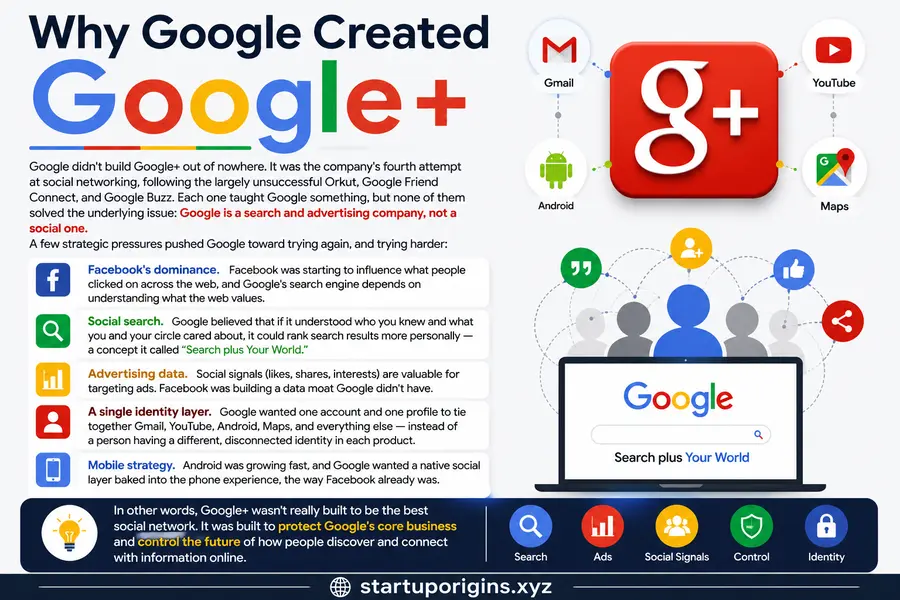
Google didn’t build Google+ out of nowhere. It was the company’s fourth attempt at social networking, following the largely unsuccessful Orkut, Google Friend Connect, and Google Buzz. Each one taught Google something, but none of them solved the underlying issue: Google is a search and advertising company, not a social one.
A few strategic pressures pushed Google toward trying again, and trying harder:
- Facebook’s dominance. Facebook was starting to influence what people clicked on across the web, and Google’s search engine depends on understanding what the web values.
- Social search. Google believed that if it understood who you knew and what you and your circle cared about, it could rank search results more personally — a concept it called “Search plus Your World.”
- Advertising data. Social signals (likes, shares, interests) are valuable for targeting ads. Facebook was building a data moat Google didn’t have.
- A single identity layer. Google wanted one account and one profile to tie together Gmail, YouTube, Android, Maps, and everything else — instead of a person having a different, disconnected identity in each product.
- Mobile strategy. Android was growing fast, and Google wanted a native social layer baked into the phone experience, the way Facebook already was.
In other words, Google+ wasn’t really built to be the best social network. It was built to protect and strengthen everything else Google already had. That distinction matters, and it shows up again and again in why the product eventually failed.
Timeline of Google+
| Year | Major Event | Why It Mattered |
|---|---|---|
| 2011 | Google+ launches June 28 as an invite-only field trial; opens to the public in September | Established Google’s fourth and most serious attempt at social networking |
| 2012 | Google+ Pages launches for businesses; integration deepens with Search, Play Store reviews, and YouTube comments | Growth numbers climb, but much of it comes from forced sign-ups rather than genuine interest |
| 2013 | Google+ redesign unveiled at Google I/O; Google claims hundreds of millions of active users | Google tries to reposition Google+ around streams, Communities, and Collections rather than as a Facebook clone |
| 2014 | Vic Gundotra departs Google; YouTube comment integration begins loosening | Loss of its chief internal champion signals declining priority inside Google |
| 2015 | Google separates Photos and Hangouts into standalone products; independent studies (including a widely cited Stone Temple Consulting analysis) suggest actual engagement is far lower than official figures implied | Google effectively begins dismantling the “everything is Google+” strategy |
| 2016 | Google+ narrows its focus toward Communities and Collections for niche interest groups | Attempt to reposition as an interest-based network rather than a Facebook competitor |
| 2017 | Enterprise-facing features quietly expand for G Suite customers | First real hint Google sees more value in Google+ for business teams than consumers |
| 2018 | Project Strobe review uncovers a March 2018 API bug and a second, larger bug affecting roughly 52.5 million users disclosed in December | Directly triggers the decision to shut the consumer product down, and later to move the date up |
| 2019 | Consumer Google+ shuts down on April 2; APIs shut down March 7; enterprise version continues under G Suite/Workspace | End of the consumer product; Google shifts remaining energy toward workplace collaboration tools |
What Made Google+ Different
Google+ wasn’t a lazy copy of Facebook. It genuinely tried a few new ideas, some of which were ahead of their time.
| Feature | Google+ | Facebook (2011) | ||
|---|---|---|---|---|
| Friend organization | Circles (custom groups, granular sharing) | One flat friends list | Public follow model | Connections + groups |
| Video chat | Hangouts, up to 10 people | Not yet native | Not available | Not available |
| Content model | Streams + interest Communities | News Feed | Real-time public feed | Professional feed |
| Identity policy | Real-name policy (early years), later relaxed | Real-name policy | Pseudonyms allowed | Real-name, professional |
| Ecosystem tie-in | Deep integration with Gmail, YouTube, Android, Search | Standalone | Standalone | Standalone |
| Business pages | Google+ Pages (launched Nov 2011) | Facebook Pages | Business profiles | Company pages |
On paper, several of these features — Circles especially — were arguably smarter privacy design than what Facebook offered at the time. Hangouts was genuinely innovative. But good features built on top of a product nobody wanted to open weren’t enough to change user behavior.
Why Did Google+ Fail?
This is the question everyone searching for “Why Did Google+ Fail” actually wants answered, so let’s go through each contributing factor in depth.
Weak Product-Market Fit
Google+ solved a problem Google cared about — owning a social identity layer — more than a problem users were asking to have solved. Most people already had a social network that worked fine for them. Circles offered better privacy controls, but privacy controls alone rarely convince someone to abandon a network where all their friends already are.
Late Entry Against Facebook
By June 2011, Facebook had roughly seven years of head start, hundreds of millions of users, and a fully built advertising business around that user base. Launching a social network in 2011 is a fundamentally different challenge than launching one in 2004, because by 2011 the “who do I already know here” question almost always pointed back to Facebook.
Confusing User Experience
Circles were powerful, but they were also a chore. Sorting every new contact into the right group added friction that Facebook’s simpler “just add a friend” model didn’t have. Streams, Sparks, and later Communities and Collections gave the product an identity crisis — it kept explaining itself instead of just being obviously useful.
Forced Google Account Integration
This is arguably the single most damaging decision Google made. Starting in 2011, creating a Gmail account increasingly meant also having a Google+ profile, whether you wanted one or not. YouTube went further in November 2013, requiring a Google+ account to comment on videos. This inflated Google’s headline user numbers dramatically, but it created deep resentment rather than genuine engagement — people were angry about a social network they were being pushed into, not excited about one they’d chosen.
Low User Engagement
Google repeatedly cited enormous user figures — at one point claiming 540 million monthly active users. But independent research told a different story. A widely cited 2015 study by Stone Temple Consulting analyzed hundreds of thousands of profiles and found that the overwhelming majority contained no public posts at all, with only a small fraction of users posting regularly. In other words, having a Google+ profile and using Google+ were two very different things, and Google’s own numbers blurred that line for years.
Privacy and Security Problems
Trust is the foundation of any social product, and Google+ suffered two serious blows to it. The first came from a March 2018 discovery, made during Google’s internal Project Strobe review — a broad audit launched in the wake of the Facebook–Cambridge Analytica scandal — that a Google+ API bug had exposed private profile data (things like names, email addresses, occupation, and age) from several hundred thousand accounts to third-party developers who shouldn’t have had access to it. Google fixed the bug quickly but didn’t disclose it publicly at the time. When this became public in October 2018, Google simultaneously announced it would shut down the consumer product, originally planning a slower, roughly ten-month wind-down.
Then in December 2018, Google disclosed a second, separate bug — this one introduced and fixed within about a week in November 2018, but one that had potentially affected the profile data of around 52.5 million users. That second disclosure is what moved the shutdown date up from August 2019 to April 2019 and pushed Google to shut down the developer APIs entirely within roughly 90 days.
Analysis: It’s worth noting that neither breach exposed passwords or financial data. But the damage wasn’t really about the technical severity of the bugs — it was about timing. Coming so soon after Cambridge Analytica had put tech companies’ handling of social data under a global microscope, these incidents made the decision to retire a struggling product much easier to justify internally and externally.
Lack of Network Effects
Social networks live or die by network effects: a platform gets more valuable as more of the people you know join it. Because so many Google+ accounts existed only because they were bundled with Gmail or YouTube, the platform never crossed the threshold where enough real, active friend groups existed on it to make staying worthwhile.
Constant Strategy Changes
Over its eight-year life, Google+ repositioned itself multiple times — general Facebook competitor, then an “interest network” built around Communities and Collections, then a tool aimed more at photographers, hobbyists, and enterprise teams. Each pivot made sense on its own, but the cumulative effect was a product that never had a stable, easily explainable identity.
Poor Developer Ecosystem
Facebook invested heavily and early in third-party developer tools, games, and the “Facebook Connect” login system that spread its brand across the web. Google+’s developer APIs existed, and Google+ Sign-In was used on other sites, but the platform never became a hub that outside developers built their businesses around the way Facebook’s platform did.
Internal Google Priorities
Google is an organization built around search and advertising, and its internal incentives reflected that. Employees and teams were reportedly pushed to integrate Google+ across products as a company-wide priority — a strategy that generated internal friction and, according to reporting at the time, contributed to Vic Gundotra’s 2014 departure. When a product needs company-mandated participation to hit its numbers, that’s usually a sign the market isn’t providing that participation on its own.
Failure to Build Emotional Connections
Ultimately, people don’t stay on social platforms because of features — they stay because of relationships, habits, and identity. Facebook had become the place where people’s real social graph already lived. Google+ never gave people an emotional reason to leave that behind, only a technical one.
Google+ vs Facebook
| Category | Google+ | |
|---|---|---|
| Users | Hundreds of millions of registered profiles, but a much smaller active, posting user base | Over a billion active users by the early 2010s |
| News Feed | Streams, later reorganized around interests | Algorithmic News Feed, continuously refined |
| Communities | Communities feature (added 2012) | Facebook Groups, more mature and widely used |
| Messaging | Hangouts | Facebook Messenger (spun out in 2011) |
| Advertising | Limited standalone ad product | Core, highly profitable ad business |
| Developer APIs | Google+ Sign-In, later shut down entirely | Facebook Login, deeply embedded across the web |
| Mobile | Native app, later integration tightened with Android | Mobile-first strategy that became its primary growth engine |
| Brand loyalty | Low — many users present only through forced integration | High — users actively chose to join and stay |
| Content discovery | Circles and Communities-based | Feed-based, algorithmically driven |
| Privacy | Granular Circles-based sharing, undermined by 2018 API bugs | Its own high-profile privacy controversies, including Cambridge Analytica |
The comparison makes something clear: Facebook didn’t necessarily win because its individual features were better in every category. It won because it built genuine, voluntary user loyalty first, and layered features on top of that foundation. Google+ largely did it in reverse.
The 2019 Shutdown
Google first announced its plan to shut down consumer Google+ on October 8, 2018, the same day it disclosed the March 2018 API bug. At that point, Google intended a gradual wind-down, with a final consumer shutdown planned for August 2019.
That timeline didn’t hold. In December 2018, after discovering the second bug affecting roughly 52.5 million profiles, Google moved the shutdown date up to April 2019 and accelerated the closure of its developer APIs to within about 90 days.
The rollout of the shutdown happened in stages:
- February 4, 2019 — Users could no longer create new Google+ profiles, pages, communities, or events; Google+ commenting was removed from Blogger.
- March 7, 2019 — Legacy Google+ APIs, including Google+ Sign-In, were shut down entirely.
- April 2, 2019 — The consumer version of Google+ was shut down completely, and Google began deleting consumer content, including posts, photos, and videos not backed up elsewhere.
Crucially, this only affected the consumer product. Google explicitly kept Google+ alive for G Suite (later Google Workspace) business and education customers, continuing to invest in enterprise-focused features. Over time, much of that collaborative, team-based functionality was folded into the broader Google Workspace suite of tools, while standalone features that had originated inside Google+ — like Hangouts and Google Photos — had already been spun out as independent products years earlier.
Could Google+ Have Succeeded?
This is where analysis has to be labeled as analysis, because nobody can know for certain. But a few reasonable arguments are worth considering.
Different launch timing might have helped enormously. If Google had built a credible social product in 2007 or 2008, before Facebook fully consolidated its user base, the story could look very different.
Better positioning — leaning fully into being a photography- and interest-based network for creators and enthusiasts, rather than trying to be a general-purpose Facebook competitor — might have carved out a smaller but more durable niche. Later Google+ pivots toward Communities and Collections hinted at this path, but arguably came years too late.
Not forcing integration could have kept goodwill intact even if growth had been slower and more organic.
A creator-economy angle, had it existed earlier, might have given Google+ a defensible identity the way platforms like YouTube (which Google already owned) or later Substack found with creators specifically.
A genuinely mobile-first evolution, rather than mobile as an afterthought to a desktop-designed product, might have better matched how social media consumption was shifting during Google+’s lifetime.
None of this guarantees success. Facebook’s network effect advantage was, and remains, extraordinarily hard to unseat. But the analysis above suggests Google+’s failure wasn’t inevitable purely because Google was “bad at social” — it was shaped heavily by specific, avoidable strategic choices.
Google+ By the Numbers
| Metric | Detail |
|---|---|
| Launch year | 2011 (invite-only field trial, June 28) |
| Public launch | September 20, 2011 |
| Peak registered accounts | Google cited figures in the hundreds of millions to over a billion registered profiles across its lifetime |
| Estimated active/engaged users | Independent 2015 research suggested a much smaller fraction of accounts — commonly cited around 100 million or fewer — showed regular public activity |
| Shutdown year (consumer) | 2019 (April 2) |
| APIs shut down | March 7, 2019 |
| Parent company | Google Inc. / Alphabet Inc. |
| Years active (consumer) | 2011–2019 (approximately 8 years) |
| Major competitors | Facebook, Twitter, LinkedIn |
| Revenue model | No standalone revenue model; supported Google’s broader advertising and identity ecosystem |
| Reason for shutdown | Low consumer engagement, plus two 2018 data exposure incidents uncovered through Google’s Project Strobe review |
| What continued | Enterprise version for Google Workspace (formerly G Suite) customers |
Note: Google’s own published “active user” figures over the years (including a widely reported claim of 540 million) counted engagement across integrated services rather than core Google+ posting activity, which is why independent researchers’ estimates differ substantially from Google’s official statements.
Frequently Asked Questions
Why did Google+ fail?
Google+ failed due to late market entry against an already-dominant Facebook, forced integration that inflated user numbers without building real loyalty, weak network effects, and two 2018 data exposure incidents that accelerated its shutdown.
When did Google+ shut down?
The consumer version of Google+ shut down on April 2, 2019, with its developer APIs shut down earlier, on March 7, 2019.
Who created Google+?
Google+ was developed under Vic Gundotra, then Google’s Senior Vice President of Social, along with Bradley Horowitz, and launched in June 2011.
Was Google+ successful?
By registered account numbers it looked large, but independent research showed most profiles were inactive, so by genuine engagement standards Google+ is widely considered unsuccessful.
Why did Facebook beat Google+?
Facebook had years of head start, an established network of real relationships, and voluntary user loyalty — advantages Google+ never overcame despite Google’s size and resources.
Was Google+ a startup?
Not in the traditional sense — it was an internal product launched by Google, an already-massive public company — but it’s frequently studied using startup-failure frameworks because of how it was built, scaled, and retired.
Can Google+ return?
There has been no indication from Google of any plan to revive the consumer version of Google+; its remaining functionality lives on in enterprise-focused Google Workspace tools.
What was Google Circles?
Circles was Google+’s system for organizing contacts into custom groups, letting users control exactly which group saw each post — an early and relatively sophisticated approach to social privacy.
Conclusion
So, why did Google+ fail? Not because Google lacked talent, money, or ambition — it had all three in abundance. It failed because a great product strategy requires more than smart features bolted onto an existing user base. It requires genuine reasons for people to show up, stay, and bring their friends with them. Google+ asked people to move their social lives onto a platform they’d been quietly pushed into rather than one they’d chosen, and by the time Google tried to fix that relationship, Facebook had already become the default.
The 2018 privacy incidents that hastened the 2019 shutdown weren’t really the cause of Google+’s failure — they were the final push on a door that had been closing for years. The deeper lesson, for founders building anything today, is that scale without genuine engagement is a mirage, and no amount of internal mandate can manufacture the kind of loyalty a product has to earn on its own.
Disclaimer
This article is an independent editorial analysis written for informational purposes only. It is not affiliated with, endorsed by, or sponsored by Google, Alphabet Inc., or Meta/Facebook. Information is based on publicly available sources, official company announcements, and industry reporting believed to be accurate as of publication; some figures (such as user counts) were self-reported by Google and may differ from independent estimates, as noted in the article. Views characterized as analysis or opinion are the author’s own and not statements of fact.

Anup Kumar Yadav is the founder of StartupOrigins.xyz, where he researches and publishes detailed stories about the world’s most successful startups. His work explores founder journeys, funding milestones, growth strategies, and the lessons entrepreneurs can learn from them.