
A business case study on why Sara Blakely’s $5,000 idea worked — and what the decisions behind it still teach founders navigating rejection, bootstrapping, and brand-building today. — 16 min read
- The Spanx Decision Every Founder Should Study
- Lesson: Rejection Is Data, Not a Verdict
- Lesson: Constraint Is a Strategy, Not Just a Limitation
- Lesson: A Simple, Ownable Brand Beats a Sophisticated One
- The Biggest Myth About Spanx’s Success
- Lesson: Protect the Idea, But Trust Execution More
- If Sara Blakely Started Spanx in 2026, What Would She Do Differently?
- What This Case Study Actually Adds Up To
Sit down and try to write a patent application from scratch, with no legal training, using a book you bought because you can’t afford a lawyer. It is slow, tedious, unglamorous work — closer to filling out a very long tax form than to the moment of inspiration people imagine when they picture a founder “having an idea.” Sara Blakely did exactly this in 1998, on the floor of her Atlanta apartment, because a patent attorney would have cost roughly as much as her entire startup budget.
It’s a small, procedural detail. It’s also the clearest evidence available for what actually built Spanx into a billion-dollar company — not the idea itself, which was modest, but the specific, repeatable decisions Blakely made when the idea ran into resistance. What Spanx Teaches Every Startup Founder is that long-term success is rarely created by a single breakthrough idea. Instead, it comes from disciplined execution, resourcefulness, and making smart decisions when resources are limited. This is not a motivational story about believing in yourself. It’s a business case study, and like any good case study, its value is in the mechanics: what happened, why the decision worked, and what it tells a founder facing a comparable situation today.
The Spanx Decision Every Founder Should Study
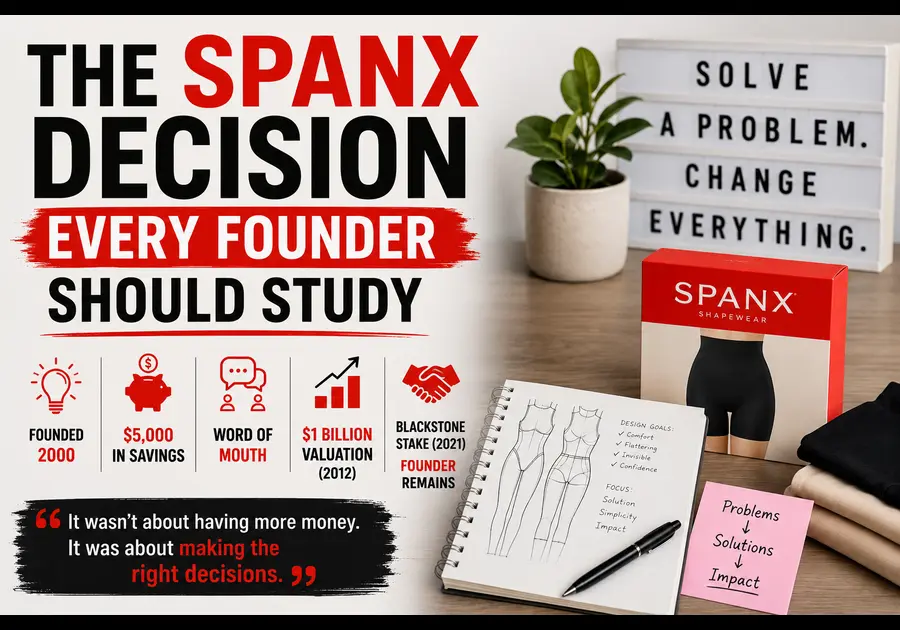
Every founder eventually chooses between two starting points: build something because the market looks attractive, or build something because a problem is bothering you personally and you can’t find anyone else who’s solved it. Blakely chose the second, and the choice is worth examining on its own terms rather than folding into the general mythology of “follow your passion.”
In the mid-1990s, Blakely was a door-to-door fax machine saleswoman with a specific, recurring irritation: she couldn’t find hosiery that gave her a smooth line under white pants without visible seams or toe lines under open shoes. She wasn’t scanning the market for a gap. She was annoyed, repeatedly, by something she personally experienced every time she got dressed for a sales call.
That distinction matters more than it sounds like it should. A founder chasing a fashionable trend is making a bet on a market’s future behavior — a genuinely difficult thing to predict, especially for someone with no industry background. A founder solving a personal, recurring frustration is working from something closer to primary-source data: their own repeated experience of a problem. Blakely didn’t need market research to confirm the discomfort was real. She’d felt it dozens of times.
Why was this unusual? Blakely had no background in fashion design or textiles and no contacts in the hosiery industry. By the conventional startup logic of the late 1990s, that should have been disqualifying. Category expertise is usually treated as a prerequisite, not an afterthought. Blakely inverted that assumption, and it worked precisely because her lack of industry conditioning let her ask a question insiders had stopped asking: why does every existing product in this category still fail at the one thing it’s supposed to do?
She had zero ties to the fashion world, which made the odds of Spanx succeeding look like a long shot from the very beginning — and that’s the part of the decision most retrospectives skip past too quickly. It wasn’t a long shot despite her inexperience. In several concrete ways, it worked because of it. She wasn’t defending an existing product line, an existing supplier relationship, or an existing reputation in the category. She had nothing to protect, which meant she had nothing stopping her from asking the industry’s most obvious, most avoided question out loud.
The lesson for founders isn’t “solve a personal problem and success will follow” — plenty of personal frustrations don’t scale into businesses. The lesson is narrower: personal, repeated frustration is one of the few sources of product insight that doesn’t require permission, capital, or credentials to access. It’s available to anyone paying attention to their own daily annoyances, which is exactly why it was available to a saleswoman with no fashion background instead of to any of the established players already inside the industry.
Lesson: Rejection Is Data, Not a Verdict
Blakely has said she heard “no” from hosiery manufacturers for roughly two years before anyone agreed to produce a working prototype. That’s not a footnote in the Spanx story — it’s close to the central mechanism of it. Understanding why she kept going, rather than simply noting that she did, is where the real lesson lives. As she put it to graduating students at her alma mater in 2026, waiting for the ideal scenario before starting can delay progress far more than an imperfect start does.
“I had no experience, but I had belief.”
— Sara Blakely, in a 2026 commencement address at Florida State University
Consider what two years of “no” actually communicated to Blakely, versus what it would communicate to most founders. From a conventional signal-reading standpoint, repeated rejection from every relevant expert in an industry usually means the idea is bad, the timing is wrong, or the market doesn’t exist. That’s a reasonable interpretation, and it’s the one that ends most startups at exactly this stage — not because the founder lacked talent, but because they correctly read the rejections as a verdict and stopped.
Blakely read the same rejections differently, and the evidence suggests it wasn’t blind optimism — it was a specific, testable belief about why she was being rejected. Manufacturers weren’t rejecting the underlying problem; they were rejecting the cost and risk of retooling a production line for an unproven product pitched by an outside founder with no track record. That’s a rejection of the packaging around the idea, not necessarily the idea itself — a distinction that matters enormously for how a founder should respond to it. When one manufacturer finally agreed, it was because he ran the idea by his three daughters, who convinced him it had merit — evidence that the underlying product had real appeal to the target customer the whole time; what had been missing was a messenger the manufacturer trusted.
That’s the actionable version of this lesson: rejection tells you something, but it rarely tells you the thing people assume it tells you. Blakely’s response wasn’t stubborn persistence for its own sake — it was continued testing of the same core hypothesis (this problem is real and underserved) against a changing set of variables (which manufacturer, which pitch, which messenger) until the variables lined up. Founders facing their own version of two years of “no” would do better to ask which part of the rejection is about the problem and which part is about the specific ask, rather than treating every “no” as a single, undifferentiated signal to quit.
Lesson: Constraint Is a Strategy, Not Just a Limitation
Blakely started Spanx with $5,000 in personal savings — money saved from years of selling fax machines — and no outside investors. That fact usually gets told as an obstacle she overcame. It’s more useful to founders as a description of how constraint actively shaped better decisions, not just harder ones.
Every dollar Blakely didn’t have was a decision she had to make without deferring to a hired specialist. Unable to afford a patent attorney, she bought a book and wrote her own application, a rare move for someone without legal training that saved her thousands of dollars — money that instead went toward fabric, travel, and the flight to pitch Neiman Marcus. She designed the packaging herself, wrote the product name herself, and personally trained retail sales associates on how to demonstrate the product in the earliest stores that carried it.
None of that is romantic. It’s what happens when a founder has no budget to outsource judgment calls to people who don’t share her specific understanding of the customer. And that turns out to matter: a designer hired to create Spanx’s packaging without Blakely’s lived understanding of the customer’s embarrassment around the shapewear category might have produced something more polished and less effective. The constraint didn’t just save money — it kept every customer-facing decision tethered to the one person in the company who actually understood, firsthand, what would make a woman trust an unfamiliar product enough to try it.
There’s a broader strategic implication here that outlasts the founding story. Spanx grew for two decades without outside investors or a large marketing budget, relying instead on word-of-mouth and grassroots effort. A venture-backed competitor with the same idea in 1998 would likely have faced pressure to scale distribution faster than the brand’s reputation could support, and to hand customer-facing decisions to specialists with no exposure to the product’s actual use case. Bootstrapping didn’t just limit Spanx’s early spending — it protected the mechanism generating the company’s advantage in the first place: founder-level customer insight, applied directly to every decision. That’s a case for bootstrapping on strategic grounds, not just financial ones. It won’t hold for every startup. It held for this one.
Lesson: A Simple, Ownable Brand Beats a Sophisticated One
The name “Spanx” itself is worth pausing on, because it’s a small decision that reveals a larger pattern in how Blakely built the brand. It’s playful, slightly irreverent, and instantly memorable — a sharp departure from the clinical, faintly medical branding language (“control top,” “support hosiery”) the category had used for decades. Blakely named the product herself, and the choice to make it sound fun rather than corrective was a direct extension of the same instinct that shaped the product: treat the customer’s relationship with the category as something that could feel good, not something to be quietly managed.
That choice had a measurable business consequence, not just an aesthetic one. A brand name that sounds like a joke between friends travels through word-of-mouth differently than a category descriptor does. Nobody tells a friend, excited, about their new “control-top support hosiery.” People did tell friends, repeatedly and by name, about Spanx — which meant the name itself was doing some of the marketing work a paid campaign would otherwise have had to do. In a company that couldn’t afford traditional advertising, a name built for conversation wasn’t a stylistic flourish. It was distribution infrastructure.
Arizona State University’s W. P. Carey School of Business has noted that Blakely shifted how customers viewed shapewear entirely — prioritizing comfort and real-world wearability over the industry’s older emphasis on aesthetics, and connecting with customers through humor and authenticity rather than the shame-based marketing language the category had relied on. That’s a brand-strategy lesson as much as a product one: simplicity and tone did work that a bigger marketing budget couldn’t have bought, because the tone itself was the differentiation, not a wrapper placed around it afterward.
The Biggest Myth About Spanx’s Success
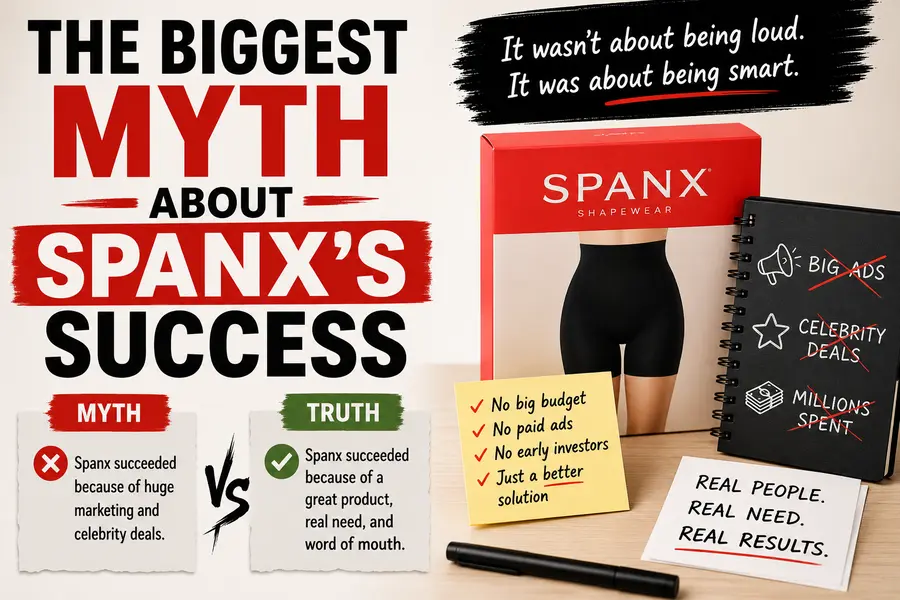
Ask most people how Spanx became a household name and you’ll get a one-word answer: Oprah. It’s the most repeated fact in the entire Spanx origin story, and it’s also the most misleading, because it implies the company’s growth was the product of a single lucky break rather than a sequence of deliberate decisions that made the company positioned to capitalize on that break when it happened.
Here’s what the timeline actually shows. Spanx had already secured placement in Neiman Marcus stores before Oprah Winfrey ever saw the product — a retail relationship Blakely won on her own, in a ten-minute pitch meeting she flew to Dallas and paid for herself, months before any celebrity endorsement existed. The Oprah moment amplified something that was already working, rather than manufacturing success out of nothing. A product that hadn’t already cleared manufacturing, retail, and early sales hurdles wouldn’t have had anywhere for that attention to land.
It’s also worth noting what happened after the Oprah spike, because “got lucky once” doesn’t explain a decade of sustained growth. Spanx continued growing through the 2000s primarily on word-of-mouth and grassroots effort, without a large marketing budget — through a QVC partnership that sold thousands of units in minutes, a Target collaboration that extended the brand to a new price point, and eventual expansion into bras, activewear, and denim, all without the initial celebrity spike repeating itself. If luck were the actual engine, growth should have faded once the Oprah moment aged out of the news cycle. It didn’t.
The more accurate — and more useful — version of the myth’s correction is this: Blakely built a company capable of converting a lucky break into durable growth, and that capability came from decisions that had nothing to do with luck. The self-written patent that meant she owned her invention outright when attention arrived. The Neiman Marcus relationship that gave the product retail credibility before the endorsement. The bootstrapped discipline that meant every dollar of new revenue reinforced the brand instead of servicing outside investors’ growth targets. Luck can open a door. It can’t walk a company through it, stock the shelves behind it, or keep customers coming back for the next decade. Those parts were Blakely’s, not Oprah’s.
Lesson: Protect the Idea, But Trust Execution More
Blakely wrote her own patent application, and it’s tempting to read that as the central intellectual-property lesson of the Spanx story: protect your invention. That’s true, but it’s not the more important half of the lesson. The patent protected the product’s specific mechanics. It did nothing to protect the underlying insight — that women wanted footless, seamless shapewear — which, as noted earlier, plenty of women had already independently discovered by cutting their own pantyhose.
What the patent actually bought Blakely was room to execute without a competitor immediately copying the specific product design once it started succeeding. But the real defensibility of Spanx came from execution that would have been difficult to replicate even without legal protection: the brand voice, the retail relationships built one pitch meeting at a time, the packaging and naming decisions rooted in a founder’s direct customer insight. A fast-follower competitor could have copied the garment. They couldn’t have copied the two years of manufacturer rejections that taught Blakely exactly how to talk about it. Founders often over-invest emotional energy in guarding an idea and under-invest in the harder, slower work of executing it distinctively enough that protection becomes almost beside the point. Blakely did both, but the patent was the smaller of the two investments.
If Sara Blakely Started Spanx in 2026, What Would She Do Differently?
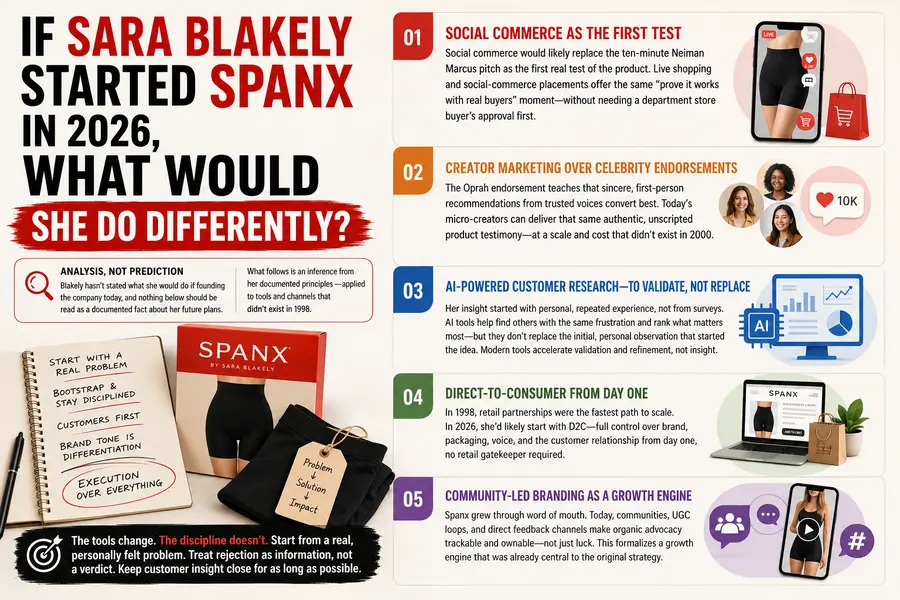
This section is analysis, not prediction. Blakely hasn’t stated what she would do if founding the company today, and nothing below should be read as a documented fact about her future plans. What follows is an inference from her documented principles — personal-problem-first product development, bootstrapped discipline, direct customer relationships, brand tone as differentiation — applied to tools and channels that didn’t exist in 1998.
Social commerce would likely replace the ten-minute Neiman Marcus pitch as the first real test of the product. Blakely’s original strategy required convincing a single retail gatekeeper to take a risk on an unproven product. A 2026 equivalent of that same instinct — solve a personal problem, then find the fastest possible way to test it against real customers — points toward live shopping and social-commerce placements, which now offer a comparable “prove it works with real buyers” moment without needing to win over a department store buyer first.
The Oprah endorsement offers a cleaner analogy to creator marketing than most people assume. The lesson of that moment wasn’t “get a celebrity.” It was that unpaid, sincere, first-person endorsement from someone the audience already trusts converts better than an advertisement ever could. That principle maps directly onto today’s creator economy, where a smaller number of highly trusted micro-creators can replicate the same mechanism — credible, personal, unscripted product testimony — at a scale and cost that simply didn’t exist in 2000.
AI-powered customer research is where the analogy gets more limited, not less. Blakely’s insight came from personal, repeated experience with the product category, not from a survey or a focus group. Modern sentiment-analysis tools are well suited to validating and refining an insight at scale — finding the other women who share the exact frustration, ranking which specific pain points matter most — but they don’t replace the initial, personal observation that generated the idea. Her documented approach has always started with a felt problem before any data enters the picture. The modern toolset would accelerate the second half of that process. It wouldn’t replace the first.
Direct-to-consumer infrastructure would probably be her starting point rather than a later addition. In 1998, a retail partnership like Neiman Marcus was close to the only viable way to reach a mass audience quickly. Working from the same bootstrapped, execution-first instincts today, she’d have direct e-commerce available immediately — control over brand voice, packaging, and the customer relationship from day one, with no retail buyer’s approval required before reaching a single customer.
And community-led branding would likely just formalize what word-of-mouth growth already was. Spanx’s actual growth engine for two decades was customers telling other customers. Today’s version of that mechanism has real infrastructure behind it — private communities, user-generated content loops, direct feedback channels — that makes organic advocacy trackable and ownable instead of something that just happens to a brand if it’s lucky. Given how central word-of-mouth already was to the original strategy, formal community infrastructure reads less like a new bet and more like the natural next step of an approach she was already running.
None of this changes the underlying lesson. The tools available to a 2026 founder are different. The discipline required to use them well — start from a real, personally felt problem; treat rejection as information to be parsed rather than a verdict to accept; keep customer insight close to the founder for as long as possible — is not.
What This Case Study Actually Adds Up To
Strip away the individual lessons and a single pattern runs underneath all of them: Blakely consistently chose the option that kept her closest to the actual customer and the actual problem, even when that option was slower, harder, or less conventional than the alternative. Bootstrapping instead of raising capital kept her closest to the customer’s actual willingness to pay. Writing her own patent kept her closest to understanding what she’d actually invented. Personally training retail associates kept her closest to how real customers responded to the product in the moment of purchase.
That’s a more specific, more testable lesson than “believe in yourself” — and it’s the one every part of this case study, examined individually, keeps pointing back to. For founders today, the question worth asking isn’t whether they have Blakely’s resilience. It’s whether their next decision keeps them closer to their customer’s actual, specific problem, or trades that closeness away for something that looks more efficient on paper.
For the full account of how the idea itself came together, read How Spanx Started With $5,000 and One Idea. For a deeper look at the founder behind these decisions, see Sara Blakely: The Founder Who Turned a $5,000 Idea Into Spanx.
Editorial Note: This article is an independent editorial feature and is not affiliated with, endorsed by, or sponsored by Spanx, Sara Blakely, or Blackstone. It is compiled from publicly available interviews, company statements, and reporting by verified news outlets, and is intended for informational purposes only. The forward-looking analysis in this article reflects editorial inference based on documented principles, not statements made by Sara Blakely about her future plans.

Anup Kumar Yadav is the founder of StartupOrigins.xyz, where he researches and publishes detailed stories about the world’s most successful startups. His work explores founder journeys, funding milestones, growth strategies, and the lessons entrepreneurs can learn from them.