
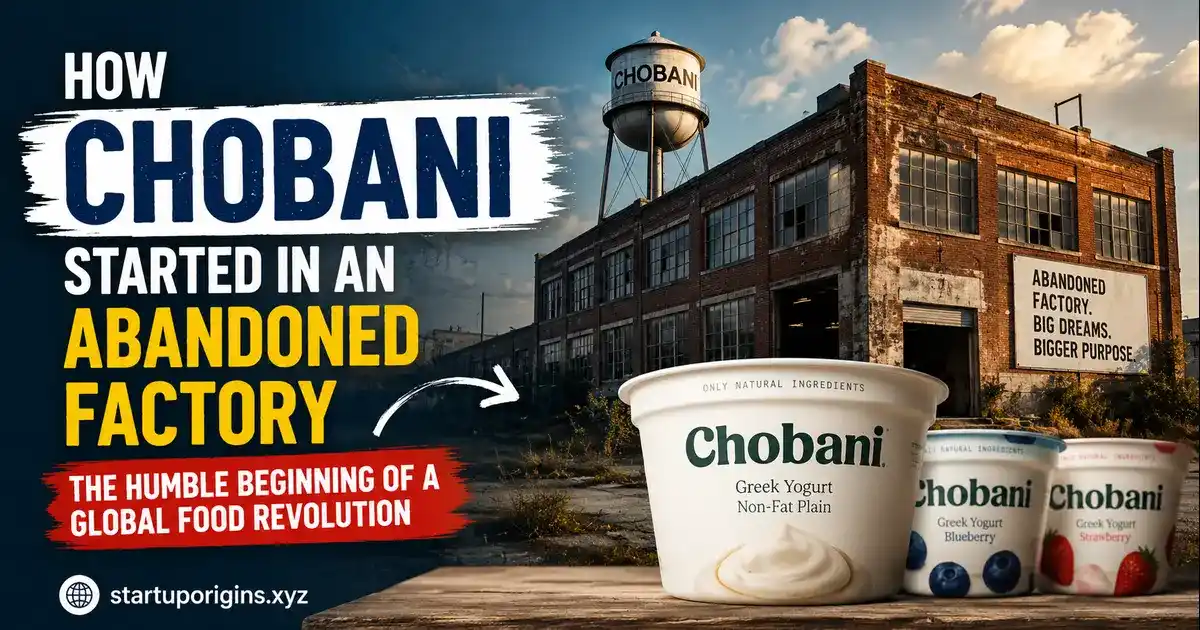
In the spring of 2005, a piece of junk mail landed on Hamdi Ulukaya’s desk advertising a piece of industrial real estate that nobody wanted: an aging Kraft Foods yogurt plant in New Berlin, New York — technically sited in the neighboring hamlet of South Edmeston — being sold off with its machinery still bolted to the floor. Kraft was walking away. So, eventually, would every other prospective buyer who toured the place. Ulukaya did not walk away. He bought it, and in doing so began one of the more improbable founding stories in modern American business — one that ended with a shepherd’s son from eastern Turkey building the country’s best-selling yogurt brand from a factory everyone else had already given up on.
Table of Contents
This is the story of how Chobani started in an abandoned factory, and why the decision to buy a dead plant instead of building something new from scratch turned out to be the single most important choice the company ever made.
A Childhood Built Around Yogurt, Long Before It Was a Business
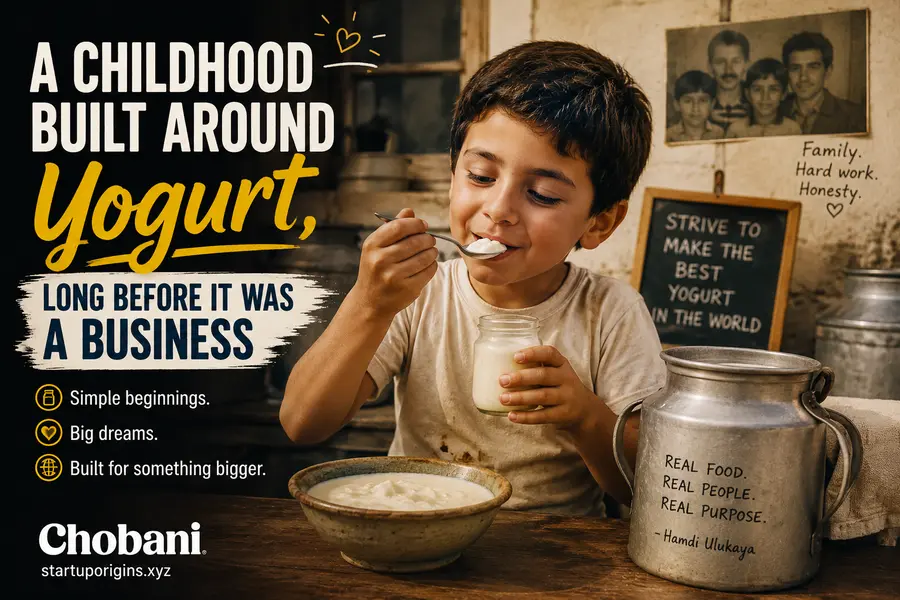
Hamdi Ulukaya grew up in a farming family in a Kurdish community near Iğdır, in the mountainous eastern reaches of Turkey, where his family raised sheep and goats and made cheese and yogurt by hand. Yogurt-making wasn’t a business plan in that household. It was simply how food worked — a craft passed down the way other families pass down recipes for bread or wine, learned by watching rather than by instruction.
He came to the United States in 1994 to study English and business, with no real intention, by most accounts, of starting a dairy company. What changed his trajectory was more personal than strategic: he found the yogurt sold in American supermarkets thin, oversweetened, and largely unrecognizable compared to what he’d grown up eating. That reaction — more visceral than analytical — eventually led him to open a small feta cheese operation called Euphrates in upstate New York. By 2005, Euphrates was a modest business, employing fewer than 40 people and generating around $2 million in revenue, barely breaking even.
It was a business small enough that most people would have called it stable. It was not obviously a business poised to become the foundation of a multibillion-dollar yogurt company. But it put Ulukaya inside the dairy industry’s supply chains, inside its factories, and inside its way of thinking — which is precisely the vantage point from which he’d eventually spot an opportunity that looked, to almost everyone else, like nothing at all.
The Ad Nobody Else Took Seriously
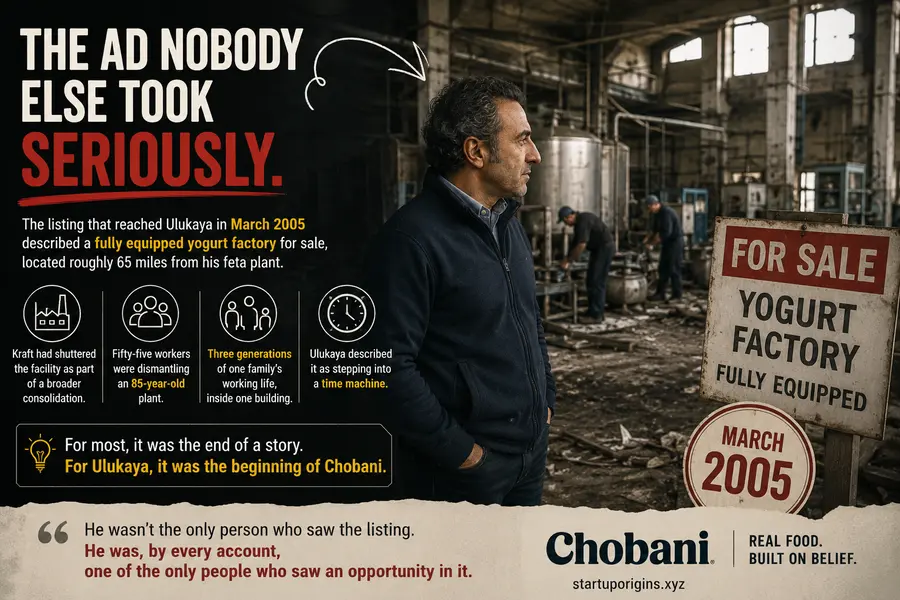
The listing that reached Ulukaya in March 2005 described a fully equipped yogurt factory for sale, located roughly 65 miles from his feta plant. Kraft had shuttered the facility as part of a broader consolidation, and by the time Ulukaya toured it, what he found felt less like a real estate showing than a wake. Fifty-five workers were quietly dismantling an 85-year-old plant, unbolting machinery that had been running, in one form or another, since before most of them were born. His guide that day was the production manager, a man whose father had made yogurt in that same building and whose grandfather, before that, had made cream cheese there — three generations of one family’s working life compressed into a single tour of a facility being taken apart piece by piece.
For most visitors, that kind of tour would have confirmed exactly what they expected to hear: this plant was finished, and so was whatever business used to run inside it. Ulukaya has since described the experience to Harvard Business Review as feeling less like an appraisal and more like stepping into a time machine — a building that still held the shape of a hundred years of dairy-making, even as it was actively being erased.
He wasn’t the only person who saw the listing. He was, by every account, one of the only people who saw an opportunity in it.
Why Everyone Ignored the Opportunity That Hamdi Ulukaya Saw
Abandoned industrial real estate in upstate New York in the mid-2000s was not scarce — manufacturing had been leaving the region for decades, and shuttered plants were a familiar, unremarkable sight. What made the Kraft factory particularly unappealing to conventional buyers wasn’t just its condition. It was what it represented: a category, Greek-style strained yogurt, that barely existed on American shelves, in a plant that a Fortune 500 company had already decided wasn’t worth running.
To a traditional investor or an experienced food executive, that combination read as a warning label. Kraft’s food scientists and market researchers had access to more consumer data than almost anyone in the industry, and their conclusion was that the plant, and the product category tied to it, weren’t worth the investment. Other prospective buyers toured the facility and walked away for the same reason: if Kraft couldn’t make the economics work, why would anyone else?
Ulukaya’s read on the situation was different, and it was different because his frame of reference was different. He wasn’t evaluating the factory as a packaged-goods executive weighing category trends against shelf space. He was evaluating it as someone who had grown up eating a thick, strained, tangy yogurt that simply didn’t exist in American supermarkets — and who had already spent several years running a small dairy operation and understood, firsthand, what it took to keep a plant like this running. Where a corporate buyer saw a failed product line, he saw an entire style of yogurt that had never actually been tried in the U.S. market at scale, sold badly or not sold at all.
There’s a broader lesson in that gap. Overlooked opportunities are frequently overlooked not because the opportunity is hidden, but because the people positioned to evaluate it are looking through the wrong lens. Kraft’s team was asking whether the existing American yogurt category could be revived. Ulukaya was asking a different question entirely: whether a category that barely existed yet could be created. Those are not the same question, and answering the wrong one is how a $20 billion company ends up starting as a rejected listing.
The Decision That Changed Chobani Forever
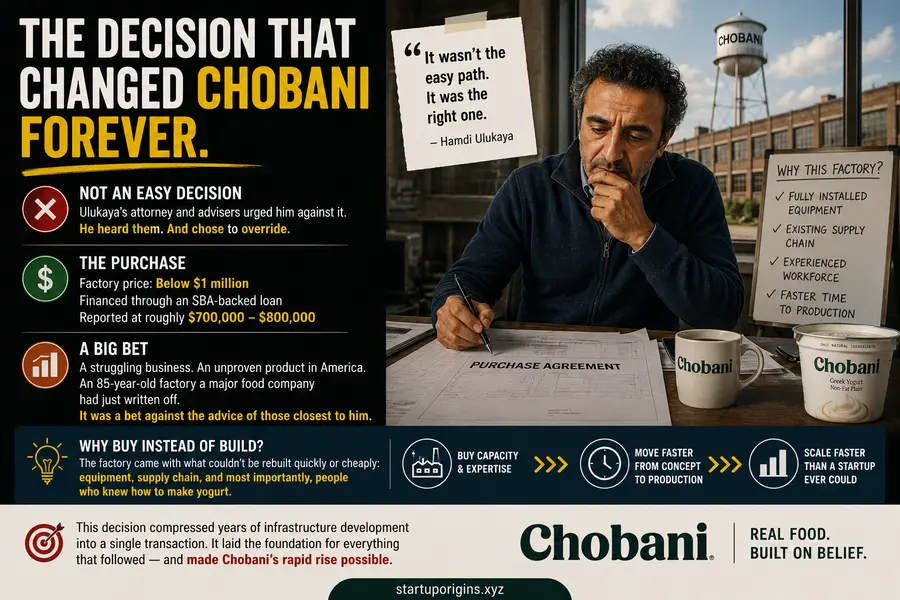
Buying the factory was not a foregone conclusion, and it was not a decision made with much encouragement. Ulukaya’s attorney and business advisers reportedly urged him against it — a message that, by his own account in Harvard Business Review, he heard clearly and chose to override. The purchase price sat below $1 million, financed largely through a loan backed by the Small Business Administration, reported at roughly $700,000 to $800,000. For a business owner running a company that was, in his own description, barely breaking even, that was not a rounding error. It was a bet against the advice of the people closest to him, made with borrowed money, on a product category with no proven American demand and a piece of real estate that a major food conglomerate had just finished writing off.
The alternative path was obvious and far safer: keep running Euphrates, stay within a category he already understood, and avoid the capital and operational risk of resurrecting an 85-year-old industrial plant. Starting fresh — building a new, smaller facility suited to modest early-stage production — would have been the conventional playbook for a founder with limited capital and no outside investors.
Ulukaya rejected that playbook for a specific reason: the factory came with something that couldn’t be rebuilt quickly or cheaply — fully installed processing equipment, a functioning supply chain relationship with regional dairy farms, and, critically, a workforce that already knew how to run a yogurt plant. Buying distressed infrastructure rather than building from zero meant Chobani could, in theory, move from concept to production far faster than a from-scratch startup ever could.
That decision — buying capacity and expertise instead of building it — became the foundation for almost everything that followed. It compressed years of infrastructure development into a single transaction. It is also, arguably, the reason Chobani could scale as fast as it eventually did once demand arrived: the plant, unlike a garage or a rented commercial kitchen, was already built for volume.
Rebuilding a Factory, and a Workforce, From the Inside Out
Ulukaya’s first move after closing the purchase was to bring back many of the employees who had just lost their jobs when Kraft shut the plant down. Only a handful remained by the time he took over — among them Maria Wilcox, one of four former Kraft workers he rehired from the small town of New Berlin, who, as she told NBC News, had watched the shutdown unfold and openly worried the empty plant would simply rot in place. Instead, she and the others found themselves back at work inside the same building, this time helping build something new rather than dismantling something old.
That reversal rippled beyond the factory floor. The local mayor at the time later credited Ulukaya with bringing a sense of rejuvenation to a town that other companies had toured and quietly passed on — a contrast he drew explicitly between Chobani’s commitment to the area and the buyers who had come before and left. Over the following years, Chobani would pour more than $190 million in capital investment into the New Berlin plant alone, grow its upstate New York workforce into the thousands, and eventually truck several million pounds of milk a day into the facility from thousands of regional dairy farms — a supply chain that a shuttered factory, and a laid-off workforce, would never have generated for anyone else.
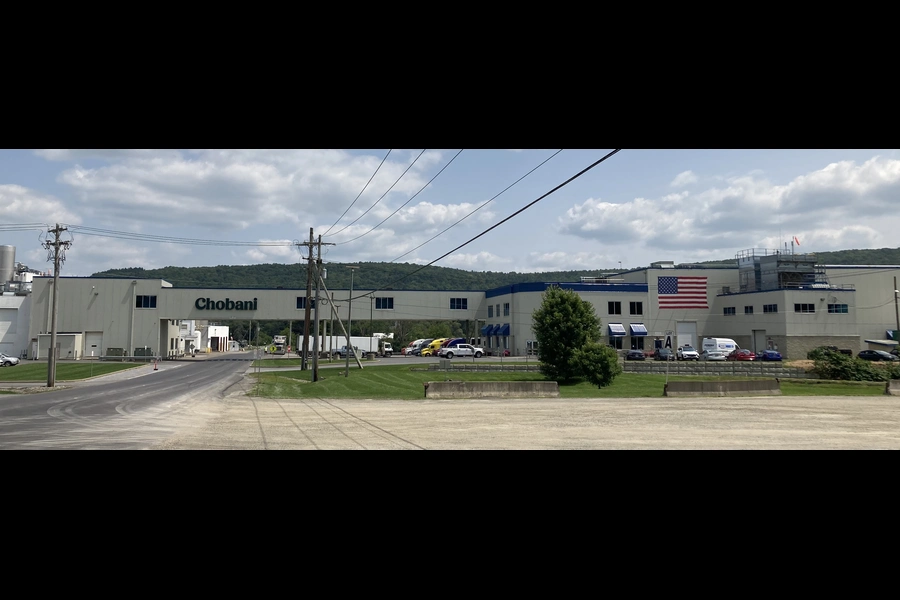
None of that came before the harder, slower work of getting the product itself right. Ulukaya recruited a master yogurt maker from Turkey to help develop the recipe, a decision that reflected the same instinct that had led him to buy the plant in the first place: Greek-style yogurt wasn’t something you could reverse-engineer from an American test kitchen. It required someone who understood the traditional straining process at a technical level, and it required patience — nearly two years of it — before a single cup reached a store shelf.
That two-year stretch was spent refining the recipe, dialing in the triple-straining process that gives Greek yogurt its dense, high-protein texture, and working through the packaging design that would eventually make Chobani instantly recognizable on shelf. This was not a rapid launch. It was a deliberate, unhurried period of getting the product right before it ever reached a single retailer, financed the entire time without outside venture capital — a choice that let Ulukaya retain full control over both the product and the pace of the company’s growth, even if it meant the factory ran for two years without generating the revenue it was built to produce.
Launch, and the Slow Build of an Unlikely Following
Chobani’s Greek yogurt reached retail shelves in October 2007, with its first placement on Long Island, New York. There was no national advertising campaign behind the launch and no major retail partnership announced with fanfare — just a small company with a two-year-old recipe trying to convince a single regional grocery chain to give its cups a few inches of cold-case space next to brands with decades of shelf history and marketing budgets Chobani couldn’t come close to matching.
The bigger risk, at that stage, wasn’t distribution. It was placement. Ulukaya made the deliberate choice to put Chobani in the mainstream dairy aisle, priced and positioned directly alongside Yoplait and Dannon, rather than tucking it into a specialty or “ethnic foods” section where thick, strained yogurt had traditionally lived in the few U.S. stores that carried it at all. That decision put an untested, premium-priced product in direct visual competition with the category leaders on their own turf — a bet that shoppers, given the choice, would notice the difference in texture and protein content and pay more for it.
Growth, in those earliest months, came from something closer to word of mouth than marketing: shoppers picking up a thicker, tangier cup out of curiosity, tasting a texture that had no real analog on the shelf around it, and coming back for more. There was no viral moment and no single retail deal that changed everything overnight. It was a slower accumulation of repeat customers, store by store, that eventually convinced larger chains to expand where Chobani sat and how much space it got.
That contrast mattered more than it might seem. The American yogurt aisle in the mid-2000s was built almost entirely around sweetened, low-protein products marketed primarily to children and dieters. Chobani’s positioning — thick, tangy, protein-forward, and priced at a premium — didn’t try to compete inside that existing framework. It offered something the aisle hadn’t had before, and it let the product’s texture and nutritional profile do the marketing that a national ad budget usually would.
The Greek Yogurt Boom, and the Bet That Made It Possible
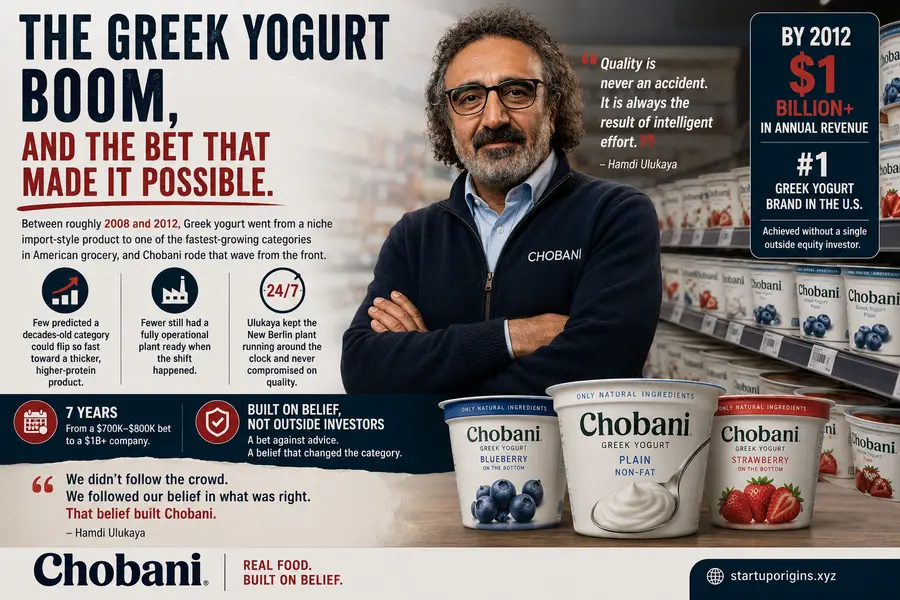
Between roughly 2008 and 2012, Greek yogurt went from a niche import-style product to one of the fastest-growing categories in American grocery, and Chobani rode that wave from the front — timing that was, by Ulukaya’s own later description, as much luck as design. Few in the food industry had predicted a decades-old, thin-and-sweet category could flip that quickly toward a thicker, higher-protein product; fewer still had a fully operational plant already sitting behind it when the shift happened. Ulukaya kept the New Berlin plant running around the clock during this period, staying personally involved in quality control and reportedly refusing to compromise on the recipe even as demand outpaced what the original factory had ever been designed to produce. By 2012, Chobani had crossed $1 billion in annual revenue and held the position as the top-selling Greek yogurt brand in the United States — a milestone reached without a single outside equity investor, seven years after a purchase his own attorney had advised against.
Meeting that demand required another significant bet: a new production facility in Twin Falls, Idaho, which would go on to become one of the largest yogurt plants in the world. The scale of that decision is easy to understate in hindsight. This was a private company with no outside equity, financing a major new plant on debt at a moment when, according to later accounts, Ulukaya had gone as long as six months without fully paying his own attorney. Financing that expansion without outside investors, at a company that had only recently finished paying off the debt from its original factory purchase, was itself an act of considerable financial nerve — a second high-stakes wager layered on top of the first, made by a founder who had already proven willing to bet the company once and was now willing to do it again.
Sharing Ownership With the People Who Built It
In 2016, Ulukaya announced that Chobani would give employees an ownership stake in the company — a program that granted shares to the workforce that had helped build the business from its factory-floor origins. The move was framed less as a conventional corporate benefits decision and more as an extension of the same philosophy that had shaped the company from day one: that the people running the plant should have a direct stake in what they were building, not just a paycheck tied to it. It became one of the more widely discussed employee ownership programs in American food manufacturing, and it reinforced the “anti-CEO” reputation Ulukaya had built over the preceding decade — including a well-documented commitment to hiring refugees resettling in nearby communities like Utica, New York.
From a Yogurt Company to a Food-and-Beverage Platform
Chobani’s ambitions expanded well beyond the yogurt cup over the following years. The company moved into oat milk and coffee creamers in 2019, entered the ready-to-drink coffee market in 2023 with its $900 million acquisition of La Colombe, and added frozen meals and smoothies to its portfolio through the 2025 acquisition of Daily Harvest. By 2024, Chobani generated roughly $3 billion in annual revenue, with yogurt sales still climbing and the company holding more than a fifth of the U.S. yogurt market.
In October 2025, Chobani raised $650 million in new equity at a valuation of roughly $20 billion — a figure that made Ulukaya, who has retained majority ownership of the company throughout its history, one of the wealthiest self-made entrepreneurs in American food manufacturing. The company had filed confidentially for an IPO back in 2021 before withdrawing those plans in 2022 amid volatile public markets; Ulukaya has repeatedly signaled that Chobani remains prepared to go public whenever the timing makes sense, even as it continues operating, and expanding, as a private company headquartered in New York City.
Through it all, the original factory in New Berlin has never stopped making yogurt. Twenty years after Kraft walked away from it, the plant Ulukaya bought against his own lawyer’s advice remains part of the operational backbone of a company now valued in the tens of billions.
For a closer look at the man behind that decision, see our companion feature, Hamdi Ulukaya: The Immigrant Founder Who Built Chobani. For a deeper dive into how the company scaled without a national ad budget, read How Chobani Grew Without Big Advertising Budgets. And for founders looking to apply these lessons to their own ventures, What Chobani Teaches Every Startup Founder breaks down the operating principles behind the company’s growth.
Frequently Asked Questions
How did Chobani start?
Chobani began in 2005 when Hamdi Ulukaya, an immigrant from Turkey running a small feta cheese company in upstate New York, purchased an abandoned Kraft Foods yogurt factory in New Berlin, New York, using an SBA-backed loan. He spent roughly two years developing a Greek-style yogurt recipe before launching Chobani in October 2007.
Who founded Chobani?
Chobani was founded by Hamdi Ulukaya, a Kurdish Turkish entrepreneur who grew up in a dairy-farming family and emigrated to the United States in 1994.
Why did Hamdi Ulukaya buy an abandoned factory instead of building a new one?
The factory came with functioning processing equipment, existing dairy supply relationships, and an experienced local workforce, allowing Chobani to move toward large-scale production far faster than building a new facility from scratch would have allowed.
How did Chobani become successful?
Chobani succeeded by introducing a thicker, higher-protein, less sugary yogurt into a category dominated by sweetened products, riding the Greek yogurt boom of 2008–2012, expanding into a large-scale Idaho production facility, and later diversifying into coffee, oat milk, and other categories through acquisitions like La Colombe and Daily Harvest.
Who owns Chobani today?
Hamdi Ulukaya remains the majority owner of Chobani, holding an estimated 68% stake, with employees also holding an ownership stake through a company-wide equity program introduced in 2016. The company raised $650 million in equity funding in October 2025 at a $20 billion valuation while remaining privately held.
Disclaimer
This article is based on publicly available reporting from outlets including Harvard Business Review, Inc., Forbes, and NBC News, as well as Chobani’s own public statements. Some figures (including the exact original purchase price and the factory’s precise town name, variously reported as New Berlin and South Edmeston, New York) vary slightly across sources and are presented with that range noted. This is an independent editorial feature and is not affiliated with or endorsed by Chobani, LLC or Hamdi Ulukaya.
Discover More Startup Origin Stories
Every successful company started with an uncertain beginning. Explore how visionary founders spotted opportunities, overcame setbacks, and transformed simple ideas into globally recognized businesses. These carefully researched stories reveal practical lessons every entrepreneur can apply.
How Shopify Started Selling Snowboards Online
A small online snowboard shop couldn’t find suitable software—so its founders built their own platform. That decision eventually created one of the world’s largest eCommerce companies.
How Discord Started
Discord wasn’t born as a chat app. It emerged from the failure of an online game, proving that some of the best startups begin with unexpected pivots.
How Spanx Started With $5,000 and One Idea
Sara Blakely invested just $5,000 of her savings to solve a common problem. Her persistence transformed Spanx into one of the world’s most successful apparel brands.
Explore real founder journeys, startup failures, funding stories, growth strategies, and business lessons—all backed by extensive research and written for entrepreneurs, founders, and curious builders.
Explore StartupOrigins →
Anup Kumar Yadav is the founder of StartupOrigins.xyz, where he researches and publishes detailed stories about the world’s most successful startups. His work explores founder journeys, funding milestones, growth strategies, and the lessons entrepreneurs can learn from them.