
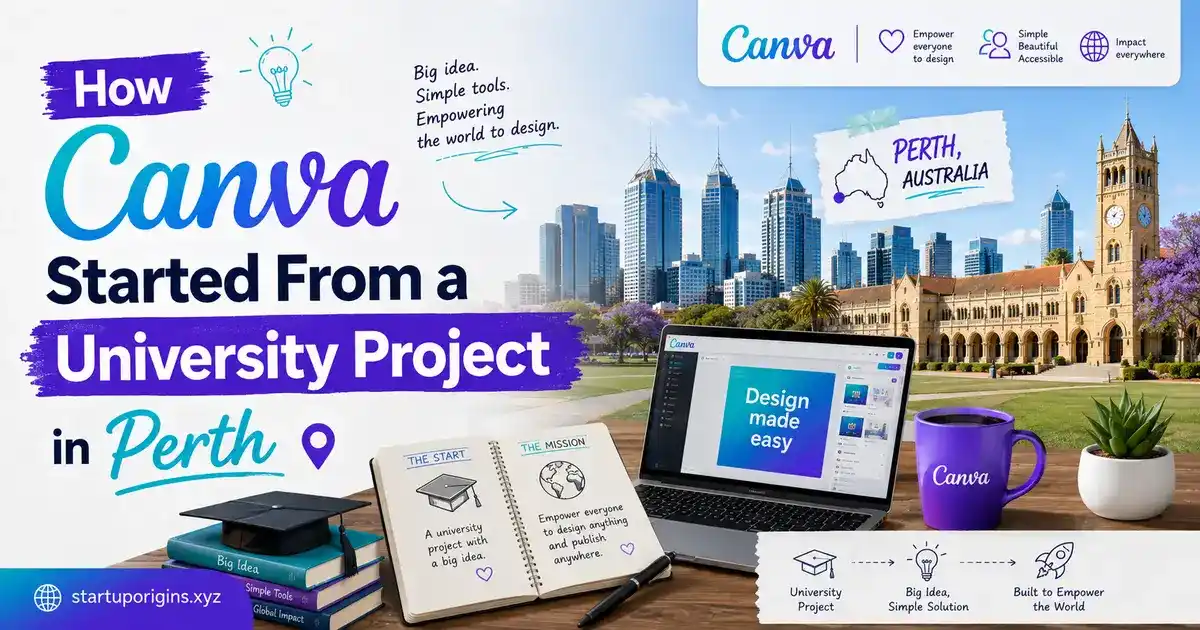
The year was 2006. Perth, Western Australia — a city more associated with sunshine and surf than software revolutions — was home to a sharp-eyed nineteen-year-old named Melanie Perkins. She was studying communications and commerce at the University of Western Australia, and to make ends meet, she’d started tutoring her fellow students in graphic design.
The sessions kept hitting the same wall.
Every time a student sat down with professional design software, frustration followed. Adobe Photoshop and InDesign were powerful tools, sure — but they were built for trained designers, not first-year students trying to lay out a simple brochure. An entire semester, Perkins would later recall, could be spent just learning where the tools lived in the interface. Students would spend hours navigating menus before creating anything at all.
- Who Founded Canva?
- The Frustrating Problem That Sparked the Idea
- Fusion Books: The Startup Before Canva
- From Perth to Silicon Valley
- How Canva Raised Its First Funding
- The Official Launch of Canva
- Why Canva Grew Faster Than Traditional Design Software
- The Canva Growth Timeline
- How Canva Became a Global Technology Giant
- Canva’s AI Transformation in 2025–2026
- Key Challenges Canva Faced
- Frequently Asked Questions
- Conclusion
- Disclaimer
That frustration wasn’t just a teaching problem. To Perkins, it was a signal.
She started asking a different question: what if design software didn’t have to work this way? What if you could put the power of a professional studio in the hands of anyone — a student, a small business owner, a teacher — without the two-year learning curve?
That question, asked in a university dorm room on the far western edge of Australia, would eventually give rise to Canva: one of the most widely used software products on the planet, valued at $26 billion at its peak, and counting more than 220 million users across 190 countries by 2026.
But the path from that Perth classroom to global technology giant was anything but smooth. It involved years of bootstrapping, nearly 100 investor rejections, a pivot from school yearbooks, and a relentless founder who refused to take no for an answer.
This is how Canva started.
Who Founded Canva?
Every great startup has a founding team story. Canva’s happens to be an unusually human one.
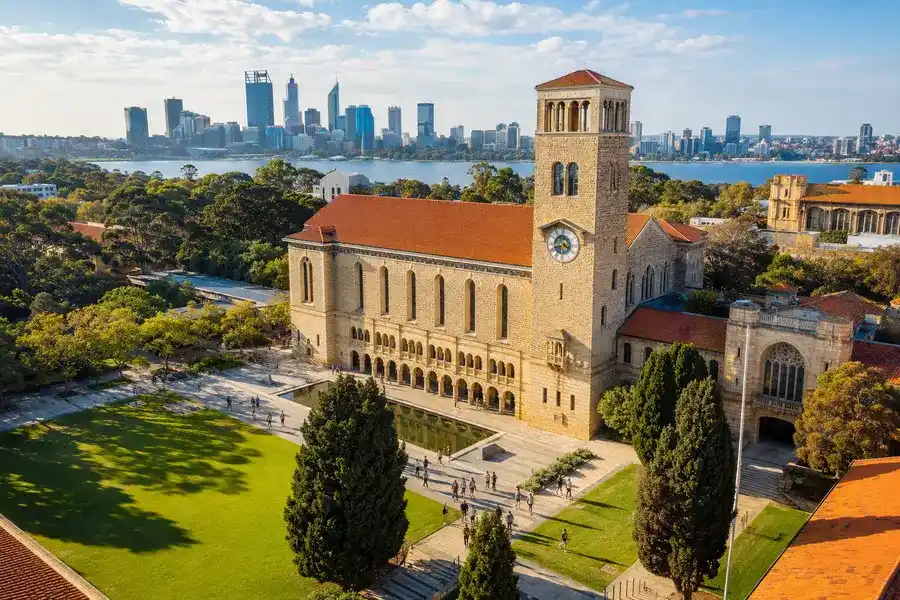
Melanie Perkins is the name most synonymous with Canva, and for good reason. She was the original visionary — the one who first noticed the problem, built the first version of the solution, and eventually pitched it to investors while learning to kitesurf off the coast of Perth to get face time with a venture capitalist. Perkins studied at the University of Western Australia and was 19 when the core idea first crystallized. She would go on to become one of the youngest female CEOs of a tech unicorn in the world.
Cliff Obrecht, Perkins’ partner both in life and in business, co-founded Canva alongside her from the very beginning. The two had been together since university, and Obrecht became the company’s Chief Operating Officer — the operational engine to Perkins’ product and vision instincts. His role was quieter but critical: keeping the wheels turning as the company scaled from a small team in Perth to a global organization.
Cameron Adams came later, but his addition was a turning point. Adams was a former Google engineer who had worked on Google Wave, and he brought a level of technical sophistication that Canva desperately needed at the time. When Perkins met him in 2012, she was still trying to raise funding. Adams joined as co-founder and Chief Product Officer, and his engineering leadership helped transform Canva’s ambitious vision into a genuinely elegant product.
Together, the three formed the founding triad that would take Canva from a Perth garage to a Sydney headquarters to offices in Manila, Austin, San Francisco, and beyond.
Melanie Perkins: How a 19-Year-Old Entrepreneur Built Canva Into a Global Design Empire
Discover how Melanie Perkins transformed a simple idea into Canva, one of the world’s most successful startups. Learn the lessons behind persistence, innovation, fundraising, and building a billion-dollar company.
Read the Full Story →The Frustrating Problem That Sparked the Idea
To understand why Canva exists, you have to understand just how broken design software was — and in many ways still is — for the average person.

Adobe’s professional suite had long been the industry standard. Photoshop. Illustrator. InDesign. These were extraordinary tools in the right hands. But they were built for professionals who had trained on them for years. They had steep learning curves, expensive licensing, and interfaces packed with hundreds of features that most users would never touch.
For someone who simply wanted to make a flyer for a school event, or a banner for a community fundraiser, or a clean one-page layout for a class project, the professional tools were overkill in the worst possible way. You had to learn the hammer before you could drive the nail.
Perkins watched this play out over and over in her tutoring sessions. Bright, capable students were defeated not by their ideas, but by the tools. The software got in the way of the work.
The insight she arrived at was deceptively simple: design tools should start with what you want to make, not with a blank canvas and a toolbar full of options you don’t understand.
Templates. Drag-and-drop. Intuitive layouts. Design that started from outcomes, not from raw tools.
This wasn’t a new idea in the abstract. Plenty of people had noticed that professional design software was intimidating. But Perkins and Obrecht were the ones who decided to actually do something about it — and they started not by building Canva, but by building something smaller first.
Fusion Books: The Startup Before Canva
Before there was Canva, there was Fusion Books. And Fusion Books is the part of this story that often gets skipped over — which is a mistake, because it’s the part that proved everything.
In 2007, while still at university, Perkins and Obrecht launched Fusion Books: an online platform that let students design and order their own school yearbooks. The concept was simple. Instead of a school paying a design agency to produce the yearbook and then sending it off to a print shop, Fusion Books gave students a drag-and-drop interface to design the whole thing themselves.
It was, in miniature, the same idea that would later become Canva.
The Fusion Books interface let users drag photos, change fonts, rearrange layouts — all without needing to know a thing about design software. The final product would be printed and delivered. Simple, functional, genuinely useful.
It took off.
Fusion Books grew to become Australia’s largest school yearbook company. They were shipping thousands of yearbooks a year, building out the operational infrastructure of a real business, and — crucially — proving that ordinary people could produce professional-looking designed materials when given the right tools.
Every school that used Fusion Books was essentially beta-testing the Canva thesis. Non-designers could create great-looking output if the software removed the technical friction.
By the time Perkins and Obrecht started pitching investors on a broader consumer design platform, they weren’t just selling a concept. They had a working business with real revenue that validated the core idea.
That mattered enormously. In the startup world, traction talks.
From Perth to Silicon Valley
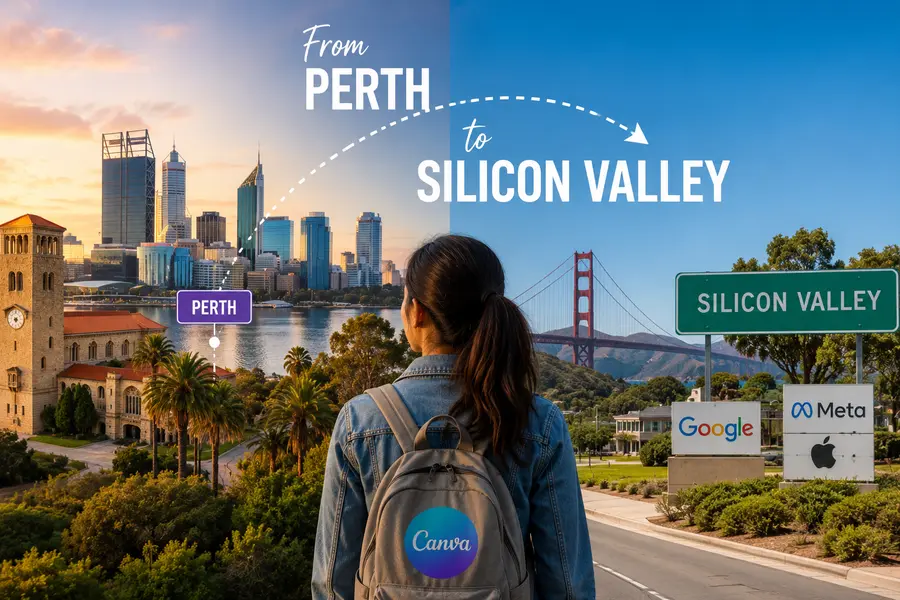
Here’s something worth appreciating: Perkins and Obrecht were trying to raise venture capital for a technology startup from Perth.
Perth is, geographically speaking, one of the most isolated cities on Earth. It is closer to Singapore than it is to Sydney. The Australian startup ecosystem in the late 2000s and early 2010s was still finding its footing. And the investors with the deepest pockets and the most appetite for ambitious consumer software companies were mostly concentrated in one place: Silicon Valley, California.
The distance wasn’t just physical. It was cultural, relational, and financial.
Perkins began flying to San Francisco for pitching trips. She reportedly faced around 100 investor rejections — a number that has become part of the Canva mythology, but which also speaks to how difficult it was for a young woman from Perth to get serious attention from venture capitalists who were still mostly betting on founders who looked and sounded like themselves.
The breakthrough came through an unlikely channel: kitesurfing.
Bill Tai, a prominent venture capitalist, was known for organizing kitesurfing events in Maui that doubled as informal networking gatherings for tech entrepreneurs. Perkins, having heard about this, learned to kitesurf specifically to attend. It was an almost absurdly resourceful move — but it worked.
Tai was impressed enough by Perkins’ determination (and eventually by her pitch) to make an introduction to Lars Rasmussen, the Australian-born co-creator of Google Maps who was then at Google. Rasmussen became a mentor and adviser, lending the project credibility and opening further doors.
The network Perkins built through sheer persistence — flying across the Pacific, learning new sports, showing up in rooms where she wasn’t necessarily expected — eventually became the foundation for Canva’s fundraising success.
How Canva Raised Its First Funding
The seed funding story is, in many ways, the emotional climax of Canva’s early years.
After years of pitching, of flying to San Francisco, of building relationships through kitesurfing events and cold emails and warm introductions, the money started to come.
The pivotal moment came when Cameron Adams agreed to join as co-founder. His credibility as a former Google engineer — someone who had worked on high-profile, technically sophisticated products — helped close a critical question that investors had been quietly asking: could this team actually build what they were describing?
With Adams aboard, the answer became much more convincing.
Canva raised a seed round in 2012 that gave the team the runway to properly build out the product. Matrix Partners and Blackbird Ventures were early institutional backers. Bill Tai, who had been a supporter since the kitesurfing days, was involved. The round was modest by later standards, but it was enough to hire a real team and build toward a public launch.
What’s important here is what that funding represented: it wasn’t just capital. After years of rejection, it was validation. It meant the world’s most discerning technology investors believed a young woman from Perth had correctly identified a problem worth solving, and had the right team to solve it.
That’s not nothing. That’s everything.
Related Reading: Explore the complete fundraising journey of Canva and discover the strategies that helped the company secure investor backing and scale into a global design platform.
The Official Launch of Canva
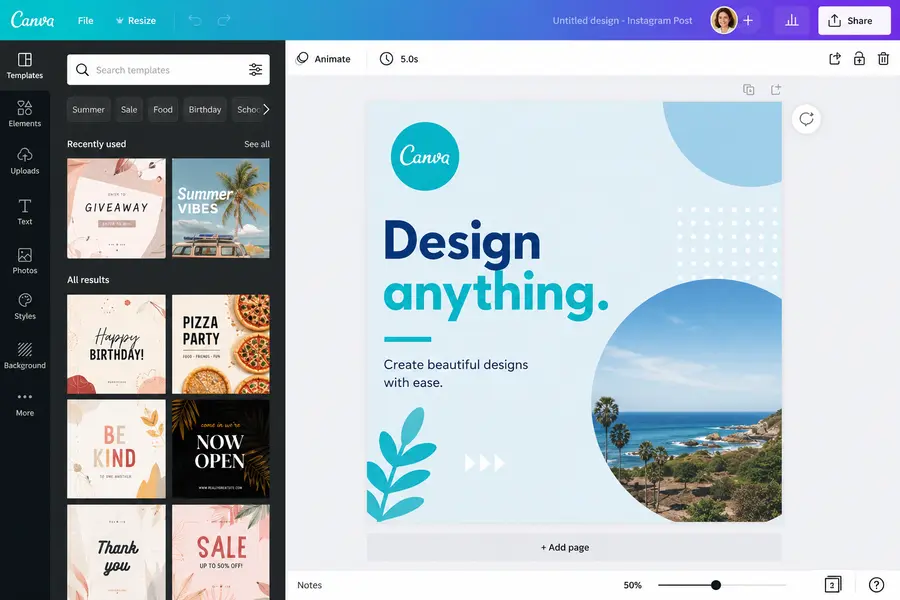
Canva officially launched to the public in August 2013.
The reception was immediate and intense. Within a month, the platform had attracted hundreds of thousands of users. The waiting list that had been building since the announcement was enormous — a sign that Perkins had been right about the market, and that people were genuinely hungry for a simpler approach to design.
The product itself was elegant in ways that professional design tools had rarely been. You chose a format — a social media post, a presentation, a flyer, a poster. You picked a template. You swapped in your content. You were done. The whole experience was built around what designers call the “jobs to be done” framework, even if Canva’s team wouldn’t have used that term at the time: start with what the user is trying to accomplish, and design backward from there.
For small businesses trying to make a Facebook ad, the impact was transformative. For teachers creating classroom materials, it was revelatory. For nonprofit organizations without design budgets, it was a genuine equalizer.
The timing was also excellent. Social media had created enormous demand for designed visual content — images for posts, cover photos, banners, infographics — and most of the people who needed to create that content had no design background whatsoever. Canva launched directly into that need.
Why Canva Grew Faster Than Traditional Design Software
The growth that followed Canva’s launch was not accidental. It was the result of several product and strategic decisions that ran directly counter to how design software had always been sold.
Free to start, paid to scale. Canva adopted a freemium model that let any user access a genuinely useful version of the product for free. This meant acquisition costs were low and word-of-mouth was enormous. Individuals shared their designs on social media. Teachers told other teachers. Small business owners showed their peers.
Templates as the product. Rather than offering a blank canvas and a set of tools, Canva built its library of professionally designed templates as a core value proposition. You didn’t have to be a designer to produce something that looked like a designer made it. The template library became both a technical moat and a marketing engine.
Collaboration from the start. Canva built collaborative features early, allowing teams to work on designs together in real time. This wasn’t an afterthought — it was central to the product vision. And it made Canva stickier in organizational settings, where shared assets and consistent branding mattered.
The cloud made it universal. Because Canva was browser-based, it worked on any device, in any country, without installation. For users in emerging markets where desktop software licenses were prohibitively expensive and often pirated, Canva was genuinely accessible in a way that Adobe never was.
Viral by design. When you created something in Canva and shared it — a presentation, a social post, an invitation — the output often included a subtle “Made with Canva” tag. Millions of designs became advertising impressions. The product marketed itself.
The Canva Growth Timeline
| Year | Canva Milestone |
|---|---|
| 2007 | Melanie Perkins and Cliff Obrecht launch Fusion Books, an online school yearbook platform, from Perth, Australia. |
| 2010 | Fusion Books grows into Australia’s largest school yearbook company. Perkins begins pitching a broader online graphic design platform to investors. |
| 2012 | Cameron Adams joins as co-founder. Canva secures seed funding, accelerating product development and platform growth. |
| 2013 | Canva officially launches in August and attracts more than 750,000 users during its first year. |
| 2017 | Canva surpasses 10 million users, raises Series B funding, and expands internationally. |
| 2018 | Acquires Zeetings and launches Canva for Work (later Canva Pro), targeting business and enterprise users. |
| 2019 | Company valuation reaches $3.2 billion, making Canva Australia’s most valuable private technology company. |
| 2021 | Valuation climbs to $40 billion. Canva acquires Kaleido, Smartmockups, and other design tools while launching Canva Presentations. |
| 2024 | Canva surpasses 180 million monthly active users and expands AI-powered tools including Magic Write, Magic Design, and Magic Edit. |
| 2025 | Launches a major AI platform overhaul with the Canva AI Suite, expands enterprise contracts, and maintains a valuation of around $26 billion. |
| 2026 | Canva passes 220 million total users, deepens AI integration across products, and strengthens its position in the enterprise visual communication market. |
How Canva Became a Global Technology Giant
What started as a simpler alternative to Adobe evolved, over a decade, into something far more ambitious: a full-stack visual communication platform used by individuals, small businesses, schools, nonprofits, and Fortune 500 companies alike.
The scale of Canva’s user base by 2026 is genuinely staggering. More than 220 million people across 190 countries have accounts. Ninety percent of Fortune 500 companies have employees using the product. Teachers use it to build lesson materials. Marketers use it to produce campaigns. HR departments use it for internal communications. Government agencies use it for public announcements.
The platform expanded well beyond its original design-for-individuals positioning. Canva for Teams brought shared brand kits, approval workflows, and centralized asset management to organizations. Canva for Education became a major product in its own right, used in schools across dozens of countries. Canva Enterprise brought enterprise-grade security and administration to large organizations.
Each of these expansions followed the same logic: find a context where visual communication mattered, and make it easier.
Canva also made a string of strategic acquisitions that accelerated its product breadth — picking up presentation tools, background removal technology, photo editing capabilities, and stock content libraries. Rather than building everything from scratch, Canva acquired the best available solutions and integrated them into a coherent platform.
By 2024 and 2025, Canva was no longer really competing with design tools. It was competing with the entire category of visual content creation — which made its addressable market essentially unlimited.
Canva’s AI Transformation in 2025–2026
The most significant chapter in Canva’s recent history has been its pivot into artificial intelligence — and it has been a thoroughgoing transformation, not a surface-level feature addition.
Canva began integrating AI capabilities into its platform in earnest around 2023 with features like Magic Write (AI-generated text content) and Magic Design (AI-generated layout suggestions). But the real leap came in 2025, when Canva unveiled what amounted to a rebuilt platform with AI woven through nearly every workflow.
Magic Edit allows users to modify photographs using natural language — describe what you want changed, and the AI makes it happen. Dream Lab brings image generation directly into the design workflow. The AI presentation builder can create a complete, designed slide deck from a text prompt in seconds.
For the average Canva user, this means the gap between having an idea and having a finished, professional-looking piece of content has narrowed dramatically. A social media manager who once needed thirty minutes to produce a week’s worth of post graphics can now do it in five.
For Canva as a company, the AI transformation represents something strategic as well. The competitive threat from Adobe — which has its own significant AI product in Adobe Firefly — is real. But Canva’s advantage has always been accessibility and ease of use, and AI amplifies those qualities rather than threatening them. The harder professional tools work to build AI features, the more complex their interfaces can become. Canva’s bet is that AI should make design simpler, not more powerful in ways most users don’t need.
It’s a bet that appears, so far, to be paying off. The platform’s user growth has continued through the AI transition, suggesting that the new capabilities are bringing in new users rather than confusing existing ones.
Canva x Anthropic: Now Powered by Claude
In a significant milestone for both companies, Canva is now integrated into Claude Design — Anthropic’s AI-powered design experience built on Claude. This collaboration brings Canva’s world-class design infrastructure together with Claude’s advanced AI capabilities, allowing users to create, edit, and refine visual content through natural conversation.
For Canva, the partnership with Anthropic represents a meaningful step in its AI-first strategy. Rather than building every AI capability in-house, Canva is aligning with one of the most respected AI research companies in the world. For Claude users, it means professional-grade design is now accessible directly inside the AI workflow — no switching tabs, no separate tools.
It is, in many ways, the fullest expression of the idea Melanie Perkins first had in that Perth classroom: design so accessible, it feels like a conversation.
Key Challenges Canva Faced
It would be easy, looking at Canva’s trajectory from the outside, to see a story of smooth, inevitable success. The reality was considerably messier.
The investor rejection gauntlet. Perkins has spoken publicly about facing close to 100 rejections from investors before securing meaningful funding. That’s not a motivational statistic — it’s an honest account of how hard it is to raise money as a first-time founder, from a remote location, in a market that investors hadn’t yet decided was large enough to bet on. The rejections spanned years and spanned continents. Most startups don’t survive that kind of sustained disappointment.
Building from Perth. Perth’s geographic isolation created real practical challenges. Flying to San Francisco for investor meetings was expensive and exhausting. Hiring top engineering talent was more difficult than it would have been in Sydney or Melbourne, let alone Silicon Valley. The time zone difference made real-time communication with potential partners and investors a logistical headache. Canva eventually built major offices in Sydney and internationally, but the early years demanded a kind of resourcefulness that founders in hub cities don’t always have to develop.
Competing against Adobe. Adobe is one of the most entrenched software companies in the world, with decades of brand loyalty, a professional user base that swears by its products, and the resources to develop competitive features. Canva’s strategy was not to fight Adobe on its own ground, but to build for the vast population of people Adobe’s tools weren’t really designed for. That framing proved correct, but it took years to demonstrate at scale.
Scaling operations globally. Going from a Perth-based team to a company serving 190 countries required building entirely new organizational capabilities — localization, legal compliance in dozens of markets, customer support across time zones, infrastructure to handle hundreds of millions of users. The technical and operational challenges of that scaling were significant, and Canva had to build them largely in public, with users counting on the platform.
🚀 5 Powerful Entrepreneurial Lessons From Canva’s Journey
Canva’s rise from a small Australian startup to one of the world’s most valuable software companies offers practical lessons for founders, entrepreneurs, and business leaders. Beyond the headlines and billion-dollar valuation, Canva’s story reveals what actually drives long-term startup success.
1️⃣ Solve Problems You’ve Personally Experienced
Melanie Perkins didn’t discover an opportunity through market research. She experienced the frustration of teaching students complex design software firsthand. The best startup ideas often come from problems you understand deeply because you’ve lived them yourself.
2️⃣ Start Small Before Thinking Big
Before Canva became a global design platform, it began as Fusion Books, a niche school yearbook business. Small markets can provide proof of concept, early revenue, and valuable customer insights that create a foundation for future growth.
3️⃣ Treat Rejection as Feedback, Not Failure
Canva faced more than 100 investor rejections before securing funding. Rejection often reflects market timing, investor perception, or network limitations—not necessarily the quality of your idea. Persistence combined with execution can eventually change the conversation.
4️⃣ Build a Team That Complements Your Weaknesses
Canva’s success came from a balanced founding team: visionary leadership, operational expertise, and world-class technical talent. Great co-founders bring skills that challenge and strengthen the company beyond what any single founder could achieve alone.
5️⃣ Simplicity Can Be Your Biggest Competitive Advantage
Canva won millions of users by making design dramatically easier. Simplicity isn’t just a product feature—it’s a business strategy. Companies that consistently remove friction for users can create a lasting competitive moat that rivals struggle to replicate.
Key Takeaway: Canva’s journey proves that startup success rarely comes from a single breakthrough. It comes from solving real problems, starting small, learning from rejection, building the right team, and obsessing over customer experience.
Frequently Asked Questions
Who founded Canva?
Canva was co-founded by three people: Melanie Perkins, who originated the idea and serves as CEO; Cliff Obrecht, her co-founder and partner who serves as COO; and Cameron Adams, a former Google engineer who joined as co-founder and Chief Product Officer in 2012, shortly before the company’s official launch.
When was Canva founded?
Canva was formally incorporated and began serious product development in 2012, following Cameron Adams joining the founding team and the completion of seed funding. The product officially launched to the public in August 2013. However, the conceptual origins of Canva trace back to 2006–2007, when Melanie Perkins was studying at the University of Western Australia and first began developing the ideas that would lead to Fusion Books and later Canva.
Where was Canva founded?
Canva’s founding story is rooted in Perth, Western Australia, where Melanie Perkins was studying and teaching design when the original idea emerged. The company’s earliest operational base was also in Perth. As it grew, Canva established its primary headquarters in Sydney, where it remains based today, while maintaining major offices in Manila, Austin, and other cities globally.
How did Canva start?
Canva started from a direct observation: graphic design software was too complicated for non-expert users. Melanie Perkins, while tutoring students at the University of Western Australia, noticed that her students spent more time learning the software than actually designing. She and Cliff Obrecht first tested the core concept through Fusion Books, a drag-and-drop school yearbook platform that became Australia’s largest in its category. When that proved the concept could work, they spent several years pitching — and being rejected by — investors before securing funding, bringing on Cameron Adams as a technical co-founder, and officially launching Canva in 2013.
How much is Canva worth?
Canva reached a peak valuation of $40 billion following a major fundraising round in 2021. Like many high-growth technology companies, its valuation adjusted during the broader tech market correction in 2022–2023, settling at approximately $26 billion. As of 2026, Canva remains one of the most valuable private technology companies in the world, and one of the most valuable technology companies ever founded in Australia. The company has not pursued an IPO as of the time of publication, though it has been consistently reported as a future candidate.
How many users does Canva have?
As of 2026, Canva has surpassed 220 million users across more than 190 countries. The platform serves individuals, students, small businesses, nonprofits, and enterprise customers including the majority of Fortune 500 companies. Its user base has grown consistently year over year since the 2013 launch, with AI-powered features driving renewed growth momentum through 2025 and 2026.
Conclusion
In 2006, a nineteen-year-old sat in a Perth classroom watching her students struggle. The software kept getting in the way of what they were trying to make. The tools were too complicated, too expensive, too designed for people who already knew what they were doing.
Most people in that situation adjust their expectations. They teach students to be more patient. They recommend tutorials. They accept that professional software is just hard.
Perkins asked a different question.
What would it look like if it weren’t?
That question — sustained over nearly two decades, through hundreds of investor rejections, through years of building a proof-of-concept yearbook company in one of the world’s most isolated cities, through technical challenges and competitive pressure and the grinding work of turning a product idea into a global organization — became Canva.
By 2026, more than 220 million people are answering that question every time they open the app. Teachers in Kenya, small business owners in Brazil, marketing teams in Japan, students in Canada — all of them making things they couldn’t have made before, without having to learn software that wasn’t built for them.
The story of how Canva started is not really a story about technology. It’s a story about what happens when someone decides that a frustrating, unnecessary difficulty in the world is worth fixing — and then refuses to stop until it is.
Perth to Sydney to San Francisco to 190 countries. A classroom observation to a company valued in the tens of billions. A student tutoring session to 220 million users.
Some ideas, it turns out, are worth the hundred rejections.
Disclaimer
This article is intended for informational purposes only. While every effort has been made to ensure accuracy, some details — including valuations, user figures, and company milestones — may have changed since the time of publication. StartupOrigins is an independent publication and is not affiliated with, endorsed by, or officially connected to Canva or any of its founders. All trademarks and company names mentioned remain the property of their respective owners.
Related Reading: Explore the key startup lessons from Canva’s remarkable growth story and learn how founders can apply these principles to build successful, customer-focused businesses.

Anup Kumar Yadav is the founder of StartupOrigins.xyz, where he researches and publishes detailed stories about the world’s most successful startups. His work explores founder journeys, funding milestones, growth strategies, and the lessons entrepreneurs can learn from them.