
It was the summer of 2015. In a two-story house in Kyoto with paper walls and no heating, two young men sat hunched over laptops for eighteen hours a day. They spoke no Japanese. Nobody around them spoke English. They had recently fired their entire team, closed their San Francisco office, moved everything they owned halfway across the world, and started rewriting millions of lines of code from the beginning.
They were not on some spiritual retreat. They weren’t chasing inspiration through Zen gardens or cherry blossom walks. They were desperately trying to save a company that had almost nothing left.
- Who Founded Notion?
- The Ambitious Product That Was Too Complicated
- When Notion Nearly Ran Out of Money
- The Decision to Start Over
- Why Ivan Zhao Moved to Kyoto, Japan
- Rebuilding Notion From Scratch
- The Launch That Changed Everything
- How Notion Turned Survival Into Growth
- The Notion Growth Timeline
- Frequently Asked Questions
- The Rebuild That Became Everything
- Disclaimer
The company was Notion. The founders were Ivan Zhao and Simon Last. And by almost every measure, Notion almost died right there — quietly, without headlines, in a rented house in a city that didn’t know their names.
They had spent three years building a product that wouldn’t stop crashing. They had burned through most of their angel money. The few users who had tried the product were confused or frustrated. The team was gone. The San Francisco office was gone. What remained was two people, two laptops, a rented house in a city they didn’t know, and a vision that refused to go quietly.
What happened next became one of the most unusual survival stories in the history of modern software. Not because Notion got a lucky break or a miraculous funding round. But because its founders chose to disappear, strip everything down to the studs, and rebuild from nothing—in silence, in isolation, in a foreign country, on borrowed time.

Notion today is used by more than 100 million people worldwide. It’s valued at $10 billion. Over half of Fortune 500 companies have adopted it. It changed how a generation of workers, students, and teams think about organizing their digital lives.
None of that was inevitable. It nearly didn’t exist at all.
Who Founded Notion?
Ivan Zhao was born in China and grew up in Canada. At the University of British Columbia, he studied cognitive science—a discipline that sits at the intersection of psychology, computer science, linguistics, and philosophy. He minored in fine art. He shot photography. He was drawn, from early on, to the question of how humans think, and how tools can shape that thinking.

After university, he took a job as a product designer at Inkling, an education publishing startup in San Francisco. It wasn’t glamorous work, but it gave him something more valuable: time to study the history of computing. He became absorbed by the thinkers of the 1960s and 70s—Douglas Engelbart, Alan Kay—who believed the computer wasn’t just a business machine but a medium for human expression and thought. Engelbart in particular fascinated Zhao. His 1968 “Mother of All Demos” had shown a world of collaborative documents, hyperlinks, and interactive text decades before the mainstream would catch up. Zhao came to think of Engelbart as Notion’s patron saint.
The question that gnawed at Zhao was this: if computing pioneers had imagined such fluid, powerful tools fifty years ago, why was modern software still so rigid? Why did people have to use twenty different apps—one for notes, one for tasks, one for wikis, one for spreadsheets—none of which talked to each other properly?
Simon Last, his co-founder, was an engineer who shared that frustration. Together, they imagined something different. Not another specialized tool. A set of building blocks—like Lego for software—that anyone could use to construct whatever workspace their mind actually needed.
They founded Notion Labs, Inc. in San Francisco in 2013. Zhao described the vision simply: build a tool flexible enough that people could shape it to solve their own problems, rather than having to conform to software that told them how to work.
It was a beautiful idea. The first version of the product was something else.
The Ambitious Product That Was Too Complicated
The early Notion was a mess. Not in terms of ambition—the ambition was there in abundance. But the product was built on a tech stack that proved fundamentally unstable. It crashed constantly. Users would open it and find their work gone. The interface tried to do too much at once, which meant it wasn’t immediately obvious how to do anything at all.
Zhao later admitted something striking about this period: he had built something he wanted to use, not something people actually needed. It was a distinction that sounds obvious in hindsight but is easy to miss when you’re deep inside a vision you believe in completely.
The engineering problems ran deep. The codebase had accumulated complexity faster than the team could manage it. Performance was poor. The system was brittle. Even as Zhao and Last worked to fix one thing, something else would break. The product felt unfinished because, in a fundamental sense, it was.
Users who tried Notion in those early years often left confused. The concept was compelling enough on paper—an all-in-one workspace where you could mix notes, databases, tasks, and more—but the execution failed to deliver that clarity. Instead of feeling empowering, the early Notion felt like a puzzle with missing pieces.
The team tried to push forward. They hired a small number of people. They kept coding. But the foundation had problems that couldn’t be patched.
When Notion Nearly Ran Out of Money
By 2015, three years after founding, the situation had become critical.
The company had raised about $2 million in seed funding from angels and friends and family. That money, spread across a San Francisco team and office, was running out faster than the product was improving. The burn rate was unsustainable. The user growth was not.
Zhao later described the math bluntly: “If you looked at the burn rate, we all would’ve died together.”
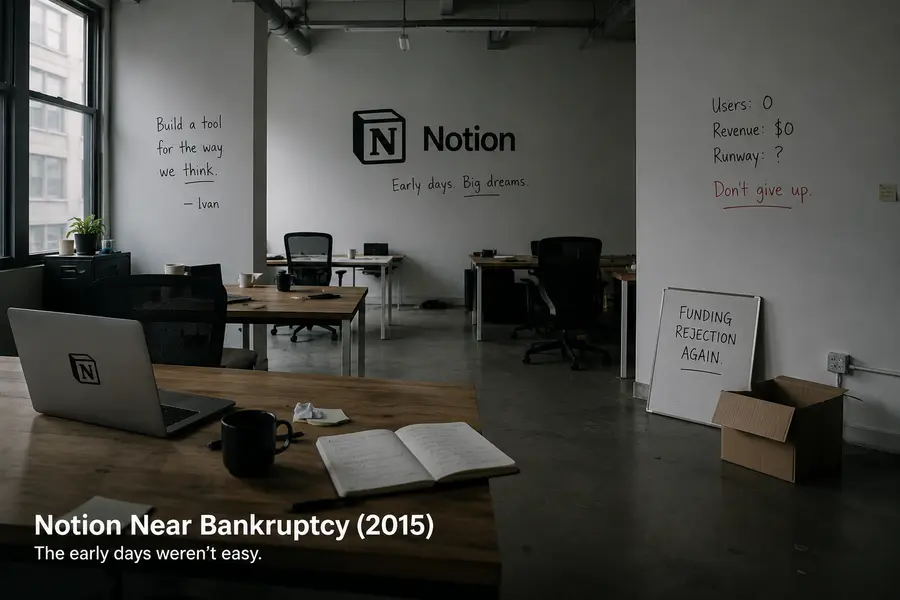
The team at that point was small—four or five people. But small doesn’t mean cheap, not in San Francisco, not in 2015. The city was already deep in one of its periodic rent spirals. Office space was expensive. Engineers commanded high salaries. Every month, the bank account got smaller.
There were no investors lining up. The product hadn’t demonstrated the kind of traction that would make a venture capitalist excited. The market hadn’t reacted the way Zhao and Last had hoped. Three years of work, and Notion had very little to show for it in terms of users or revenue.
At some point, the founders had to face a question that every struggling startup eventually reaches: do we keep going with what we have, or do we change something fundamental?
The team couldn’t survive as constituted. That much was clear from the numbers. Continuing to pay salaries while rebuilding the product was not an option. Something had to give.
So Zhao and Last let their colleagues go. It was a brutal decision—laying off people who had believed in the vision, who had committed their time and energy to building it. But the arithmetic left no room for sentiment. The company had to get smaller to have any chance of getting bigger.
With the team gone, a question remained: what do two founders do when they’ve run out of money, run out of time, and have a product that doesn’t work?
The Decision to Start Over
The decision to rebuild Notion from scratch was not made lightly. Three years of code doesn’t feel like three years of code until you’re thinking about throwing it away. It represents choices, arguments, late nights, breakthroughs, setbacks. It represents the company’s history.
But Zhao and Last had to be honest with themselves about what they had built. The existing codebase was the problem, not just a thing that needed improvement. The instability wasn’t a surface issue that could be fixed with patches. It ran through the architecture. To build something that would actually work—that would actually hold up under real users—they needed to start fresh.
The decision to rebuild also meant a decision about the product’s philosophy. The early Notion had tried to be too many things at once, in a way that made it overwhelming rather than empowering. The new version needed to be simpler. More focused. More immediately useful.
Zhao described the shift as going from building something he wanted to building something people actually needed. That meant resisting the temptation to include every feature, every idea, every capability. It meant choosing what to leave out as much as what to put in.
The risk was enormous. Rebuilding a product from scratch takes time—time that the company’s bank account was not going to fund indefinitely. They needed to be leaner, faster, and smarter than before.
Which is where Japan came in.
Why Ivan Zhao Moved to Kyoto, Japan
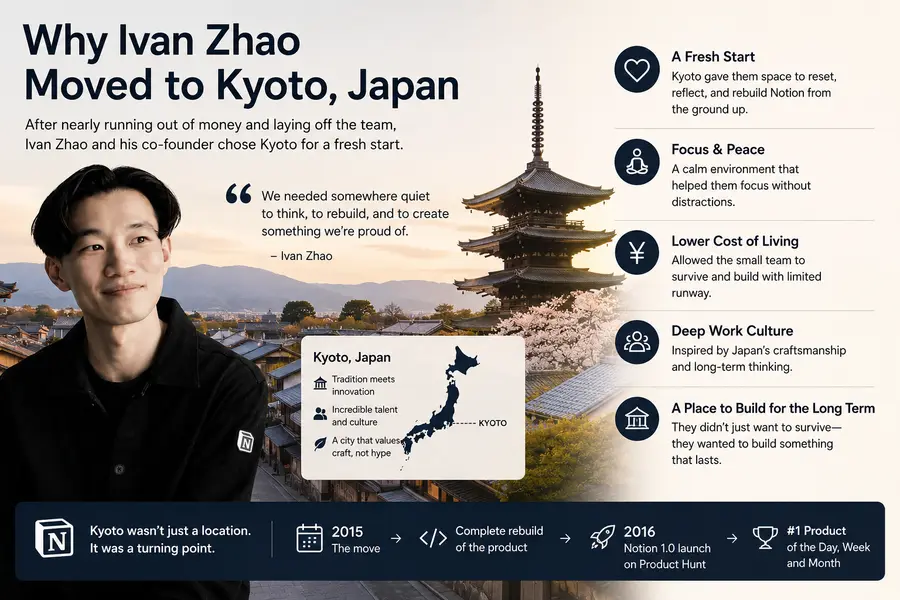
The choice of Kyoto was partly financial and partly philosophical.
San Francisco in 2015 was not a cheap place to be broke. The cost of living was staggering—among the highest in the United States. Every month Zhao and Last spent in the city, even with just two people and a sublet office, was money they couldn’t afford to lose.
Kyoto offered the opposite. The cost of living was roughly half of San Francisco. A modest house could be rented for a fraction of what a small apartment would cost in the Bay Area. Food was cheap. There was no social obligation, no startup scene to network in, no investor meetings to prepare for, no Slack notifications from colleagues who no longer existed.
Zhao framed it simply: “Neither of us spoke Japanese and nobody there spoke English, so all we did was code in our underwear all day.”
That line carries more weight than it might appear. The isolation in Kyoto wasn’t incidental—it was the point. Silicon Valley in 2015 was a relentlessly social place. There were events to attend, connections to maintain, appearances to keep up. All of that took energy, time, and money. In Kyoto, there was none of it. There was the code, and the vision, and nothing else.
The city itself, with its deliberate rhythms and ancient architecture, offered something that Silicon Valley’s frenetic energy could not: quiet. Whether intentionally or not, Zhao and Last had placed themselves somewhere that demanded focus.
They lived, by multiple accounts, like monks. Early mornings, late nights, eighteen-hour days at their laptops. A rented house with paper walls and no heating in a city they navigated with almost zero language. The austerity was total. There was no version of the Kyoto period that resembled startup culture as it was typically understood.
But that was precisely the idea.
Rebuilding Notion From Scratch
In that two-story house, Zhao and Last did what they had come to do: they rewrote Notion from the ground up.
The technical reset was complete. Out went the unstable stack. In came modern web technologies, rebuilt with performance as a non-negotiable priority. The crashes that had plagued the early product would not survive in the new architecture. Offline capabilities were built in. The database engine was redesigned.
But the more profound change was philosophical.
The new Notion was built around simplicity. Not simplicity in the sense of being limited—the vision of a flexible, block-based workspace remained intact. But simplicity in the sense of clarity. Every element of the product had to justify its presence. Everything that confused users, everything that required explanation rather than intuition, had to be reconsidered.
The block-based system that would eventually become Notion’s signature—the ability to mix text, images, tasks, tables, and databases in a single flexible space—took shape during this period. The insight was that users didn’t need a finished product to do a finished job. They needed a set of primitives, like Lego bricks, that they could assemble into whatever structure worked for them.
Pre-built templates became a key feature of the new design. Instead of arriving at a blank page and needing to know what to do with it, users could click a button and start with something that already worked. The flexibility was still there for those who wanted to customize everything. But the initial barrier to entry had been dramatically lowered.
Zhao described the new approach with an analogy he’d return to many times: “sugar-coated broccoli.” People don’t want broccoli. But they’ll eat it if it’s wrapped in sugar. Notion was the broccoli—flexible, powerful, capable of doing genuinely complex things. The sugar was the simplicity and beauty of the interface that made all that power accessible.
Month after month in Kyoto, the new product took shape. Two people, two laptops, a rented house, and a product being born for the second time.
The Launch That Changed Everything
In March 2016—roughly a year after the move to Japan—Zhao and Last had something they were ready to show the world.
Notion 1.0 launched on Product Hunt, the platform where technology enthusiasts discover and vote on new products. The launch was timed carefully and supported by connections in the community, including early angel investor Naval Ravikant, whose Product Hunt profile carried significant weight.
The response was immediate and overwhelming.
Notion 1.0 became Product of the Day. Then Product of the Week. Then Product of the Month. It received more than 2,500 upvotes and thousands of comments from early adopters who felt, finally, that someone had built the tool they’d been waiting for.
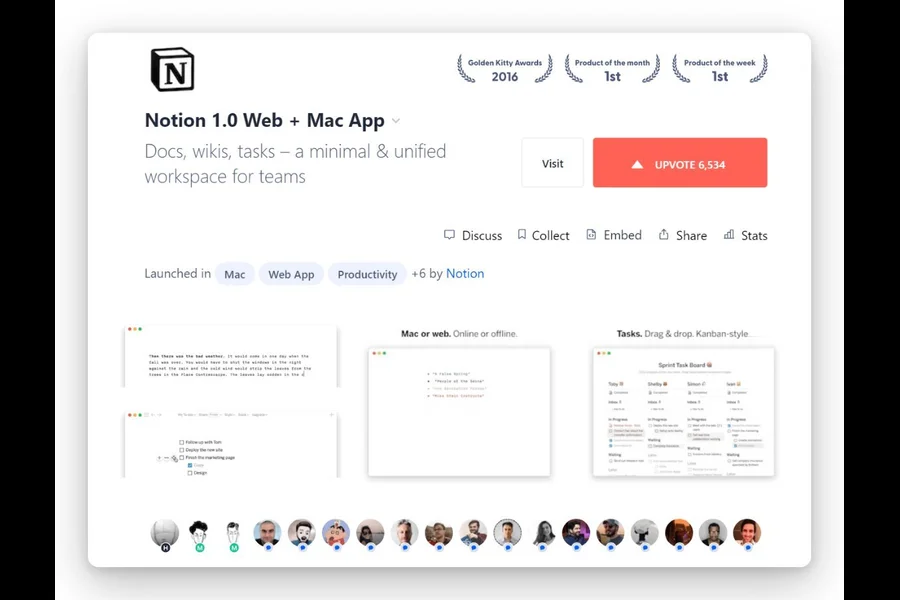
The Golden Kitty Award—Product Hunt’s annual recognition of the year’s best launches—followed. For a company that had spent three years struggling, crashing, and nearly disappearing, this was validation of an entirely different kind.
Ivan wrote about it later, with unmistakable emotion: “At that time, the company was just my co-founder Simon and I, and we were nearly running out of money (thanks mom for the bridge!) If not for the Product Hunt launch and the overwhelming support from this community, we wouldn’t have made it.”
The parenthetical about his mother is easy to skim past. It shouldn’t be. It means that in the final stretch before the launch, when even the reduced living costs of Kyoto weren’t enough, Zhao had borrowed money from his own family to keep the lights on. The launch wasn’t a launch from a stable company. It was a last bet, made with borrowed funds, by two people who had given everything they had.
And it worked.
Notion achieved profitability after the launch. The team started growing again, carefully and slowly. The product that had been rebuilt from nothing had found its people.
How Notion Turned Survival Into Growth
The 2016 launch was validation. What followed was something rarer: genuine product-market fit.
Notion’s growth in the years after the relaunch was almost entirely organic. The company didn’t pour money into advertising. It didn’t hire a big sales force. It grew because people who used Notion couldn’t stop talking about it—on Twitter, in Slack communities, on YouTube, in design and product circles where productivity tools were endlessly debated.
In 2018, Notion 2.0 launched. It added databases to the core platform—tables, Kanban boards, calendars—alongside the existing notes and wiki capabilities. The result, in Ivan’s own words, was the version of Notion he’d always been building toward: “In all honesty, Notion 2.0 is really the 1.0 for us. It finally delivers on our promise—a singular tool that handles all your work outside email and Slack.”
The 2.0 launch hit Number 1 on Product Hunt again. The Wall Street Journal covered it. The community that had been quietly growing exploded into something visible and vocal. People weren’t just using Notion; they were building tutorial channels, creating and selling templates, writing guides, making the product part of their identity.
Notion reached one million users by late 2019—with just eighteen people on the team and no venture capital funding. The company had resisted VC money for years, even as investors came calling after the 2018 momentum. It finally accepted its first institutional funding in July 2019: a $10 million Series A led by Sequoia Capital, at an $800 million valuation.
Then 2020 arrived. The global pandemic reshaped work overnight. Remote teams scrambled for tools that could keep people organized and connected without physical proximity. Notion was exactly what millions of newly distributed workers needed. Usage surged. In February 2020, Index Ventures invested $50 million at a $2 billion valuation—reportedly reaching a deal within 36 hours of Zhao starting the process.
By October 2021, Notion raised $275 million at a $10 billion valuation, led by Coatue and Sequoia Capital. Twenty million users. A decade removed from its founding, eight years from its darkest moment in a cold Kyoto house.
In 2022, Notion introduced AI features to the platform. By 2024, it had crossed 100 million users and was generating $400 million in annual revenue—a 60% increase over the prior year.
The Notion Growth Timeline
| Year | Milestone | Funding | Product Development |
|---|---|---|---|
| 2013 | Notion Labs founded in San Francisco. | ~$2M seed funding from friends, family, and angel investors. | First version of Notion in development. |
| 2015 | Near bankruptcy; team laid off; founders relocated to Kyoto, Japan. | Surviving on remaining seed funds. | Complete codebase rebuild begins. |
| 2016 | Notion 1.0 launches on Product Hunt and becomes #1 Product of the Day, Week, and Month. | Profitable post-launch; bridge loan from Ivan Zhao’s mother. | New block-based architecture introduced. |
| 2017 | Expansion into desktop and mobile ecosystem. | — | Windows and iOS applications released. |
| 2018 | Notion 2.0 launches; featured by The Wall Street Journal; user growth accelerates toward 1 million. | — | Databases, Kanban boards, and calendars added. |
| 2019 | Reached 1 million users and secured first major venture capital investment. | $10M Series A led by Sequoia Capital at an $800M valuation. | Android app released and core product refined. |
| 2020 | Remote work boom drives rapid adoption; Notion becomes a unicorn startup. | $50M Series B led by Index Ventures at a $2B valuation. | Collaboration tools and template ecosystem expanded. |
| 2021 | Surpassed 20 million users worldwide. | $275M Series C/D from Coatue, Sequoia, and others at a $10B valuation. | Major enterprise-focused expansion. |
| 2022 | Introduced AI features and acquired Cron and Flowdash. | — | AI writing assistance and workflow automation capabilities added. |
| 2023 | Public launch of Notion AI and major template gallery redesign. | — | Expanded AI-powered productivity features. |
| 2024 | Reached 100 million users and approximately $400M annual recurring revenue. | Secondary market activity valued the company at roughly $10B+. | Full AI integration across the platform. |
| 2026 | Secondary market financing round completed. | $270M secondary round backed by Bridgespan VC, GIC, Index Ventures, and Sequoia at an ~$11B valuation. | Continued AI innovation and enterprise expansion. |
Frequently Asked Questions
Did Notion almost fail?
Yes. By 2015, three years into building the company, Notion had burned through most of its seed funding, was struggling with a technically unstable product that users didn’t adopt, and had laid off its small team. Founders Ivan Zhao and Simon Last were on the verge of shutting down. They chose instead to move to Kyoto, Japan, cut costs dramatically, and rebuild the product from scratch.
Why did Notion move to Japan?
Primarily for financial reasons: the cost of living in Kyoto was roughly half that of San Francisco, which allowed the founders to stretch their remaining capital. Equally important was the isolation—moving to a city where they had no social connections or professional obligations gave them the environment to focus entirely on rebuilding the product. Ivan Zhao later described the Kyoto period as coding in their underwear eighteen hours a day, with no distractions and no English speakers nearby.
Who founded Notion?
Notion was founded by Ivan Zhao and Simon Last. Zhao studied cognitive science and fine art at the University of British Columbia and worked as a product designer before founding Notion. Last served as the technical co-founder and CTO. The two built Notion together from its 2013 inception through its near-failure in 2015, its Kyoto rebuild, and its eventual rise to a $10 billion valuation.
What happened before Notion became successful?
Notion spent three years building a product that failed to work reliably or resonate with users. The company struggled with an unstable tech stack, poor performance, and a product that was too complex. By 2015, the team had been let go, the San Francisco office had been closed, and the founders had relocated to Japan. They spent roughly a year rebuilding the product completely before the Notion 1.0 launch in 2016.
How did Notion survive?
Notion survived because its founders refused to quit. They radically reduced their costs by moving to Japan, rebuilt the product from scratch with modern technology and a simpler design philosophy, and launched Notion 1.0 on Product Hunt in 2016. That launch succeeded beyond expectations, providing validation, users, and a path to profitability. Ivan Zhao also borrowed money from his mother to bridge the final stretch before launch—a detail that cuts through any mythology and reveals the raw, unglamorous reality of what startup survival actually looks like.
The Rebuild That Became Everything
It is worth returning to the image at the center of this story: two people, a rented house, paper walls, no heat, a foreign city, an empty bank account, and a product being written from nothing.
There was no investor in that house. No PR firm. No growth hacker. No strategy deck. There was a vision, which Zhao had carried for years, and which had not yet found the form that would make it real. And there was the decision—made with whatever combination of desperation and conviction such decisions require—to try one more time.
Most startups that reach that point don’t come back. The rational choice, in many cases, is to stop. The money is gone. The team is gone. The market hasn’t responded. A reasonable person could look at Notion in 2015 and conclude that the experiment had run its course.
Zhao and Last were not, in that moment, being rational. They were being something harder to define: unwilling to let go of a thing they believed was possible. The move to Kyoto was not a strategic calculation—it was the act of founders who had no better options and weren’t ready to accept the worst one.
What they built in that house, over those months of eighteen-hour days in a city that offered nothing but silence and cheap rent, eventually became the tool that 100 million people use to organize their work and lives. It became the product that reshaped how people think about productivity software. It became, by any measure, one of the more remarkable software companies of its generation.
That arc—from a cold house in Kyoto to a $10 billion company—didn’t happen because of clever strategy or perfect timing or the right investors. It happened because two people, down to almost nothing, chose to rebuild instead of quit.
The product they built in that silence turned out to be exactly what the world needed. They just had to get quiet enough to find it.
Disclaimer
This article is intended for informational purposes only. While every effort has been made to ensure the accuracy of the information presented, details regarding Notion’s history, funding, and growth are based on publicly available sources and may not reflect the company’s complete or official account. StartupOrigins is not affiliated with Notion Labs, Inc. or any of its founders, investors, or partners. All trademarks and company names mentioned are the property of their respective owners.

Anup Kumar Yadav is the founder of StartupOrigins.xyz, where he researches and publishes detailed stories about the world’s most successful startups. His work explores founder journeys, funding milestones, growth strategies, and the lessons entrepreneurs can learn from them.