
In late 2012, a repurposed yellow school bus pulled into a parking lot in Georgetown, Washington, D.C., its interior gutted and rebuilt to look like a small reading room, complete with an optician’s station parked outside on the sidewalk. It was on its way to visiting more than a dozen cities over roughly six months, part of a touring pop-up called the Warby Parker Class Trip. The company running it had built its entire reputation on the idea that customers didn’t need a physical store to buy glasses — that the whole point of Warby Parker was to prove eyewear could be sold well over the internet, without the overhead of retail. And yet here it was, driving a bus around the country because it wanted to know, city by city, where people might actually show up to shop in person.
- The Internet Solved the Price Problem — but Created a Trust Problem
- Home Try-On Turned a Weakness Into a Growth Engine
- When Word of Mouth Started Doing the Marketing
- The Unexpected Discovery That Customers Wanted Stores
- Why an Online Disruptor Started Opening Stores
- The Growth Decision That Changed Warby Parker Forever
- Why Warby Parker’s Online-to-Offline Strategy Was Harder to Copy Than It Looked
- The Part of Warby Parker’s Growth Story That DTC Startups Often Miss
- Going Public Changed the Growth Equation
- Warby Parker in 2026: Did the Strategy Work?
- Frequently Asked Questions
- Sources & Further Reading
Eighteen months later, in April 2013, the company opened a permanent, 2,000-square-foot store in New York’s SoHo neighborhood. By 2026, it operated more than 320 stores, with a stated goal of exceeding 900. The company that set out to bypass physical retail had become, in a very literal sense, a physical retailer. Understanding how Warby Parker grew from that starting point into an omnichannel brand means answering a more interesting question than whether that’s a contradiction. It’s why it wasn’t.
Company Snapshot · FY2025 / Early 2026
Warby Parker at a Glance
Key facts, financial performance, customer growth and retail expansion figures for Warby Parker, one of the best-known direct-to-consumer eyewear brands in the United States.
- Founded
- 2010 in Philadelphia, Pennsylvania
- Founders
- Neil Blumenthal, Dave Gilboa, Andrew Hunt and Jeffrey Raider
- Headquarters
- New York, New York
- Stock ticker
- NYSE: WRBY Direct listing completed September 29, 2021
- FY2025 net revenue
- $871.9 million +13.0% YoY
- FY2025 Adjusted EBITDA
- $95 million ~30% YoY growth
- Store count
- 323 stores across 102 markets as of December 31, 2025
- Stores opened in 2025
- 47 stores — a company record
- Active customers
- Approximately 2.7 million +7% YoY
- Average revenue per customer
- $310 in Q1 2025
- Estimated U.S. market share
- Approximately 1.3% of an estimated ~$70 billion U.S. eyewear market
- Long-term store target
- More than 900 U.S. locations
The Internet Solved the Price Problem — but Created a Trust Problem
How Warby Parker started selling glasses directly to consumers online is its own story, one StartupOrigins has told in detail elsewhere. What matters for this article is the problem that founding decision immediately created. Eyewear isn’t a book or a phone charger. It sits on a customer’s face, has to match a specific prescription, and factors heavily into how that person looks and feels in front of other people every day. Getting the fit and the look right, historically, required trying frames on in a store, under a salesperson’s guidance, in front of a mirror.
Warby Parker’s founders had removed the cost structure that made expensive eyewear expensive — the licensing fees, the wholesale markups, the retail middlemen — but in doing so, they’d also removed the one thing that made customers comfortable buying glasses in the first place. Less than 2.5 percent of U.S. eyewear sales happened online at the time of the company’s 2010 launch, and that wasn’t simply because nobody had tried; it reflected genuine consumer hesitation about a fit-dependent, personal purchase. A cheaper pair of glasses nobody trusted enough to order was still a pair of glasses nobody would buy.
Home Try-On Turned a Weakness Into a Growth Engine
The mechanism Warby Parker built to solve that problem is by now well known, but it’s worth being precise about why it worked rather than simply noting that it existed. The Home Try-On program let customers select up to five frames on the website, receive them by mail at no cost, wear them around the house for five days, and ship back whatever they didn’t want — with no payment required until they decided to buy. It didn’t ask customers to trust a photograph or a size chart. It let them put the physical object on their actual face before spending a dollar, which was the entire transaction the traditional optical showroom had always provided, just relocated to the customer’s own bathroom mirror.
That mattered because it addressed the specific point of hesitation, rather than a generic one. It’s easy to build free shipping or a generous return policy into an e-commerce business; those reduce financial risk. Home Try-On reduced decision risk — the fear of guessing wrong on something as visible and personal as your own face — which is a different problem and a harder one to solve with a return policy alone. Within days of the company’s February 2010 launch, demand for the program was heavy enough that the founders temporarily suspended it just to catch up on the backlog of five-frame boxes going out the door, according to Neil Blumenthal’s own account of that period. That’s a strange problem for a young company to have — too much interest in the exact tool meant to build trust — but it’s a clear signal the mechanism was doing its job.
When Word of Mouth Started Doing the Marketing
It would be inaccurate to say Warby Parker grew without any marketing spend; the company invested in public relations from the outset, and its founders actively courted press attention before launch, including the GQ and Vogue features that ran the same week the site went live in February 2010. What’s more defensible is that its earliest growth relied disproportionately on unpaid channels relative to what a typical retail launch would require — press coverage, referrals, and social sharing driven by a product genuinely built to be talked about.
Home Try-On helped here too, in a way that was more structural than incidental. A box of five frames arriving at someone’s apartment is, by design, a shareable moment: friends compare which pair looks best, people photograph themselves in options they’re deciding between, and some of those friends request boxes of their own. Company estimates cited in later interviews suggested roughly half of Warby Parker’s traffic in its first several years came through word of mouth rather than paid acquisition — a genuinely unusual ratio for a retail startup, though one that reflects a specific moment in the company’s history rather than a permanent feature of its growth. As the company matured, and particularly as it approached its 2021 public offering, its own disclosures describe a much more conventional mix of paid and organic acquisition, and by 2024 leadership was explicitly discussing “years of spending pullback” on marketing and a decision to increase it again to drive brand awareness. The early word-of-mouth advantage was real. It was not, and was never intended to be, a permanent substitute for marketing spend.
The Unexpected Discovery That Customers Wanted Stores
Here the record resists the tidy version of the story. Warby Parker didn’t decide to build a national store network because a market study told it to. It backed into physical retail almost apologetically, and only expanded once the results made the case on their own.
The first hint came almost immediately after the chaotic 2010 launch. With the Home Try-On program overwhelmed and customers unable to get frames fast enough, some began calling the company directly to ask if there was anywhere they could go to try glasses on in person. There was, technically: Neil Blumenthal’s apartment, which briefly doubled as an informal showroom. When the founders leased their first proper office in New York, they deliberately built in enough open floor space to let customers browse frames on-site — not a retail strategy so much as a stopgap for a problem the company hadn’t anticipated.
Over 2011 and 2012, the company tested the idea more deliberately, but still cautiously. It rented a vacant Manhattan garage over the 2011 holiday season and filled it with frames, coffee, and other local vendors under the name the Warby Parker Holiday Spectacle Bazaar. In October 2012, it bought and gutted an old yellow school bus, rebuilt it to resemble a small library, and sent it on the road as the Warby Parker Class Trip, stopping in more than a dozen cities over roughly fifteen months with a stylist and an optician riding along. Dave Gilboa later described the purpose plainly: the company wanted to find out which cities responded well enough to justify a permanent lease. It wasn’t testing whether physical retail could work in the abstract. It was using a school bus as a low-commitment way to answer a specific real-estate question before signing anything long-term.
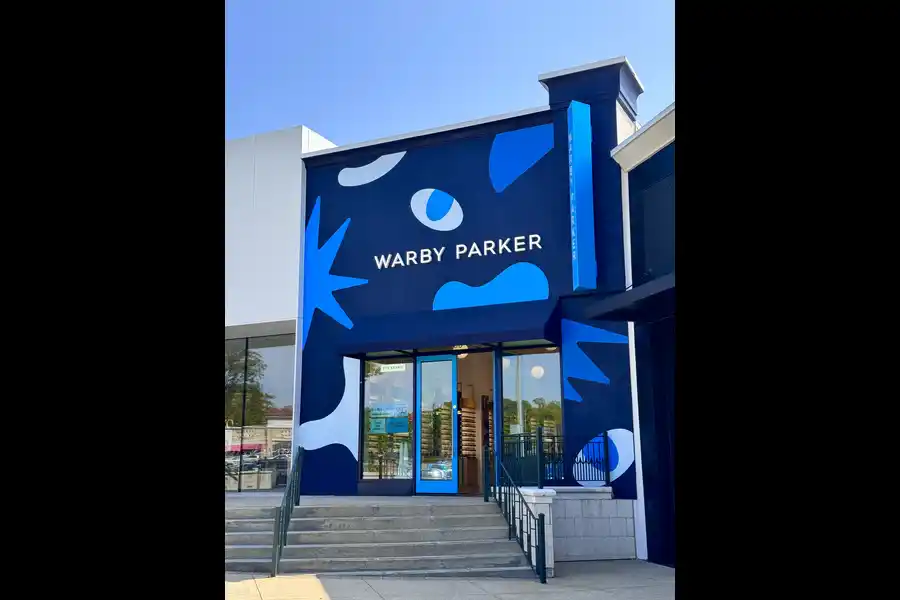
The SoHo store that opened in April 2013 was, by that measure, a calculated bet rather than a leap of faith — informed by eighteen months of pop-ups and one very unusual bus tour. But even the founders seem to have underestimated what they’d built. Gilboa told The Wall Street Journal in early 2015 that the company’s earliest retail locations had already covered their own launch costs and were “a meaningful driver of sales and profitability,” language he described as genuinely unexpected. Warby Parker’s stores were, by the company’s own later disclosures, generating close to $3,000 in sales per square foot — a figure that placed them near Tiffany & Co. and not far behind Apple, long considered the gold standard for retail productivity, at a time when most specialty retailers were producing a fraction of that.
Why an Online Disruptor Started Opening Stores
The “customers wanted stores” explanation is true but incomplete. What Warby Parker’s own disclosures and executive commentary point to is a set of overlapping economic advantages that a story about consumer preference alone doesn’t fully capture.
Stores turned out to double as extremely effective marketing. A retail location in a neighborhood functions as a constant, physical advertisement, and Warby Parker has said as much directly in SEC filings, describing its stores as “valuable marketing vehicles for introducing new customers to our brand and driving repeat purchases.” That’s a different justification than “some customers prefer to shop in person” — it’s an argument that the store itself lowers the cost of acquiring customers who may never buy anything inside it, some fraction of whom go home and order online instead.
Stores also opened a second, structurally important revenue line: prescriptions and eye exams. An online retailer can sell frames, but it can’t perform a comprehensive eye exam or issue a new prescription, which meant Warby Parker was excluded from a meaningful share of eyewear purchases that begin with “I need to see an optometrist” rather than “I want new glasses.” By 2024, roughly 80 percent of its stores offered eye exams, and eye care and contact lenses had grown into revenue categories with distinct, faster growth rates than the core glasses business — 40 percent year-over-year growth in eye care revenue in the first quarter of 2025 alone, according to the company’s own results. None of that is available to a website.
And stores improved unit economics on the customer relationship itself, not just the transaction. The company has reported that its Average Revenue per Customer climbed steadily as the store network expanded and diversified — from $287 in the fourth quarter of 2023 to $296 a quarter later to $310 by the first quarter of 2025 — a trend management has tied explicitly to higher-margin frame and lens sales and to the cross-sell effect of in-person exams. It would be an overstatement to attribute all of that growth to stores alone; broader product mix shifts and pricing changes played a role too. But the direction and timing track closely with the retail expansion, and the company’s own commentary treats the two as connected.
The Growth Decision That Changed Warby Parker Forever
If there’s a single decision in this story that deserves to be studied on its own, it’s not the choice to open a store. It’s the choice, made sometime between the Class Trip bus tour and the 2015 profitability comments, to treat physical retail as a core growth strategy rather than a supplementary convenience for the customers who insisted on it.
Staying online-only had been, by design, the whole point. It was cheaper to run, it matched the company’s founding critique of an industry weighed down by rent and retail overhead, and it let a four-person team scale without the operational complexity of managing store leases, staff, and inventory across dozens of locations. The limitation that emerged wasn’t that online sales stalled — they didn’t — but that a meaningful category of demand simply sat outside what an e-commerce-only company could capture: people who wanted to try before buying without shipping a box back and forth, people who needed an actual eye exam, and people who had never heard of Warby Parker at all and needed to encounter the brand somewhere in the physical world before they’d consider ordering from it online.
The risk in committing further to stores was substantial, and it was the risk that had defined the entire eyewear industry the founders had set out to disrupt: rent, staff, inventory sitting on shelves, all the fixed costs a direct-to-consumer model exists to eliminate. Opening a national store network meant reintroducing, deliberately, a version of the cost structure Warby Parker’s entire origin story was built around avoiding. What made that bet defensible rather than contradictory was the productivity data: if a Warby Parker store could generate sales per square foot approaching Apple’s, the overhead was no longer a concession to tradition. It was simply a second, highly efficient channel.
What happened afterward is a matter of record, and the pace is easier to see laid out year by year than buried in a single sentence:
| Milestone | Date | Store count |
|---|---|---|
| First permanent store (SoHo, NYC) | April 2013 | 1 |
| Post-Series D expansion | 2015 | ~20 |
| Pre-IPO footprint | Mid-2021 | 145+ |
| End of fiscal 2023 | Dec. 2023 | 237 |
| End of fiscal 2024 | Dec. 2024 | 276 |
| End of fiscal 2025 | Dec. 2025 | 323 |
| Long-term target | — | 900+ |
Retail revenue growth consistently outpaced e-commerce growth in most recent quarters — 24 percent versus 2 percent in the first quarter of 2024 alone. By 2025, management was describing a long-term opportunity for more than 900 U.S. locations, still a small fraction of the roughly 41,000 optical retail stores operating in the country. The decision to build stores didn’t abandon the direct-to-consumer thesis. It expanded what “direct” meant.
Why Warby Parker’s Online-to-Offline Strategy Was Harder to Copy Than It Looked
By the mid-2010s, plenty of direct-to-consumer startups were opening stores of their own, and it became fashionable to describe brick-and-mortar retail as simply the next stage every DTC brand would eventually reach. Warby Parker’s version was harder to replicate than that framing suggests, for reasons that have less to do with real estate strategy and more to do with what the company controlled before it opened a single store.
Warby Parker designs its own frames and, since 2017, has increasingly manufactured lenses through its own optical labs rather than relying entirely on third-party partners — a vertically integrated model that gives it direct control over cost, quality, and delivery timing in a way that companies simply licensing or reselling existing eyewear brands don’t have. That mattered once stores entered the picture, because it let Warby Parker price consistently across channels and fill store inventory from the same supply chain feeding its website, rather than negotiating with outside vendors for retail-specific stock.
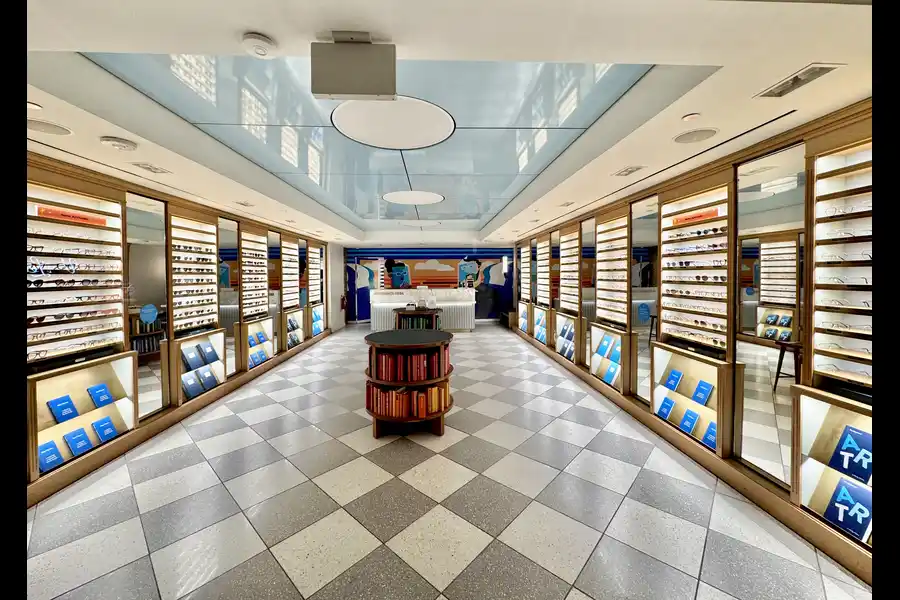
The brand itself functioned as another layer of defense. A retailer selling other companies’ frames at a discount can be undercut by another retailer doing the same thing with a lower price or a better location. Warby Parker’s frames are its own design, sold under a name and an aesthetic — vintage-inspired shapes, a literary reference buried in the company name, an unmistakable in-store look built around library and reading-room motifs — that a competitor can imitate but not license or acquire. Buy a Pair, Give a Pair, the company’s giving model, reinforced that same differentiation on the mission side, tying the brand to a cause in a way that pure price competition doesn’t easily erode.
None of this made Warby Parker’s retail strategy unbeatable. Its central and most enduring competitive obstacle is EssilorLuxottica, the vertically integrated eyewear conglomerate formed by the 2018 merger of Luxottica and Essilor, which controls a substantial share of global frame manufacturing, lens production, and licensing relationships with major fashion houses — advantages of scale that a company Warby Parker’s size cannot easily match. Warby Parker has also had to compete with lower-priced online-only rivals like Zenni Optical and EyeBuyDirect on pure price, a fight it generally does not try to win. Its defensibility rests less on being unbeatable than on being difficult to copy quickly, across design, supply chain, brand, and retail simultaneously, rather than on any one of those factors alone.
The Part of Warby Parker’s Growth Story That DTC Startups Often Miss
Much of the direct-to-consumer playbook that emerged in the 2010s rested on a simple equation: eliminate physical stores, sell online, strip out the overhead that stores require, and use the savings to either lower prices or fund faster customer acquisition. Warby Parker’s own history is frequently cited as an example of that formula working — and in its first several years, it did. What tends to get left out of the case study is what happened next.
The company’s growth didn’t plateau because digital acquisition became too expensive, exactly, though rising customer-acquisition costs across digital advertising in the 2010s were a real industry-wide pressure. It plateaued against a subtler ceiling: a meaningful share of the eyewear market simply wasn’t reachable through a website alone, no matter how good the website was. People who wanted an eye exam, people unfamiliar with the brand who needed to encounter it physically before trusting it with a purchase, people who wanted to try on frames without the five-day round-trip of a Home Try-On box — all of that demand existed regardless of how well Warby Parker executed online.
The nuance worth taking from this isn’t that physical retail always wins, or that every DTC brand should rush to open stores. Warby Parker’s e-commerce business remained substantial throughout this period — roughly 60 percent of net revenue as recently as 2021 — and the company has continued investing in improving it, including a return to faster e-commerce growth in 2024 and 2025 after a period of reduced marketing spend. The real lesson is closer to this: the choice between “online” and “stores” was never really the choice Warby Parker was making. It was choosing which parts of the customer’s actual decision-making process — discovery, trust-building, fitting, prescription verification, purchase, and repeat purchase — could be handled digitally, and which genuinely required a physical presence, then building channels for each rather than picking one model and forcing every customer through it.
Going Public Changed the Growth Equation
Warby Parker went public on September 29, 2021, through a direct listing on the New York Stock Exchange under the ticker WRBY, joining a short list of companies including Spotify and Coinbase that had used that path rather than a traditional IPO. Shares opened at $54.05 against a $40 reference price and closed the day up 36 percent, giving the company an initial market valuation above $6 billion.
Going public didn’t change what Warby Parker was selling, but it changed what the company had to report, and how quickly the market expected results to show up in a P&L rather than in a growth narrative. Warby Parker posted a net loss of $63.2 million in fiscal 2023 on revenue of $669.8 million, and a smaller net loss the following year even as revenue climbed to $771.3 million — figures that were entirely visible, quarter by quarter, to public shareholders in a way that a private company’s early losses never are. The pressure this created was not subtle: investors wanted to see the store-expansion and vision-care investments the company had been making since the mid-2010s actually convert into GAAP profitability, and the stock traded well below its opening-day price for extended stretches while that conversion took longer than some had hoped.
That conversion arrived in stages rather than all at once. The company reported its first quarter of positive GAAP net income as a public company in the first quarter of 2025, and closed out the full 2025 fiscal year with net revenue of $871.9 million, up 13 percent year-over-year, alongside its first full year of net income profitability as a public company. Being public didn’t slow the store expansion — the company opened a record 47 stores in 2025 — but it did impose a discipline that a founder-run private company can defer almost indefinitely: proving, on a predictable public timeline, that the growth was paying for itself.
Warby Parker in 2026: Did the Strategy Work?
Separating Warby Parker’s operating performance from its stock-market valuation matters here, because the two tell somewhat different stories. On operations, the record through the first half of 2026 is genuinely strong: full-year 2025 revenue of $871.9 million, up from $669.8 million just two years earlier; a store count of 323 locations across 102 markets, with 47 opened in 2025 alone, the most in any year in the company’s history; active customers up to roughly 2.7 million; and adjusted EBITDA of $95 million, up 30 percent year-over-year. First-quarter 2026 results showed continued growth, with net revenue up 8.3 percent year-over-year to $242 million, alongside expansion into new categories including sport-focused eyewear and a partnership with Google and Samsung on AI-enabled smart glasses. By the company’s own accounting, it still holds only about 1.3 percent of the roughly $70 billion U.S. eyewear market, leaving, by its own telling, a long runway ahead.
On valuation, the picture is less triumphant. Warby Parker’s stock has spent long stretches trading below its 2021 direct-listing price, and its cumulative shareholder return since going public has lagged behind broader retail and consumer peer indices through year-end 2024, according to the company’s own compensation disclosures. That gap between steady operating improvement and a stock price that hasn’t fully caught up to it isn’t unique to Warby Parker among direct-to-consumer companies that went public in 2021, but it’s a real part of the story rather than a footnote to it.
What the strategy did prove, on the operating side, is that the trade-off Warby Parker made — reintroducing physical overhead into a business built to avoid it — paid for itself and then some, provided the stores were productive enough to justify the fixed costs and tightly enough integrated with the online business to reinforce it rather than compete with it. That, in the end, is how Warby Parker grew: not by choosing stores over the internet, but by refusing to treat the choice as final. Whether that translates into the kind of investor enthusiasm that met the company’s direct listing in 2021 remains, five years later, an open question rather than a settled one.
For the founder-level decisions and personal history that shaped this company’s early direction, see Neil Blumenthal’s founder journey. And for the broader principles other startup founders have drawn from Warby Parker’s evolution, see the upcoming StartupOrigins piece, What Warby Parker Teaches Every Startup Founder.
Frequently Asked Questions
How did Warby Parker grow?
Warby Parker grew by pairing its original online, direct-to-consumer model with an expanding network of physical stores, which turned out to generate high sales per square foot, support prescription and eye-exam services e-commerce alone couldn’t offer, and function as low-cost brand marketing in the neighborhoods where they opened.
Why did Warby Parker become successful?
Its early success came from combining lower prices with the Home Try-On program, which let customers try frames at home before buying and addressed the specific trust problem online eyewear sales faced. Its longer-term growth came from adding physical retail, eye care, and contact lenses to that original model.
What is Warby Parker’s business model?
Warby Parker designs and manufactures its own eyewear, sells it through both its website and its own physical stores, and increasingly offers eye exams and contact lenses alongside glasses, using a vertically integrated supply chain to keep prices lower than traditional optical retailers.
Does Warby Parker sell only online?
No. As of 2025, Warby Parker operated 323 physical stores across the U.S. and Canada, and retail sales have generally grown faster than e-commerce sales in recent years.
Why did Warby Parker open physical stores?
Early customers began asking to try glasses on in person shortly after the company’s 2010 launch. Warby Parker tested pop-ups and a touring bus store before opening its first permanent store in 2013, and expanded once those stores proved highly productive and supported services, like eye exams, that an online-only business couldn’t provide.
How does Warby Parker’s Home Try-On program work?
Historically, customers selected up to five frames online, received them by mail for free, wore them for five days, and returned whichever they didn’t want at no cost. Warby Parker announced in 2025 that it would sunset the program, citing its expanded store network and improved virtual try-on tools as replacements.
When did Warby Parker go public?
Warby Parker went public via a direct listing on the New York Stock Exchange on September 29, 2021, under the ticker symbol WRBY.
Sources & Further Reading
- Warby Parker 10-K, fiscal year 2025 (SEC filing via StockTitan)
- Warby Parker Q1 2025 results (BusinessWire)
- Digital Commerce 360 — Warby Parker Q1 2024 and Q1 2025 ecommerce coverage
- Retail Dive — Warby Parker fiscal 2023 results and 2024 outlook
- Fast Company — “Warby Parker Stores Are Profitable, Cofounder Dave Gilboa Says” (2015)
- CNBC — Warby Parker and Allbirds betting on stores ahead of public debuts (2021)
- Inc. — “How Warby Parker Reinvented Retail”
- The Philadelphia Inquirer — Warby Parker Class Trip bus feature (2016)
Disclaimer: This article was independently researched and written by the StartupOrigins editorial team using Warby Parker’s SEC filings, investor communications, and reporting from established business and retail publications. It is not affiliated with or endorsed by Warby Parker Inc. Figures reflect the most recent reliable disclosures available as of August 2026 and are subject to change; readers should consult Warby Parker’s investor relations materials for current financial information.

Anup Kumar Yadav is the founder of StartupOrigins.xyz, where he researches and publishes detailed stories about the world’s most successful startups. His work explores founder journeys, funding milestones, growth strategies, and the lessons entrepreneurs can learn from them.