
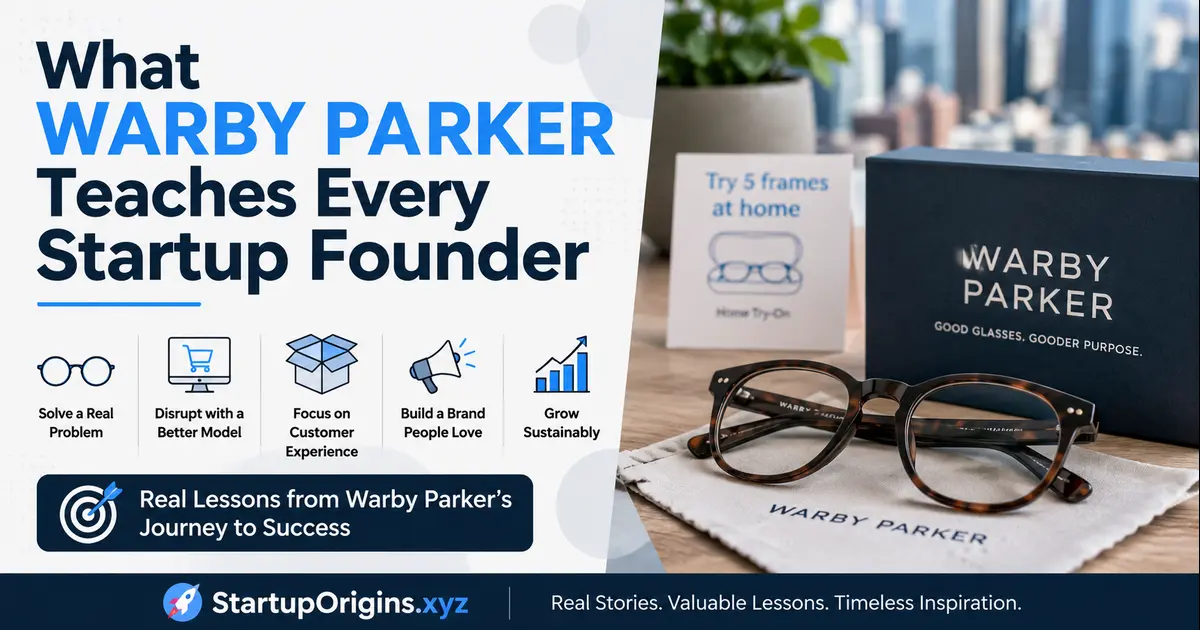
A startup built to challenge traditional eyewear retail eventually discovered that physical stores could strengthen the very business that began online. In August 2025, Warby Parker’s executives told analysts they were sunsetting Home Try-On, the free five-frame mail program that had defined the brand since its 2010 launch. The reason wasn’t that the idea had failed — it was that the company now had more than 300 stores, and most people requesting Home Try-On kits already lived a short drive from one. The tool that once solved the company’s biggest problem had been quietly solved by something else the company built afterward.
That’s the tension worth sitting with before any list of “lessons.” Warby Parker didn’t abandon its founding idea. It abandoned a tactic that had served that idea for fifteen years, the moment a better tactic existed. Great founders don’t stay loyal to their original business model simply because it worked first. They stay loyal to the customer problem. That distinction — between defending a model and defending a mission — is really what Warby Parker teaches every startup founder willing to look past the highlight reel. Warby Parker’s history, covered in full in how Warby Parker started and how Warby Parker grew, is a twenty-year argument for that distinction. This piece is about what that argument means for someone building a company right now.
Lesson 1: Solve an Expensive Problem Customers Already Understand
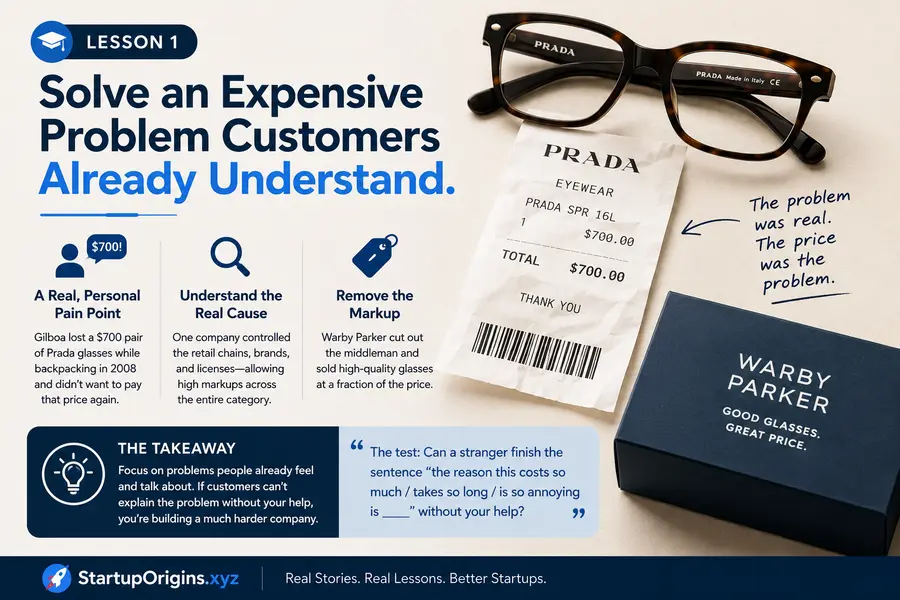
Gilboa’s own entry point into the idea was personal and mundane: he lost a $700 pair of Prada glasses on a backpacking trip in 2008, right before starting his MBA, and balked at replacing them at that price. That single receipt is the whole insight in miniature. The founders didn’t have to convince anyone that glasses mattered or that $700 felt wrong — every one of their Wharton classmates had lived some version of that same math. What they had to do was explain why the price was that high, and the answer, once Gilboa worked it out, was structural: a single company owned the dominant retail chains, several major brands, and the licenses for luxury labels like Prada, which let it hold markups across the entire category rather than face price competition anywhere in the chain.
That distinction — a known problem with an identifiable cause, versus a problem nobody has named yet — is why Warby Parker’s founding is a poor template for “find a big market” and a good template for “find a specific, explainable markup.” The founders never had to run an education campaign. They ran an explanation campaign: here is why your $700 glasses cost $700, and here is the exact mechanism we’re removing. A startup solving an already-understood pain point can spend its early capital on product and trust-building. A startup that first has to convince someone a problem exists has to spend that same capital on education before it ever gets to sell anything — a materially more expensive and slower path, no matter how large the eventual market looks on a slide.
The test this suggests for a founder today isn’t “is this a big market.” It’s whether a stranger can finish the sentence “the reason this costs so much / takes so long / is this annoying is _” without your help. If they can’t, you’re building demand from zero, which is a different and harder company than the one Warby Parker built.
Lesson 2: Don’t Just Lower the Price — Remove the Reason Customers Are Afraid to Buy
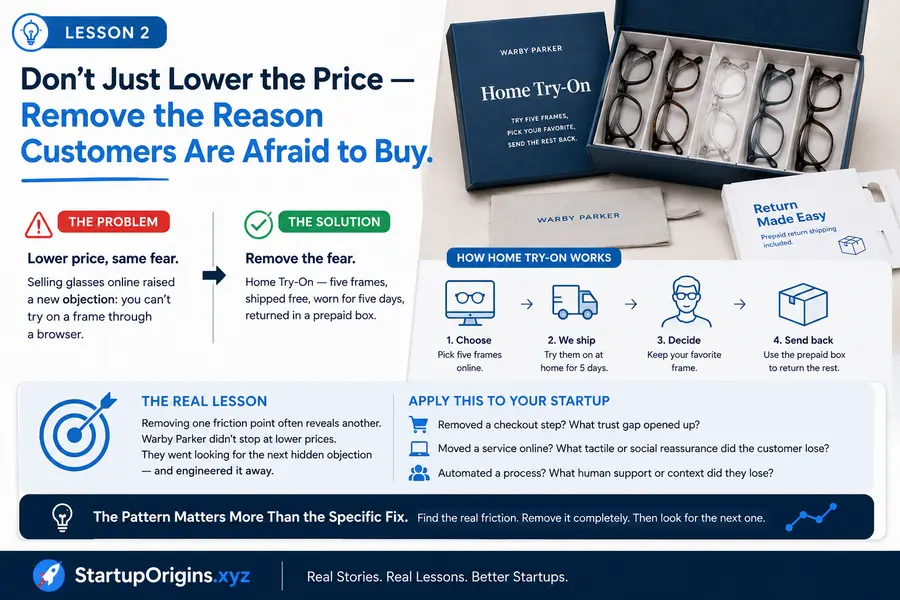
Selling glasses online at a lower price didn’t fix the purchase. It surfaced a new objection: you can’t try on a frame through a browser. Classmates warned the founders about exactly this before launch. The team’s answer was Home Try-On — five frames, shipped free, worn for five days, returned in a prepaid box.
The lesson isn’t “offer free trials.” It’s that removing one friction point in a business often creates a second, less visible one, and the founders who win are the ones who go looking for it instead of declaring victory at the first fix. Warby Parker’s team treated “customers can’t try glasses on” as a design problem to be solved with logistics, not as an inherent limitation of selling eyewear online that they’d have to live with. That’s a meaningfully different posture than most startups take toward their own weak points, which tend to get explained away in the pitch deck rather than engineered around.
The generalizable move for a founder today: after you remove your category’s most obvious friction, go find the friction your removal just created. If you cut a checkout step, what new trust gap opened up? If you moved a service online, what tactile or social reassurance did the customer lose? The pattern matters more than the specific fix.
Lesson 3: Distribution Can Be Part of the Product
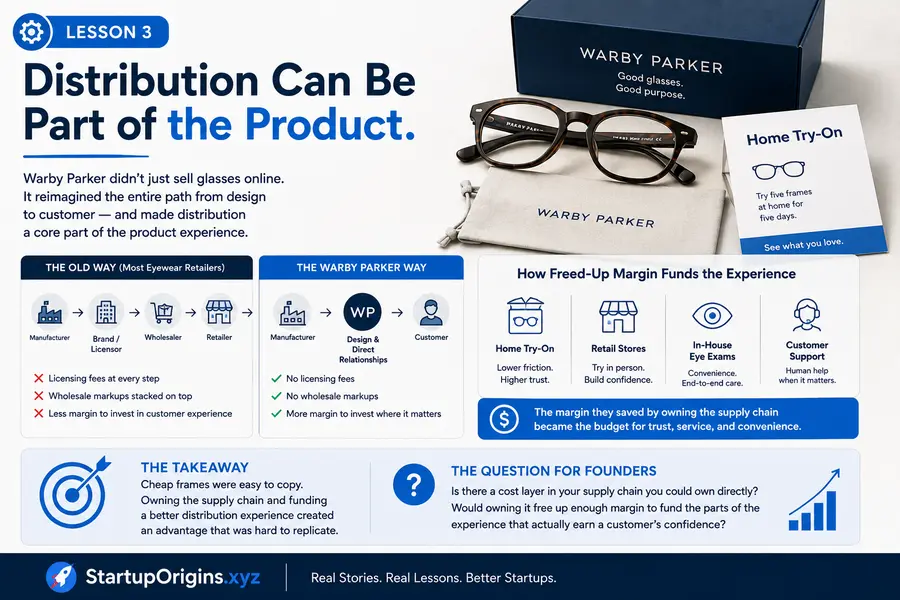
Consider what Warby Parker chose to own versus what it chose to outsource. It built its own design team and its own direct relationships with manufacturers in Italy, Japan, and China — the same factories, in some cases, that supply Luxottica-owned brands — rather than licensing existing frame designs or buying wholesale, which is how most eyewear retailers before it operated. That single choice is why the company could hold a $95 price and still fund the logistics of Home Try-On, a store network, and in-house eye exams: the margin it freed up by cutting out licensing fees and wholesale markups became the budget for everything downstream that made the product easier to trust.
That’s a different sequence than most founders run. The instinct is usually to treat manufacturing and sourcing as a cost to minimize so more budget is available for marketing and customer acquisition. Warby Parker inverted it: it spent on owning the supply chain first, and that spending is what paid for the distribution experience — try-on, stores, service — that became the actual point of differentiation once every competitor could also sell frames for under $100 online. Cheap frames were replicable within a couple of years. A vertically integrated supply chain funding a trust-building distribution layer was not.
The transferable question isn’t “should I open stores” or “should I build my own logistics.” It’s whether there’s a cost layer in your supply chain you could own directly, and whether owning it would free up enough margin to fund the parts of the experience that actually earn a customer’s confidence.
Lesson 4: Your Original Business Model Isn’t Sacred
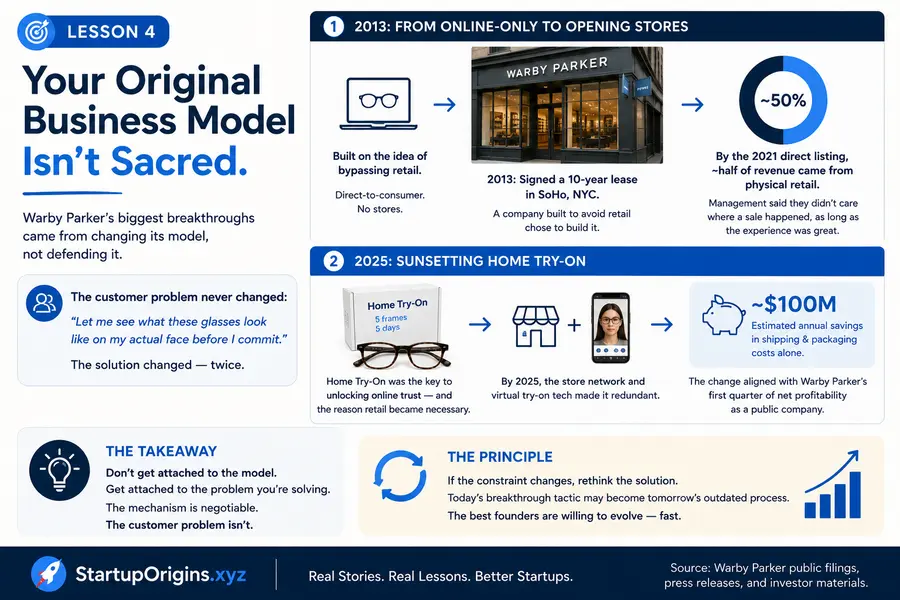
This is the sharpest lesson in Warby Parker’s history, and it shows up twice.
The first time was 2013, when a company that had built its entire identity on bypassing physical retail signed a ten-year lease in SoHo — a decision covered in more depth below. By the company’s direct listing eight years later, roughly half its revenue came from physical retail, and management was telling investors it didn’t particularly care which channel a sale came through, as long as the experience was good.
The second time was 2025. Home Try-On — the program that had made the retail pivot necessary to build out in the first place — was discontinued once the store network and virtual try-on technology made it redundant. A retail consultant estimated the shift could save the company close to $100 million a year in shipping and packaging costs alone, and the change coincided with Warby Parker’s first quarter of net profitability as a public company.
Put those two decisions side by side and the pattern is obvious: the customer problem — let me see what these glasses look like on my actual face before I commit to them — never changed. The solution did, twice, because the constraints around solving it changed. Founders get emotionally attached to labels like “we’re a DTC company” or “we’re subscription-first” because the label is what got them their first customers and their first round of funding. Warby Parker’s history argues that the label was never the asset. The mechanism for solving the customer’s problem was always negotiable; the problem itself wasn’t.
Lesson 5: Brand Is More Than Advertising
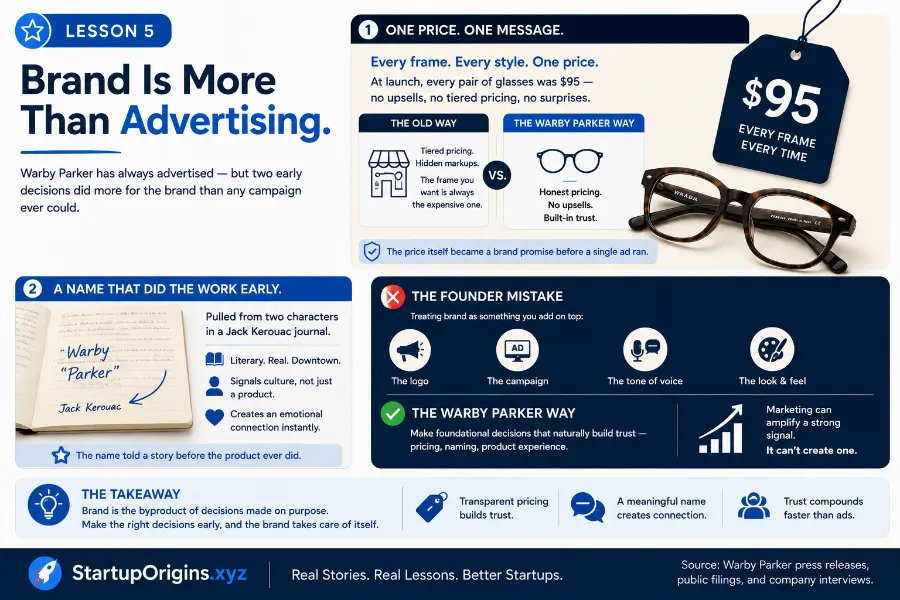
Warby Parker has always advertised — it isn’t a company that grew purely on word of mouth, and it would be inaccurate to claim otherwise. But one decision did more for the brand than any campaign could have: the choice to price every frame the same, regardless of style, material, or how coveted a particular design became.
That single, flat number — $95 at launch — functioned as a brand signal every time a customer compared it to a traditional optical shop’s tiered pricing, where the frame you actually wanted was always somehow the expensive one. It told the customer the company wasn’t going to upsell them, before a single ad ever made that claim. The name itself did similar work before the product did: pulling “Warby” and “Parker” from two characters in a Jack Kerouac journal signaled a literary, downtown sensibility that a traditional eyewear brand’s name — usually a founder’s surname or a manufactured-sounding trademark — never could. Neither decision cost anything to execute. Both did more to shape how the company was perceived than a media buy would have at the same stage.
The mistake founders make is treating brand as the layer applied on top of the business — the logo, the campaign, the tone of voice — rather than as a byproduct of decisions like pricing structure and naming that get made anyway, with or without a brand strategy attached. Warby Parker’s early brand equity came from making those foundational decisions deliberately instead of by default. A marketing budget can amplify that kind of signal once it exists; it can’t manufacture it from a company that upsells customers and picked its name from a spreadsheet of available domains.
Lesson 6: Mission Works Better When It Connects to the Business
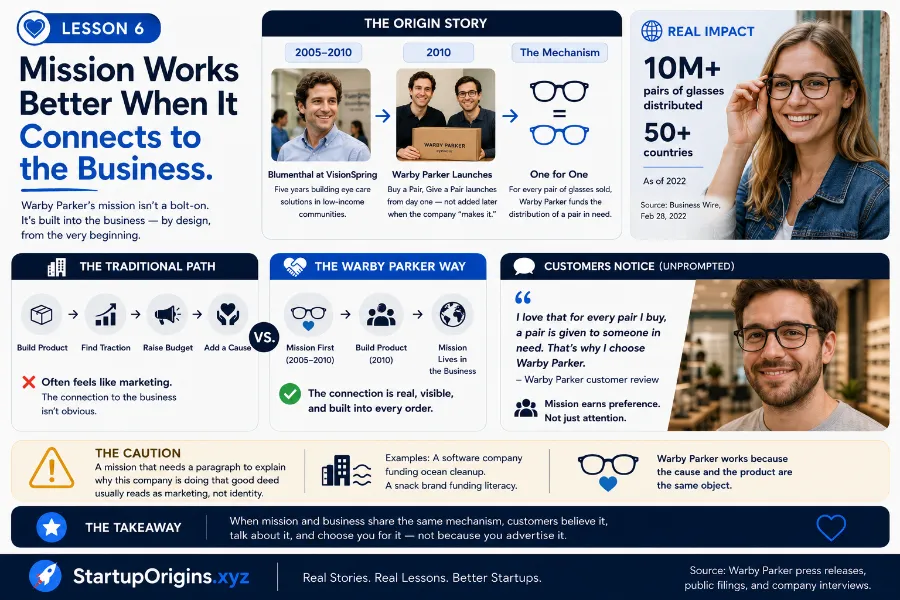
Blumenthal spent five years at VisionSpring, a nonprofit that trains people in low-income communities to administer basic eye exams and sell affordable glasses, before he co-founded Warby Parker. That sequencing is the whole argument. Buy a Pair, Give a Pair — for every pair of glasses sold, Warby Parker funds distribution of a pair to someone in need, largely through VisionSpring itself — launched with the company in 2010, not as a program added once the company had budget to spare for social responsibility. By 2022, the company said the program had helped distribute more than ten million pairs across more than fifty countries.
Compare that sequence to the more common pattern: a company builds a product, finds commercial traction, and then attaches a cause to the brand once there’s marketing budget available to fund it. Warby Parker’s mission predates the product by half a decade and shares its exact mechanism — a pair of glasses for a pair of glasses — which means a customer doesn’t have to take the company’s word that the mission is sincere. The math is visible and one sentence long. Customer reviews on the company’s own site repeatedly cite the giving program, unprompted, as a reason for choosing Warby Parker over a cheaper alternative, which is the outcome every cause-marketing campaign is trying to buy and rarely gets.
The caution is just as instructive. A mission that needs a paragraph of explanation to justify why this company is doing that good deed — a software company funding ocean cleanup, a snack brand funding literacy — tends to read as marketing rather than identity, because the mechanism connecting the business to the cause isn’t visible without being told. Warby Parker’s version works specifically because the cause and the product are the same object.
Lesson 7: Growth Eventually Exposes What the Startup Story Hides
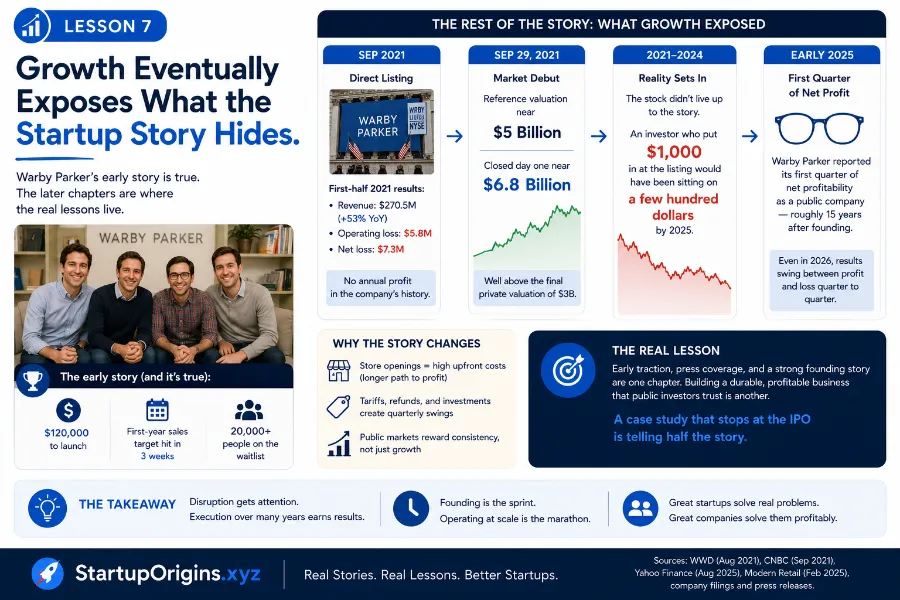
Warby Parker’s founding narrative is full of the things press coverage loves: a $120,000 launch, first-year sales targets hit within three weeks, a 20,000-person waitlist. That story is true, and it’s also incomplete in a way that only becomes visible years later.
By its September 2021 direct listing, Warby Parker had never posted an annual profit. First-half 2021 revenue had grown 53% to $270.5 million, but the company still reported an operating loss of $5.8 million and a net loss of $7.3 million over that same period. Shares opened at a reference valuation near $5 billion and closed day one near $6.8 billion — well above its final private valuation of $3 billion. Four years later, the stock had fallen far enough that an investor who put $1,000 in at the listing would have been sitting on a few hundred dollars.
The company didn’t report its first quarter of net profitability as a public company until early 2025 — roughly fifteen years after founding. Even in 2026, quarterly results have swung between GAAP profit and loss depending on store-opening costs, tariff refunds, and new product investment. This is the part the founding story doesn’t prepare a reader for: disruption, press attention, and rapid early demand are a different phase of company-building than the multi-year grind of proving a durable operating model to public shareholders who mark a stock down on a single earnings miss. A case study that stops at the IPO is telling half the story.
The Warby Parker Decision Every Founder Should Study
Go deeper than the growth version of this story and one decision stands out: the choice, made by a company that had built its identity on being online-first, to sign a ten-year retail lease in 2013.
What assumption changed? The founding assumption was that bypassing physical retail was the source of the cost advantage — no store overhead meant lower prices. Early customer behavior challenged that directly. Within 48 hours of the 2010 launch, demand for Home Try-On kits overwhelmed the company and forced a temporary suspension of the program. Customers began calling the company’s own apartment-based office asking to try frames on in person.
Why could ignoring that evidence have been dangerous? Because the evidence was arriving through customer behavior, not customer surveys, and it was arriving immediately and repeatedly. A founder who treats “we are an online company” as core identity rather than as one implementation of the mission risks optimizing a channel the customer is actively trying to route around.
What did management do? They didn’t reverse course all at once. They tested cheaply first — pop-up shops and small showrooms embedded in existing retailers in Los Angeles, Nashville, and San Francisco — before committing capital to a flagship. Only after those experiments proved profitable did the company sign the SoHo lease.
The practical principle: treat your business model as a hypothesis about how to reach the customer, not as the customer relationship itself. Test contradictory evidence cheaply before you either dismiss it or bet the company on it.
The Biggest Myth About Warby Parker’s Success
The easy explanation — “Warby Parker succeeded because it sold cheaper glasses online” — is the version of the story that gets repeated most often, and it’s incomplete enough to be actively misleading to a founder trying to learn from it.
Cheaper glasses were necessary but not sufficient. DTC eyewear competitors offering similar prices and similar try-on mechanics — Zenni, EyeBuyDirect, Liingo — exist today without Warby Parker’s brand equity or growth trajectory. What separated Warby Parker was the combination: a price low enough to feel disruptive but not so low it read as cheap; design considered enough to work as a fashion accessory rather than a medical device; a friction-removal mechanism that generated word-of-mouth because it was inherently shareable; a mission with a credible origin story; retail expansion that reinforced the digital brand instead of contradicting it; and timing — a GQ feature that hit before the product itself even launched — that a company selling the same idea two years off either side might have missed entirely. Vertical integration gave it margin room its imitators didn’t have, which is part of why it could absorb the cost of stores and eye-care services lower-margin competitors couldn’t — a structure the company still details for shareholders in its quarterly investor disclosures.
No single lever explains the outcome. That’s the point worth taking from this section: successful disruption is very rarely one clever tactic. It’s usually several ordinary decisions that reinforce each other, executed in a sequence that happens to match how the market was ready to move.
What Warby Parker Got Wrong — or Had to Rethink
Warby Parker’s own numbers tell a more complicated story than the press narrative. The company went public without ever having posted an annual profit, and didn’t reach its first profitable quarter as a public company until early 2025 — a gap of roughly fifteen years between founding and sustained profitability. Analysts have pointed to a multi-year average operating margin in negative territory and periods of negative return on invested capital, evidence that scaling stores, services, and headcount cost more, for longer, than the founding narrative implied.
Physical retail, the same decision this article holds up as a founder lesson, also came with real costs the company underestimated in its early public disclosures: doctor staffing and occupancy expenses in 2026 have grown faster than revenue in specific quarters, compressing margins even as store revenue outperformed e-commerce. Digital sales, meanwhile, declined following the end of Home Try-On, a reminder that killing a channel — even a redundant one — has a revenue cost that doesn’t show up until afterward.
The stock’s performance after the 2021 direct listing is its own lesson in overreach: a valuation set at a moment of maximum optimism about direct-to-consumer brands, followed by years of the market repricing the company against the slower reality of retail-driven, lower-margin growth. Investors who bought at the listing and held would have lost a substantial majority of their investment for most of the years since.
None of this erases what the company built. It does mean a founder studying Warby Parker should resist the temptation to read its history as a straight line from clever idea to inevitable success. The company’s own management has spent years publicly explaining why growth and profitability didn’t arrive on the timeline its early narrative implied — which is itself a more useful lesson than a highlight reel would be.
What Founders Should NOT Copy From Warby Parker
Startup case studies become dangerous when founders copy the visible tactic instead of understanding the customer insight, economics, and constraints that made it work. Warby Parker offers several good examples.
Don’t copy: Home Try-On
Warby Parker’s Home Try-On program made sense because buying glasses online created a specific customer anxiety: people could not easily know whether a frame would look or feel right before paying. If your product does not have an equivalent uncertainty, shipping free trials may simply add logistics, returns, and cost without solving an important problem.
Study instead: the friction it removedDon’t copy: Opening physical stores
Retail was not automatically the next step because Warby Parker began online. The important signal was customer behavior: people repeatedly wanted to see, touch, and try the product in person. Without that kind of demand, opening stores can become an expensive real-estate commitment disguised as a growth strategy.
Study instead: the customer signalDon’t copy: Buy a Pair, Give a Pair
Warby Parker’s social mission fit the company unusually well. The founders had relevant experience, the cause was directly connected to eyewear, and the model was simple enough for customers to understand immediately. Adding an unrelated charitable promise to a product does not automatically create the same authenticity or brand trust.
Study instead: why the mission fitDon’t copy: “Cut out the middleman”
Direct-to-consumer economics worked particularly well in eyewear because the category had meaningful markups and a concentrated supply chain. Not every industry contains the same inefficiency. Removing intermediaries only creates an advantage when those intermediaries add enough cost without adding equivalent customer value.
Study instead: the industry economicsDon’t copy: Flat pricing
Simple pricing can improve the customer experience, but only when the underlying cost structure can support it. Warby Parker could simplify prices across many styles because the economics were relatively consistent. A business with large differences in materials, manufacturing, shipping, or service costs may need more flexible pricing.
Study instead: the cost structureDo not copy the artifact. Copy the reasoning process. For every successful startup tactic, ask what customer insight triggered it, what constraint made it viable, and whether those same conditions actually exist in your own business.
Would the Warby Parker Playbook Still Work in 2026?
This deserves a genuinely mixed answer rather than a confident yes or no.
Some conditions that favored Warby Parker in 2010 are harder to find today. Digital acquisition costs across DTC categories have risen substantially since Meta and Google auctions matured, making the “acquire cheaply online, fund brand-building with the margin” sequence Warby Parker followed far more expensive to replicate now. The DTC eyewear category itself is no longer uncontested — Zenni and EyeBuyDirect compete on price with less brand overhead — and Warby Parker’s own leadership has described the retail buildout as a long-term bet against a much larger addressable footprint even as near-term profitability stays uneven.
Other conditions have improved. A 2026 founder has better tools for the trust-building job stores and logistics once did alone: AI-driven virtual try-on has gotten good enough that Warby Parker judged Home Try-On redundant, and social and creator-driven commerce offer discovery paths that didn’t exist in 2010. The company’s move into Gemini-powered smart glasses with Samsung, expected in 2026, shows the same founding team still treating “what does the product need to become” as an open question — arguably the most transferable habit in this whole case study.
The honest conclusion: a founder attacking a similarly consolidated, high-markup, low-innovation category today could plausibly repeat Warby Parker’s early trajectory. A founder trying to repeat the specific tactics — free online trials, a fast pivot to physical retail, a simple cause-marketing hook — in a category that’s already crowded with DTC competitors would be fighting a much more expensive battle than Warby Parker fought in 2010.
The Warby Parker Test for a Startup Idea
Before writing a pitch deck, raising money, or building a product, run your startup idea through these five questions inspired by Warby Parker’s journey.
Is the customer problem already painful enough?
If you have to convince people that the problem exists before you can sell them the solution, you are building a harder company. Strong startup ideas often begin with problems customers already complain about, work around, or actively pay to solve.
What friction does my solution remove?
Be specific. Saying your product is “cheaper” or “better” is not enough. Identify the exact obstacle you remove, such as confusing pricing, limited choice, inconvenient purchasing, slow delivery, or an inability to verify quality before paying.
What new friction does my solution create?
Every improvement can introduce a new problem. Warby Parker solved one kind of eyewear friction while discovering another almost immediately after launch. Look for the side effects of your business model before customers are forced to point them out.
Am I attached to the business model or the customer problem?
A company should be defined by the outcome it creates, not merely by the channel it uses. If your answer to “what business are we in?” is something like “we are an online company,” you may eventually defend a tactic long after customers need something different.
What advantage becomes stronger as the company grows?
The strongest startup advantages compound. Warby Parker’s brand recognition, direct customer relationships, retail footprint, and operational capabilities became more valuable as the company expanded. A temporary viral moment or cheap paid acquisition usually does not. Know which kind of advantage you are building.
A promising startup idea does more than solve a visible problem. It removes meaningful friction, survives the new friction it creates, stays flexible about how the solution is delivered, and builds an advantage that becomes harder to copy over time.
FAQ
What can startup founders learn from Warby Parker?
The customer problem should stay fixed even as the tactics for solving it change. Warby Parker moved from mail-only try-on to a store network to virtual try-on tools without ever changing what it was promising: confidence a pair of glasses will look right before you buy it.
Why was Warby Parker successful?
No single reason. Prices made possible by cutting out a consolidated, high-markup supply chain; a trial mechanism that solved online buying’s biggest objection; brand choices that made the product feel considered rather than discounted; and a mission credible enough to function as real differentiation.
What made Warby Parker’s business model different?
Vertical integration. Designing frames in-house and working directly with overseas manufacturers let the company hold a lower price and higher margins than retailers buying through licensed distributors.
How did Warby Parker disrupt the eyewear industry?
By identifying that one company controlled much of the retail, brand, and licensing layers of the eyewear market, then building a model that bypassed that consolidation on price and distribution alike.
Why did Warby Parker start opening stores?
Demand for in-person try-on appeared almost immediately after the 2010 launch, and small showroom experiments proved profitable enough to justify a permanent SoHo flagship in 2013 — a data-driven pivot, not an abandonment of the company’s mission.
Is Warby Parker still a direct-to-consumer company?
It still sells directly to consumers, but it’s now omnichannel: stores have outperformed e-commerce in recent quarters, and the company discontinued its mail-order try-on program in 2025 as store coverage made it redundant.
Disclaimer: This article is for educational purposes only and does not constitute financial, investment, or business advice. Figures, quotes, and events are sourced from public reporting and Warby Parker’s own disclosures as of August 2026 and may have changed since publication. Always consult primary sources and a qualified professional before making business or investment decisions.
Go Deeper Into the Warby Parker Story
Warby Parker wasn’t built through one breakthrough alone. Follow the story from its original idea and founding team to the strategy that helped turn an online eyewear startup into a recognizable consumer brand.

Anup Kumar Yadav is the founder of StartupOrigins.xyz, where he researches and publishes detailed stories about the world’s most successful startups. His work explores founder journeys, funding milestones, growth strategies, and the lessons entrepreneurs can learn from them.