
Quick Facts: Neil Blumenthal
Key facts about the Warby Parker co-founder, entrepreneur, former VisionSpring director, and business leader.
The Wharton School, University of Pennsylvania — MBA, 2010
Warby Parker: 2010–present
In 2003, a few years out of Tufts, Neil Blumenthal was working in public policy and quietly coming apart from it. He has described the feeling plainly in later interviews: he wanted to see change happen in the world, and instead he watched his ideas disappear into committees and process. So when a friend introduced him, more or less by chance, to an optometrist named Dr. Jordan Kassalow, Blumenthal didn’t hesitate. Kassalow had started a small foundation called Scojo, selling stylish reading glasses in the U.S. and using part of the profits to fund a program that trained low-income women in the developing world to sell eyeglasses in their own communities. He invited Blumenthal to help monitor a pilot program the foundation was running in El Salvador. Blumenthal became employee number two.
That detail tends to surprise people who know Warby Parker only as a fast-growing, venture-backed retail brand. Blumenthal didn’t arrive at the idea of selling glasses through an MBA case study or a market-sizing spreadsheet. He arrived at it after five years spent inside the actual mechanics of the global eyewear-poverty problem — watching, at close range, what it does to a person’s income and options when they simply cannot see well, and what it takes, operationally, to fix that at scale. By the time he sat down in a Wharton computer lab with three classmates who were griping about the price of designer frames, he already understood the eyewear supply chain from the bottom up. That, more than any flash of business-school inspiration, is the real starting point of his story.
Before VisionSpring: A Detour Through Disillusionment
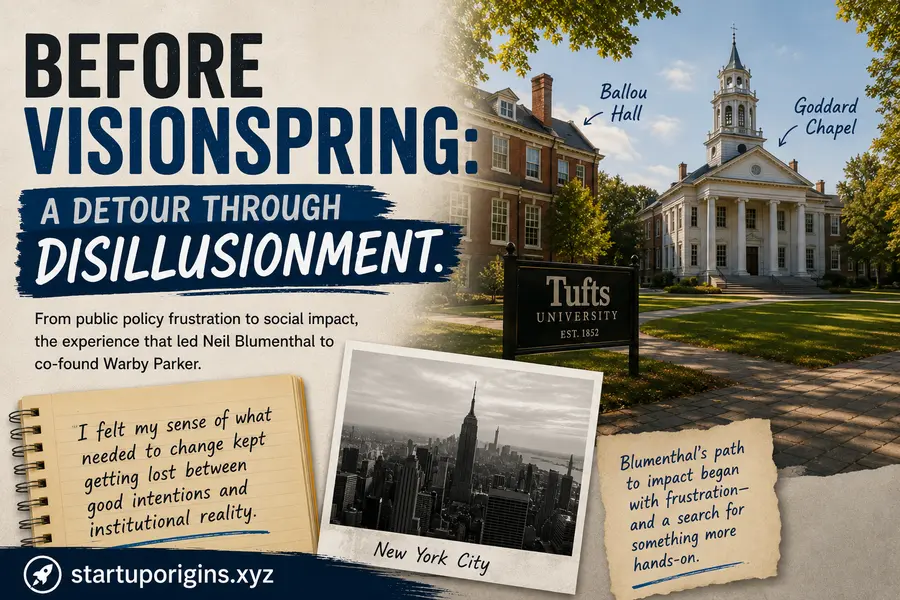
Blumenthal grew up in New York City and studied history and international relations at Tufts University, graduating in 2002. It was at Tufts, on the quad between Ballou Hall and Goddard Chapel, that he first met a fellow undergraduate named Rachel Bravman — the woman he would later marry, and who would go on to found the children’s clothing brand Rockets of Awesome. Neither of them has described their academic years as the moment Blumenthal decided to become an entrepreneur; if anything, his path ran in the opposite direction first, toward public service.
The public-policy job that followed college is the part of Blumenthal’s résumé that gets skipped over most often, and it’s worth sitting with for a moment. In interviews with Tufts Now, he’s said the work left him feeling that his sense of what needed to change kept getting lost somewhere between good intentions and institutional reality — that public policy, for all its importance, moved too slowly and too indirectly for the kind of impact he wanted to have. That frustration is what sent him looking for something more hands-on, and it’s what made him receptive when a chance introduction put Jordan Kassalow in front of him.
Before Warby Parker, There Was VisionSpring
Kassalow’s foundation gave Blumenthal exactly the kind of direct, operational work he’d been missing. Scojo — later renamed VisionSpring after Kassalow sold the commercial eyewear brand and rebuilt the nonprofit arm around it — wasn’t a grant-making charity that wrote checks and measured outcomes from a distance. It ran an actual distribution business, training women (and later men) in countries including India, Bangladesh, and El Salvador to become door-to-door and market-stall opticians, selling low-cost reading and prescription glasses to customers who often earned less than four dollars a day.
Blumenthal spent roughly five years there, eventually becoming director, and by his own account helped grow the organization’s footprint to ten countries and its staff from two people to thirty. The job put him in front of parts of the eyewear business that most eventual eyewear entrepreneurs never touch. He has talked about visiting factories in China repeatedly — exciting the first time, he’s said, considerably less so by the eighth — which means he had a granular, firsthand sense of what glasses actually cost to manufacture long before he ever pitched investors on undercutting the industry’s retail prices. He also learned, the hard way, what does and doesn’t work in distribution at the bottom of the income pyramid. The women VisionSpring trained weren’t struggling because they lacked compassion for their customers; they struggled, Blumenthal noted at the time, because they needed to be taught to run a business and market a product to people who had frequently never worn glasses before. Passion for the mission wasn’t the bottleneck. Operational and commercial skill was.
That distinction shaped how Blumenthal came to think about “doing good” as a business proposition rather than a charitable impulse. He’s said explicitly that the VisionSpring model deliberately avoided pure donation, because handing out free glasses in the wrong environment can create dependency and undercut the very local economies it’s trying to help. The organization’s approach — training entrepreneurs to sell a product profitably rather than giving it away — was a bet that sustainable systems beat one-time generosity. It’s not a coincidence that this is close to the logic Warby Parker would later apply to its own giving model: rather than simply donating a pair of glasses for every pair sold, the company primarily funds VisionSpring’s network of local entrepreneurs to sell glasses into their own communities, treating the giving side of the business with the same operational rigor as the retail side. Blumenthal has been direct about this in interviews, arguing that doing good is frequently harder to execute well than making money, and that treating it casually is a mistake founders make.
It would be an overstatement to say VisionSpring alone produced Warby Parker’s business model — the direct-to-consumer online strategy, the pricing, the brand aesthetic all came together later, at Wharton, with Gilboa, Hunt, and Raider fully part of that process. But the pattern-recognition Blumenthal brought to those conversations was distinct. When his future co-founders were reacting to a $700 repair bill with outrage, Blumenthal was reacting with something closer to recognition: he’d already spent years inside an industry where the gap between what glasses cost to make and what people were charged for them was the entire point of the business he was running.
Getting to Wharton, and Finding Three Co-Founders
By 2008, after five years at VisionSpring, Blumenthal felt he’d hit a different kind of wall — not disillusionment this time, but a sense that the value of nonprofit and social-enterprise experience wasn’t being recognized the way he thought it should be within the broader business world. He’s said he hoped an MBA, especially one from a program as rigorous as Wharton’s, would round out his credentials and change how people read his background. He enrolled that fall.
It’s at Wharton that the origin story most people already know begins — the shared frustration over the price of eyewear, the late-night conversations in Huntsman Hall, the decision by four first-year students to build a company instead of writing a case study about one, as Blumenthal has recounted to Wharton Magazine. StartupOrigins has covered how Warby Parker started in detail elsewhere, so this isn’t the place to retell that chapter scene by scene. What’s worth isolating here is Blumenthal’s specific contribution to that room. Andrew Hunt is generally credited with posing the question that reframed the whole conversation — why wasn’t anyone selling glasses online? Dave Gilboa supplied the animating grievance, having lost an expensive pair of prescription glasses on a trip before school started. Jeffrey Raider brought his own version of the same complaint. Blumenthal brought the only firsthand knowledge in the room of how eyewear actually got made, priced, and distributed to people who couldn’t otherwise afford it — plus five years of practice building an organization from two employees to thirty. Warby Parker was, from its first weeks, a genuinely collaborative venture between four people with different but complementary experience. None of them built it alone, and Blumenthal has never suggested otherwise.
Before Warby Parker Was Big: What Blumenthal Understood About Brand
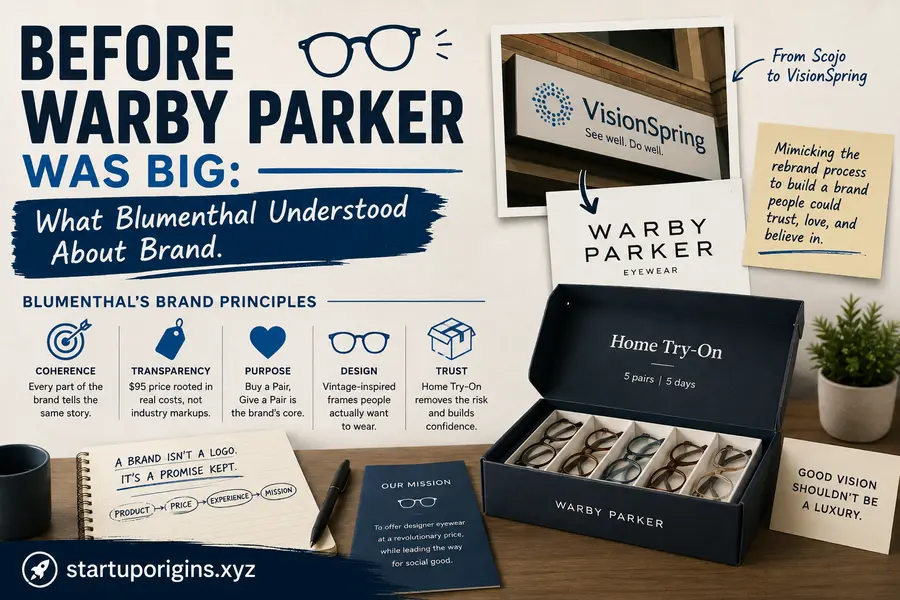
Long before Warby Parker had a warehouse or a marketing budget, Blumenthal had already been through one brand transformation up close — and he’s said, plainly, that he drew on it directly. Kassalow’s organization didn’t stay Scojo forever; the commercial eyewear line was sold off and the nonprofit foundation was rebuilt and renamed VisionSpring, a process Blumenthal lived through as an employee. Asked years later, on the Mixergy podcast, whether any experience from his past had shaped how he approached a specific challenge at Warby Parker, Blumenthal didn’t reach for a business-school framework. He pointed to that rebrand. He said he had, in his words, more or less mimicked that process when the founding team was building Warby Parker’s own identity.
That’s a small, specific admission, and it says more about Blumenthal’s approach to brand than any amount of generic commentary about “storytelling” would. For Blumenthal, brand was never primarily about a logo or an advertising campaign. It was about coherence — making sure the name, the visual identity, the pricing, the retail experience, and the social mission all told the same story to a customer who had never had a reason to trust an eyewear company before. Warby Parker’s early aesthetic decisions — vintage-inspired frames the founders described as things they’d actually want to wear, a name pulled from two obscure Jack Kerouac characters rather than anything overtly optical, a $95 price anchored to a specific promise about what the industry’s real costs should allow — only work as a brand if they reinforce each other. Blumenthal has talked about the company’s giving model in exactly these terms: Buy a Pair, Give a Pair wasn’t bolted onto the brand as a marketing flourish after the fact. It was, from Blumenthal’s perspective, inseparable from what the company was actually built to prove — that a business could scale, turn a profit, and do good without charging a premium for any of it.
Home Try-On fits the same pattern, though it’s usually credited to the founding team collectively rather than to Blumenthal individually. What’s notable is how directly it solved the trust problem Blumenthal understood from the other side of the eyewear business — that customers, especially first-time or low-income customers unfamiliar with a brand, will not commit to eyewear they haven’t been able to see on their own face. VisionSpring’s local entrepreneurs solved that problem with in-person demonstrations. Warby Parker solved it by mailing people a box.
The Decision Every Founder Should Study: Choosing to Share the Chair
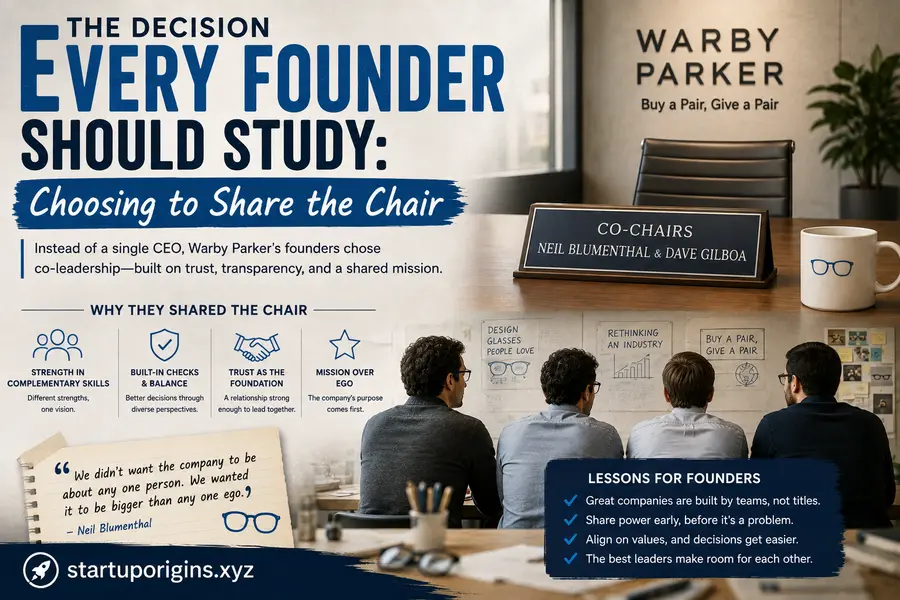
If there’s one decision in Blumenthal’s career that deserves close study — more than any single product choice or marketing campaign — it’s the one he and Gilboa made, and have kept remaking, about how to run the company together. From Warby Parker’s founding in 2010, Blumenthal and Gilboa have served as co-CEOs, a structure that remained unchanged more than fifteen years later, through an IPO, a pandemic, hundreds of store openings, and a full public-company reporting cycle.
Shared CEO titles are unusual for a reason. Most governance experts and plenty of investors view co-leadership skeptically, on the theory that split authority breeds ambiguity, slows decisions, and eventually forces a costly reckoning over who’s actually in charge. Warby Parker’s board could reasonably have pushed for a single chief executive at almost any point along the way — after the Series A, after the first wave of retail expansion, certainly ahead of the 2021 direct listing, when public-market investors are typically assumed to want a clear, singular voice at the top.
Blumenthal and Gilboa chose differently, and did so deliberately rather than by default. According to accounts both founders gave CNBC, they made two explicit commitments early on: that their friendship would take priority over the business if the two ever came into serious conflict, and that they would periodically and honestly revisit whether the co-CEO arrangement still made sense, rather than simply defaulting to it out of inertia or attachment to the title. Blumenthal has described the practical mechanics of the partnership in similar terms — that his instinct, when facing a hard problem, is to bring it to Gilboa immediately, on the premise that Gilboa will sharpen or improve whatever he’s thinking rather than compete with it.
The risk in this decision wasn’t abstract. Co-CEO structures at other companies have failed publicly and expensively, and Blumenthal and Gilboa were betting, essentially, that their working relationship could survive the pressures that break most partnerships: money, credit, control, and the compounding stress of running a company through a decade and a half of change. What happened instead is that the arrangement became one of the more durable co-leadership structures in modern American retail, with the two men publicly describing entrepreneurship as an inherently lonely undertaking that the partnership made less so.
The lesson for other founders isn’t “get a co-CEO.” Plenty of companies with shared leadership have struggled precisely because the founders never did the harder work Blumenthal and Gilboa describe — the recurring, sometimes uncomfortable conversations about whether the structure still serves the company, rather than the egos of the people inside it. The lesson is closer to this: Blumenthal treated a governance question that most founders settle once, quietly, and never revisit, as something to keep actively renegotiating. That discipline, applied consistently over fifteen years, is a genuinely unusual habit — and one considerably harder to imitate than the org chart it produced.
From Founder to Public-Company Executive
Blumenthal’s job changed considerably as Warby Parker grew from a four-person apartment operation into a public company. In the earliest years, the founders split responsibilities informally and did whatever the moment required — Blumenthal has described personally emailing and calling customers during the chaotic weeks after the company’s 2010 launch, when demand outstripped inventory and the young team had no customer-service department to absorb it. As the company scaled, that hands-on, generalist role gradually formalized into a more conventional executive structure, with Blumenthal and Gilboa as co-CEOs overseeing a leadership team, and Hunt and Raider remaining involved as directors even as their day-to-day operating roles shifted — Raider, notably, went on to co-found the men’s grooming brand Harry’s using a similar direct-to-consumer approach before returning fully to Warby Parker’s board.
By the time Warby Parker filed to go public via direct listing in 2021, Blumenthal was managing a business with hundreds of millions of dollars in annual revenue, a growing physical retail footprint, and the reporting obligations of a public company — a considerably different job than the one he’d been doing out of his apartment a decade earlier, even if the underlying partnership with Gilboa had not fundamentally changed. Colleagues and observers who’ve covered the company over multiple years have generally described a rough division of emphasis between the two co-CEOs, Forbes among them, with Blumenthal more associated with culture, people, and the company’s social mission, and Gilboa more associated with strategy and operations — though both have been careful, in public commentary, to characterize the division as fluid rather than fixed, and to credit each other’s input across areas nominally outside their own lane.
What Blumenthal’s Path Says About the Company He Helped Build
It’s tempting, in hindsight, to describe Warby Parker’s mission-driven identity as an inevitable extension of Neil Blumenthal’s biography — the former public-policy idealist turned social-enterprise director turned socially conscious CEO. That reading isn’t wrong, exactly, but it risks flattening a genuinely collaborative founding story into a single-founder narrative that doesn’t match the record. Andrew Hunt asked the question that reframed the industry. Dave Gilboa supplied the founding grievance and, by most accounts, much of the strategic and financial rigor that helped the company scale. Jeffrey Raider brought his own perspective and later applied the same direct-to-consumer thinking to an entirely different industry. Warby Parker’s brand, giving model, and retail strategy emerged from all four of them working through the same problem from different angles, inside a partnership structure Blumenthal and Gilboa have spent fifteen years actively maintaining rather than taking for granted.
What Blumenthal’s specific path adds to that story is a kind of operational fluency in the exact problem the company set out to solve — not as an abstract market opportunity, but as something he had already spent years inside, watching what expensive, inaccessible eyewear actually does to people’s lives, and what it takes to build a distribution system that fixes it without collapsing into either charity or exploitation. That’s a different kind of preparation than an MBA case study provides, and it shows up less in any single decision than in the steady, consistent thread running through how Warby Parker has talked about its own mission since the week it launched.
For more on how that mission scaled from a Philadelphia apartment into a national retail brand, see How Warby Parker Grew From Online Eyewear Startup to Retail Brand. And for the broader lessons other founders have drawn from the company’s fifteen-year run, see What Warby Parker Teaches Every Startup Founder.
Frequently Asked Questions
Who is Neil Blumenthal?
Neil Blumenthal is a co-founder and co-CEO of Warby Parker, the direct-to-consumer eyewear company he started in 2010 with three Wharton MBA classmates: Dave Gilboa, Andrew Hunt, and Jeffrey Raider.
Is Neil Blumenthal the founder of Warby Parker?
He is one of four co-founders. Warby Parker was founded jointly by Blumenthal, Dave Gilboa, Andrew Hunt, and Jeffrey Raider in 2010.
Who are the four founders of Warby Parker?
Neil Blumenthal, Dave Gilboa, Andrew Hunt, and Jeffrey Raider, all first-year MBA students at the Wharton School when they founded the company.
What did Neil Blumenthal do before Warby Parker?
Before Warby Parker, Blumenthal worked briefly in public policy before spending roughly five years at VisionSpring (originally the Scojo Foundation), a nonprofit social enterprise that trained low-income entrepreneurs, primarily women, to sell affordable eyeglasses in developing countries.
Where did Neil Blumenthal go to college?
Blumenthal earned a bachelor’s degree in history and international relations from Tufts University in 2002, and later an MBA from the Wharton School of the University of Pennsylvania in 2010.
What is Neil Blumenthal’s role at Warby Parker?
Blumenthal has served as co-CEO of Warby Parker alongside Dave Gilboa since the company’s founding in 2010, a shared leadership structure the two have maintained for more than fifteen years.
How did Neil Blumenthal get into the eyewear industry?
He entered the eyewear industry through nonprofit work, joining Dr. Jordan Kassalow’s Scojo Foundation (later VisionSpring) in the early 2000s after a personal introduction, years before he met his future Warby Parker co-founders at Wharton.
Disclaimer: This article was independently researched and written by the StartupOrigins editorial team using publicly available interviews, company materials, university publications, and reporting from established business outlets. It is not affiliated with or endorsed by Warby Parker Inc. or Neil Blumenthal. Quotations and factual claims are attributed to their original sources; where sources described events in general terms rather than exact figures, this article reflects that level of specificity rather than inventing precision that wasn’t available. Details are current as of August 2026 and may change over time.
More Founder Journeys
Meet the entrepreneurs behind remarkable companies and discover the decisions, setbacks and ideas that shaped their journeys.

Anup Kumar Yadav is the founder of StartupOrigins.xyz, where he researches and publishes detailed stories about the world’s most successful startups. His work explores founder journeys, funding milestones, growth strategies, and the lessons entrepreneurs can learn from them.