
Rdio had almost everything a startup could ask for. It was built by two of the most credible founders in consumer technology. It launched with major-label licensing already in place. It arrived in the United States a full year before its most famous rival. And critics loved it — reviewers routinely called it the best-designed music service on the market.
It still went bankrupt.
By November 2015, Rdio was filing for Chapter 11 protection in the Northern District of California, and a bankrupt competitor, Pandora, was paying $75 million just to pick through its technology and its engineers. Spotify, the company Rdio beat to America, went on to become the dominant audio platform on Earth. As of Spotify’s second-quarter 2026 results, the company reported roughly 777 million monthly active users, 300 million paying subscribers, and a presence in 184 markets worldwide.
The easy explanation — that Spotify simply made a better product — doesn’t hold up well against the historical record. People who used both services in the early 2010s frequently preferred Rdio’s interface, its social features, and its approach to music discovery. That makes the outcome more interesting, not less. Understanding why Rdio failed means looking past that easy explanation entirely — this is the story of how a well-funded, well-reviewed, well-connected startup lost a war it was, for a while, arguably winning on points.
What Was Rdio?
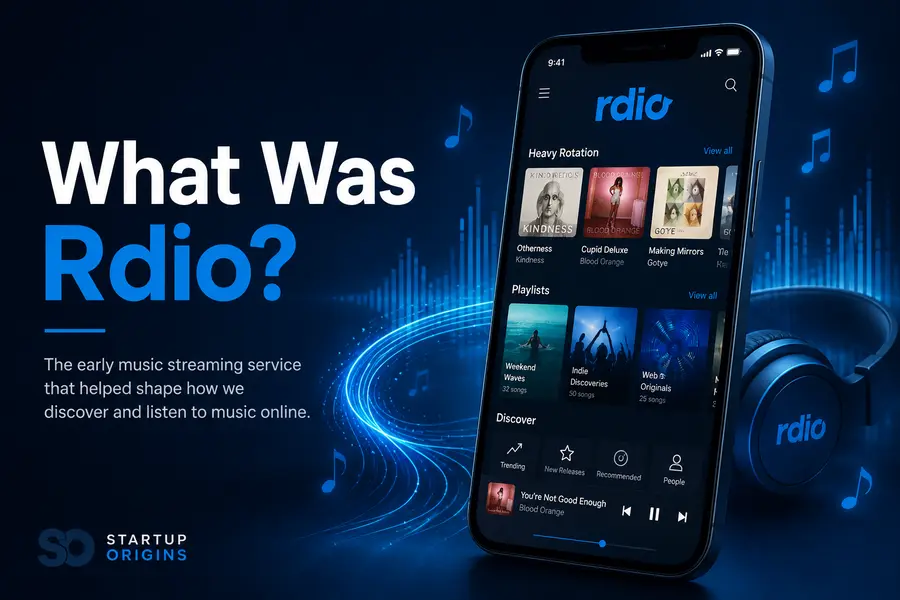
Rdio was an on-demand music streaming service that let subscribers search for and play virtually any song, album, or playlist from a licensed catalog, rather than owning downloaded files. It launched publicly on August 3, 2010, offering a web-based streaming tier for $4.99 a month and a version with mobile access for $9.99 a month, built on a catalog that started at roughly 8 million tracks and later grew past 30 million.
What set it apart in the early years wasn’t the pricing — Spotify, MOG, Napster, Rhapsody, and Deezer all had comparable subscription tiers. It was the emphasis on browsing and sharing. Rdio organized music visually, around album artwork and a social feed showing what friends were listening to, rather than around a search bar and a playlist queue. It shipped apps for iOS, Android, BlackBerry, and Windows Phone, along with desktop clients and, eventually, integrations with Sonos and other connected-home audio systems.
The Skype Founders’ Bet on Music Streaming
Rdio was founded in 2008 and launched in 2010 by Niklas Zennström and Janus Friis, the Scandinavian entrepreneurs behind Kazaa and Skype. After selling Skype to eBay in 2005 and later to Microsoft, the pair had both capital and credibility most startup founders never get. Their prior venture in streaming media, the peer-to-peer video service Joost, had folded in 2009 after struggling with licensing costs and rising competition from YouTube — a preview, in some ways, of problems Rdio would face a few years later with music.
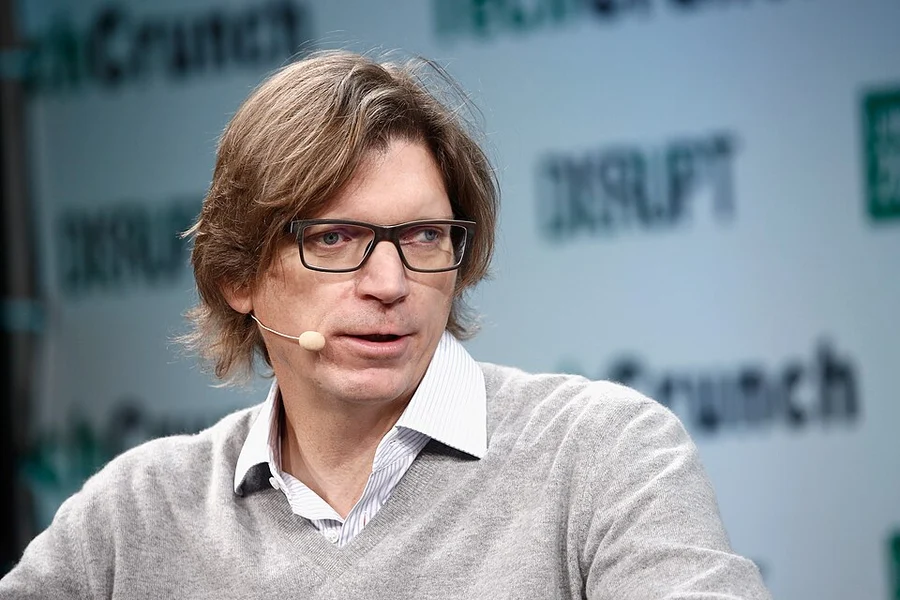
Zennström and Friis recruited Carter Adamson as a co-founder, and the company brought on Drew Larner as its first chief executive. It wasn’t a research project. Rdio secured licensing agreements with EMI, Sony Music, Universal Music Group, and Warner Music Group before its public launch, along with independent aggregators like The Orchard, IODA, and CD Baby — the same kind of major-label access that took Spotify years of negotiation to lock down for the U.S. market.
Rdio Arrived in America Before Spotify
This is the detail that makes Rdio’s failure genuinely counterintuitive rather than a routine story of a slower company losing a race: Rdio was in the U.S. market first.
Rdio launched publicly in the United States and Canada on August 3, 2010. Spotify — despite operating in Sweden, the U.K., and several other European markets since October 2008 — did not launch in the U.S. until July 14, 2011, nearly a year later, after prolonged negotiations with American record labels. In the intervening months, Rdio had the U.S. streaming market largely to itself, alongside older incumbents like Rhapsody and Napster and the newer entrant MOG.
A head start of eleven months sounds significant, and in some markets it would have been decisive. But streaming music in 2010 and 2011 was still a nascent, unproven category. Most Americans had never paid for a music subscription and weren’t sure why they should. Rdio’s early lead bought it critical acclaim and a passionate niche of early adopters, but it did not translate into the kind of runaway adoption that locks in a market position before a better-funded rival arrives. The head start mattered for reputation. It did not, on its own, secure the market.
Why People Actually Loved Rdio
It’s worth dwelling on this, because it’s the part of the story most “why X failed” articles skip past. Rdio was not a bad product limping toward an inevitable death. Contemporary reviews were often glowing, and Rdio was frequently framed as the more polished of the two services.
A TechCrunch feature-by-feature comparison published the week Spotify launched in the U.S. concluded that Rdio’s browsing experience was superior for discovery, noting that nearly every page nudged users toward new music without interrupting playback. One independent reviewer who tested both services side by side that same month wrote that he was sticking with Rdio, finding its discovery tools and social integration stronger than Spotify’s, even as he acknowledged Spotify’s faster, more search-driven native app appealed to “lean-forward” power users. What Hi-Fi’s review praised Rdio’s “well designed UI” and “great social connectivity,” while flagging its bitrate and lack of an Android tablet app as weaknesses. In 2014, TIME included Rdio on its list of the year’s 50 best websites, citing its catalog size and interface design.
The pattern across these reviews is consistent: reviewers tended to see Rdio as the more thoughtfully designed, more socially engaging product, and Spotify as the faster, more utilitarian one. Anthony Bay, who became Rdio’s CEO in December 2013, later put it this way in an interview with Billboard: when he joined, he said, “Rdio was considered the best service but not very well known,” describing it as often seen as “the iPhone of music services” compared to rivals that felt more like Android.
That distinction — beloved by people who used it, unknown to people who didn’t — turns out to be close to the center of the whole story.
Then Spotify Changed the Competition
Spotify’s U.S. entrance in July 2011 was backed by roughly $100 million in fresh funding and arrived with an aggressive strategy: a free, ad-supported tier available to essentially anyone, alongside paid options at $4.99 and $9.99 a month. New users got a six-month trial of unrestricted free listening; afterward, the free tier was throttled to roughly ten hours of listening a month before Spotify scrapped that restriction entirely in March 2012, making its ad-supported tier free without hard limits.
Spotify also leaned hard into virality. It built deep integration with Facebook, at a moment when the “Spotify is Facebook Music” framing was circulating in tech press, letting users see friends’ listening activity and share tracks directly into their social feeds. One account of Spotify’s U.S. rollout noted that within a month of launch, the company had already captured a meaningful share of the U.S. streaming market, and it reported roughly 5 million users worldwide by the end of that year.
Rdio also had Facebook sharing — it added the integration in September 2011 — and it wasn’t short on social features generally; social discovery was arguably its signature strength. The more consequential difference wasn’t the presence of a feature. It was distribution economics: Spotify’s free tier, backed by substantial venture capital, functioned as a mass-market acquisition funnel in a way Rdio’s initially subscription-only model did not attempt to match until years later.
The Business Model Problem Behind Rdio
Rdio launched as a paid-only service. There was no free tier at all until October 2011, when it introduced an ad-free but time-limited free trial, and it wasn’t until January 2014 — more than three years after launch — that Rdio rolled out an ongoing, ad-supported free listening tier resembling Pandora’s internet-radio model. By then, Spotify’s freemium approach had already had roughly two and a half years to build a habit among American listeners: try the free version, get hooked, eventually convert to Premium.
Music streaming is an unusually brutal business to scale for a simple reason: the cost of goods sold is enormous and largely fixed by contracts with rights holders, not by the company’s own engineering. Industry-wide estimates commonly put royalty payments at somewhere around 70 percent of streaming revenue, which means providers need enormous subscriber volume just to cover fixed licensing costs before spending a dollar on marketing, engineering, or customer support. A service with a smaller audience carries close to the same catalog and licensing obligations as a much larger one, but has far less revenue to spread those costs across.
This is why audience size in streaming isn’t just a vanity metric — it is closely tied to the unit economics of the business. Anthony Bay articulated a version of this argument publicly, but from the opposite angle. In a June 2015 interview with CNBC, Bay called Spotify’s free-tier strategy “silly,” arguing that “the idea that giving it away for free leads more people to buy is flawed” and that free tiers cannibalized users who would otherwise have paid. In a separate interview with the trade publication Music Ally that same month, Bay described streaming as “a retail business, not an internet business,” pointing to Rdio’s licensing costs as a fundamentally different economic structure than the software margins associated with typical internet startups.
Bay’s criticism of Spotify’s model is a documented opinion from a company executive, not an independently verified explanation for Rdio’s failure — and it’s worth noting Bay made these comments while Rdio itself was already partly walking back its subscription-only positioning, having introduced its own free radio tier the year before. But his framing does illuminate the dilemma Rdio faced: without a comparably large free funnel, Rdio had a smaller top of the audience pipeline feeding into a business where scale determined survival.
Rdio Built a Great Product — But Could It Build a Mass Audience?
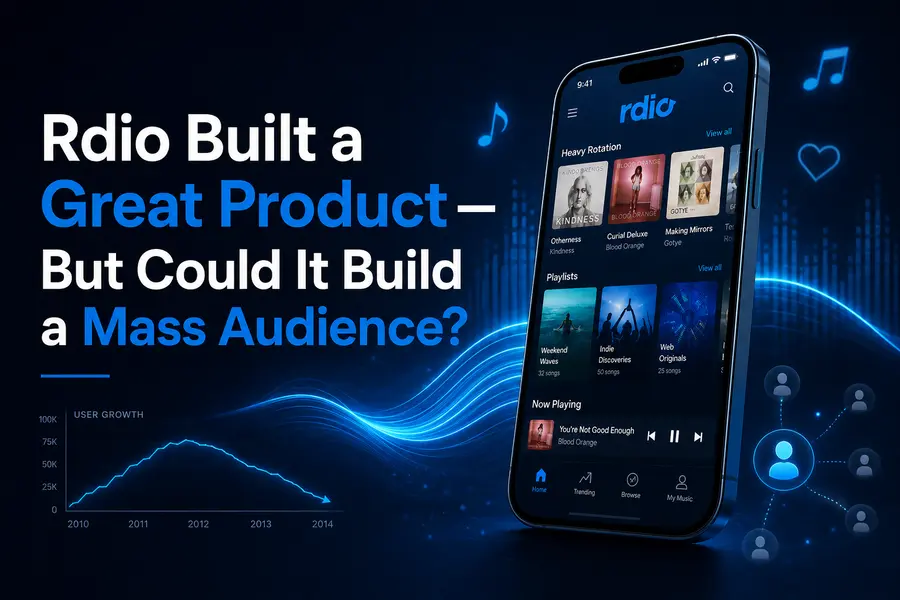
This wasn’t a problem Bay identified alone, or only late in the company’s life. His predecessor said much the same thing two years earlier. In a 2013 interview with The New York Times, then-CEO Drew Larner named awareness — not product quality or catalog size — as Rdio’s central obstacle: “It’s really awareness,” Larner said. “To the wider world, streaming is still relatively nascent.” Two chief executives, roughly two years apart, independently pointed to the same gap: people who tried Rdio tended to like it, but most people simply hadn’t tried it, or didn’t know what a music subscription was for in the first place.
Bay’s version of the diagnosis, from the same period, put it in stronger terms. “The average person doesn’t know what streaming music is, and what subscription music is,” he told The Globe and Mail in an interview referenced by Vice in 2015. Rdio never disclosed hard subscriber numbers publicly, which independent reporting at the time treated as a sign the figures were unflattering relative to competitors. A December 2013 TechCrunch report noted that Rdio had not shared user numbers “in a while,” contrasting that silence with Deezer’s disclosure of passing 5 million users and Spotify’s reported 6 million paying subscribers as of that same period.
By late 2014, in a Billboard interview, Bay estimated Rdio’s competitors at roughly 50 million users for Spotify and more than 75 million active listeners for Pandora — while declining, again, to state a comparable figure for Rdio. No reliable public figure for Rdio’s total registered users or paying subscribers at any point in its history appears in primary sourcing; estimates in secondary sources vary and should be treated with caution rather than repeated as fact.
What is documented is that Rdio, competing against companies with dramatically larger marketing budgets and, in Spotify’s case, a self-reinforcing viral loop through Facebook, struggled to convert its critical acclaim into broad public recognition. A product beloved by early adopters and tastemakers is not automatically a product most consumers have heard of.
Rdio Tried to Change Course
Rdio was not a company that stood still and watched itself lose. It made a series of significant strategic pivots between 2011 and 2015, several of them clearly aimed at closing the gap with Spotify and Pandora:
- It launched a free, ad-supported internet-radio-style tier in 2014, moving toward the freemium model it had previously avoided.
- It introduced a $3.99 mid-tier plan, allowing limited on-demand access and offline downloads, positioned similarly to Pandora’s paid tier.
- It expanded internationally, reaching roughly 60–85 countries by various points in its history, including a notable push into Brazil and India.
- It launched Vdio, a pay-per-view movie and TV streaming spinoff, in 2013 — a diversification bet that added complexity without solving the core music-streaming problem.
- It underwent leadership change, with Drew Larner stepping down as CEO in 2013, saying publicly he was looking for a replacement with a different skill set to scale the company, and Anthony Bay — a former Amazon and Microsoft executive — taking over in December 2013.
None of these moves reversed the trajectory. The free tier arrived roughly three years after Spotify’s, well after habits had formed. The international expansion put Rdio into markets where it still had to build licensing relationships and brand awareness essentially from scratch, competing with rivals who were doing the same thing with larger budgets.
The Streaming War Became Much More Expensive
Rdio wasn’t only losing ground to Spotify. The competitive field around it kept getting more crowded and better capitalized through the early-to-mid 2010s. Pandora, though structured differently as an internet-radio service rather than full on-demand streaming, had scale advantages of its own, with tens of millions of active listeners. Apple Music launched in June 2015, backed by Apple’s enormous installed base of iTunes customers and unmatched marketing reach. YouTube Music arrived that same year. Amazon and Google were both building out their own music offerings. Deezer, a French competitor, was expanding aggressively as well.
Reporting on Rdio’s decline pointed specifically to Apple Music’s June 2015 launch and YouTube Music’s debut that same year as decisive blows, arriving just as Rdio was already financially strained. Every one of these competitors could absorb years of losses while building scale — a luxury a company relying on venture funding and a comparatively small user base did not have for long.
The Final Months
By mid-2015, the financial pressure on Rdio was severe and increasingly public. Bay was giving interviews defending Rdio’s business model even as reports about the company’s finances grew more pointed. Later litigation disclosed in reporting from Billboard and The Hollywood Reporter — a fraud lawsuit Sony Music filed against Rdio executives in 2016 over dealings before the Pandora transaction — stated that Rdio was losing approximately $2 million per month in the period leading up to its bankruptcy filing, and that at the time of filing the company reported more than $190 million in secured debt and roughly $30 million in unsecured debt.
Those figures come from litigation and contemporary reporting rather than from Rdio’s own public disclosures or the underlying bankruptcy petition itself, since Rdio was privately held and not required to publish financial statements, and the original court filing sits behind PACER’s paid access system rather than being freely reproducible here. They should be read as reported, sourced figures rather than officially audited totals, but they are consistent across multiple outlets — Billboard, The Hollywood Reporter, and financial press covering the Pandora deal — that separately put Rdio’s total lifetime funding at somewhere between roughly $117 million and $125 million-plus.
Rdio Files for Bankruptcy
On November 16, 2015, Rdio, Inc. filed a voluntary Chapter 11 bankruptcy petition in the United States Bankruptcy Court for the Northern District of California. The filing was announced the same day Pandora disclosed, in a Form 8-K filed with the Securities and Exchange Commission, that it had entered into an Asset Purchase Agreement to acquire certain Rdio assets through a court-supervised sale under Section 363 of the Bankruptcy Code, for $75 million in cash, subject to price adjustments.
Pandora Paid $75 Million — But It Didn’t Buy Rdio
This is one of the most commonly garbled details in coverage of Rdio’s collapse, so it’s worth stating precisely. Pandora did not acquire Rdio as an operating company. It bought a defined set of assets out of a bankruptcy proceeding.
Pandora’s own SEC filing describes the purchase as covering the “Transferred Assets” under the agreement — not an acquisition of Rdio’s ongoing business, its brand, or its customer contracts. In its public statement, Rdio confirmed that Pandora was acquiring “key assets from Rdio’s business, including intellectual property and technology,” and Pandora explicitly stated that it was “not acquiring the operating business of Rdio,” but rather “the technology and talent to accelerate its own business strategy.” The transaction was contingent on Rdio actually filing for bankruptcy protection, and it was structured so that Rdio would wind down the Rdio-branded service entirely, in every market, once the sale closed.
Pandora also extended job offers to a substantial share of Rdio’s staff — reporting at the time put the number at roughly 100 employees — while Rdio’s CEO, Anthony Bay, did not move to Pandora. In a statement carried by Metal Injection and other outlets at the time, Bay said he was “pleased that many members of the Rdio team will continue to shape the future of streaming music” at Pandora, calling Rdio’s platform “an acclaimed product and technology platform that has consistently led innovation in the young streaming industry.” Pandora’s chairman and CEO, Brian McAndrews, described the acquisition as part of “defining the next chapter of Pandora’s growth story,” alongside the company’s earlier purchase of the ticketing platform Ticketfly, according to contemporary coverage from Digital Music News.
None of the licenses Rdio held with record labels transferred as part of the deal — licensing agreements in the music industry generally do not survive a change of control this way — which financial press coverage at the time flagged as the reason Pandora could not simply relaunch Rdio’s service under its own umbrella, and instead had to build its own on-demand capabilities separately over the following year.
The Day Rdio Went Silent
Rdio notified subscribers on December 15, 2015, that the service would shut down worldwide the following week, on December 22, 2015, at approximately 5 p.m. Pacific time. Subscriptions and automatic renewals had already been halted on November 23. In the days before shutdown, Rdio built a “farewell” site letting users export playlists and listening history and pointed them toward third-party tools to migrate their libraries to competing services — including, notably, tools built specifically to move Rdio collections onto Spotify.
The farewell email Rdio sent its users struck a plain, almost elegiac tone: “Over the course of five years, Rdio has grown to become a global community of music lovers — a place to discover, listen, and collect. We’re proud to have built that community with you.” Rdio.com went dark on schedule. A company that had once been called “the iPhone of music services” by its own chief executive simply stopped existing.
Why did Rdio fail?
Rdio failed primarily because it could not build an audience large enough to sustain a licensing-heavy business against much better-funded, faster-scaling rivals. It launched as a paid-only service and didn’t add an ongoing free tier until 2014, three years after Spotify’s freemium model began pulling in mass-market U.S. users. By the time Rdio adjusted its strategy, Spotify, Pandora, and later Apple Music had already built the brand recognition and subscriber scale that streaming’s thin, royalty-heavy margins require. Rdio filed for Chapter 11 bankruptcy in November 2015, and Pandora paid $75 million for its technology and staff — not its operating business.
Was Rdio Actually Better Than Spotify?
This depends entirely on what “better” is being asked to measure, and the honest answer is that it isn’t a single question.
On product design, discovery, and social features — the dimensions most reviewers actually evaluated in 2011 through 2014 — Rdio frequently came out ahead in contemporary coverage. Its browsing experience, album-centric visual layout, and friend-activity feed were consistently praised as more elegant and more oriented toward discovering new music than Spotify’s more search-driven interface.
On business performance — audience scale, brand recognition, capital efficiency, and the ability to convert product quality into a sustainable subscriber base — Rdio lost decisively and, ultimately, terminally. Those are not contradictory facts. A product can be preferred by the people who use it and still fail as a business, if it cannot acquire and retain users fast enough to cover a cost structure defined largely by fixed licensing obligations. Rdio’s story is a clean illustration of the gap between product quality and business durability — a gap that matters enormously in markets with heavy fixed costs and strong network effects.
Rdio vs Spotify: Where Their Paths Split
| Factor | Rdio | Spotify |
|---|---|---|
| U.S. launch | August 3, 2010 | July 14, 2011 |
| Early access model | Paid subscription only at launch ($4.99–$9.99/mo) | Freemium from Swedish launch; unrestricted U.S. free tier from March 2012 |
| Ongoing free tier | Not introduced until January 2014 | Central to strategy from the start |
| Social/discovery | Album-centric browsing, friend activity feed, widely praised by reviewers | Facebook integration, playlist sharing, search-driven discovery |
| Audience-growth approach | Relied on paid conversion and critical acclaim; user numbers never publicly disclosed | Used a large free tier as an acquisition funnel to build scale before monetizing |
| Outcome | Chapter 11 bankruptcy, Nov. 16, 2015; assets sold to Pandora for $75M; service shut down Dec. 22, 2015 | ~300 million paying subscribers and ~777 million MAUs as of Q2 2026 |
What Happened to Rdio’s Technology?
After the bankruptcy court approved the sale, Pandora absorbed Rdio’s technology, patents, and a portion of its engineering team, with reporting indicating roughly 100 Rdio employees received job offers. Notably, Pandora’s purchase did not include Rdio’s record-label licensing agreements — those don’t transfer in an asset sale — which meant Pandora still had to negotiate its own on-demand rights from scratch before it could build a competing product, a gap financial press coverage at the time flagged as the reason Pandora’s stock kept falling even after the acquisition was announced. One contemporary analysis from Fox Business noted that Pandora didn’t plan to launch its own on-demand service until “late 2016” — nearly a year after absorbing Rdio’s assets.
Of the Rdio executives named in the deal, Chris Becherer, Rdio’s SVP of Product, was reportedly the only member of Rdio’s executive team to move to Pandora. There, according to his own later professional profile, he led the team that rebuilt Pandora’s app “from a radio player into a fully-featured on-demand music service with multiple subscription tiers” — the product that shipped as Pandora Premium in 2017. That is a documented, direct line from specific Rdio product leadership to a specific later Pandora product, even though it would be an overstatement, unsupported by available documentation, to describe Pandora Premium generally as “Rdio rebuilt.” Anthony Bay, by contrast, did not move to Pandora. Pandora itself was later acquired by SiriusXM in a deal that closed in 2019, folding whatever remained of Rdio’s technical lineage into a still larger audio company.
Rdio’s Failure Looks Even More Striking in 2026
The scale of the gap that ultimately opened between the two companies is easier to grasp with current numbers. As of its second-quarter 2026 results, reported on August 4, 2026, Spotify disclosed roughly 777 million monthly active users, 300 million Premium subscribers, and availability in 184 markets worldwide, alongside quarterly revenue of roughly €4.8 billion and record gross margins. Spotify itself has openly discussed the difficulty of sustaining growth at that scale — deliberately slowing user growth in some emerging markets in 2026 to improve conversion economics, a reminder that even the company that won the streaming war still fights the same fundamental battle over audience size and unit economics that Rdio lost a decade earlier. Rdio, which never disclosed a comparable user count at any point in its five-year public existence, no longer exists in any form a subscriber could sign up for.
Final Conclusion
Rdio’s story resists the tidy morality of most startup-failure writing, and that’s exactly why it’s worth telling in detail. Nothing about its collapse required incompetence, bad design, or founders who didn’t understand their market. Rdio arrived early. It built something reviewers loved. It secured major-label licensing before its most famous competitor had even entered the country. And it still lost, because product quality, distribution, business-model economics, and market scale did not line up quickly enough, in a category where the gap between “well-liked” and “large enough to survive” turned out to be the only gap that mattered.
Frequently Asked Questions
Why did Rdio fail?
Rdio struggled to build a large enough audience to sustain a music-streaming business with heavy, fixed licensing costs. It launched as a paid-only service and didn’t introduce an ongoing free tier until 2014, well after Spotify’s freemium model had already captured a large U.S. user base. Rdio filed for Chapter 11 bankruptcy in November 2015.
What happened to Rdio?
Rdio filed for Chapter 11 bankruptcy on November 16, 2015. The same day, Pandora announced an agreement to buy certain Rdio assets — including technology, intellectual property, and much of its engineering team — for $75 million through a court-supervised sale. The Rdio-branded service shut down worldwide on December 22, 2015.
Did Spotify buy Rdio?
No. Spotify never acquired Rdio. Spotify was Rdio’s primary competitor in the U.S. streaming market throughout Rdio’s existence. Rdio’s assets were purchased by Pandora, not Spotify.
Did Pandora buy Rdio?
Pandora purchased select assets from Rdio — including patents, technology, and job offers to roughly 100 employees — for $75 million as part of a bankruptcy-court-supervised sale in November 2015. Pandora did not acquire Rdio’s operating business, its brand, or its music-licensing agreements, and the Rdio service itself was wound down entirely.
Was Rdio available before Spotify in the United States?
Yes. Rdio launched publicly in the U.S. and Canada on August 3, 2010. Spotify did not launch in the U.S. until July 14, 2011, nearly a year later, after lengthy licensing negotiations with major American record labels.
Who founded Rdio?
Rdio was founded in 2008 by Niklas Zennström and Janus Friis, the co-founders of Skype and Kazaa, along with co-founder Carter Adamson. It launched publicly in August 2010 with Drew Larner as its first CEO; Anthony Bay became CEO in December 2013 and led the company through its 2015 bankruptcy.
When did Rdio shut down?
Rdio shut down worldwide on December 22, 2015, at approximately 5 p.m. Pacific time, following its Chapter 11 bankruptcy filing and the asset sale to Pandora.
Disclaimer: This article is a work of business journalism and historical analysis for informational purposes only. It is not investment, legal, or financial advice. Facts, figures, and quotations were compiled from publicly available SEC filings, court-related reporting, company statements, and contemporary press coverage current as of August 2026; financial figures describing Rdio’s private finances are drawn from litigation and press reports rather than from audited company disclosures, since Rdio never published its own financial statements. Readers seeking investment guidance regarding Spotify, Pandora/SiriusXM, or any other company mentioned should consult a licensed financial advisor and each company’s official investor relations materials.

Anup Kumar Yadav is the founder of StartupOrigins.xyz, where he researches and publishes detailed stories about the world’s most successful startups. His work explores founder journeys, funding milestones, growth strategies, and the lessons entrepreneurs can learn from them.