

The inside story of how a fax-machine saleswoman with no fashion background turned a pair of cut-up pantyhose into a billion-dollar company — told through the rejections, the risks, and the one decision that made it possible. — 15 min read
There is a pair of white pants hanging in a closet in Atlanta, unworn for eight months — and if you want to understand how Spanx started, that closet is the only place to begin.
That single detail is where the Spanx story actually begins — not with a business plan, not with a pitch deck, not with a garage full of prototypes, but with a 27-year-old fax machine saleswoman named Sara Blakely standing in front of her mirror, annoyed that she still hadn’t found anything to wear underneath them.
- The Seven Years That Built the Founder Before the Company Existed
- A Problem the Fashion Industry Had Simply Learned to Live With
- Building the Idea at Night, Telling No One
- The Rejection Tour: Cold-Calling Hosiery Mills in North Carolina
- Why Everyone Rejected the Idea That Eventually Changed an Industry
- The Decision That Changed Spanx Forever
- Getting Into the Store: Ten Minutes and a Flight She Paid for Herself
- Right When the Money and the Friends Were Running Out, Oprah Called
- Scaling Without a Marketing Department — or Any Outside Money
- The Blackstone Deal: Selling Control Without Selling the Vision
- A Tougher Chapter, and a Brand Fighting to Stay Relevant
- Spanx: A Quick Timeline
- What the Spanx Story Actually Teaches
- Frequently Asked Questions
She wanted the smooth lines you get from control-top pantyhose. She did not want the visible seams that showed through under the fabric, and she certainly didn’t want the sandal-ready toes that made the whole idea pointless the moment she put on open shoes. So she picked up a pair of scissors, cut the feet off her hosiery, and pulled the mangled result on under her pants.
It worked. It also itched, rode up at the waist, and bunched at the knee every time she sat down.
She wore it anyway, all night. Nobody noticed. That was the whole point.
What she couldn’t have known that night was that this small act of household improvisation would eventually become a global shapewear brand, reshape an entire category of women’s clothing, and turn her into the youngest self-made female billionaire in America. She also couldn’t have known how long, humiliating, and expensive the road between a pair of scissors and an actual company was going to be.
The Seven Years That Built the Founder Before the Company Existed
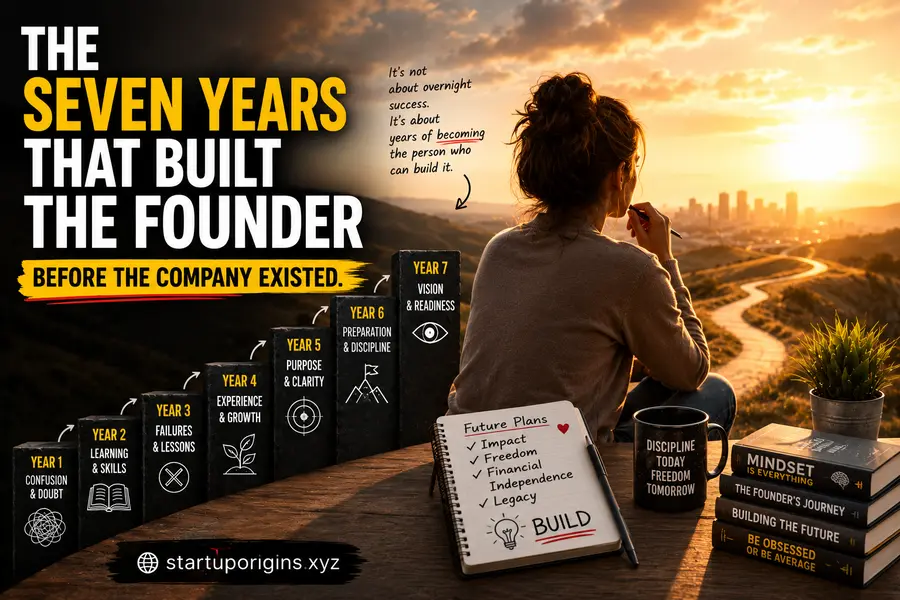
To understand why Blakely was able to survive what came next, you have to understand the seven years that came before it.
Before Spanx, Blakely spent nearly a decade selling fax machines door-to-door for the office-supply company Danka, rising to national sales trainer over seven years of mostly rejection. This wasn’t a glamorous sales job with warm leads and friendly receptionists. It was cold, repetitive, and frequently humiliating. In a talk she later gave about that period, she described the daily texture of the work bluntly: she got kicked out of buildings, and people ripped up her business card in front of her face.
Most people would tell you that selling fax machines has nothing to do with inventing an apparel category. In Blakely’s case, it had everything to do with it. Cold-calling office managers who didn’t want to see you, five days a week, for seven years, builds a specific kind of nervous system — one that doesn’t flinch when a stranger says no. It also builds something else, quieter and more durable: the assumption that rejection is simply the first answer, not the final one.
By the time she started sketching out her pantyhose idea, Blakely had already logged thousands of hours getting doors closed in her face. That experience didn’t just prepare her for the manufacturing rejections to come. It was, in a very real sense, the unofficial training program for founding Spanx — years before she knew that’s what she was training for.
A Problem the Fashion Industry Had Simply Learned to Live With
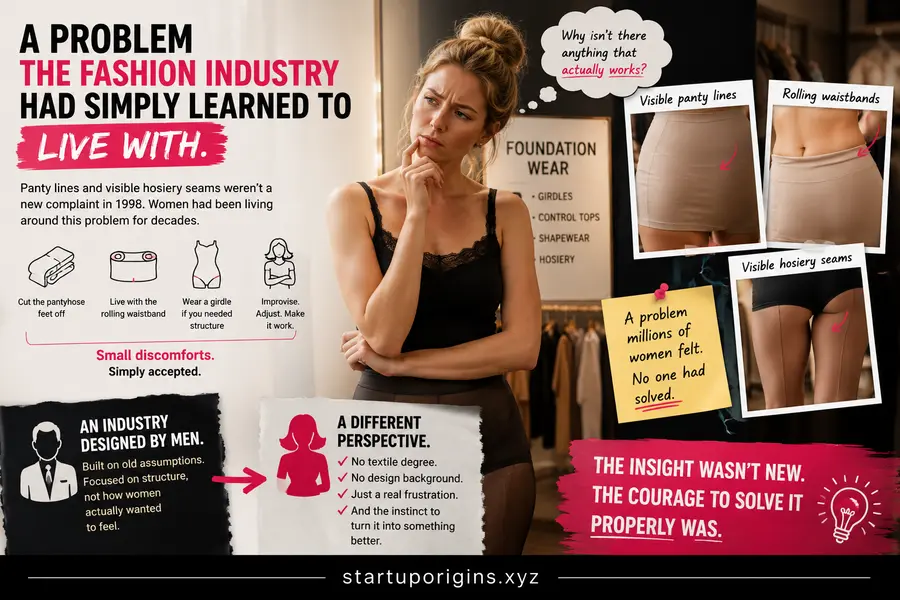
Panty lines and visible hosiery seams weren’t a new complaint in 1998. Women had been living around this problem for decades, folding it quietly into the long list of small discomforts that came with getting dressed. Cut the pantyhose feet off, live with the rolling waistband, wear a girdle if you needed real structure and didn’t mind the bulk — women had improvised their own version of Blakely’s scissors trick for years without anyone turning it into a business.
Which is the interesting part, from a market standpoint: the “insight” wasn’t really an insight. Millions of women had already discovered the workaround. What none of them had done was ask why nobody had built the product properly, engineered a fabric that would actually hold its shape, do away with the toe seam issue for good, and sell it with a name and a look that didn’t scream “surgical garment.”
The undergarment industry at the time was overwhelmingly run and designed by men, largely serving a market built around older assumptions about foundation garments — think structured girdles and control-top hosiery marketed with clinical, unglamorous branding. Blakely, a woman in her twenties who wanted something invisible under her clothes rather than something that announced itself, was looking at the exact same shelf every other woman was looking at and asking why nothing on it actually worked.
She didn’t have a textile background. She didn’t have a design degree. What she had was a specific, personal, repeatedly-felt frustration — and, crucially, the sales instinct to recognize that a problem she felt intensely was probably a problem millions of other women felt too, even if nobody had said so out loud.
Building the Idea at Night, Telling No One
Blakely didn’t quit her job the moment inspiration struck. She kept working full-time at Danka while she developed the idea after hours, researching fabrics, patent law, and trademark filing on nights and weekends. This wasn’t caution for its own sake — it was math. She needed the paycheck, and more importantly, she needed the health insurance. She has said she didn’t leave her job until she had already landed Neiman Marcus and Saks Fifth Avenue as retail partners — that was when she felt she had the courage to go out on her own.
She also told no one. Not her roommate, not her parents, not her closest friends. For roughly a year, the idea existed only in her head and in a growing pile of hand-cut hosiery samples. She has explained that ideas are at their most vulnerable in the moment you have them, and that she waited so ego and outside doubt wouldn’t creep in too early. It wasn’t secrecy for its own sake. It was giving the idea room to survive before anyone got the chance to talk her out of it.
Money was the other constraint shaping every decision. She started the business with roughly $5,000 in personal savings — money saved from years of selling fax machines. That sum had to cover fabric sourcing, travel, and legal protection, and there wasn’t enough of it to cover all three comfortably. When she went looking for a patent attorney, she got quotes in the $3,000-to-$5,000 range — effectively her entire starting budget just to file the paperwork.
So she bought a book on how to write a patent. Nights and weekends, on the floor of her apartment, surrounded by cut-up hosiery and legal pads, she taught herself the language of claims and prior art, drafting the application section by section — a process the National Inventors Hall of Fame, which inducted Blakely in 2026, credits as central to how she protected the idea before she had any leverage to defend it otherwise. She paid a lawyer a few hundred dollars for the one part she genuinely couldn’t write herself. The trademark she filed on her own, for about $150.
This wasn’t grit for the sake of a good story later. It was arithmetic, done at a kitchen table, by someone who understood that every dollar spent on a lawyer was a dollar that couldn’t go toward fabric, samples, or the flight she’d eventually need to get herself in front of a buyer.
The Rejection Tour: Cold-Calling Hosiery Mills in North Carolina
With a prototype concept in hand but no manufacturer, Blakely turned to the traditional hosiery belt in North Carolina, cold-calling mill after mill and asking male plant owners to produce a product that, on paper, sounded almost absurd: pantyhose, with the feet cut off, that a woman would pay a premium for.
The response was close to universal rejection. Mill owner after mill owner turned her down, uninterested in retooling their lines for a product they didn’t understand and didn’t think would sell. This wasn’t polite hesitation — it was, by her own account, a string of doors closing on an idea that experienced textile manufacturers looked at and simply couldn’t see the value in.
The reversal, when it finally came, wasn’t the result of a brilliant pitch landing on the right desk. One manufacturer’s daughters, after hearing about Blakely’s idea, encouraged their father to give her a chance — and that encouragement was what finally got a prototype made. Most retellings flatten that into a single throwaway sentence. It shouldn’t be. It says something real about who was actually equipped to see the opportunity — which is worth pulling apart properly.
Why Everyone Rejected the Idea That Eventually Changed an Industry
It’s tempting to look back at the string of hosiery mill rejections and assume the manufacturers were simply shortsighted — men who couldn’t picture a product built around a woman’s discomfort because they’d never experienced it themselves. That’s part of the story, but it’s not the whole explanation, and treating it as the whole explanation misses what actually made the opportunity available to Blakely in the first place.
Think about what the mill owners were actually being asked to do. Retooling a hosiery production line isn’t a trivial cost. It means new patterns, new finishing processes, and a bet on a market segment with no sales history and no brand behind it. From a manufacturer’s chair, saying no to Sara Blakely wasn’t obviously irrational — it was the same call they’d have made about almost any unproven product from a founder with zero track record. Outside founder, no capital, no connections, unconventional product: that pattern reads as risk, not opportunity, through a standard manufacturing lens.
What the mill owners were missing wasn’t a data point. It was a frame of reference. None of them had spent a lifetime navigating the discomfort of ill-fitting foundation garments, because none of them wore them. The entire category — hosiery, shapewear, girdles — had been engineered and evaluated for decades by an industry that rarely needed its own product to work. That gap, between who designs a product and who uses it, is where Blakely’s advantage lived. She wasn’t smarter than the manufacturers about textiles. She understood something they structurally couldn’t: exactly how the existing options failed, moment to moment, in a woman’s actual day.
This is also why persistence mattered more than expertise in this particular case. Expertise, in the traditional sense, would have told Blakely that a footless pantyhose product wasn’t going to move mills. Persistence was the only tool available to someone whose real advantage — lived understanding of the problem — couldn’t be demonstrated on a spreadsheet. She had to keep showing up until she found the one context where someone with manufacturing authority was willing to listen to a perspective the industry hadn’t been designed to hear. That context turned out to be a mill owner whose own daughters could tell him, in language he trusted, that the idea had merit.
Market skepticism, in other words, wasn’t just an obstacle Blakely had to push through. It was the opportunity itself. If the idea had been obviously good to every manufacturer in North Carolina, someone with more capital and better industry connections would likely have built it first. The very fact that experienced insiders dismissed it is part of why the door was still open when an outsider with no other qualifications except the right lived experience walked through it.
The Decision That Changed Spanx Forever
If there’s a single hinge point in this story — a moment where a different choice would have quietly ended it — it’s the decision to keep cold-calling manufacturers after rejection had become the norm rather than the exception.
Continuing wasn’t free. Each unsuccessful pitch cost travel time, phone calls, and emotional energy she was already spending at a demanding full-time sales job. She was doing this without a business partner, without an advisor, without anyone in her life yet knowing what she was working on.
No venture capitalist to reassure her the concept had promise. No co-founder to split the doubt with. One person, a scissors-cut prototype, and a stack of “no.”
The rational alternative was obvious and easy to justify: stop. She had a stable job, a decent income, and a plausible story to tell herself about why the idea wasn’t going to work. Plenty of good ideas die at exactly this stage — not because they were bad, but because the founder ran out of reasons to keep absorbing rejection with nothing to show for it.
Why did she keep going instead? The clearest answer sits in the seven years that preceded this moment. Selling fax machines door-to-door had already taught her that rejection was routine, not diagnostic — that a “no” from one person in one room told you almost nothing about whether the next person would say yes. She wasn’t hearing these mill rejections as verdicts on the idea. She was hearing them as the normal cost of doing anything worth doing, the same cost she’d been paying five days a week for years already.
There’s also a simpler, more personal reason worth taking seriously: she believed the product actually solved her own problem, and she trusted that if it solved hers, it would solve it for other women too. That’s a thin thread to hang a company on, but it was enough, paired with the stubbornness the sales years had built into her, to get her through one more phone call, and then another, until she reached the mill owner whose daughters saw what he initially hadn’t.
The consequences of that decision shaped everything that followed. Had she stopped, there’s no reason to think anyone else would have picked up the idea — it wasn’t sitting in a public patent database waiting to be discovered; it existed only in Blakely’s head and in a drawer full of hand-cut hosiery samples. Continuing past the point of reasonable discouragement is what turned a private frustration into a manufactured product, and a manufactured product is what eventually made its way onto a shelf at Neiman Marcus.
Getting Into the Store: Ten Minutes and a Flight She Paid for Herself
Once she had a working prototype, Blakely needed retail distribution, and she went straight for the top of the market rather than starting small. She bought her own ticket to Dallas, sat in a beige conference room with a buyer who had a full calendar and no particular reason to care about a stranger’s hosiery idea, and got ten minutes to prove it mattered. Ten minutes was the entire meeting Neiman Marcus’s buying office gave her. No slide deck, no market research, just the product itself and whatever she could say about it in the time it takes to microwave a coffee.
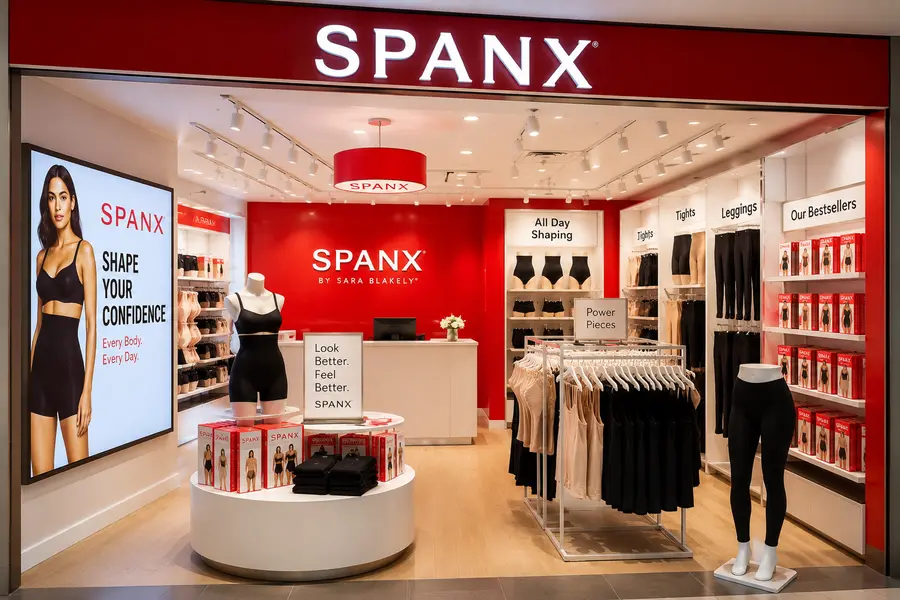
The pitch worked. Neiman Marcus agreed to carry the product, and Spanx launched in seven of the retailer’s stores in 2000. But landing the order and guaranteeing it would sell were two different problems, and Blakely wasn’t willing to leave the second one to chance. Ahead of the launch, she called friends who lived near those seven stores, asked them to go buy the product, and even offered to pay them back for doing it. It’s the kind of unglamorous, slightly embarrassing tactic that never makes it into a polished founder profile, but it’s exactly the sort of hustle that determined whether those first orders would look successful enough to justify a second one.
She also handled fulfillment herself in the earliest days, an operation that looked less like a national apparel launch and more like a one-woman shipping department improvising as it went. Semi-trucks would arrive outside her Atlanta apartment, and she’d pack and ship the orders personally — a detail that captures just how thin the line was, in those first months, between “company” and “one determined person with a product and a phone.”
Right When the Money and the Friends Were Running Out, Oprah Called
The Neiman Marcus launch alone might have kept Spanx alive as a modest regional success. What turned it into a household name was a single piece of unpaid media exposure that Blakely engineered on pure instinct.
She sent a gift basket containing a Spanx prototype directly to Oprah Winfrey’s team, with a personal note explaining how much Winfrey had inspired her. It’s a move that looks, in retrospect, almost naively hopeful — a first-time founder mailing a product to one of the most influential media figures in the country and hoping someone actually tried it on.
Someone did. Winfrey’s stylist put the sample in her dressing room, and Winfrey liked what she found. In November 2000 — just weeks after the Neiman Marcus launch — Oprah named Spanx one of her “Favorite Things,” the single most-watched episode format on her show each year. Blakely later described the timing with disarming honesty: “Right when I was running out of friends and money, Oprah called. She chose it as her favorite product of the year.”
“Right when I was running out of friends and money, Oprah called.”
— Sara Blakely
The effect was immediate and enormous. Orders on Spanx’s website surged, reportedly by tens of thousands within a matter of weeks, and the brand went from a scrappy regional retail launch to a name recognized well outside Atlanta almost overnight. Oprah didn’t just mention the product once and move on, either — in 2006, she told her audience “Spanx really changed the way I wore clothes,” describing how she’d sworn off other undergarments entirely in favor of Spanx. That kind of repeated, unpaid, visibly sincere endorsement is close to impossible to manufacture through paid advertising, and it became the foundation of a brand built almost entirely on word of mouth rather than marketing spend.
Scaling Without a Marketing Department — or Any Outside Money
What happened over the following decade is, in some ways, more unusual than the founding story itself: Spanx grew into a billion-dollar valuation without ever taking outside investment. Blakely has said flatly that she never had a single investor in Spanx other than herself, self-funding the business entirely for the first two decades of its existence.
That self-funded structure shaped how the company grew. Without investor capital pushing for rapid expansion, Blakely scaled deliberately, reinvesting revenue back into the business and controlling the pace and direction of growth herself. QVC became another turning point: after signing a deal with the home shopping channel in 2001, she sold 8,000 pairs of Spanx within five minutes of going on air. The company also built a partnership with Target in 2006, launching an “Assets by Sara Blakely” line that made shapewear accessible at a lower price point without diluting the flagship brand.
Spanx crossed the billion-dollar valuation mark in 2012, a milestone the brand reportedly reached without spending money on traditional advertising — an almost unheard-of feat for a consumer apparel company at that scale, and a direct legacy of the organic, celebrity-driven visibility the Oprah moment had kicked off more than a decade earlier. That same year, Forbes named Blakely the youngest self-made female billionaire, a distinction that turned her personally into a case study in business schools and a fixture on entrepreneurship stages around the world.
Along the way, the brand expanded well beyond its original footless pantyhose product into bras, activewear, denim, loungewear, and swimwear — categories that let Spanx follow its core customer through her entire wardrobe rather than staying confined to the undergarment aisle where it started.
The Blackstone Deal: Selling Control Without Selling the Vision
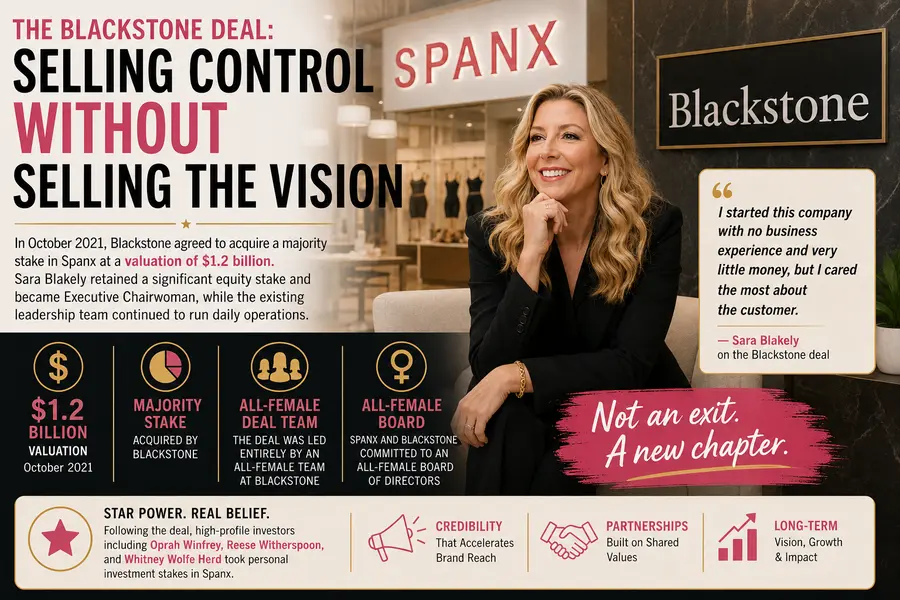
By 2021, Spanx had grown into a business substantial enough to attract serious private equity interest, and in October of that year, Blackstone announced it had agreed to acquire a majority stake in the company at a valuation of $1.2 billion. Blakely retained a significant equity stake in the business and stepped into the role of executive chairwoman, while the company’s existing senior leadership stayed on to run day-to-day operations.
The deal had a distinctive structural detail: it was led entirely by an all-female team on the Blackstone side, and the two companies committed to building an all-female board of directors for Spanx going forward — a symbolic and practical continuation of the brand’s identity as a company built by and largely for women. In the years following the deal, high-profile figures including Oprah Winfrey, Reese Witherspoon, and Whitney Wolfe Herd took personal investment stakes in the company, extending the same kind of organic, credibility-driven association that had powered the brand’s growth from its earliest days.
Blakely framed the moment not as an exit but as a continuation. “I started this company with no business experience and very little money, but I cared the most about the customer, and that gave me the courage to launch the company,” she said at the time, adding that the Blackstone partnership represented “a really important moment in time for female entrepreneurs.”
“I started this company with no business experience and very little money, but I cared the most about the customer.”
— Sara Blakely, on the Blackstone deal
A Tougher Chapter, and a Brand Fighting to Stay Relevant
No origin story worth telling ends at the moment everything worked. In the years since the Blackstone deal, Spanx has faced real competitive pressure, most visibly from newer, social-media-native shapewear brands like Skims, founded by Kim Kardashian, which has captured significant attention and market share in the category Spanx originally defined. Industry reporting has noted that Spanx’s more recent annual sales figures have come in below the levels analysts had expected based on the brand’s mid-2010s peak, and the broader shapewear category itself took a pandemic-era hit as fewer people needed structured, event-ready clothing during years of remote work. By 2026, business press covering the private-equity ownership of legacy consumer brands was framing the question directly: five years into Blackstone’s stewardship, could the firm find Spanx a second act, or had the category it invented simply been claimed by someone else?
Spanx’s response has been to widen its footprint rather than retreat into its original category. Since 2021 the company has pushed into activewear, denim, and loungewear, launched new bra collections, and in early 2026 relaunched a dedicated swimwear line — its first major swim push since 2023 — built around three distinct compression levels aimed at bringing its core shaping technology into a category it had only dabbled in before. The brand also marked its 25th anniversary in 2025 with a series of collaborations, including a limited-edition capsule with the Pantone Color Institute built around a signature “Spanx Red” shade, alongside continued product innovation in its founding shapewear category through new fabric technologies.
None of that has settled the argument. What isn’t in question is the foundation the company was built on: a self-funded, founder-controlled business model that gave Blakely — and later, Blackstone — the flexibility to adapt the brand’s product mix without the pressure of servicing outside investors who wanted faster, riskier growth in the company’s early years.
Spanx: A Quick Timeline
| Year | Milestone |
|---|---|
| 1998 | Sara Blakely begins developing the idea nights and weekends while working full-time selling fax machines |
| 2000 | Spanx launches in seven Neiman Marcus stores; Oprah names it a “Favorite Thing” weeks later |
| 2001 | QVC debut — 8,000 pairs sold in five minutes |
| 2006 | Target partnership launches “Assets by Sara Blakely” |
| 2012 | Spanx crosses a billion-dollar valuation; Blakely named youngest self-made female billionaire |
| 2021 | Blackstone acquires a majority stake at a $1.2 billion valuation |
| 2025 | Spanx marks its 25th anniversary with a Pantone “Spanx Red” collaboration |
| 2026 | Spanx relaunches its swimwear line with three compression levels |
What the Spanx Story Actually Teaches
Strip away the Oprah moment and the billion-dollar headline, and what’s left is a far more instructive story than the highlight reel suggests. Blakely didn’t succeed because she had a uniquely brilliant product idea — footless pantyhose is, on its face, a modest innovation. She succeeded because she correctly identified a problem that an entire industry had structurally overlooked, protected that insight long enough to develop it properly, and then kept absorbing rejection past the point where most people would have reasonably quit.
The $5,000 budget wasn’t an obstacle she overcame despite everything else — it was a forcing function that shaped nearly every early decision, from writing her own patent to personally shipping orders out of her apartment. Constraint, in this story, isn’t the villain. It’s closer to the architect.
For founders navigating their own version of manufacturer rejection or investor skepticism today, the lesson isn’t “believe in yourself and it will work out.” It’s narrower and more useful than that: look for the gap between who currently makes decisions in an industry and who actually experiences its product, because that gap is often where the real opportunity is hiding — dismissed by insiders not because it lacks merit, but because it doesn’t fit the frame they’re used to evaluating ideas through.
For more on the woman behind the company, see our companion feature, Sara Blakely: The Founder Who Reinvented Shapewear. To understand how the brand grew into a household name without a traditional marketing budget, read How Spanx Grew Without Traditional Advertising. And for founders looking to apply these lessons directly, don’t miss What Spanx Teaches Every Startup Founder.
Editorial Note: This article is an independent editorial feature and is not affiliated with, endorsed by, or sponsored by Spanx, Sara Blakely, or Blackstone. It is compiled from publicly available interviews, company statements, and reporting by verified news outlets, and is intended for informational purposes only.
Frequently Asked Questions
How did Sara Blakely start Spanx with just $5,000?
Blakely funded the earliest stages of Spanx entirely from personal savings accumulated over seven years selling fax machines door-to-door. She stretched that budget by writing her own patent application, registering her trademark independently for about $150, and personally handling early sales, marketing, and fulfillment rather than hiring outside help.
What inspired the idea for Spanx?
Blakely wanted to wear a pair of white pants but couldn’t find hosiery that gave her a smooth silhouette without visible seams or toe lines under open shoes. She cut the feet off a pair of control-top pantyhose to solve the problem for herself, and that improvised solution became the basis for the company’s first product.
Who manufactured the first Spanx products?
After being rejected by numerous hosiery mills in North Carolina, Blakely eventually found a manufacturer willing to produce her prototype after the mill owner’s own daughters encouraged him to take the idea seriously.
How did Oprah Winfrey’s endorsement affect Spanx?
Blakely mailed a Spanx sample directly to Oprah Winfrey’s team, and Winfrey subsequently named Spanx one of her “Favorite Things” in November 2000, shortly after the brand’s retail launch at Neiman Marcus. The endorsement drove a significant surge in orders and gave the brand national visibility it could not have purchased through traditional advertising.
Who owns Spanx today?
Sara Blakely founded and self-funded Spanx without outside investors for the company’s first two decades. In 2021, Blackstone acquired a majority stake in the business at a $1.2 billion valuation, while Blakely retained a significant ownership stake and became the company’s executive chairwoman.
Every Billion-Dollar Startup Started With One Small Decision.
If the story of Spanx inspired you, these founder journeys reveal how overlooked ideas became billion-dollar companies.
How Shopify Started Selling Snowboards Online
The online snowboard shop that accidentally created one of the world’s biggest eCommerce platforms.
How Discord Started After a Failed Game
One failed game eventually became one of the world’s most-used communication platforms.
How Notion Almost Died Before Rebuilding in Japan
The incredible comeback that transformed Notion into a global productivity giant.

Anup Kumar Yadav is the founder of StartupOrigins.xyz, where he researches and publishes detailed stories about the world’s most successful startups. His work explores founder journeys, funding milestones, growth strategies, and the lessons entrepreneurs can learn from them.