
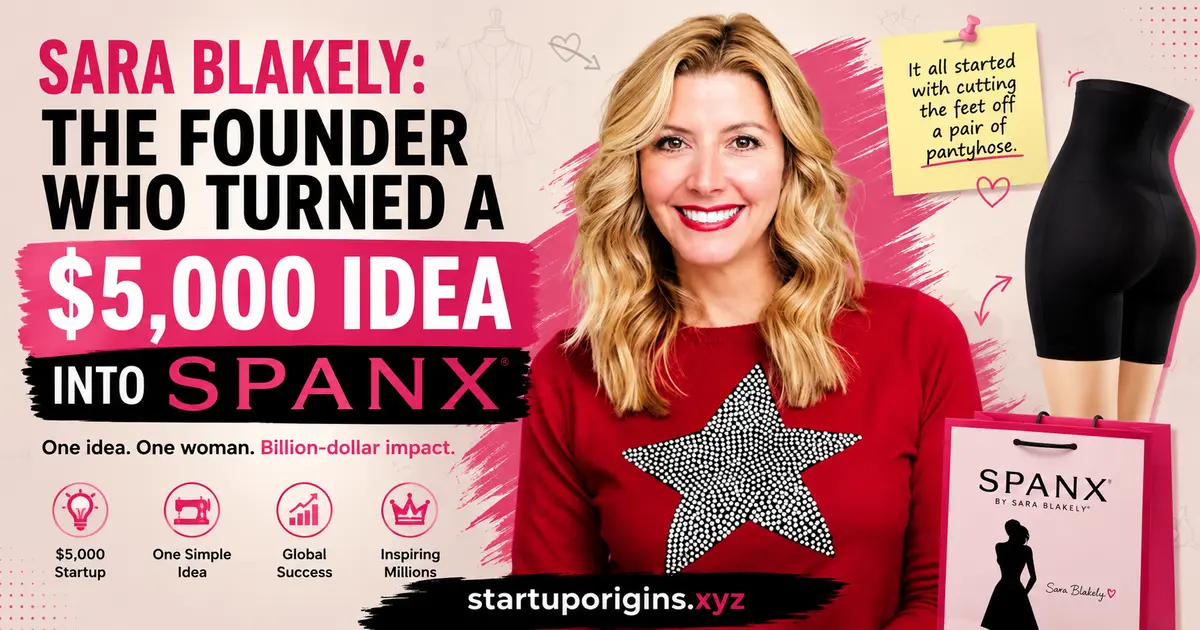
What a childhood dinner-table ritual, two failed law school exams, and a stint as a Disney World ride operator have to do with how one founder learned to think like a customer instead of a CEO. — 14 min read
At a cocktail party not long after Spanx had started making headlines, a man approached Sara Blakely with the kind of unsolicited advice successful women get used to receiving. “Sara, we heard you invented something. I hope you’re ready to go to war. Business is war,” he told her. She remembers looking at him and thinking one word: why.
She went home that night, sat on the floor of her apartment, and thought, “I don’t want to go to war.” Then, in her own words, a voice inside her head said: “Do it differently. Take a different approach.”
- The Dinner Table That Built the Founder
- Two Failed Exams and a Goofy Costume That Didn’t Fit
- What Selling Fax Machines Actually Taught Her
- Why Sara Blakely Thought Like a Customer Before She Thought Like a CEO
- The Decision That Changed Everything
- Building Confidence in Public, One Rejection at a Time
- The Leadership Philosophy That Emerged as Spanx Grew
- Letting Go Without Letting Go: The Blackstone Transition
- Sara Blakely: A Quick Timeline
- What Sara Blakely’s Journey Actually Teaches
- Frequently Asked Questions
That moment is a better entry point into who Sara Blakely actually is than almost any other detail from the Spanx creation story. It isn’t about pantyhose, or patents, or Neiman Marcus. It’s about a founder who kept getting handed a rulebook — for how business gets done, how leaders are supposed to act, how founders are supposed to sound — and kept quietly setting it down instead of picking it up. Understanding how she became someone capable of doing that requires going back further than the moment she cut the feet off a pair of pantyhose. It requires going back to a kitchen table in Clearwater, Florida.
The Dinner Table That Built the Founder
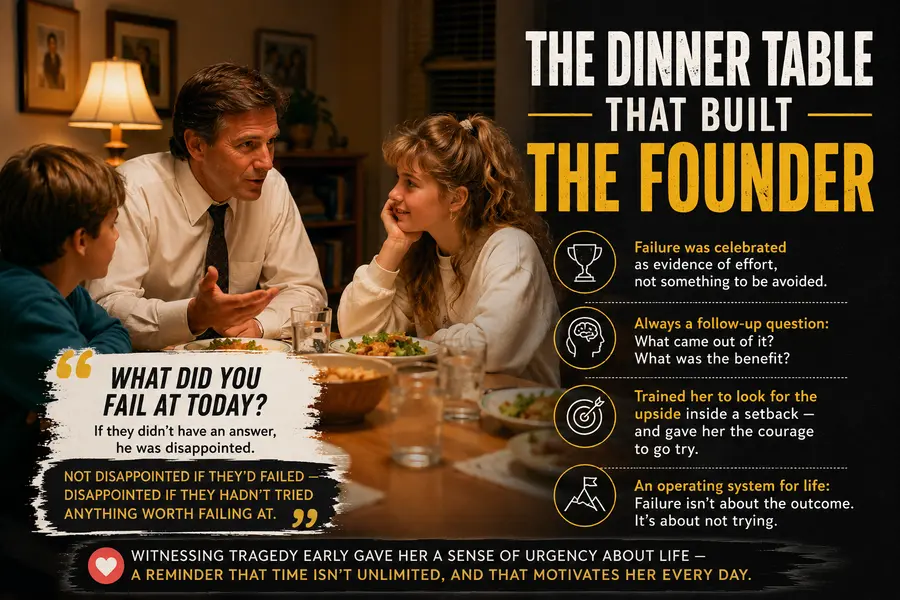
Long before Sara Blakely had a company, she had a ritual. Every evening, her father — a personal injury attorney named John Blakely — would ask her and her brother one question at dinner: “What did you fail at today?” If they didn’t have an answer, he was disappointed. Not disappointed if they’d failed — disappointed if they hadn’t tried anything worth failing at.
It’s easy to read that as a cute anecdote and move past it. It’s worth sitting with instead, because it’s genuinely unusual. Most households, even encouraging ones, treat failure as something to be managed or minimized. The Blakely household treated it as evidence of effort. Sara started actively seeking things to fail at — auditions she didn’t make, sports she was bad at, words she misspelled — because she wanted something to report back. Her father would celebrate the failures with genuine enthusiasm, then, according to people who’ve heard her tell the story, ask a second question: what came out of it. What was the benefit. That follow-up, she has said, trained her brain to look for the upside inside a setback — and that habit of looking is what eventually made her want to go try things in the first place.
By the time she reached adulthood, this had become something closer to an operating system than a fond memory. She would later describe her adult relationship to failure in almost clinical terms: failure isn’t attached to outcome, it’s attached to not trying. Most people, she’s noted, tie failure to something not working out or to how they’re perceived. She learned to tie it only to whether she’d made the attempt at all.
That reframing did real work later. A founder who experiences rejection as data point rather than verdict behaves differently than one who experiences it as a referendum on their worth. Blakely got the first version installed early, and it shows up again and again through every stage of what came next.
Her early years weren’t only shaped by comfortable lessons, either. She witnessed a car accident that killed her best friend while she was riding her bike as a child, her parents separated that same year, and both of her prom dates later died in unrelated, tragic circumstances. She has said that witnessing death at sixteen gave her a persistent sense of urgency about life — that thinking about her own mortality is something she finds motivating rather than morbid, because it can remind her that time isn’t unlimited. It’s not a detail she leans on for sympathy in interviews. It’s one she’s pointed to, matter-of-factly, as part of why she moves as fast and as directly as she does.
Two Failed Exams and a Goofy Costume That Didn’t Fit
Blakely didn’t set out to build a company. She grew up wanting to be a lawyer, like her father, and earned a communications degree from Florida State with that plan in mind. Then she took the LSAT. Twice. She failed it both times, and the legal career she’d been assuming for years quietly closed.
What she did next says something about her relationship to plans that stop working: she didn’t spend long mourning the closed door. She took a job at Walt Disney World in Orlando, where she’d hoped to work in costume — including, as she’s told the story, as Goofy — before being told she wasn’t tall enough for the role and ending up as a ride operator instead. Even that fell through fast; she lasted roughly three months before answering a classified ad from Danka, the office equipment company, to sell fax machines door-to-door.
There’s a version of this résumé that reads as a string of setbacks: failed the bar exam track, didn’t fit the costume, quit the ride job, ended up cold-calling office managers who didn’t want to see her. There’s another version — the one that matters for understanding Spanx — where none of those setbacks actually slowed her down, because nothing about her early conditioning had taught her that a closed door meant the search was over. It just meant this particular door was closed.
What Selling Fax Machines Actually Taught Her
By age 25, Blakely had been named national sales trainer at Danka, having spent years navigating the specific, grinding rejection of unsolicited business-to-business sales. For a deeper look at how those years directly shaped the founding of Spanx, we’ve covered the origin story in detail in How Spanx Started With $5,000 and One Idea — but the relevant point here is less about what happened and more about what the job installed in her.
Cold-calling strangers who don’t want to see you, five days a week, for the better part of a decade, does something specific to a person’s relationship with rejection: it makes it boring. Ordinary. Something that happens on a Tuesday and doesn’t require an emotional recovery period before Wednesday. That’s a strange kind of skill to bring into entrepreneurship, but it turned out to be close to the only skill that mattered when she started pitching a product idea to hosiery manufacturers who had every reason, on paper, to say no.
It’s worth noticing what she didn’t have when she started developing the idea that became Spanx. No fashion background. No manufacturing contacts. No retail relationships. No formal business training beyond a communications degree. What she had instead was seven years of proof that “no” from one person in one room told her almost nothing about what the next room would say — and a father’s voice, twenty years deep in her head, treating every rejected pitch as evidence she was trying rather than evidence she was wrong.
Why Sara Blakely Thought Like a Customer Before She Thought Like a CEO
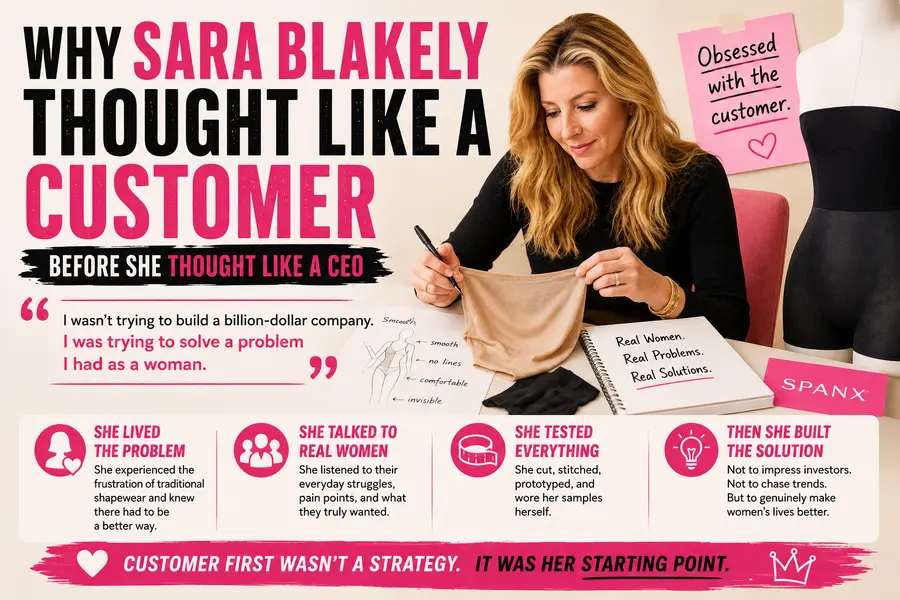
Most retellings flatten this part of Blakely’s story into a single line — “she solved her own problem” — when it actually explains most of what makes her leadership distinct from a typical founder’s.
Blakely didn’t approach the shapewear category as an executive looking for a market gap. She approached it as a woman standing in front of a mirror, annoyed, with no product on the shelf solving her actual problem. That’s a meaningfully different starting position than the one most founders occupy, and it produced a meaningfully different kind of company.
In the earliest days, that showed up in the small operational calls. She personally showed up at department stores to meet customers face to face, and she designed the brand’s cherry-red packaging herself — decisions a founder with a traditional retail or fashion background might have handed to a merchandising team or a design agency on day one. Blakely didn’t have that team, so she made the calls herself, guided by the same instinct that had made her cut the feet off her own pantyhose in the first place: does this actually work for the person wearing it, and does it make her feel good rather than clinical or embarrassed.
That instinct became a genuine strategic advantage, not just a personality quirk. Professor Chris Neck of Arizona State University’s W. P. Carey School of Business, who studies leadership and teaches Blakely’s story to his classes, has noted that before Spanx, shapewear was treated as an unglamorous necessity women tolerated rather than something to feel good about — and that Blakely rewrote that narrative by framing the product around confidence rather than concealment. Neck credits her ability to connect with customers through humor and authenticity, rather than shame, as central to why the brand resonated the way it did.
This is where “thinking like a customer” and “thinking like a CEO” genuinely diverge. A CEO optimizes for market size, margin, and competitive positioning. A customer-first founder optimizes for a single, specific frustration and trusts that if it’s real for her, it’s real for enough other people to build something on. Blakely’s early decisions — the packaging, the in-person store visits, even the plainspoken, slightly irreverent marketing voice she insisted on instead of the clinical tone the category had always used — all trace back to that second instinct, not the first.
It also explains why she resisted the “business is war” framing from that cocktail party years earlier. War requires opponents. Serving a customer’s actual, specific discomfort doesn’t. She wasn’t competing against other hosiery brands in her head when she started; she was trying to solve a problem she personally had every single time she got dressed. The competitive advantage came later, almost as a side effect of getting the customer relationship right first.
The Decision That Changed Everything
If there’s a single moment where a different choice would have quietly ended the Spanx story before it began, it’s the decision to keep pitching hosiery manufacturers after rejection had become the pattern rather than the exception.
Blakely has said she heard “no” from manufacturers for roughly two years before anyone agreed to produce a working prototype. Two years of making an unpaid case to strangers with no obligation to listen. Each pitch cost travel time, phone calls, and emotional energy she was already spending at a demanding full-time sales job — without a partner, without investors, without most people in her life even knowing the scale of what she was attempting.
“Failure is not attached to outcome, but to not trying.”
— Sara Blakely
The alternative was sitting right there, entirely reasonable: stop. She had a stable career and a plausible story to tell herself about why the idea wasn’t going to work. Plenty of good ideas end at exactly this stage — not because they were bad, but because the person carrying them runs out of reasons to keep absorbing “no” with nothing to show for it.
Why did Blakely keep going instead? The dinner-table conditioning matters here in a very literal, mechanical way. She wasn’t experiencing two years of manufacturer rejection as a verdict on the idea. She was experiencing it as the normal cost of trying something — the same currency she’d been taught to spend, and even seek out, since childhood. A person who’s spent two decades treating failure as proof of effort doesn’t hear “no, and no again” the way most people do. She hears it as the process working exactly as expected.
There’s also a simpler mechanism at play, one rooted in the customer-first instinct described above: she believed the product solved a problem she genuinely had, and she trusted that if it worked for her, it would work for other women too. That belief isn’t sophisticated market research. It’s closer to stubborn faith. But paired with a nervous system that had been trained since childhood not to flinch at rejection, it was enough to get her through one more phone call, and then another, until a manufacturer’s own daughters convinced him the idea was worth a shot.
The consequences reached far beyond getting one prototype made. Continuing past the point most people would have reasonably stopped is what turned a private frustration into an actual, manufactured product — and a manufactured product is the only reason there was anything to pitch to Neiman Marcus, anything for Oprah’s team to receive in a gift basket, anything to eventually attract Blackstone’s attention two decades later. Nothing downstream of that decision happens if Blakely treats the two-year “no” the way most people would have: as an answer, rather than as a phase.
Building Confidence in Public, One Rejection at a Time
What’s easy to miss about Blakely’s early years running Spanx is how much of the confidence she’s known for now was built in real time, under pressure, rather than arriving pre-installed. Working at Disney World, she took up stand-up comedy, which she’s credited with helping her build the public-speaking skills she’d later need constantly as the public face of her own company. That’s not a coincidence, or a charming footnote — it’s a founder deliberately practicing a skill she could tell she was going to need before she had any evidence she’d need it.
The pattern repeats through the Neiman Marcus pitch, the self-written patent application, and the earliest marketing decisions, all of which she made without formal training in any of the relevant disciplines. What she had instead was a track record — patchy, awkward, built mostly out of failed auditions and rejected sales calls — of doing things she wasn’t yet qualified to do, and getting slightly better at them by doing them scared. Confidence, in Blakely’s case, looks less like something she arrived with and more like a habit she’d been rehearsing since childhood dinners: try the thing, report back on how it went, do it again.
The Leadership Philosophy That Emerged as Spanx Grew
Running a fast-growing company forces most founders to eventually adopt someone else’s management playbook — hire the executives who’ve done it before, install the processes those executives are used to, and let the original founder’s instincts get diluted by “best practice.” Blakely resisted a lot of that, deliberately.
Leadership researchers who study her career, including Arizona State University’s W. P. Carey School of Business, have described her style as a blend of entrepreneurial, transformational, and servant leadership. In practice, that meant staying personally involved as the company’s primary creative voice well past the point where most founders hand that role to a marketing department, while building structures that gave other people room to fail the way she’d been given room to fail as a kid.
A key tenet of that approach, by her own account, is admitting her own mistakes openly and giving employees the same room to admit theirs. “I don’t subscribe to the fact that you have to act serious to be taken seriously,” she’s said — a direct rejection of the “business is war” posture from that early cocktail party, carried into how she built Spanx’s internal culture.
That philosophy extended outward, too. In 2006, she founded what’s now known as the Red Backpack Foundation, which supports women entrepreneurs and educational initiatives for girls — and named it after the lucky red backpack she carried through the earliest, hardest days of pitching Spanx, including her first sale at Neiman Marcus. It’s servant leadership in the technical sense researchers use the term, but it’s also an extension of the dinner-table lesson, scaled up: notice the gap, try something about it, don’t wait for the first attempt to look polished.
Business writers covering her leadership approach in recent years have specifically framed it as “failing on purpose” — a deliberate, structural habit rather than an occasional tolerance for mistakes, which is a fairly precise description of someone whose formative professional training was a fax-machine sales floor and whose formative personal training was a dinner table in Clearwater, Florida.
Letting Go Without Letting Go: The Blackstone Transition
By 2021, Spanx had grown into a business substantial enough to attract serious private equity interest. That October, Blackstone announced a majority investment valuing the company at $1.2 billion, with Blakely maintaining a significant equity stake and, at closing, becoming executive chairwoman of a newly appointed board. She told CNBC at the time that the company was preparing to push into denim and broader apparel, extending what she called “the magic of Spanx” beyond the shapewear category it had originally defined.
That was only the first step in a longer handoff, not the whole of it. In 2022, longtime company veteran Kim Jones — who had worked alongside Blakely to secure the Blackstone investment — was promoted from president and CFO to chief executive officer, taking over daily operations while Blakely remained founder and executive chairwoman. Jones departed in 2023, and Cricket Whitton, who had joined Spanx in 2017 and most recently served as chief growth officer, was named CEO in her place, with retail veteran Jeanne Jackson — formerly of Nike, Gap, and Walmart.com — stepping into a newly created executive chair role.
That progression matters more than a single ownership headline. Across roughly three years, Blakely moved from sole operator to executive chairwoman to founder working alongside a professional CEO and an outside executive chair — each step handing off a little more operational control while, by her own public statements, keeping her hand on the brand’s creative direction. “Her deep commitment to our brand gives me a lot of confidence in the continued success of our business,” Blakely said of Whitton’s appointment — the kind of statement a founder makes when she’s letting go of the wheel, not the destination.
What made that sequence work, by most outside accounts, is that none of it was framed as Blakely stepping back from the vision — only from day-to-day control. The customer-first instinct that had shaped every major Spanx decision since 1998 stayed structurally embedded in the company rather than getting replaced wholesale by a new owner’s playbook. It’s a different kind of confidence than the one required to cold-call hosiery mills for two years, but it draws on the same underlying trait: trusting her own read on what the company needed at each stage, even when the easier, more conventional move — staying on as CEO indefinitely — would have been simpler to justify to the outside world.
Sara Blakely: A Quick Timeline
| Year | Milestone |
|---|---|
| 1971 | Born in Clearwater, Florida |
| ~1993 | Fails the LSAT twice; takes a job at Walt Disney World |
| Mid-1990s | Sells fax machines door-to-door at Danka; named national sales trainer by 25 |
| 1998–2000 | Develops the Spanx idea nights and weekends with $5,000 in savings |
| 2000 | Founds Spanx; product launches at Neiman Marcus; named an Oprah “Favorite Thing” |
| 2006 | Founds the Sara Blakely Foundation (now the Red Backpack Foundation) |
| 2012 | Spanx reaches a billion-dollar valuation; Forbes names her youngest self-made female billionaire |
| 2013 | Signs the Giving Pledge, committing to give away at least half her wealth |
| 2021 | Blackstone acquires a majority stake at $1.2 billion; Blakely becomes executive chairwoman |
| 2022–2024 | Kim Jones, then Cricket Whitton, take over as CEO as Blakely shifts fully into a founder role |
What Sara Blakely’s Journey Actually Teaches
Strip away the billion-dollar headline and the Oprah moment, and what’s left is a more useful story than the highlight reel usually offers. Blakely didn’t succeed because she had unusual talent in any single discipline — not fashion, not manufacturing, not finance. She succeeded because a specific, unusual childhood habit taught her to treat rejection as information rather than judgment, decades before she needed that skill professionally, and because she never let anyone else’s definition of how a founder is supposed to think replace her own read on what a customer actually needed.
For founders navigating their own version of a two-year “no,” the lesson isn’t the vague reassurance to “believe in yourself.” It’s narrower and more testable than that: the instinct worth trusting is usually the one closest to your own lived, specific frustration — not the one that sounds most defensible in a pitch meeting. Blakely built a category-defining company by staying loyal to a problem she personally felt, long after conventional wisdom said she should have moved on. That loyalty, more than any single tactic, is what turned $5,000 and a pair of scissors into one of the most recognizable brands in the world.
For the full account of how the idea itself came together, read How Spanx Started With $5,000 and One Idea. To understand how the brand scaled without a traditional advertising budget, see How Spanx Grew Without Traditional Advertising. And for a breakdown of specific, applicable lessons from the company’s growth, don’t miss What Spanx Teaches Every Startup Founder.
Editorial Note: This article is an independent editorial feature and is not affiliated with, endorsed by, or sponsored by Spanx, Sara Blakely, or Blackstone. It is compiled from publicly available interviews, company statements, and reporting by verified news outlets, and is intended for informational purposes only.
Frequently Asked Questions
Who is Sara Blakely?
Sara Blakely is the founder of Spanx, the shapewear and apparel company she started in 2000 with roughly $5,000 in personal savings. Before founding Spanx, she sold fax machines door-to-door for the company Danka and worked briefly as a ride operator at Walt Disney World.
How did Sara Blakely’s childhood shape her entrepreneurial mindset?
Blakely’s father asked her and her brother a nightly question at dinner: “What did you fail at today?” He expressed disappointment only when they had no failure to report, which taught Blakely from an early age to treat failure as evidence of effort rather than something to avoid.
Did Sara Blakely have a business or fashion background before starting Spanx?
No. She earned a communications degree from Florida State University with plans to attend law school, but failed the LSAT twice. She had no formal training in fashion, textiles, or manufacturing before developing the idea for Spanx.
What is Sara Blakely’s leadership style?
Leadership researchers have described her approach as a blend of entrepreneurial, transformational, and servant leadership — staying personally involved as the company’s primary creative voice, prioritizing customer empathy over industry convention, and supporting women entrepreneurs through the Red Backpack Foundation, which she founded in 2006.
Is Sara Blakely still involved with Spanx today?
Yes, as founder. After Blackstone acquired a majority stake in 2021, Blakely first became executive chairwoman; the company has since brought in a professional CEO (Cricket Whitton, as of 2024) and an outside executive chair (Jeanne Jackson), with Blakely remaining involved as founder and the brand’s public creative voice rather than running day-to-day operations.


Anup Kumar Yadav is the founder of StartupOrigins.xyz, where he researches and publishes detailed stories about the world’s most successful startups. His work explores founder journeys, funding milestones, growth strategies, and the lessons entrepreneurs can learn from them.