
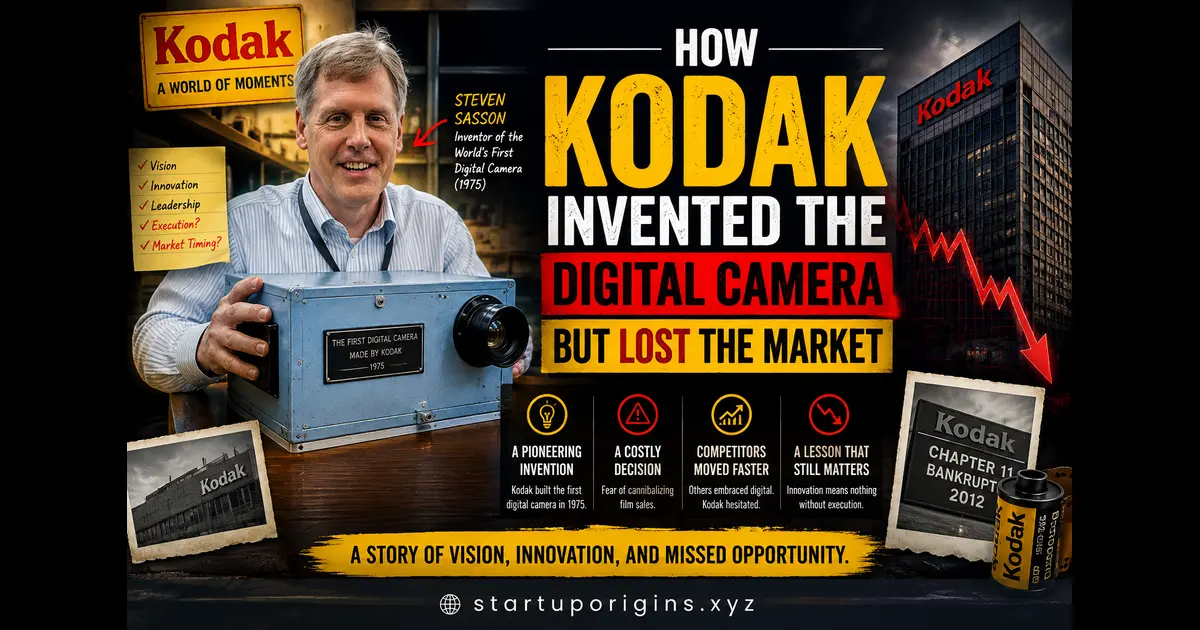
In December 1975, a 24-year-old Kodak engineer named Steven Sasson pointed an 8-pound contraption of scavenged parts at a lab assistant and pressed a button. Twenty-three seconds later, a blurry black-and-white image appeared on a television screen. It was the world’s first digital photograph, and Kodak owned the patent. Thirty-seven years later, the company that invented digital photography filed for Chapter 11 bankruptcy, undone by the very technology it had pioneered. How Kodak invented the digital camera but lost the market is one of the most studied case failures in modern business history — not because Kodak lacked vision, but because it had too much of it and not enough courage to act on it. This is the full story, told with the facts, the timeline, and the lessons that still apply to every company sitting on a technology it’s afraid to use.
Kodak Before the Digital Era
Eastman Kodak was founded in Rochester, New York, in 1888 by George Eastman, a bookkeeper turned inventor who wanted to make photography simple enough for anyone to use. His slogan, “You press the button, we do the rest,” captured the entire business model: Kodak sold cheap cameras and made its real money on film, chemicals, and paper — the consumables that customers had to keep buying.
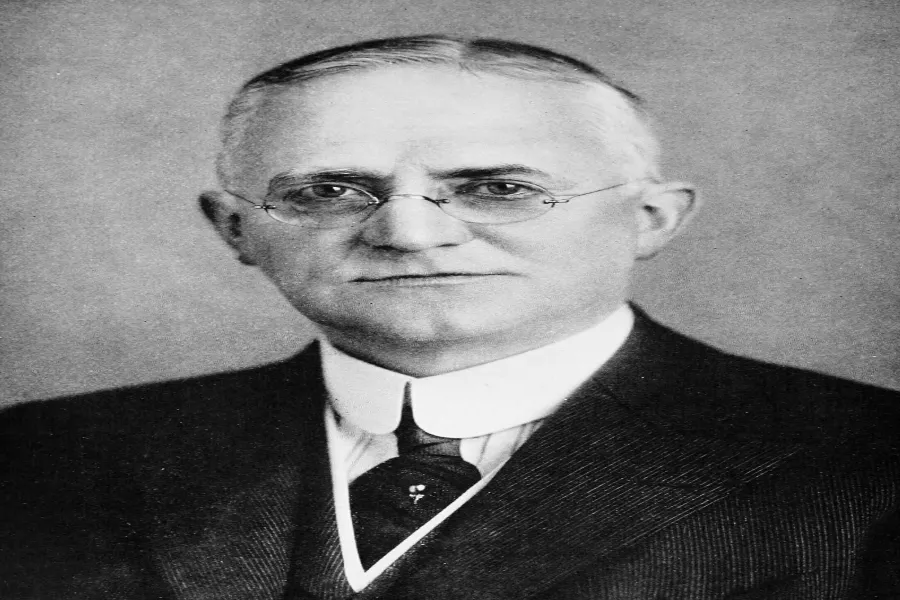
That razor-and-blades model turned Kodak into one of the most dominant companies of the twentieth century. By the 1970s, Kodak controlled roughly 90% of film sales and 85% of camera sales in the United States. Its yellow-and-red box was one of the most recognized brand marks on earth. Eastman himself pioneered flexible roll film, which later became the basis for motion picture film and helped birth Hollywood’s studio system.
Kodak’s marketing didn’t just sell film — it sold memory itself. The company coined the phrase “Kodak moment” to describe the instant worth capturing forever, a phrase so effective it entered everyday English as shorthand for any picture-perfect occasion. At its peak in the late 1980s, Kodak employed more than 145,000 people worldwide and was regularly ranked among the most valuable brands on the planet, alongside Coca-Cola and IBM. Few companies have ever owned a category, and a piece of cultural language, as completely as Kodak owned photography.
How Kodak Invented the Digital Camera but Lost the Market
The seeds of Kodak’s undoing were planted inside its own research labs. In 1974, Kodak supervisor Gareth Lloyd asked a young electrical engineer, Steven Sasson, to explore what could be done with a newly developed charge-coupled device (CCD) — a component that converts light into digital data. Sasson, fresh out of Rensselaer Polytechnic Institute, was given remarkable freedom to experiment.
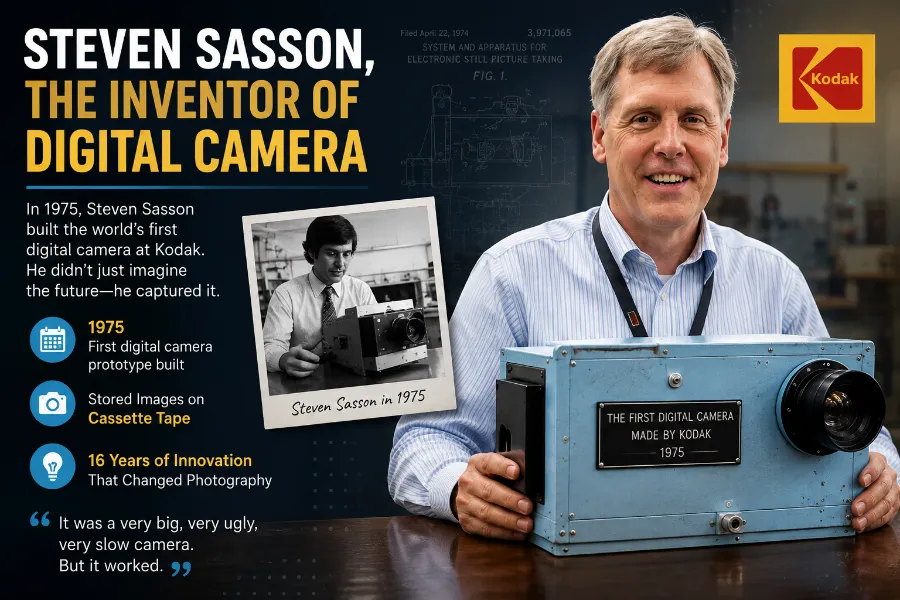
Working largely on his own, Sasson built a camera out of a lens salvaged from a Kodak Super 8 movie camera, a Fairchild CCD sensor, an analog-to-digital converter borrowed from Motorola parts, and a portable cassette recorder to store the data. The result was a toaster-sized, 8-pound machine powered by 16 AA batteries. On December 12, 1975, Sasson and a colleague photographed a lab assistant, Joy Marshall. The image took 23 seconds to record and another 23 seconds to play back on a television. It showed only the faint outline of her hair; her face dissolved into static. Marshall reportedly told him, “You need work.”
The camera captured images at a resolution of just 0.01 megapixels — 100 by 100 pixels — in black and white only, and had no way to reproduce the image on paper. It was slow, crude, and utterly impractical as a consumer product. But it proved something enormous: a camera could exist without film. Kodak filed a patent on the technology in 1977, listing Sasson and Lloyd as co-inventors, and the patent was granted the following year. Sasson’s contribution is now formally recognized by the National Inventors Hall of Fame, which credits him with sparking the mass digitization of photography.
When Sasson demonstrated the prototype to Kodak executives, the reaction was not excitement but unease. As Sasson later recalled to The New York Times, Kodak’s marketing team acknowledged the camera could technically be sold — but wouldn’t be, because a filmless camera threatened to cannibalize the company’s enormously profitable film business. It’s worth noting, as fact-checkers have since clarified, that the full story is more nuanced than “Kodak buried the invention.” The 1975 prototype was genuinely too primitive for consumers, and Kodak did continue funding digital imaging research for decades afterward, filing hundreds of related patents and later profiting from licensing them. The failure wasn’t secrecy — it was Kodak’s refusal to build a business around what it already knew was coming.
Complete Timeline (1888–2026)
| Year | Milestone |
|---|---|
| 1888 | George Eastman founds Eastman Kodak Company in Rochester, New York |
| 1900 | Kodak launches the Brownie camera, making photography affordable for the masses |
| 1935 | Kodak introduces Kodachrome, the first commercially successful color film |
| 1963 | Kodak launches the Instamatic camera, selling over 50 million units |
| 1973 | Steven Sasson joins Kodak as an electrical engineer |
| 1975 | Sasson builds the first self-contained digital camera prototype |
| 1978 | Kodak is granted the patent for the “electronic still camera” |
| 1981 | Sony unveils the Mavica, an analog electronic still camera, intensifying industry interest in filmless photography |
| 1989 | Sasson and colleague Robert Hills develop the first digital SLR camera; Kodak does not bring it to market |
| 1991 | Kodak releases the DCS 100, the first commercial digital SLR, aimed at photojournalists, priced near $13,000 |
| 1994 | Apple’s QuickTake 100, developed with Kodak’s imaging technology, becomes an early consumer digital camera |
| 1996 | Kodak’s stock and revenue peak; the company still dominates global film sales |
| 2001 | Kodak acquires Ofoto (later Kodak Gallery), an online photo-sharing service |
| 2003 | Kodak announces a major strategic shift toward digital imaging, cutting thousands of film-related jobs |
| 2004 | Kodak removes film cameras from its lineup in North America and Europe |
| 2005 | Kodak briefly becomes the top-selling digital camera brand in the United States |
| 2007–2008 | Smartphone cameras and cheap point-and-shoots erode Kodak’s digital camera margins |
| 2011 | Kodak’s stock falls below $1 as losses mount and cash reserves dwindle |
| 2012 | Kodak files for Chapter 11 bankruptcy protection; Instagram, a two-year-old startup, is acquired by Facebook for $1 billion the same year |
| 2013 | Kodak emerges from bankruptcy as a smaller, restructured industrial imaging company |
| 2013 | Kodak sells the bulk of its digital imaging patent portfolio for $525 million to a consortium including Apple, Google, Microsoft, and Samsung |
| 2018 | Kodak briefly ventures into cryptocurrency with “KodakCoin,” generating controversy and a temporary stock spike |
| 2020 | Kodak announces a U.S. government loan to produce pharmaceutical ingredients, later scaled back |
| 2022 | Kodak repurposes former film-manufacturing equipment to produce materials for electric vehicle batteries |
| 2025 | Kodak discloses “substantial doubt” about its ability to continue as a going concern, citing 2026 debt maturities |
| 2026 | Kodak completes a pension plan settlement that returns cash to reduce debt; the company reports a stock rally while continuing to rely on a shrinking print segment |
Why Kodak Built the Digital Camera
Kodak’s digital camera didn’t emerge from a corporate mandate to disrupt itself — it came out of the same research culture that had made Kodak a technology powerhouse in the first place. The company operated one of the largest private research laboratories in America, employing thousands of scientists and engineers and holding, at various points, more active U.S. patents than almost any other American corporation.
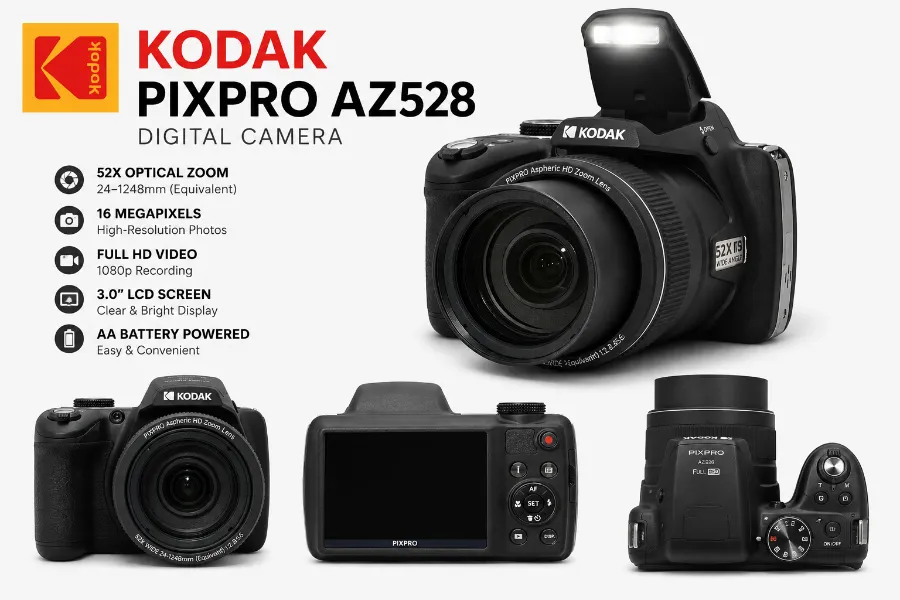
That research apparatus wasn’t limited to chemistry and film emulsions. Kodak’s labs had been experimenting with electronic imaging since the 1960s, tracking early work in television and semiconductor sensors. When Fairchild Semiconductor developed the CCD in the early 1970s, Kodak wanted to understand its implications before rivals did — a defensive research posture as much as an offensive one. Giving Sasson latitude to build a working prototype was, in that sense, classic Kodak: fund the science, patent the result, and decide later whether to commercialize it.
Kodak continued that pattern for years. Its imaging scientists produced foundational patents in image sensors, compression, and digital processing throughout the 1980s and 1990s — technology so fundamental that in 2013, a package of roughly 1,100 of those patents sold for $525 million to a consortium that included Apple, Google, Microsoft, Samsung, and Facebook, some of the very companies that had gone on to dominate the market Kodak helped create.
📉 Why Kodak Failed to Lead the Digital Revolution
Kodak’s downfall is widely studied in business schools because it perfectly illustrates what Harvard Business School professor Clayton Christensen described as the “Innovator’s Dilemma.” The company wasn’t defeated because it lacked technology—it actually invented the world’s first digital camera. Instead, Kodak struggled to embrace an innovation that threatened the highly profitable business it had spent decades building.
Several strategic and organizational factors combined to prevent Kodak from becoming the leader of the digital photography era.
📷 1. Fear of Cannibalizing Film Sales
For decades, Kodak earned exceptional profits from selling photographic film, chemicals, and printing paper. Unlike digital cameras, film generated recurring revenue because customers had to continually purchase new rolls and pay for photo development.
Internal business analyses reportedly showed that every digital camera sold could replace years of future film purchases. Executives understood that adopting digital photography would reduce one of the company’s most profitable revenue streams. Rather than disrupting its own business, Kodak attempted to protect it—giving competitors valuable time to capture the emerging market.
🏢 2. Leadership Was Invested in the Old Business Model
Many senior executives had built successful careers around Kodak’s traditional film business throughout the 1980s and early 1990s. Their performance targets, promotions, and internal influence were closely linked to protecting film sales rather than replacing them.
Moving aggressively into digital photography would have required leadership to accelerate the decline of the very business that had made Kodak one of America’s most successful companies. As a result, strategic decisions often favored preserving existing profits instead of investing fully in future growth.
🏭 3. A Slow and Conservative Corporate Culture
Kodak operated for decades from Rochester, New York, where it dominated the local economy and faced relatively limited competition in North America. This long period of success created a culture that valued careful planning and extensive internal review.
While this approach worked well in the film era, it proved too slow for the rapidly evolving consumer electronics market. Product development often required lengthy approval processes, making it difficult for Kodak to compete with faster-moving companies that released new digital products every year.
⚖️ 4. Digital Was Treated as a Complement, Not a Replacement
Kodak invested billions of dollars in digital imaging research and owned thousands of digital imaging patents. However, the company’s strategy was cautious rather than transformational.
Instead of positioning digital cameras as the inevitable future of photography, Kodak initially marketed them as products that would coexist alongside traditional film cameras. By the time the company fully committed to digital photography in the early 2000s, consumer preferences had already shifted dramatically, and competitors such as Canon, Sony, Nikon, and Fujifilm had established strong positions in the market.
💰 5. Film Profits Delayed Urgent Change
One of Kodak’s greatest advantages eventually became one of its biggest weaknesses. Film continued generating substantial profits well into the 1990s, allowing the company to postpone difficult strategic decisions.
Because the core business remained financially healthy for years, Kodak never experienced the early warning signs that often force struggling companies to reinvent themselves. This delayed response reduced the urgency to pivot toward digital imaging while competitors invested aggressively in the technologies consumers increasingly wanted.
💡 StartupOrigins Insight
Kodak’s story demonstrates that innovation alone is not enough. The company possessed world-class engineers, valuable patents, and groundbreaking technology, yet organizational incentives, dependence on legacy profits, and slow strategic execution prevented it from leading the digital revolution. The lesson for modern founders is clear: if your own innovation threatens your existing business, it’s usually better to disrupt yourself before someone else does.
How Competitors Adapted Faster
While Kodak deliberated, a different set of companies — many without any legacy film business to protect — built the digital photography industry Kodak had sketched out in 1975.
| Company | Starting Position | Why It Adapted Faster |
|---|---|---|
| Canon | Camera and optics manufacturer | No film-profit conflict; leveraged existing lens and camera-body engineering to move quickly into digital SLRs |
| Sony | Consumer electronics giant | Deep expertise in sensors, batteries, and miniaturized electronics; launched early electronic imaging products like the Mavica in 1981 |
| Nikon | Camera and optics manufacturer | Strong professional photographer relationships eased the transition to professional-grade DSLRs |
| Fujifilm | Kodak’s closest film-industry rival | Diversified early into cosmetics, healthcare, and document imaging using its film-chemistry expertise, cushioning the decline of its film business |
| Apple | Consumer technology company | Integrated cameras into phones, redefining “camera” as a feature of a broader device rather than a standalone product |
| Samsung | Electronics and semiconductor manufacturer | Vertical integration in chips and displays let it mass-produce cheap, high-quality camera sensors for its own phones and others |
| Adobe | Software company | Built the editing and storage software layer (Photoshop, Lightroom, Creative Cloud) that made digital photography usable and valuable to professionals and consumers alike |
The common thread among Kodak’s most successful rivals wasn’t superior invention — Kodak had invented first. It was the absence of a profitable legacy business standing in the way, or, in Fujifilm’s case, a willingness to actively diversify that legacy business into new markets rather than defend it indefinitely.
Kodak’s Biggest Strategic Mistakes
Treating digital as a threat to manage rather than a business to build. For roughly two decades, Kodak’s digital strategy was largely defensive — designed to slow film’s decline rather than to win the digital category outright.
Underestimating how fast image quality and cost would improve. Kodak executives reasonably assumed early digital cameras were too expensive and low-quality to threaten film in the near term. That assumption became a self-fulfilling delay: while Kodak waited for digital to mature “enough” to warrant urgency, competitors were making it mature faster than Kodak expected.
Missing the shift from cameras to camera-phones. Kodak built cameras. It did not build phones, software ecosystems, or social platforms. When smartphones absorbed the camera function entirely, Kodak had no foothold in the device category that ultimately won, unlike Sony or Samsung, which had semiconductor and electronics divisions to fall back on.
Failing to own the photo-sharing and storage layer. Kodak launched an online photo service, Ofoto (later Kodak Gallery), as early as 2001 — years before Facebook or Instagram existed. But the company treated it as a print-ordering channel rather than a social platform, and it never became the central hub for how people shared images the way Instagram would a decade later.
Slow, sequential rather than parallel transformation. Kodak tried to transition its enormous film infrastructure and workforce gradually, preserving jobs and revenue streams as long as possible. Rivals building digital businesses from a smaller base could move faster because they had less to protect.
Could Kodak Have Won?
Business historians are not unanimous on whether Kodak could have dominated digital photography even with a faster, bolder strategy. One school of thought, closely associated with Christensen’s innovator’s dilemma framework, argues Kodak’s fate was largely structural: any company as dependent on a high-margin legacy product would have struggled to self-disrupt at the necessary speed, regardless of leadership talent.
A competing view, echoed in retrospectives from Harvard Business Review and MIT Sloan Management Review, holds that Kodak’s failure was more a matter of choices than inevitability. Fujifilm, facing the identical collapse of the film market, aggressively diversified into cosmetics, pharmaceuticals, and document solutions using the same chemical and materials science it had built for film — and remained a large, profitable company. That comparison suggests Kodak’s outcome was not predetermined by its starting position but shaped by specific decisions about where to invest, how fast to move, and how much of the legacy business to protect versus sacrifice.
The honest answer, supported by the evidence rather than hindsight, is probably both: Kodak faced real structural headwinds that made a fast pivot genuinely difficult, and it also made avoidable strategic errors that widened the gap between where it started (as the technology’s inventor) and where it ended up (as a bankrupt also-ran).
Kodak’s Bankruptcy in 2012
By the late 2000s, Kodak’s digital camera business, which had briefly made it the top-selling digital camera brand in the U.S. around 2005, was being squeezed from two directions: cheaper Asian manufacturers competing on price, and smartphones eliminating the standalone camera market altogether. Kodak’s stock, which had traded above $80 in 1997, fell below $1 by 2011.
On January 19, 2012, Eastman Kodak Company filed for Chapter 11 bankruptcy protection in the U.S. Bankruptcy Court for the Southern District of New York. The filing listed roughly $5.1 billion in assets against $6.75 billion in liabilities. Kodak framed the move as a restructuring rather than a liquidation, aiming to shed unprofitable consumer businesses and refocus on commercial and industrial imaging.
Over the following eighteen months, Kodak sold off major pieces of itself: its online photo-sharing business, its document-imaging division, and, most significantly, a large tranche of its digital imaging patents for $525 million in late 2012 and early 2013. It also exited the consumer digital camera, pocket video camera, and digital picture frame businesses entirely, and terminated its involvement in traditional film camera manufacturing for consumers. Kodak emerged from bankruptcy in September 2013 as a far smaller company focused on commercial printing, packaging, and specialty chemicals, with its once-massive workforce reduced to a small fraction of its 1980s peak.
Where Kodak Is Today (August 2026)
Kodak today bears little resemblance to the consumer photography giant of the twentieth century. Its business is organized around industrial and commercial segments: commercial print systems, packaging and specialty chemicals under its Advanced Materials & Chemicals division, and a small but symbolically important motion picture film business that supplies Hollywood productions — several 2026 awards-season films were shot on Kodak film stock, part of a broader resurgence of analog photography and cinema among younger consumers and filmmakers.
Financially, Kodak has spent much of 2025 and 2026 working through serious balance-sheet stress. In its second-quarter 2025 SEC filing, the company disclosed “substantial doubt” about its ability to continue as a going concern, tied to roughly $477 million in term loans and $99 million in Series B preferred stock maturing in May 2026. Kodak’s management plan centered on recovering excess cash from the termination of its U.S. pension plan, the Kodak Retirement Income Plan, to pay down that debt. Kodak’s leadership, led by CEO Jim Continenza, publicly pushed back on characterizations that the company was shutting down, stressing it had no plans to cease operations.
By early-to-mid 2026, that pension settlement had largely materialized, and Kodak’s cash position and debt load improved substantially, contributing to a sharp rally in its stock price. However, the company’s core print segment — still roughly 70% of total revenue — remains in long-term decline, and Kodak’s overall revenue trajectory continues to raise questions among analysts about its longer-term growth prospects even as its immediate solvency crisis eased. Kodak has also diversified into adjacent ventures over the past several years, including producing materials for electric vehicle batteries using repurposed film-manufacturing equipment, underscoring a broader strategy of applying its legacy chemical and materials expertise to new markets — a strategy reminiscent of the diversification path Fujifilm took decades earlier.
What Modern Businesses Can Learn from Kodak
Established companies facing their own “Kodak moment” — a term now used ironically in business strategy circles — can draw several practical takeaways. First, fund internal research broadly, but review it with a genuine willingness to act, not just to patent and shelve. Second, separate resource allocation for emerging technologies from the performance metrics of the legacy business, so a promising new line isn’t starved to protect this quarter’s numbers. Third, study Fujifilm’s diversification, not just Kodak’s decline: the same core competencies that built a legacy business can often be redirected into adjacent markets rather than defended indefinitely in a shrinking one. Finally, treat customer behavior signals — not internal margin assumptions — as the primary guide for when to pivot; Kodak’s numbers said film was still profitable long after consumers had already begun mentally moving on.
Common Myths About Kodak
| Myth | Fact |
|---|---|
| Kodak buried the digital camera invention in a vault and hid it from the world | Kodak patented the invention publicly in 1977–1978 and continued researching digital imaging for decades, later profiting from licensing those patents |
| Kodak went completely out of business in 2012 | Kodak filed for Chapter 11 reorganization, not liquidation, and emerged in 2013 as a smaller, restructured company that still operates today |
| Kodak never made digital cameras | Kodak sold digital cameras from the early 1990s onward and briefly led the U.S. digital camera market around 2005 |
| Kodak’s failure was entirely due to bad luck or an unforeseeable market shift | Digital photography’s rise was foreseeable and foreseen — by Kodak’s own engineers, decades in advance |
| No company in Kodak’s position could have adapted successfully | Fujifilm, facing the same collapse in film demand, diversified successfully and remains a large, profitable company today |
Frequently Asked Questions
Who invented the first digital camera at Kodak?
Steven Sasson, a Kodak electrical engineer, built the first self-contained digital camera prototype in December 1975. Working with a CCD sensor from Fairchild Semiconductor, a lens salvaged from a Kodak movie camera, and a portable cassette recorder, Sasson created an 8-pound device that captured a black-and-white image at 0.01 megapixels. Kodak patented the technology in 1977, listing Sasson and his supervisor Gareth Lloyd as co-inventors.
Why didn’t Kodak sell the first digital camera commercially?
The 1975 prototype was far too primitive for consumer use, taking 23 seconds to capture and playback a low-resolution image with no way to print it. Beyond the technical limitations, Kodak’s marketing division was also wary of a filmless camera undercutting the company’s highly profitable film business, a concern Sasson has confirmed executives raised at the time.
When did Kodak file for bankruptcy?
Eastman Kodak filed for Chapter 11 bankruptcy protection on January 19, 2012, listing about $5.1 billion in assets against $6.75 billion in liabilities. The company emerged from bankruptcy in September 2013 as a smaller business focused on commercial printing and imaging.
Is Kodak still in business in 2026?
Yes. Kodak continues to operate, now focused on commercial print systems, specialty chemicals, and motion picture film. The company faced a serious “going concern” warning in 2025 tied to 2026 debt maturities, which it worked to resolve through a pension plan settlement, and its stock rallied through early 2026 as that plan progressed.
What happened to Kodak’s digital camera business?
Kodak sold digital cameras from the 1990s through the early 2010s and briefly led the U.S. market around 2005. As smartphones absorbed the standalone camera market and margins collapsed, Kodak exited the consumer digital camera business entirely as part of its 2012 bankruptcy restructuring.
Did Kodak invent the digital SLR camera too?
Kodak engineers, including Steven Sasson and colleague Robert Hills, developed the first self-contained digital SLR camera in 1989, but Kodak chose not to bring it to market at the time. Kodak later did release commercial digital SLRs, including the DCS 100 in 1991, aimed primarily at professional photojournalists.
Conclusion
How Kodak invented the digital camera but lost the market is ultimately a story about the gap between invention and commitment. Kodak’s engineers saw the future in 1975, patented it, and kept refining it for decades. What the company never fully did was bet its identity on that future while it still had the resources, brand trust, and market position to win. By the time Kodak committed fully to digital, the market it had quietly pioneered had already been built by companies willing to move faster and risk more. The enduring lesson, for founders and legacy companies alike, is that the hardest part of innovation is rarely the invention itself — it’s having the courage to let a new idea replace the business that made you successful in the first place.
Continue Reading
“I skate to where the puck is going to be, not where it has been.” — Wayne Gretzky, a line frequently cited in business strategy discussions of anticipating disruption rather than reacting to it.
Disclaimer
This article is for informational and educational purposes only and does not constitute financial, investment, or legal advice. Figures related to Kodak’s finances, including its 2025–2026 going concern disclosures, reflect publicly reported data at the time of writing and may have changed since publication. Readers should consult Kodak’s official investor relations filings and other primary sources for the most current information.

Anup Kumar Yadav is the founder of StartupOrigins.xyz, where he researches and publishes detailed stories about the world’s most successful startups. His work explores founder journeys, funding milestones, growth strategies, and the lessons entrepreneurs can learn from them.