
There is a version of the Chobani story that has calcified into a fable: immigrant buys forgotten factory, invents a better yogurt, gets rich. It’s true enough, as far as it goes, but it also flattens the company into a parable — the kind of story that makes founders feel good for twenty minutes and gives them nothing to actually do on Monday morning.
- Opportunity Doesn’t Announce Itself — It Looks Like Decline
- Knowing the Product Cold Is a Moat Money Can’t Buy Overnight
- Ownership Structure Is a Strategy Decision, Not Just an HR Perk
- Purpose Can Be a Genuine Operating Constraint, Not a Marketing Layer
- Sustainable Capital Discipline Outlasts the Pressure to Raise or Sell
- The Chobani Decision Every Founder Should Study
- The Biggest Myth About Chobani’s Success
- If Hamdi Ulukaya Started Chobani in 2026, What Would He Do Differently?
- Why Chobani Became More Than a Yogurt Company
- The Actual Takeaway
- Disclaimer
The more useful version of Chobani is not a fable. It’s a series of specific, high-stakes decisions — about capital, ownership, hiring, and reputation — each of which could plausibly have gone the other way, and several of which were actively discouraged by the people around Hamdi Ulukaya at the time. What makes those decisions worth studying isn’t that they worked. It’s that the reasoning behind them still holds up, nearly two decades later, when you test it against how Chobani operates today: a company that in 2025 alone acquired a plant-based meals brand, broke ground on a $1.2 billion New York facility, and raised $650 million in fresh capital at a $20 billion valuation, according to Forbes — all while remaining privately held by choice.
This is a case study, not a biography, and it’s built around a narrower question than the usual retrospective: what Chobani teaches every startup founder, specifically, once you strip away the parts of the story that are unique to yogurt, to Ulukaya, or to 2005. The origin story lives elsewhere; the growth story lives elsewhere. What follows is an attempt to isolate the mechanisms — the specific, transferable decisions — underneath Chobani’s twenty-year run, and to be honest about where the analogy to your own business breaks down.
Opportunity Doesn’t Announce Itself — It Looks Like Decline
In 2005, Kraft Foods was closing a yogurt plant in South Edmeston, New York, laying off the last of its workforce and preparing to sell off the equipment. Every signal available to a rational observer said the same thing: yogurt manufacturing in that building was a dead business. Hamdi Ulukaya, who was running a small feta cheese operation at the time and had no experience running a plant of that scale, saw a real-estate listing for the facility and drove up to look at it anyway.
According to his own recounting in a widely viewed TED talk, his first call afterward was to his lawyer, Mario, to say he wanted to buy it. Mario’s reply, as Ulukaya has told it, was blunt: one of the largest food companies in the world was walking away from yogurt in that building, and Ulukaya hadn’t even paid his legal bills in months. Ulukaya bought it anyway, financing the purchase with a Small Business Administration loan rather than outside investors — a detail that matters more than it first appears, because it meant no one with capital at risk had the standing to veto the decision.
The lesson here isn’t “buy failing factories.” It’s narrower and more useful than that: the market’s verdict on an asset (a factory, a product line, a customer segment) reflects what the previous owner could make of it, not what it’s actually worth to someone with a different plan. Kraft’s decision to exit yogurt manufacturing in that building was almost certainly correct for Kraft — a company managing a vast portfolio, unwilling to retool a single regional plant for a niche, strained-yogurt category America barely knew existed. It was not a verdict on the building, the location, or the opportunity. Ulukaya wasn’t betting against Kraft’s judgment; he was betting that Kraft’s judgment didn’t apply to what he intended to do with the asset, which was something Kraft had never tried.
For founders evaluating what looks like a dying market, an unwanted asset, or a category everyone else has written off, the operative question isn’t “why did the last owner fail here?” It’s “does their reason for failing apply to what I’m planning to do?” Those are very different questions, and conflating them causes founders to either chase every distressed opportunity indiscriminately or avoid every one out of borrowed pessimism.
Knowing the Product Cold Is a Moat Money Can’t Buy Overnight
Ulukaya’s edge in 2005 wasn’t capital — he had almost none — and it wasn’t manufacturing experience at scale. It was that he had grown up in a dairy-farming family in eastern Turkey, where his mother made the kind of thick, strained yogurt that barely existed on American shelves, and he knew, viscerally, that what Americans called “yogurt” tasted wrong to him. That’s a qualitative, hard-to-quantify form of expertise, and it’s precisely the kind that’s difficult for a well-funded competitor to replicate on a deadline. General Mills and Danone could and did commit enormous marketing budgets to Greek yogurt once Chobani proved the category — but neither could manufacture, on short notice, a founder who had spent a childhood knowing exactly what the product was supposed to taste like.
This is a lesson about where durable advantage actually comes from in a category with low technical barriers to entry. Yogurt is not a patentable technology. Anyone with capital could build a straining line. What competitors couldn’t quickly buy was the specific, embodied knowledge of what “correct” tasted like — the reference point Ulukaya was building toward for two years of recipe development before the first cup ever shipped. Founders entering categories where the underlying technology is replicable should ask a harder question than “what can I build?” It’s “what do I understand about this problem that a fast-follower with more money genuinely cannot learn quickly?” If the honest answer is “nothing,” the business is a temporary arbitrage, not a moat.
Ownership Structure Is a Strategy Decision, Not Just an HR Perk
In April 2016, Ulukaya gathered Chobani’s roughly 2,000 full-time employees and told them he was giving them a collective ownership stake worth up to 10 percent of the company’s value, vesting on a sale or IPO. As he put it to staff at the time, in a line picked up widely by outlets covering the announcement, it wasn’t meant as charity — it was, in his words, a mutual promise to work together with a shared purpose. Longer-tenured employees stood to receive shares potentially worth hundreds of thousands of dollars, funded out of Ulukaya’s own majority stake rather than a new share issuance, according to reporting at the time from CNN Money and Fortune.
The business case for this move is easy to miss if you only see the headline about generosity. Employee ownership, even at a minority stake, has a well-documented tendency to change how a workforce behaves — reducing turnover, increasing the willingness to flag problems early, and aligning day-to-day decisions on a factory floor with long-run company value rather than short-run convenience. Ulukaya framed the move in exactly those terms on the day he announced it, telling employees, “We used to work together. Now we are partners” — a line that reframes the entire relationship, not just the compensation structure.
For founders, the transferable insight isn’t “give away 10 percent of your company.” Most early-stage startups don’t have the cap table room to do that responsibly, and a poorly structured equity grant can create resentment as easily as loyalty. The insight is that ownership structure is itself a strategic lever, not an afterthought bolted on once the “real” strategy is set. Chobani built plants staffed substantially by people with a real, if small, financial stake in whether those plants ran well — a different operating environment than one staffed entirely by wage employees with no upside, and one that shows up in retention and quality control in ways hard to isolate in a spreadsheet but easy to notice on a factory floor.
Purpose Can Be a Genuine Operating Constraint, Not a Marketing Layer
A recurring pattern across Chobani’s history is that Ulukaya’s stated values weren’t decorative — they showed up in decisions that cost the company something. The clearest example is refugee hiring. Starting at the original New York plant and later at the massive Twin Falls, Idaho facility, Chobani built a workforce that included a substantial number of refugees, at a moment when doing so was neither a competitive requirement nor a marketing necessity. Ulukaya has said his conviction on this came from direct experience: as he put it in one widely cited interview, the moment a refugee gets a job is the moment they stop being defined by that status. In 2016, he formalized this into the Tent Partnership for Refugees, a coalition that has since grown to include hundreds of major companies working to connect refugees with employment, according to Tent’s own account of Ulukaya’s work.
That commitment was tested in a way few companies ever face. In 2017, after a criminal case in Twin Falls involving refugees that had nothing to do with Chobani drew national attention, right-wing radio host Alex Jones published claims on InfoWars tying the company’s hiring practices to the case and to unrelated public-health statistics, under a headline falsely accusing the company of “importing migrant rapists.” Chobani sued for defamation rather than wait out the news cycle. Jones settled within weeks, retracting the claims and stating on video, as reported by NBC News, that he regretted mischaracterizing the company and the Twin Falls community.
The business lesson here is not about refugee hiring specifically — it’s about what happens when a company’s stated purpose collides with real cost or real risk. Plenty of companies publish values statements that never get tested because the values never require the company to spend money, lose customers, or take on legal exposure to defend. Chobani’s refugee-hiring commitment did all three at different points, and the company held the position anyway. That consistency is precisely what separates a purpose that functions as an operating constraint from one that functions as a marketing layer — and customers, employees, and retailers can generally tell the difference, even if they can’t articulate exactly how.
Sustainable Capital Discipline Outlasts the Pressure to Raise or Sell
For a company now valued in the tens of billions, Chobani’s relationship with outside capital has been strikingly cautious for most of its history. Ulukaya financed the original factory purchase with a government-backed small-business loan, not venture capital. He didn’t take on his first major outside financing — a $750 million convertible loan from TPG Capital — until 2014, nine years after founding the company and well after Chobani had already become the best-selling brand in its category. He filed confidentially for an IPO in 2021, reportedly targeting a valuation between $7 billion and $10 billion, and then withdrew the registration in September 2022 as public markets soured on consumer IPOs — a decision Ulukaya has since described as a matter of timing rather than a change of intent, according to trade coverage of Chobani’s financing history.
That discipline continued even as the company’s ambitions grew. Chobani financed its $900 million acquisition of coffee brand La Colombe in December 2023 through a term loan, cash on hand, and an equity swap rather than a rushed public offering, and it acquired the plant-based meal company Daily Harvest in May 2025 on similarly private terms, according to reporting from Nosh.com. Even the October 2025 capital raise — $650 million at a $20 billion valuation — was structured as a private equity round rather than a public listing, preserving Ulukaya’s control of a company he still owns roughly two-thirds of outright.
The pattern across two decades is consistent: raise capital when it serves a specific, identified purpose — a factory, an acquisition, a stated expansion — rather than on a timeline dictated by investor expectations. This isn’t a universal prescription; plenty of legitimate businesses need early institutional capital to survive, and bootstrapping isn’t virtuous by default. But it’s a useful counterweight to the reflexive startup assumption that faster fundraising is always better fundraising. A company that waited nine years for its first major outside check, and is still privately negotiating its capital structure twenty years in, has had a degree of strategic control most venture-backed competitors never get to exercise.
The Chobani Decision Every Founder Should Study
If you isolate one decision in Chobani’s history as the hinge point — the one choice that made every subsequent choice possible — it’s the purchase of that abandoned Kraft factory in 2005, and specifically the decision to buy an existing, idle asset rather than build a company from scratch.
The risk was substantial and multidimensional. Ulukaya had no experience operating a facility of that scale. He had essentially no capital of his own and was taking on SBA-backed debt to buy equipment designed for a much larger operator. The building itself came with legacy costs — aging equipment, a workforce that had just been laid off, a location far from major population centers — that a from-scratch startup wouldn’t have inherited. And the category he intended to enter, Greek-style strained yogurt, had no meaningful mass-market presence in the United States at the time, meaning there was no existing distribution playbook to follow.
Why did Ulukaya believe it could work despite all of that? The clearest signal is what the factory represented rather than what it cost: real manufacturing capacity, built to actual food-safety and production standards, available at a fraction of the price of building new. Constructing a comparable plant from the ground up would have required capital Ulukaya didn’t have and years he couldn’t spare. Buying the shell of an abandoned operation and re-equipping it for a different product was, paradoxically, the lower-risk path to manufacturing scale for someone with no money — even though it looked, from the outside, like the far riskier choice.
The alternative paths were real. Ulukaya could have started smaller — a farmers-market stand, a regional co-packing arrangement, a licensing deal with an existing yogurt manufacturer to produce his recipe on contract. Each of those paths carried less downside risk and would have let him test the product with less capital at stake. He chose the factory instead, betting that owning the means of production outright — control over ingredients, batch consistency, and the pace of scaling — mattered more than minimizing initial risk.
What this teaches founders today has less to do with real estate and more to do with a specific kind of asymmetry: sometimes the “safe,” incremental path to testing a business idea is actually the path that guarantees you never reach the scale the idea requires, while the “risky” path of committing to real infrastructure early is the one that removes a future bottleneck before it becomes fatal. That’s not a case for recklessness — it’s a case for distinguishing between risks that threaten survival and risks that merely feel large because they’re unfamiliar.
The Biggest Myth About Chobani’s Success
The most common explanation for Chobani’s rise, repeated across a decade of business coverage, is some version of: Greek yogurt became trendy, and Chobani was there first. It’s a tidy story, and it’s incomplete in a way that actually matters for founders trying to learn from it.
Greek yogurt didn’t become trendy on its own — Chobani made it trendy, at real financial risk, years before the format had any measurable American consumer demand. When Ulukaya launched Chobani in 2007, Greek-style yogurt held a sliver of U.S. yogurt sales, sold mostly through specialty and ethnic grocers. Chobani didn’t discover a wave and ride it; it built the wave through years of retail-by-retail persuasion, betting its entire early cash position on a format American shoppers hadn’t asked for. Crediting “trendiness” for Chobani’s rise gets the causality backward — the trend was largely downstream of Chobani’s success, not upstream of it.
A second, related myth holds that Chobani eventually won simply by outspending competitors once it had scale — that its billion-dollar revenue base let it buy shelf space and advertising that smaller Greek-yogurt rivals couldn’t match. This misreads the actual sequence. Chobani built its initial distribution and customer base with a marketing budget that was, for years, a rounding error next to Dannon’s or General Mills’. By the time larger competitors did commit serious money to their own Greek lines — Danone’s relaunch of Oikos in 2011, backed by a Super Bowl ad campaign, is the clearest example — Chobani was already the entrenched leader with years of retailer trust and repeat-purchase data behind it. Outspending an entrenched leader is a real strategy, and it did claw back some share; it simply arrived too late to unseat the position Chobani had already built without that spending.
A third myth treats timing as destiny — the idea that Chobani simply happened to launch as American tastes were shifting toward higher-protein, lower-sugar foods, and any reasonably competent operator would have succeeded in that environment. This one is the hardest to fully dismiss, because timing genuinely mattered. But it ignores that Fage, the Greek yogurt category’s original leader in the U.S. market, had access to the same timing and the same shifting consumer preferences and chose a specialty, premium-retail positioning instead of a mass-market one. Two companies had access to the same macro trend; only one built a company to meet it at scale in the mainstream dairy aisle. Timing created an opening. It didn’t determine who would walk through it, or how.
If Hamdi Ulukaya Started Chobani in 2026, What Would He Do Differently?
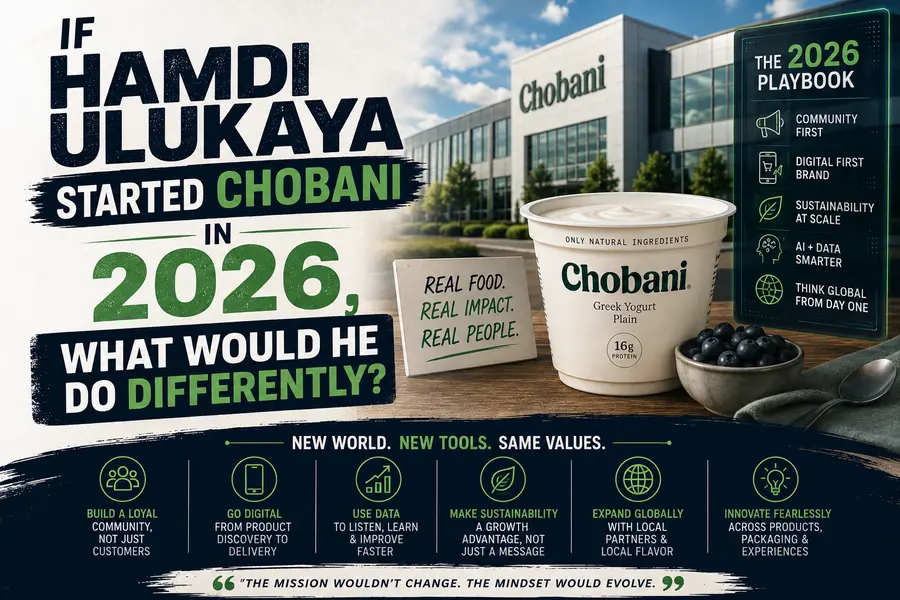
This section is explicitly analytical rather than factual — an exercise in extrapolating from Ulukaya’s documented decisions and stated philosophy, not a report of anything he has said about starting a company today.
Much of the original playbook would likely survive unchanged. Ulukaya’s preference for controlling manufacturing directly, his insistence on mainstream retail placement over specialty positioning, and his aversion to premature outside capital are documented, repeated patterns across two decades — not one-time choices dictated by 2005-era conditions. A 2026 Ulukaya would almost certainly still resist raising money faster than the business needed it, judging by how consistently he applied that logic through the TPG loan, the IPO withdrawal, and the privately structured La Colombe and Daily Harvest acquisitions.
Where the playbook would likely adapt is in how a product reaches its first customers. Chobani’s original growth engine depended on grocery buyers as gatekeepers and word-of-mouth as the amplifier — suited to a 2007 landscape with no real direct-to-consumer infrastructure for perishable dairy. A founder with Ulukaya’s instincts but today’s tools would likely treat social commerce and DTC channels not as a replacement for retail trust but as a faster, smaller-scale way to generate the same proof-of-demand signal Chobani spent years building store by store, before ever walking into a grocery buyer’s office.
AI-assisted operations would plausibly show up first in the unglamorous but essential parts of the business: demand forecasting under strict cold-chain constraints, quality-control monitoring across a growing multi-plant footprint, and sourcing logistics across the dairy-farm relationships Chobani has spent years cultivating. It’s harder to imagine AI replacing what Ulukaya has always kept deliberately human — recipe development, retailer relationships, and an ownership culture that depends on people feeling like partners, not on automation.
Sustainability expectations, which barely registered as a mainstream concern in 2007, would likely be built into the original plan rather than retrofitted. Chobani’s actual sustainability initiatives — a 2019 “Milk Matters” dairy-farm program, non-GMO ingredient commitments, a stated zero-waste-to-landfill goal — arrived years after its initial growth phase, largely because consumer and retailer expectations arrived later too. A company founded in 2026 with the same values would likely front-load those commitments, simply because retailers and consumers now expect them earlier in a brand’s life.
What almost certainly would not change is the sequencing: product quality and manufacturing control first, distribution trust second, marketing spend last — a sequence Ulukaya has followed with unusual consistency from the original yogurt launch through the La Colombe and Daily Harvest acquisitions, each extending existing manufacturing and distribution strength into an adjacent category rather than starting a new go-to-market motion from zero.
Why Chobani Became More Than a Yogurt Company
By 2026, describing Chobani as a yogurt company undersells what the business has actually become: a food-and-beverage platform built on manufacturing scale, retail trust, and — less quantifiably but no less real — a reputation for standing behind stated values under pressure.
The employee-ownership program remains a distinguishing structural feature rather than a one-time gesture; Chobani has continued operating with a workforce that includes a meaningful ownership stake as the company has grown past 3,000 employees. The refugee-hiring initiative scaled from a single-plant practice into the Tent Partnership for Refugees, a network that has grown to include hundreds of major global companies working on refugee employment — a philanthropic effort that also, not incidentally, gave Chobani a recruiting and retention advantage in tight rural labor markets around its Idaho and New York plants that competitors couldn’t easily replicate without building the same reputation over the same amount of time.
The Chobani Incubator, launched in 2016, extended the company’s product-innovation philosophy outward: rather than relying solely on internal R&D, Chobani began offering small food and beverage startups no-strings grants and mentorship, an arrangement that has since expanded internationally through a partnership supporting food entrepreneurs in Guatemala. It’s a structure that lets Chobani spot emerging food trends and occasionally acquire promising alumni companies, while building goodwill in the broader food-startup ecosystem — a very different innovation model than the traditional CPG approach of acquiring proven brands only after they’ve already scaled elsewhere.
Product innovation itself has followed the same logic that built the original yogurt business: extend into adjacent categories where Chobani’s existing manufacturing and cold-chain distribution strength applies directly, rather than chasing unrelated trends. Oat milk and coffee creamers, launched in 2019, extended the brand into breakfast occasions beyond yogurt. The 2023 acquisition of La Colombe brought ready-to-drink coffee into the portfolio, financed in part through Keurig Dr Pepper converting its existing minority stake in La Colombe into Chobani equity. The 2025 acquisition of Daily Harvest extended the company into the frozen aisle for the first time, aimed, according to a company statement, at bringing the brand into “every home in America.”
None of that expansion would carry the same weight without the underlying customer trust Chobani built during its first decade — trust that showed up concretely when the company weathered a 2013 manufacturing recall by moving quickly and transparently rather than downplaying the problem, and again when it chose public legal confrontation over quiet accommodation in the face of defamatory claims about its refugee-hiring practices. Brand reputation of that durability isn’t manufactured through a marketing campaign. It accumulates, slowly, across a series of moments when a company could have taken the easier, less costly path and didn’t.
The Actual Takeaway
Strip away the specific details — the yogurt, the factory, the immigrant founder — and what’s left is a company that made a small number of high-conviction, high-cost decisions early, then applied the same logic consistently for twenty years rather than reinventing its principles with each new opportunity. It bet on an undervalued asset instead of building from scratch. It built ownership and purpose into its operating structure rather than treating them as communications strategy. It resisted outside capital until capital served a specific purpose. And it treated its stated values as commitments to defend at real cost, not slogans to retire under pressure.
None of that guarantees success — plenty of founders have made equally disciplined bets and lost. But the discipline itself, and the willingness to hold a position when holding it is expensive, is the part of Chobani’s history that’s actually available to any founder willing to apply it, regardless of what they’re selling.
Disclaimer
This article is an independent editorial analysis based on public reporting, verified interviews, and company statements available through July 2026. It is not affiliated with, endorsed by, or sponsored by Chobani, LLC, Hamdi Ulukaya, or the Tent Partnership for Refugees. Figures cited — including revenue, valuation, and employee counts — are drawn from third-party sources current as of publication and may since have changed.

Anup Kumar Yadav is the founder of StartupOrigins.xyz, where he researches and publishes detailed stories about the world’s most successful startups. His work explores founder journeys, funding milestones, growth strategies, and the lessons entrepreneurs can learn from them.