
The classroom was ordinary. Fluorescent lights, rows of desks, students hunched over computers running Adobe InDesign. Melanie Perkins was nineteen, studying at the University of Western Australia, and she’d started tutoring her peers in graphic design to earn extra money.
What she saw in those sessions stuck with her in a way she couldn’t shake.
Students who were perfectly capable — bright, motivated, creative — kept getting crushed by the software. Not by the work. By the tools. A single semester could disappear into learning where buttons lived, how layers worked, what each cryptic menu option actually did. By the time a student understood the interface well enough to make something, half the year was gone.
- Who Is Melanie Perkins?
- The Classroom Moment That Changed Everything
- Building Fusion Books Before Canva
- The Long Road of Investor Rejections
- Learning Kitesurfing to Meet Investors
- Finding the Right Co-Founders
- Launching Canva in 2013
- How Melanie Perkins Built a Different Kind of Company
- Leading Canva Through Hypergrowth
- Melanie Perkins and Canva’s AI Future
- Frequently Asked Questions
- Conclusion
- Disclaimer
Perkins understood design. But watching others learn it, she noticed something that practitioners rarely notice: just how high the wall was for everyone else.
She started asking a question that sounds simple in retrospect and was, at the time, genuinely radical: what if design software started with what you wanted to make, rather than with a blank screen and two hundred tools you hadn’t been trained to use?
Nobody handed her an answer. What followed was fifteen years of building one — through a school yearbook startup in Perth, through close to a hundred investor rejections across two continents, through kitesurfing lessons taken specifically to get into a room with a venture capitalist, through a product launch that drew hundreds of thousands of users in its first weeks, and eventually through the construction of one of the most widely used software platforms on the planet.
By 2026, Canva has more than 220 million users in 190 countries. It is used by Fortune 500 marketing teams and primary school teachers and nonprofit directors and freelance photographers and government agencies. It is, by almost any measure, a defining product of its era.
It started in a Perth classroom because a teenager paid close attention.
Who Is Melanie Perkins?
There is a version of Melanie Perkins’ story that gets told as a fairy tale — the young woman who dreamed big, believed in herself, and built an empire. That version is not wrong, exactly. It just leaves out too much.

Perkins grew up in Perth, Western Australia, in a family with mixed heritage — her mother is Malaysian, her father Australian. Perth is a beautiful, sun-drenched city, and also one of the most geographically isolated metropolitan areas on Earth. It sits closer to Singapore than to Sydney. For decades, its distance from the major hubs of technology and finance meant that ambitious people often left.
Perkins was ambitious. She was also, by her own accounts, someone who struggled with the traditional structures of education — not because she lacked intelligence, but because she was thinking about problems that didn’t fit neatly inside the curriculum. When she enrolled at the University of Western Australia to study communications and commerce, she was already the kind of person who asked structural questions: why does this work this way, and does it have to?
The tutoring sessions she began running — teaching design software to fellow students — were never just about earning money. They were, in a sense, her first market research. She was watching real users encounter real friction in real time. And she was doing it long before anyone was using phrases like “user research” or “product-market fit” in the circles she moved in.
She was nineteen. She hadn’t founded anything. She had no investors, no network in Silicon Valley, no technical co-founder. What she had was an observation sharp enough to build a decade of work around.
Featured Founder Story
Discover how Melanie Perkins turned a simple idea into Canva, one of the world’s most valuable design platforms. Learn about the early struggles, 100+ investor rejections, fundraising journey, and the leadership lessons behind Canva’s remarkable growth.
Read the Full Canva Origin Story →The Classroom Moment That Changed Everything
To understand why Perkins’ observation mattered, you have to understand what professional design software actually asked of its users in the mid-2000s.
Adobe’s Creative Suite — Photoshop, Illustrator, InDesign — was extraordinary technology. It could produce anything. But it had been built, iteratively, by engineers adding capability on top of capability over decades. The interface reflected that history. It was dense, precise, and thoroughly unforgiving of inexperience. Learning it properly took years. Using it casually, for the kind of everyday design tasks that most people actually needed, meant navigating a system that had been optimized for professionals doing work at a different level of complexity entirely.
Most people who encountered this friction accepted it as the natural order of things. Design was hard. Design software was hard. That was the deal.
Perkins didn’t accept it. She watched her students struggle and asked a question that was less about the software and more about what the software was supposed to be for: if the point was to help someone make something, why was the tool so determined to get in the way?
The insight she arrived at was not, on its surface, technically complex. Design tools should be organized around outcomes, not capabilities. Start with a template — a poster, a presentation, a social media graphic — and let people work within it, rather than confronting them with an empty canvas and a toolbar full of options they didn’t know how to use.
Simple to describe. Enormously difficult to build. And, in 2006, not something that existed.
Perkins saw the gap. The question was what to do about it.
Building Fusion Books Before Canva
She didn’t try to build Canva first. That’s one of the most important decisions in this story, even if it didn’t look like a decision at the time.
In 2007, Perkins and her then-boyfriend Cliff Obrecht launched Fusion Books: a platform that let schools design and order their own yearbooks using a drag-and-drop online interface. The concept was a direct expression of the core Canva thesis in miniature. Give non-designers the tools they need to produce professional-looking output. Remove the technical friction. Start with the finished product — a yearbook — and design the software backward from there.
They built it from Perth. On a small budget. Without a technical co-founder. Perkins later described the early development process as relentless — long hours building a product for a market that was narrow but real and theirs to own if they moved fast enough.
It worked. Fusion Books grew steadily, picking up school clients across Australia, eventually growing to become the country’s largest school yearbook company. They were shipping thousands of yearbooks a year. They had revenue. They had a real business.
More importantly, they had proof.
Every school that used Fusion Books was confirming the same thing: ordinary people, given the right interface, could produce designed materials that looked genuinely good. The concept wasn’t theoretical anymore. It was operational. It was making money. It was, for anyone paying attention, the Canva thesis validated on a small scale.
When Perkins eventually began pitching investors on a broader platform — design tools for everyone, not just schools ordering yearbooks — she wasn’t asking them to believe an idea. She was showing them a working business that demonstrated the idea already functioned.
In early-stage fundraising, that is not a small thing.
The Long Road of Investor Rejections
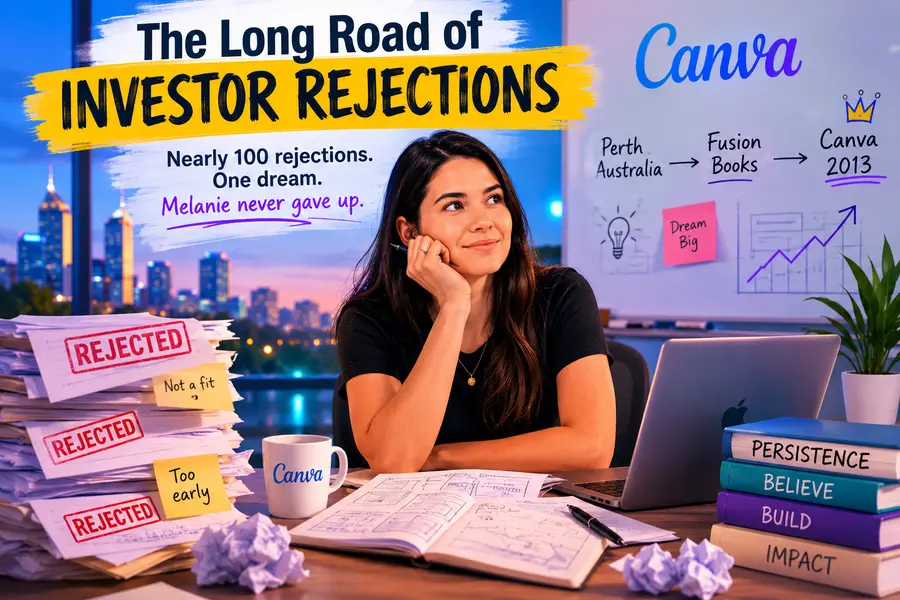
What happened next is the part of Melanie Perkins’ story that tends to get compressed into a single sentence — “she faced nearly 100 investor rejections” — and then left behind as the narrative rushes toward the eventual success. It deserves more than that.
The rejections weren’t just setbacks. They were, cumulatively, a sustained argument from the investment community that she was wrong. Wrong about the market size. Wrong about the timing. Wrong about whether non-designers actually wanted design tools, or whether the complexity of existing software was simply the correct and necessary price of entry.
Some of the skepticism was probably genuine. The consumer software market in the late 2000s and early 2010s was littered with products that had seemed obvious in theory and failed in practice. Investors who had backed similar pitches and lost money had reasons to be cautious.
But some of it was something else. Perkins was a young woman, operating from Perth — about as far from Sand Hill Road as you can get while still being in a Western country with a functioning venture capital ecosystem. She didn’t look like the founders who were getting funded. She wasn’t presenting from a San Francisco office. She was flying in from Australia for meetings, pitching a consumer design tool to investors who were, at that moment, mostly chasing enterprise software and mobile applications.
She has spoken about the gender dynamics of those years with careful clarity, noting the ways in which female founders faced different questions than their male counterparts — more scrutiny of their credentials, more skepticism about their ability to execute, more demand for proof that didn’t seem to be required of others.
She kept pitching anyway. Flight after flight. Meeting after meeting. Rejection after rejection.
What sustained her, she has said, wasn’t blind optimism. It was conviction rooted in evidence. She had watched students struggle with design software with her own eyes. She had built a company that validated the core concept. The market was real. The problem was real. The question was finding investors who could see past the geography and the gender and the unfamiliar profile to the actual opportunity underneath.
Learning Kitesurfing to Meet Investors
This is, objectively, one of the stranger pivots in the history of technology fundraising.
Bill Tai was a prominent venture capitalist — one of the early backers of companies including Zoom — who had a well-known habit of organizing gatherings that combined technology networking with kitesurfing. The events, held in Maui, brought together founders, investors, and operators in a setting that was deliberately informal, deliberately physical, and deliberately far from conference rooms and pitch decks.
Perkins heard about these events. And she made a decision that reflects, perhaps better than any other single moment in her story, the particular quality of her persistence.
She learned to kitesurf.
Not because she had always wanted to. Not because it fit naturally into her life in Perth. But because access to that network required it, and she was not going to let a sport she hadn’t yet learned stand between her and the room she needed to be in.
She went to Maui. She got in front of Tai. And she impressed him — not just with her pitch, but with what her presence there demonstrated about how she operated.
Tai made an introduction that opened the next door: Lars Rasmussen, the Australian-born engineer who had co-created Google Maps and was then working at Google. Rasmussen became a mentor and eventually an adviser, lending Perkins and Canva the kind of credibility that Silicon Valley’s tightly interconnected ecosystem runs on.
The kitesurfing story gets told sometimes as a charming anecdote. It’s actually a precise illustration of something more fundamental about how Perkins approached the problem of being an outsider. She didn’t wait for doors to open. She learned the skills required to open them herself.
Finding the Right Co-Founders
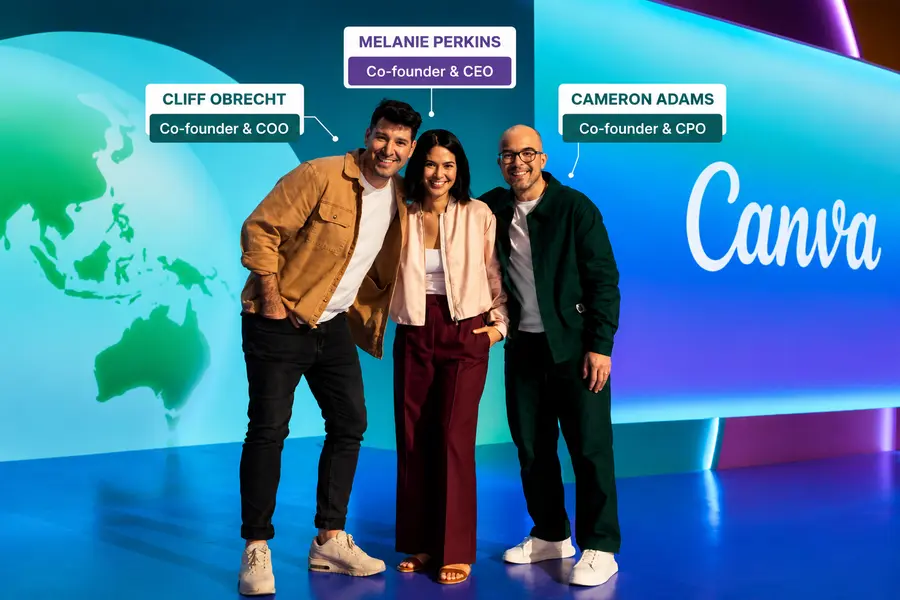
Cliff Obrecht had been there from the beginning. As co-founder and eventual Chief Operating Officer, his role was the operational engine beneath Perkins’ product and strategy vision — the person who kept the business moving while Perkins stayed focused on where it was going. They had met at university and had been together personally and professionally for years before Canva launched. Their partnership had already been tested, severely, through the Fusion Books years.
Cameron Adams was a different kind of addition.
Adams had been an engineer at Google, where he’d worked on Google Wave — an ambitious product that didn’t ultimately succeed commercially but that demonstrated serious technical sophistication. He was Australian, which mattered to the cultural coherence of the founding team. And he was, by any measure, exactly the kind of technical co-founder that Canva needed if it was going to build the product Perkins had been describing to investors for years.
When Perkins recruited Adams in 2012, something shifted in the fundraising conversations almost immediately. The question investors had been quietly asking — could this team actually build what they were describing? — had a different answer with Adams in the room. His presence closed a credibility gap that no amount of Fusion Books traction had fully addressed on its own.
The three-way founding structure that resulted was unusually well-balanced. Perkins brought the vision, the product instincts, and the relentless founder energy that had kept the company alive through years of rejection. Obrecht brought operational discipline and the experience of having already built and scaled a real business. Adams brought the technical depth to match the ambition of what they were trying to build.
It is not a coincidence that serious funding followed within a year of Adams joining.
Launching Canva in 2013
Canva opened to the public in August 2013 with a waiting list that had been building for months.
The reception was immediate. Within the first year, the platform attracted hundreds of thousands of users — a number that surpassed even Perkins’ most optimistic early projections. People who had never thought of themselves as designers were making things: social media posts, event flyers, presentation slides, birthday invitations. They were making them quickly, making them professionally, and then sharing them — which brought more users in.
The timing was not accidental. The mid-2010s were the years when social media platforms shifted from text-heavy to image-heavy. Facebook’s algorithm began rewarding visual content. Instagram was growing fast. Twitter posts with images drew significantly more engagement than those without. The demand for designed visual content exploded precisely as Canva launched a product that let anyone meet that demand without a design degree.
The early product was elegant in ways that professional tools rarely managed. You chose a format. You chose a template. You made it your own. You were done. The experience was organized entirely around what you were trying to accomplish, not around what the software was technically capable of.
For a generation of small business owners, teachers, marketers, and creators who had been trying to communicate visually and failing because the tools weren’t built for them, Canva was less a product than a relief.
How Melanie Perkins Built a Different Kind of Company
There is a question worth asking about the companies that reach genuine scale: do they reflect their founders? In Canva’s case, the answer is clearly yes — though not always in the ways that get written about most often.
Perkins has been consistent, across interviews and public statements over more than a decade, about the kind of company she wanted to build. She wanted Canva to be genuinely useful to people who didn’t have resources — students in developing countries, nonprofits without design budgets, teachers making materials for classrooms that couldn’t afford agency work. The free tier of Canva’s product was never a growth hack. It was, from the beginning, a values statement.
The company’s mission — “empowering the world to design” — is the kind of corporate language that usually functions as wallpaper. At Canva, it has functioned more like an actual constraint on decision-making. Product choices, pricing decisions, and market expansion have consistently been evaluated against whether they make design more accessible, not just more monetizable.
Perkins has also been notably deliberate about the culture she’s built. Canva has consistently ranked among Australia’s best places to work, and the company’s approach to hiring and retention has emphasized mission alignment alongside capability. In an industry where cultures frequently fracture under the pressure of rapid growth, Canva’s culture has remained unusually coherent.
None of this happened by accident. It reflects a founder who thought carefully, early, about what kind of company she was building — and who built systems to protect those values as the company grew past the point where any single person could hold them in place through presence alone.
Leading Canva Through Hypergrowth
The years between Canva’s 2013 launch and its 2021 peak valuation of $40 billion were years of compounding: more users, more markets, more products, more funding, more organizational complexity.
Canva raised successive funding rounds that brought in Blackbird Ventures, Sequoia Capital, and others. Each round reflected a company that had graduated to a new stage of growth, and each brought with it new expectations. Perkins had to learn, in real time, how to run an organization of hundreds and then thousands of people — a genuinely different skill set from the one required to found a startup.
The company expanded internationally with unusual speed. Canva for Education became a major product in its own right. Canva for Teams brought shared brand management to organizations. Enterprise contracts arrived as large companies began standardizing on Canva for internal communications. The platform became, over the decade following launch, something considerably larger than a design tool: a system of record for visual communication at organizational scale.
Acquisitions accelerated the product breadth. Canva picked up Kaleido (background removal), Smartmockups, and other complementary tools, integrating them without losing the simplicity that defined the core experience. That integration discipline — acquiring capability without acquiring complexity — reflected a product philosophy that ran all the way back to what Perkins had first noticed in that Perth classroom.
Throughout this growth, Perkins remained the company’s public face and strategic center of gravity. In an era when founders frequently step back from operational roles as their companies scale, she remained deeply involved in product direction, culture, and the long-term vision — even as the day-to-day complexity of the organization grew well beyond what any single leader could manage alone.
Melanie Perkins and Canva’s AI Future
The AI transition that has reshaped the software industry since 2023 has found Canva in an interesting position: a company whose core value proposition — making sophisticated capability accessible to non-experts — aligns naturally with what AI does at its best.
Canva began integrating AI features into its platform with Magic Write (AI text generation) and Magic Design (AI-generated layouts), but the more significant transformation came in 2025 with a platform-wide overhaul that embedded AI across nearly every workflow. Magic Edit allows users to modify photographs with natural language instructions. Dream Lab brings image generation directly into the design experience. The AI presentation builder produces complete, designed slide decks from a text prompt.
For Perkins, the AI moment has been less a disruption than a validation. The original Canva thesis was that sophisticated design capability could be made accessible to anyone if you removed the technical friction. AI removes more friction. It doesn’t change the direction of the company — it accelerates it.
In a significant development for Canva’s AI strategy, Canva is now integrated with Claude Design, Anthropic’s AI-powered design experience. The partnership with Anthropic brings Canva’s design infrastructure together with Claude’s AI capabilities, allowing users to create and refine visual content through natural conversation. For Perkins, who has spent nearly two decades arguing that design should be as frictionless as a conversation, the integration feels less like a strategic partnership and more like a logical conclusion.
The competitive dynamics have also shifted. Adobe’s Firefly represents a serious AI push from the most established player in design software. But Perkins’ consistent framing — that Canva is not competing with Adobe for the same users, but serving a vastly larger population that Adobe never fully reached — has, if anything, become more defensible as AI capabilities arrive. The more powerful professional tools become, the more complex their interfaces tend to grow. Canva’s bet is that AI should make design simpler and more accessible, and the company’s product choices have remained organized around that principle.
By 2026, with more than 220 million users and AI features woven through the platform, the thesis Perkins formed in a Perth classroom in 2006 looks less like a startup pitch and more like a prediction that came true.
📌 5 Leadership Lessons From Melanie Perkins
The journey of Canva co-founder Melanie Perkins offers valuable leadership insights for entrepreneurs, startup founders, and business leaders. Beyond Canva’s success, her story reveals practical lessons about persistence, execution, team building, and company culture.
Perkins faced more than 100 investor rejections, but her persistence wasn’t blind stubbornness. Years of observing students struggle with design software and the success of Fusion Books gave her real-world proof that the problem existed. Strong leaders rely on evidence, not ego.
Rather than accepting barriers, Perkins treated them as challenges. Her famous kitesurfing effort to meet investors shows that opportunities often come to those willing to find creative ways into the right rooms.
Fusion Books wasn’t a distraction from Canva—it was the foundation. It provided revenue, operational experience, customer feedback, and credibility. Great founders often begin with smaller adjacent opportunities that validate larger visions.
When Cameron Adams joined Canva, investor confidence increased significantly. A strong co-founder can bring expertise, credibility, and complementary skills that transform how a startup is perceived.
Company culture doesn’t scale through good intentions alone. Perkins built hiring processes, leadership principles, and organizational frameworks that preserved Canva’s values even as the company expanded globally.
Frequently Asked Questions
Who is Melanie Perkins?
Melanie Perkins is the co-founder and CEO of Canva, the visual communication platform used by more than 220 million people worldwide. She co-founded Canva in 2013 alongside Cliff Obrecht and Cameron Adams after first validating the core concept through Fusion Books, a school yearbook platform she launched in 2007. She is widely regarded as one of Australia’s most significant technology founders and one of the most influential female entrepreneurs in the global technology industry.
How old was Melanie Perkins when she started Canva?
Perkins first developed the idea that became Canva at age 19, while tutoring graphic design students at the University of Western Australia around 2006–2007. Fusion Books, the precursor company, launched in 2007. Canva itself launched publicly in 2013, by which time Perkins was in her mid-twenties. The long gap between the original idea and the eventual product launch is part of what makes her story unusual — she spent years building toward the vision before it reached a form she could take to market.
Where is Melanie Perkins from?
Perkins was born and raised in Perth, Western Australia. Perth’s geographic isolation from Australia’s main technology and business centers, let alone from Silicon Valley, made her path to building a global technology company considerably harder than it would have been for a founder based in Sydney or Melbourne. She has remained closely identified with Perth throughout Canva’s growth, and the company’s origin story is frequently cited as evidence that world-class startups can be built from anywhere.
How did Melanie Perkins build Canva?
The construction of Canva happened in distinct stages over nearly a decade. Perkins first identified the problem — that design software was too complex for non-expert users — while tutoring students at university. She tested the concept through Fusion Books, a school yearbook platform she built with Cliff Obrecht. She then spent several years pitching investors, facing close to 100 rejections, before connecting with Bill Tai through kitesurfing events and eventually recruiting Cameron Adams as a technical co-founder. Canva launched in 2013 with strong early traction, grew rapidly through a freemium model and viral sharing, and expanded globally into the platform it is today.
What is Melanie Perkins known for?
Perkins is known primarily as the co-founder and CEO of Canva, one of the world’s most valuable private technology companies. She is also known for the founder journey that preceded Canva’s success — specifically, the years of investor rejection she endured and the resourceful, persistent approach she took to building the network and credibility required to raise funding from Perth. She is frequently cited as a model for female founders navigating male-dominated investment environments, and as an example of a founder who maintained product and culture coherence through an unusually extended period of rapid growth.
Conclusion
The classroom where this story began still exists, somewhere in Perth. Fluorescent lights, rows of desks, students trying to learn software that wasn’t built for them.
Most people who walk through that kind of room see a teaching problem. You adjust your curriculum. You find better tutorials. You work around the tool.
Perkins saw a design problem. And she decided, at nineteen, with no funding and no technical background and no network in the cities where funding lived, that the tool itself was what needed to change.
What followed is the part of the story that tends to get told in highlight reel form: the yearbook company, the hundred rejections, the kitesurfing, the funding, the launch, the growth, the billions. The milestones are real. But they compress something that was, in the living, considerably more uncertain and more grinding than any summary can convey.
There were years when Fusion Books was the whole company and the broader vision was still just a pitch deck. There were years when the rejections outnumbered the meetings and the meetings were happening in cities she’d flown thousands of miles to reach. There were years when the product existed and was growing fast and the organizational challenge of scaling it was an entirely new kind of difficulty.
None of those years were a prelude. They were the work.
By 2026, more than 220 million people use what came out of that work. Teachers in Indonesia making lesson materials. Marketing teams in Germany building campaign assets. Students in Mexico designing class projects. Small business owners everywhere producing things they wouldn’t have been able to produce before.
They’re mostly not thinking about Perth. They’re just making something.
Which is exactly what Perkins wanted.
Disclaimer
This article is published for informational and educational purposes only. StartupOrigins is an independent publication and is not affiliated with, endorsed by, or officially connected to Canva, Melanie Perkins, or any individuals mentioned herein. Details including valuations, user figures, and company milestones reflect information available at the time of publication and may have changed since. All trademarks, company names, and personal names remain the property of their respective owners.

Anup Kumar Yadav is the founder of StartupOrigins.xyz, where he researches and publishes detailed stories about the world’s most successful startups. His work explores founder journeys, funding milestones, growth strategies, and the lessons entrepreneurs can learn from them.