
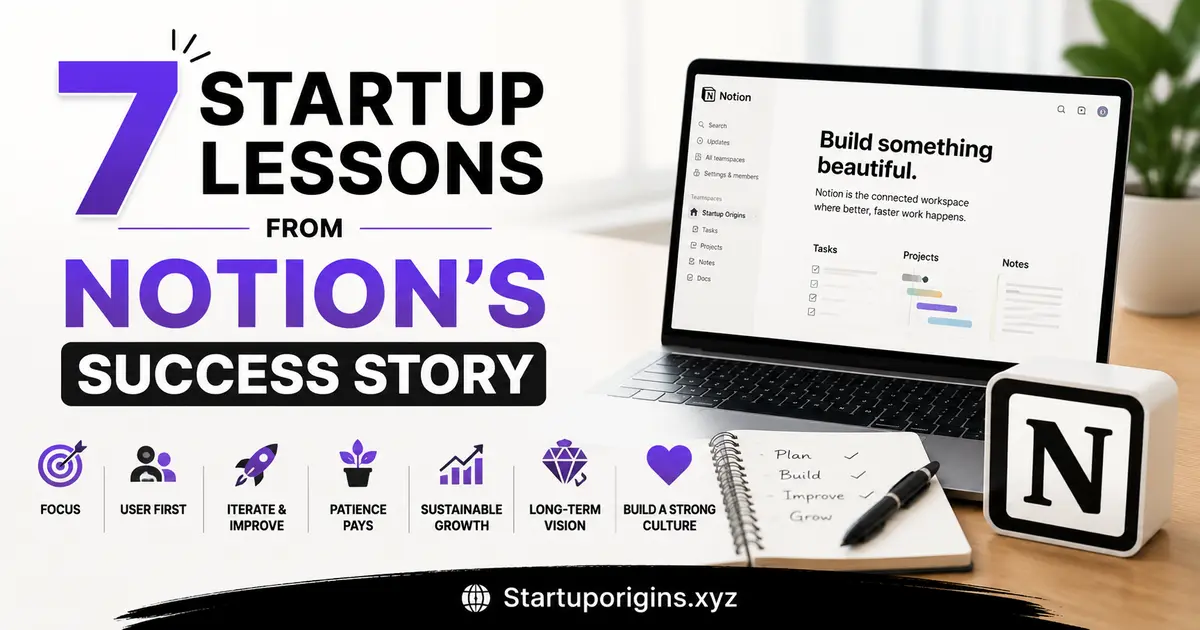
Published: June 2026 | StartupOrigins | Category: Startup Lessons
In 2015, Notion was not a success story. It was a cautionary one in the making.
The company had spent three years building a productivity tool that didn’t work the way it needed to. The codebase crashed constantly. The small team had been let go. The roughly $2 million in seed funding was nearly gone. Two founders — Ivan Zhao and Simon Last — were left with a product that didn’t function, a vision that hadn’t found its market, and very little money to figure out what came next.
A decade later, Notion is used by more than 100 million people. In January 2026, a $270 million tender offer involving Sequoia Capital, Index Ventures, and Singapore’s sovereign wealth fund GIC valued the company at $11 billion.
- The Story Behind Notion’s Success
- Lesson #1: Surviving Is Sometimes More Important Than Growing
- Lesson #2: Solve One Problem Extremely Well
- Lesson #3: Product-Market Fit Is More Valuable Than Funding
- Lesson #4: Small Teams Can Build Extraordinary Companies
- Lesson #5: Community Can Become Your Best Marketing Channel
- Lesson #6: Build a Platform, Not Just a Product
- Lesson #7: Long-Term Thinking Beats Startup Hype
- How These Lessons Apply to Modern Startups in 2026
- A Timeline of Notion’s Most Important Milestones
- What the Lessons Actually Add Up To
- Disclaimer
It would be easy to read that arc as a triumph story — the kind where a founder’s vision is vindicated and everything that happened along the way becomes a footnote to the eventual win. But that reading misses what actually makes Notion’s history useful.
The interesting part isn’t that Notion succeeded. It’s how — and the decisions that produced that success were rarely the obvious or comfortable ones. They were often the opposite. Founders facing financial pressure typically try to grow faster, not slower. Companies trying to differentiate typically narrow their focus to a specific use case, not broaden it. Startups trying to scale typically hire aggressively, not hold the line on team size.
Notion did the opposite of what conventional wisdom would suggest, repeatedly, and it worked.
This article isn’t about celebrating Notion’s success. It’s about the startup lessons from Notion that emerge when you look closely at how it survived — seven decisions, made under real pressure, with real consequences, that any founder can learn from. Each one emerged from a specific moment in Notion’s history. Each one is verifiable. And each one offers something more useful than the generic advice that circulates in most startup content.
The Story Behind Notion’s Success
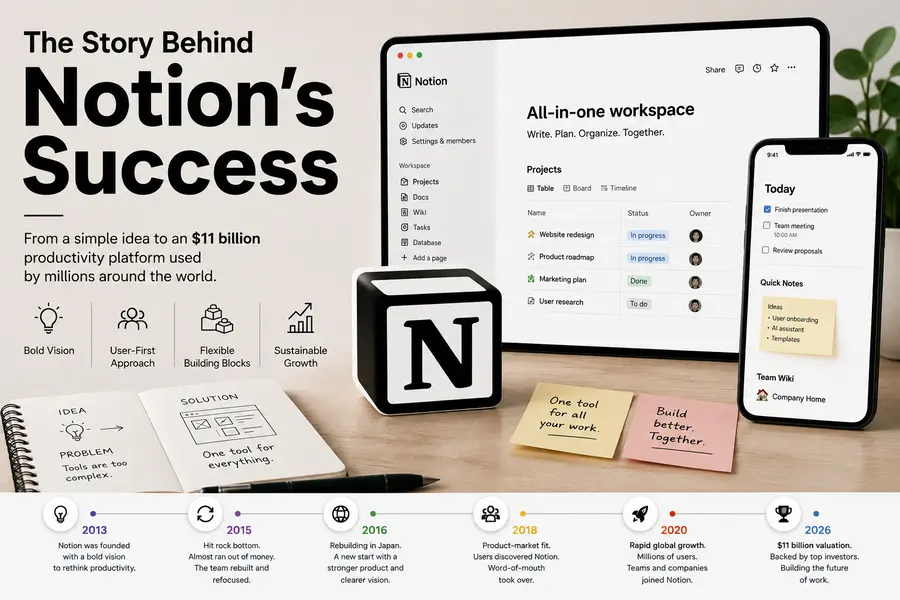
Ivan Zhao founded Notion in San Francisco in 2013, alongside Simon Last. Zhao had studied cognitive science and fine art at the University of British Columbia, and he carried into the company a specific belief: that most software was too rigid, forcing people to adapt their thinking to fit the tool, rather than the other way around. He wanted to build something flexible — a set of building blocks, like Lego, that people could assemble into whatever workspace their work actually required.
The first version of that vision didn’t work. The product, built on an unstable framework, crashed constantly. By 2015, the company had laid off its small team and was down to just Zhao and Last, operating on what remained of a $2 million seed round.
Rather than try to patch the existing product, the two founders moved to Kyoto, Japan — where the cost of living was less than half of San Francisco’s — and rebuilt Notion from scratch. The rebuild took roughly a year. In March 2016, Notion 1.0 launched on Product Hunt and became Product of the Day, Week, and Month. The company achieved profitability shortly after.
What followed was years of organic, word-of-mouth growth. By late 2019, Notion had one million users and just eighteen employees — and that was the moment it raised its first institutional funding, a $10 million Series A from Sequoia Capital at an $800 million valuation. The pandemic accelerated everything: a $50 million Series B from Index Ventures in 2020 valued the company at $2 billion, and a $275 million round in October 2021 pushed the valuation to $10 billion.
By 2024, Notion had crossed 100 million users and $400 million in annual revenue. Through 2025, the company invested heavily in AI, and by the end of that year, more than half of its annual recurring revenue came from AI-enabled customers. In January 2026, the $270 million tender offer brought the valuation to $11 billion.
Each phase of that journey — the near-collapse, the rebuild, the organic growth, the funding, the platform expansion — contains a lesson. Here are seven of them.
Lesson #1: Surviving Is Sometimes More Important Than Growing
By 2015, Notion’s situation had become unsustainable. The seed funding was nearly exhausted. The product’s foundation — built on an unstable web framework — couldn’t support the growth the founders had hoped for. The team, already small, had to be let go entirely.
Most startup advice at this stage points toward acceleration: raise an emergency round, pivot the pitch, find a growth hack that buys time. Zhao and Last did none of those things. They made the company smaller. They moved somewhere cheaper. They stopped trying to grow and started trying to survive long enough to fix the actual problem.
The move to Kyoto cut their costs by more than half. It also removed every distraction that came with operating in San Francisco — the networking events, the investor updates, the social pressure to appear to be winning. What remained was the actual work: rebuilding a product that had never worked properly in the first place.
Ivan Zhao later described this period candidly: “It was kind of like despair, I would say. I almost never had that feeling before.” That honesty matters. The decision to prioritize survival over growth wasn’t framed as a clever strategic pivot at the time — it was framed as the only option left.
The lesson for founders is not that growth doesn’t matter. It’s that growth built on an unstable foundation isn’t really growth — it’s a countdown. When the foundation is broken, the right move is often to shrink, simplify, and rebuild, even when every instinct says to push harder. Notion’s entire future — the funding rounds, the valuation, the hundred million users — was made possible by a decision to stop growing and start over.
Lesson #2: Solve One Problem Extremely Well
The first version of Notion tried to do too much, too abstractly. It was, in Zhao’s own words, “not really a product.” It was built for people who wanted to build their own software tools — a small, technical audience. “It was more for nerdy tech crowds,” he said.
The rebuild in Kyoto wasn’t just a technical reset. It was a narrowing of focus. Instead of asking users to understand a flexible, tool-building platform from day one, the new Notion met people where they already were: writing documents, taking notes, organizing lists. The deeper flexibility — the block-based system, the database capabilities — was still there. But it was no longer the entry point.
Zhao described this shift using an analogy: “sugar-coating broccoli.” The broccoli — the genuinely powerful, flexible underlying system — hadn’t changed. What changed was the sugar: an interface simple enough that someone could open Notion for the first time and immediately understand what to do with it, without a tutorial.
This is a distinction that’s easy to miss. Notion didn’t succeed by abandoning its ambitious vision for something simpler. It succeeded by solving the simplest version of the problem — “I need somewhere to write things down” — extremely well, and letting the more ambitious capabilities reveal themselves to users as they grew into them.
For founders, the lesson is about sequencing, not scope. Ambitious visions are not the problem. Asking users to understand the full ambition before they’ve experienced the basic value is. Solve the smallest, clearest version of the problem first. Let people fall in love with that. The rest can follow.
Lesson #3: Product-Market Fit Is More Valuable Than Funding
For years after the 2016 relaunch, Notion grew without venture capital. The company became profitable on the strength of its early user base, and it stayed that way through 2018 and into 2019. By the time Notion raised its first institutional round — a $10 million Series A from Sequoia Capital in July 2019 — the company already had one million users and a team of just eighteen people.
Akshay Kothari, who joined Notion as COO around this time, described the company’s position to TechCrunch with unusual candor: “So far one of the things we’ve found is that we haven’t really been constrained by money. We’ve had opportunities to raise a lot more, but we’ve never felt like if we had more money we could grow faster.”
That statement only makes sense in the context of genuine product-market fit. Notion’s growth wasn’t bottlenecked by capital — it was driven by retention, word-of-mouth, and a user base that kept expanding its own use of the product over time. Money wasn’t the constraint, because the thing that actually drives sustainable growth — people using the product, loving it, and bringing others in — was already happening.
When Notion did raise money, the terms reflected that leverage. Index Ventures closed a $50 million investment within 36 hours of Zhao starting the conversation. Sequoia reportedly decided to invest after reviewing the numbers for about 30 minutes. Those aren’t typical fundraising timelines — they’re what happens when investors are responding to evidence that’s already overwhelming, rather than being persuaded by a pitch.
The lesson here isn’t that funding doesn’t matter. It’s that funding is a multiplier, not a foundation. Notion proved its model was working before it took outside capital — and that sequence, fit before funding, is what gave the founders leverage, speed, and terms that founders who raise before achieving fit rarely get.
Lesson #4: Small Teams Can Build Extraordinary Companies
One of the most striking facts about Notion’s growth is how long the team stayed small relative to the company’s reach. At one million users in late 2019, Notion employed eighteen people. For context, many companies with a fraction of that user base employ teams ten times that size.
This wasn’t an accident or a temporary phase before “real” scaling began. It reflected something about how Zhao approached the company from the start. A small team forces clarity. Every person’s work has to matter. There’s no room for the coordination overhead, the redundant processes, or the diluted ownership that creeps into larger organizations.
The Kyoto rebuild itself is the most extreme example: a team of two, operating with no support structure, no management layer, no specialized roles — just two people building a product from nothing. That constraint didn’t slow the rebuild down. In some ways, it accelerated it. There was no one to convince, no meetings to schedule, no consensus to build. There was only the work.
As Notion scaled into the hundreds of millions of dollars in revenue, the team grew — but more slowly than the business did. The company maintained a reputation for being lean relative to its scale well into its growth phase, raising over $330 million while maintaining low dilution and a focused team.
The lesson isn’t that startups should avoid hiring. It’s that headcount is not a proxy for progress, and in the early years especially, a small team that deeply understands the product can often move faster and think more clearly than a larger one. Growth in team size should follow proven need, not anticipated scale.
Lesson #5: Community Can Become Your Best Marketing Channel
Notion’s growth after 2016 was not driven by advertising. It was driven by people who used the product and then told other people about it — repeatedly, enthusiastically, and at scale.
This took specific forms. Users built and sold Notion templates — pre-built page structures for everything from habit trackers to company wikis — creating a secondary economy around the product. YouTube creators built entire channels dedicated to Notion setups and workflows, introducing the product to audiences who had never heard of it. Reddit and Twitter communities formed around elaborate personal systems built on Notion’s block-based architecture.
None of this was manufactured by a marketing team. It emerged because the product was flexible enough that different users found genuinely different value in it — a student organizing coursework, a startup tracking its roadmap, a writer building a research system — and each of those users had their own network to share it with.
The 2018 launch of Notion 2.0, which added databases, accelerated this further. The Wall Street Journal covered the launch, but by that point, the community had already been building momentum for two years. The press coverage amplified something that was already in motion rather than creating it from nothing.
For founders, the lesson is that community-led growth can’t be bolted onto a product after the fact — it has to be earned by building something flexible and valuable enough that people want to make it part of their own identity and workflow. When that happens, users don’t just stay. They recruit. And the recruitment they do is more credible than anything a marketing budget can buy, because it comes from genuine use, not promotion.
Lesson #6: Build a Platform, Not Just a Product
Notion’s expansion from a notes app to something much larger didn’t happen all at once, and it didn’t happen by accident. It happened because the underlying architecture — the block-based system built during the Kyoto rebuild — was designed to be extended.
The 2018 launch of Notion 2.0 added databases: tables, Kanban boards, calendars, and galleries. That single addition transformed Notion from a flexible document editor into something that could replace dedicated project management software. Teams that had been using Notion for meeting notes started using it for product roadmaps and sprint planning.
In January 2024, Notion acquired Cron and relaunched it as Notion Calendar, bringing time management into the same ecosystem as notes and databases. In April 2025, Notion Mail extended that ecosystem further, into email. And starting in 2023, Notion AI began integrating large language model capabilities directly into the workspace — not as a separate add-on, but as a layer running through every document, database, and page a user touched.
By the end of 2025, more than half of Notion’s annual recurring revenue came from AI-enabled customers — a proportion that had more than doubled over the previous year. The company wasn’t bolting AI onto an existing product as an afterthought. It was extending a platform that had been designed, from its post-Kyoto rebuild onward, to absorb new capabilities without breaking its core experience.
This is the difference between a product and a platform. A product solves a specific problem and, eventually, hits a ceiling defined by that problem’s size. A platform solves a foundational problem — in Notion’s case, “how should information and work be organized” — and can keep expanding into adjacent problems without requiring a different product entirely.
The lesson for founders is architectural as much as strategic: decisions made early about how flexible and extensible your core system is will determine, years later, how many adjacent markets you can enter without starting over.
Lesson #7: Long-Term Thinking Beats Startup Hype
Across nearly every major decision in Notion’s history, the founders chose the slower, less visible option over the faster, more visible one.
They chose to rebuild the entire product rather than patch it and ship something half-working faster. They chose to stay profitable and self-sufficient for years rather than raise capital to accelerate growth before the product was ready. They kept the team small rather than hiring aggressively to signal momentum to the market. They waited until 2019 — six years after founding — to take their first institutional investment, despite reportedly having opportunities to raise much earlier.
Even the January 2026 tender offer reflected this orientation. Rather than a primary fundraising round designed to fuel rapid expansion, it was a secondary transaction — a liquidity event for employees, structured with a waived vesting requirement so that nearly everyone who had contributed to the company could participate. The choice of GIC as a new investor was explicitly tied to long-term, Asia-Pacific-focused growth plans rather than a near-term exit narrative.
None of these decisions would generate the kind of headlines that come from rapid fundraising, explosive hiring, or aggressive market expansion announcements. They’re decisions that look unremarkable in the moment and only make sense in retrospect, once the long arc of the company becomes visible.
That’s precisely the point. Startup hype rewards visible momentum — funding announcements, headcount growth, feature releases, press coverage. Long-term thinking often looks, from the outside, like nothing is happening. Notion spent years in that state: profitable, growing slowly, mostly invisible to anyone not already using the product. What was actually happening — a flexible platform compounding in value as more users found more uses for it — wasn’t visible until it was undeniable.
How These Lessons Apply to Modern Startups in 2026
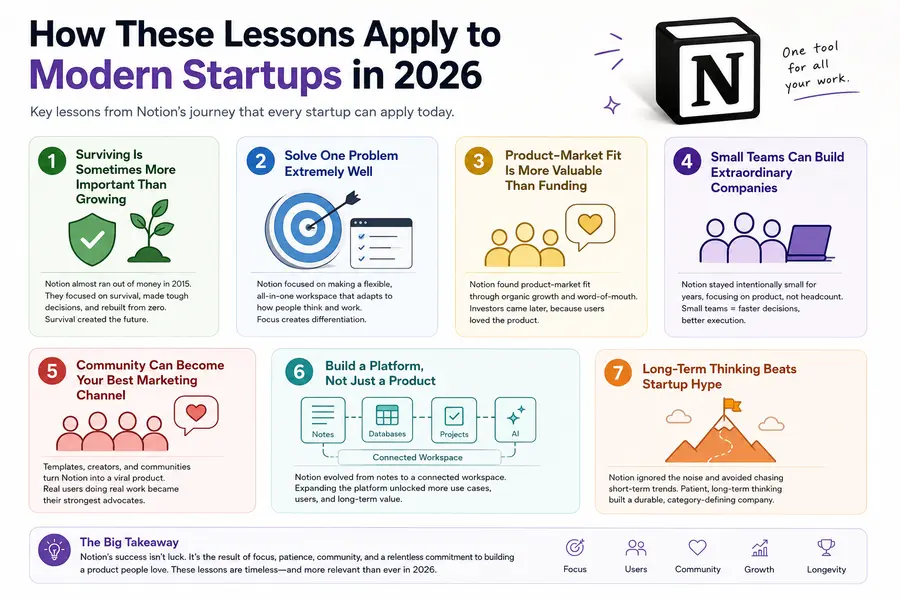
The startup landscape in 2026 looks different from 2013 in almost every respect — AI has reshaped what’s possible to build, capital is more available for early-stage companies than ever, and the pressure to demonstrate rapid traction has only intensified. But the underlying lessons from Notion’s history apply with, if anything, more force.
For AI startups, Lesson #2 — solving one problem extremely well before expanding — is especially relevant. The temptation to build a sprawling “AI for everything” platform from day one mirrors exactly the mistake Notion made with its first version: building something technically impressive that most people don’t know how to use. Notion’s own AI strategy reflects the lesson it learned the hard way — AI was integrated into an existing, well-understood product, not launched as a standalone platform requiring its own adoption curve.
For SaaS founders, Lesson #3 — product-market fit before funding — remains the clearest signal of a company’s actual trajectory. In a funding environment where capital is often easy to access, the discipline to wait until growth is genuinely organic, rather than capital-fueled, is harder than ever — and more valuable than ever.
For solo founders and small teams, Lesson #4 is direct validation: the constraints of being small are not necessarily disadvantages. A two-person team in Kyoto, working without any of the infrastructure a larger company would have, rebuilt a product that would eventually be valued at $11 billion. The constraint forced clarity that a larger team might never have found.
For early-stage companies of every kind, Lesson #1 remains the most uncomfortable but most important: sometimes the path forward requires becoming smaller, slower, and less visible before it can become bigger. That’s not failure. It’s often the only way to fix a foundation that’s broken — and Notion’s history shows what becomes possible on the other side of that decision.
A Timeline of Notion’s Most Important Milestones
| Year | Milestone | Lesson Learned |
|---|---|---|
| 2013 | Notion Labs founded by Ivan Zhao and Simon Last in San Francisco | Vision alone isn’t enough — execution determines everything |
| 2015 | Company nearly runs out of money; team laid off; founders relocate to Kyoto, Japan | Survival sometimes requires shrinking before growing (Lesson #1) |
| 2016 | Notion 1.0 launches on Product Hunt after complete rebuild; achieves profitability | Solving the simplest version of the problem unlocks adoption (Lesson #2) |
| 2018 | Notion 2.0 launches with databases; Wall Street Journal coverage | A flexible architecture allows organic platform expansion (Lesson #6) |
| 2019 | Reaches 1 million users with 18 employees; raises $10M Series A from Sequoia at $800M valuation | Product-market fit attracts funding on your terms (Lesson #3) |
| 2020 | $50M Series B from Index Ventures at $2B valuation amid pandemic-driven remote work boom | Community and word-of-mouth compound during macro shifts (Lesson #5) |
| 2021 | $275M round led by Coatue and Sequoia values Notion at $10B | Long-term patience creates leverage at scale (Lesson #7) |
| 2024 | Surpasses 100 million users and $400M in annual revenue; launches Notion Calendar | Platform extensions compound the value of early architecture (Lesson #6) |
| 2025 | Notion Mail launches; over 50% of ARR comes from AI-enabled customers | Integrating new technology into an existing platform beats building separately (Lesson #6) |
| 2026 | $270M tender offer with GIC, Sequoia, and Index Ventures values Notion at $11B | Sustainable growth, not hype, builds lasting valuation (Lesson #7) |
What the Lessons Actually Add Up To
Return, for a moment, to that house in Kyoto. Two founders. No team. Barely any money left. A product that had failed for three years, about to be thrown away entirely and rebuilt from nothing.
None of the seven lessons in this article were visible from inside that house. Nobody sets out to write “Lesson #1: Surviving Is Sometimes More Important Than Growing” while living through the despair Ivan Zhao later described. Lessons like these are only visible afterward, once the outcome retroactively organizes the decisions that produced it.
That’s worth sitting with, because it’s the opposite of how most startup advice is presented. Most advice arrives as a formula — do this, then this, then this, and you’ll get that. Notion’s history doesn’t support a formula. It supports something closer to a set of dispositions: a willingness to shrink when shrinking is what survival requires, a commitment to solving the smallest real problem before chasing the biggest imagined one, the patience to let product-market fit arrive before chasing capital, and the discipline to keep building quietly while everyone else is making noise.
None of that guarantees an $11 billion outcome. Most companies that make these same choices won’t get there. But the companies that do get there rarely get there by doing the opposite — by growing past a broken foundation, by trying to be everything before being something, by raising money to manufacture momentum that doesn’t yet exist.
Notion’s success wasn’t built through a shortcut. It was built through a decade of decisions that, individually, often looked like setbacks, retreats, or unnecessary caution — and that, together, became the foundation for one of the most significant productivity software companies in the world.
The lesson underneath all the other lessons might be this: the decisions that feel like giving up sometimes aren’t. Sometimes they’re the only way to actually start.
Disclaimer
This article is intended for informational purposes only. All information is based on publicly available sources including founder interviews, official company announcements, and verified press reports. StartupOrigins is not affiliated with Notion Labs, Inc., its founders, investors, or partners. All trademarks and company names are the property of their respective owners.

Anup Kumar Yadav is the founder of StartupOrigins.xyz, where he researches and publishes detailed stories about the world’s most successful startups. His work explores founder journeys, funding milestones, growth strategies, and the lessons entrepreneurs can learn from them.