
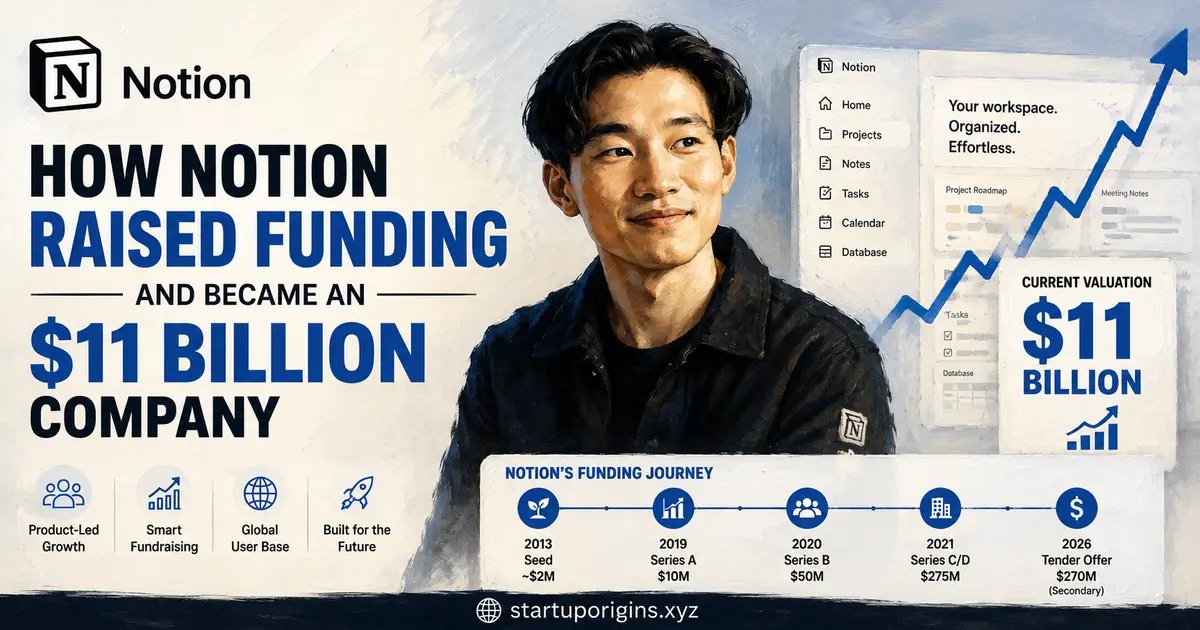
Published: June 2026 | StartupOrigins | Category: Funding Stories
In January 2026, Notion published a short post on its official blog. The tone was measured — almost matter-of-fact — for an announcement that described one of the more significant liquidity events in private SaaS history. The company had just completed a $270 million tender offer. New investor GIC, Singapore’s sovereign wealth fund, had joined alongside returning backers Sequoia Capital and Index Ventures. The transaction valued Notion at $11 billion.
The beneficiaries were current and former employees. Notion had waived the standard one-year vesting requirement so that nearly everyone on the team could participate. The message was clear: this was a company that believed it owed its people something, and had the numbers to back it up.
- Who Founded Notion?
- Why Raising Money Was Difficult in the Early Days
- The Crisis That Nearly Ended Notion
- The Japan Rebuild That Changed Everything
- How Notion Raised Its Early Funding
- The Growth That Changed Investor Perception
- Notion’s Major Funding Rounds
- How Notion Reached a $10 Billion Valuation
- The 2026 Tender Offer and $11 Billion Valuation
- How Notion Became More Than a Note-Taking App
- What Investors Saw in Notion
- Frequently Asked Questions
- The Long Way Around
- Disclaimer
Eleven billion dollars. From a startup that, eleven years earlier, had nearly run out of money entirely.
By 2015, Notion was facing the kind of situation most startups don’t survive. The $2 million raised from friends, family, and angel investors was almost gone. The product crashed constantly. The small team had been let go. Ivan Zhao and co-founder Simon Last were down to two people, a failing codebase, and a vision they weren’t ready to abandon.
What followed — the move to Kyoto, the complete rebuild, the Product Hunt launch, the years of organic growth, the patient fundraising, and eventually the $270 million tender that brought a Singapore sovereign wealth fund to the cap table — is the story of how Notion raised funding in a way almost no other startup has: not through aggressive pitching or strategic positioning, but through the deliberate, sometimes painful act of building something genuinely worth funding.
🚀 Featured Founder Story
Discover how Ivan Zhao rebuilt Notion from the ground up after facing near failure, moved operations to Japan, and eventually turned the company into one of the world’s most valuable productivity startups.
Read the Full Story →Who Founded Notion?
Notion was founded by Ivan Zhao and Simon Last in 2013. Zhao was born in China and grew up in Canada. He studied cognitive science and fine arts at the University of British Columbia. After graduating, he worked in product at Inkling. Last, meanwhile, graduated in Computer Science from the University of Maryland and worked as a software engineer before co-founding Notion.
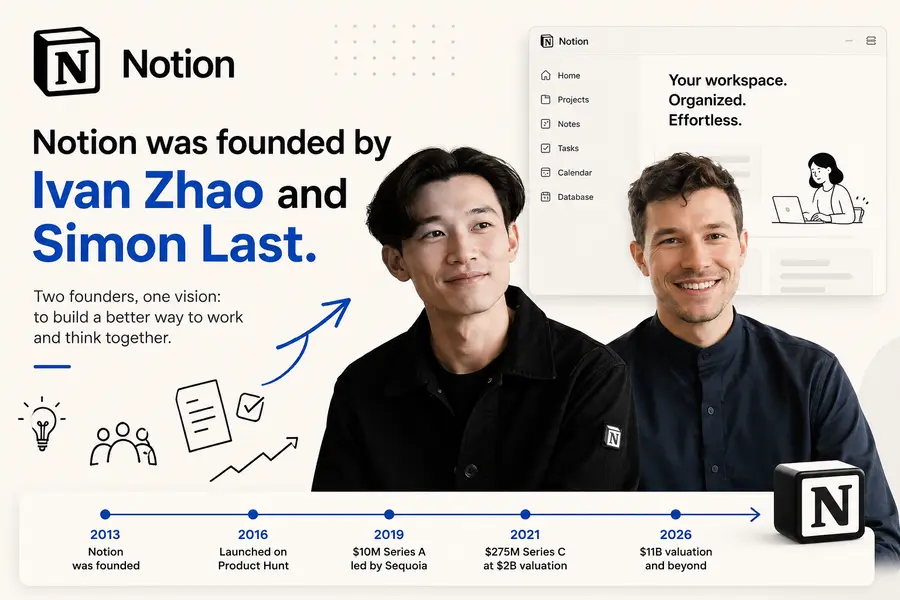
The idea driving the company was architectural in its ambition. Zhao had watched people spend their working lives switching between a dozen different applications — notes here, tasks there, wikis somewhere else, databases in a separate tool — none of which communicated well with the others. He wanted to build the opposite: a single, modular workspace where users could construct whatever they needed from flexible building blocks, like Lego for software.
With a background in cognitive science and design, he envisioned a workspace that combined the functionalities of various tools — a “LEGO for software” where users could build their own digital environments. That vision led to the founding of Notion Labs, Inc. in San Francisco, with roughly $2 million raised from a network of angels, friends, and family.
Zhao was not building for investors. He was building for users. That distinction would shape everything about how Notion raised money — including when, from whom, and on what terms.
Why Raising Money Was Difficult in the Early Days
The productivity software market in 2013 was not a space that screamed opportunity to most venture capitalists. Microsoft Office was the incumbent. Evernote was at its peak. Google Docs was free. Dropbox was dominant in file storage. The space felt crowded, mature, and dominated by companies with resources that a two-person startup could not match.
More than that, Notion’s pitch was genuinely hard to explain. It wasn’t a notes app. It wasn’t a project manager. It wasn’t a wiki or a database. It was all of those things, or none of them, depending on how you used it. The flexibility that made the vision compelling also made it difficult to package into the kind of crisp, category-defining pitch that early-stage investors respond to.
The first version of Notion was built on a Google web framework called Web Components, which proved fundamentally unstable. “Bugs came from everywhere,” Zhao later said. “It was unstable. People were losing their content.”
Users who tried the early product often left frustrated. The concept was compelling in the abstract. The execution hadn’t yet caught up. Without strong retention metrics, without a clean category, and without the kind of growth curve that signals product-market fit, Notion was not an easy story for investors to get behind.
Akshay Kothari, who had been one of Notion’s early angel investors, later said plainly: “I thought investing was a mistake, because the company didn’t go anywhere. It almost ran out of money.”
The Crisis That Nearly Ended Notion
By 2015, the math had turned against them.
The $2 million seed round was almost exhausted. The team — never large — had been let go. The product had an unstable foundation that couldn’t be patched, only replaced. Zhao had spent three years building something that didn’t work reliably enough for ordinary people to depend on.
“It was kind of like despair, I would say,” Zhao recalled. “I almost never had that feeling before.”
What made the situation particularly difficult was the diagnosis. The problem wasn’t a feature gap or a marketing failure. The framework the product was built on was wrong at an architectural level. Bugs emerged faster than they could be fixed. The only real solution was to start over — which meant throwing away three years of code, with almost no money left to fund the rebuild.
Most startups in that position make one of two choices: raise emergency capital (which requires leverage you don’t have) or shut down. Zhao chose a third option. He was going to cut costs drastically, move somewhere cheap, and rebuild from nothing.
🚀 Recommended Founder Story
After learning how Notion nearly failed in Japan, read the complete founder journey of Ivan Zhao: The Founder Who Rebuilt Notion From Scratch and discover the personal struggles, decisions, and vision that helped transform Notion into a global software company.
The Japan Rebuild That Changed Everything
Zhao and Last moved from San Francisco to Kyoto, Japan — a city that cost less than half as much to live in. In a rented two-story house so small that only a traditional Shoji screen separated their bedrooms, they spent 18 hours a day at their laptops. “We were just, code, code, code,” Zhao remembered. “Then, ‘Hey, let’s go out for food.’ Then, we go eat, go back to work, and do it again.” Neither man could speak Japanese fluently, but Zhao is from China and could read enough characters to navigate menus.
The rebuild was total. The old codebase was scrapped. In its place, Zhao and Last built on React Libraries — the more stable framework that had become the market standard. The new architecture was centered on blocks: every element of a Notion page was a modular unit that could be moved, transformed, or combined with others.
Zhao described the philosophical shift plainly: “It was not really a product. It didn’t work because the product was not understandable for most people. It was more for nerdy tech crowds. We realized, in order to be a big software tool, we have to start from a product that is already ubiquitous, that people recognize, and hide the tool-making, hide the programming ability — like how you sugarcoat broccoli.”
The new Notion would be simple on the surface and powerful underneath. Templates gave users a starting point. The block editor gave them flexibility. The result — one year later — was a product that was finally ready to meet ordinary people where they were.
The Kyoto period is directly responsible for everything that followed in Notion’s funding story. Without the rebuild, there is no Product Hunt launch. Without the launch, there is no traction. Without traction, there are no investors. The financial decisions made in that cold house — cutting the team, reducing costs to a minimum, borrowing from Zhao’s own family to bridge the final stretch — created the conditions under which Notion could finally prove itself.
How Notion Raised Its Early Funding
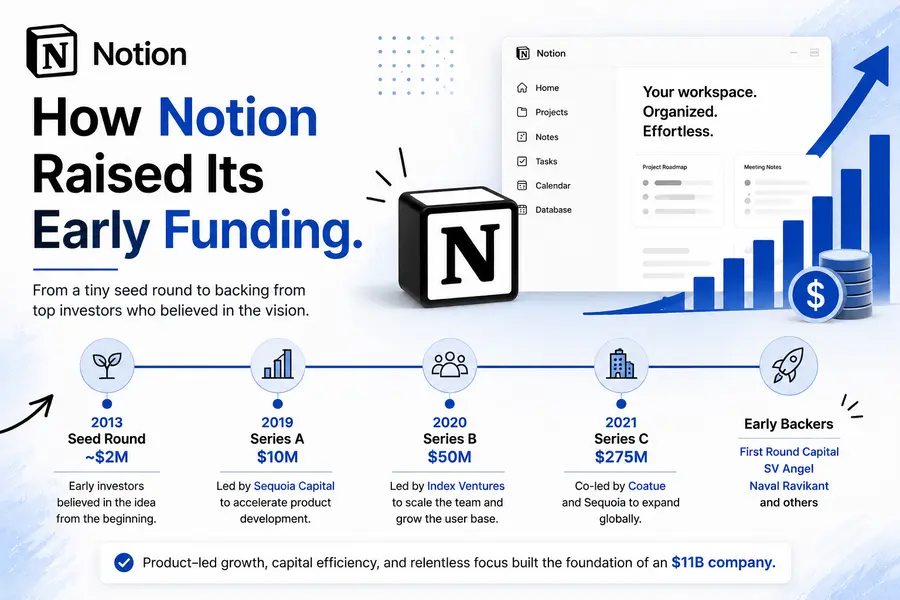
When Notion 1.0 launched on Product Hunt in March 2016, it arrived with support from Naval Ravikant — entrepreneur, co-founder of AngelList, and one of Silicon Valley’s most respected angel investors. Ravikant had backed Uber, Twitter, and Notion before they were household names. His presence in the community gave the launch credibility before a single vote had been cast.
The response was immediate and significant. Notion became Product of the Day, then Product of the Week, then Product of the Month. The Golden Kitty Award — Product Hunt’s annual recognition of the year’s best launch — followed. Zhao later wrote about the moment with unusual candor: at the time of the launch, the company was just him and Simon Last, nearly out of money, the final stretch funded by a bridge loan from Zhao’s mother.
The launch worked. Notion achieved profitability in the months that followed, without raising a single new round. The product was generating enough revenue from early users to sustain the two-person team.
As COO Akshay Kothari told TechCrunch in late 2019: “So far one of the things we’ve found is that we haven’t really been constrained by money. We’ve had opportunities to raise a lot more, but we’ve never felt like if we had more money we could grow faster.”
That was not a performance of humility. It was a genuine description of the company’s position. Notion was growing on the strength of its product, not its capital. Investors wanted in. The founders weren’t ready to take their money.
The Growth That Changed Investor Perception
Between 2016 and 2019, Notion did something unusual for a venture-backed technology company: it grew almost entirely through word of mouth, without a marketing budget, without a sales team, and without a venture capital investor on its board.
Users discovered Notion and couldn’t stop recommending it. YouTube creators built tutorial channels dedicated to Notion workflows. Reddit communities formed around templates and setups. Twitter power users shared elaborate personal systems built on the platform. Students introduced their professors. Designers introduced their product teams. Knowledge workers introduced their companies.
In 2018, Notion 2.0 launched. It added databases to the platform — tables, Kanban boards, calendars, galleries — alongside the existing notes and document capabilities. The Wall Street Journal covered it. The community that had been quietly growing for two years suddenly became a visible, vocal movement.
By late 2019, Notion had reached one million users with a team of just eighteen people. The metrics told a story that was almost impossible to argue with: extraordinary growth, minimal capital, and a user base that was genuinely passionate rather than merely retained.
Zhao’s philosophy was clear: “If you build something great, the network will come and investors will say yes.” By 2019, the network had come. And investors were, indeed, saying yes.
Notion’s Major Funding Rounds
💰 Notion’s Major Funding Rounds
From a small seed round to an $11 billion valuation.
| Year | Round | Amount Raised | Lead Investors | Valuation |
|---|---|---|---|---|
| 2013 | 🌱 Seed | ~$2M | SV Angel, Naval Ravikant, First Round Capital | — |
| Jul 2019 | 🚀 Series A | $10M | Sequoia Capital | $800M |
| Apr 2020 | 📈 Series B | $50M | Index Ventures | $2B |
| Oct 2021 | 🔥 Series C/D | $275M | Coatue Management, Sequoia Capital | $10B |
| Jan 2026 | 🏆 Secondary Tender | $270M | GIC, Sequoia Capital, Index Ventures | $11B |
• Total primary capital raised: approximately $337 million
• Largest round: $275 million Series C/D (2021)
• Peak valuation: $11 billion (2026)
• The January 2026 transaction was a secondary tender offer, meaning investors purchased shares from employees and existing shareholders rather than investing new capital into Notion.
How Notion Reached a $10 Billion Valuation
The speed of Notion’s valuation growth from 2019 to 2021 is difficult to overstate. In July 2019, the company was valued at $800 million. Sixteen months later, in April 2020, that figure had risen to $2 billion — a 2.5x increase. By October 2021, it had reached $10 billion. The whole arc, from seed stage to decacorn, had taken eight years. The last three had been almost vertical.
Index Ventures invested $50 million at a $2 billion valuation just 36 hours after Ivan Zhao started looking for funding. Sequoia decided to invest after looking at the numbers for 30 minutes. Sequoia partner Pat Grady later said the $10 billion valuation was “very painful” — but they paid it anyway.
That speed reflects two things simultaneously. First, the quality of the underlying business: strong retention, organic growth, a passionate user community, and a product that had proven itself across individuals, small teams, and enterprise accounts. Second, the market conditions of 2020 and 2021: near-zero interest rates, unlimited appetite for SaaS multiples, and the COVID-19 pandemic restructuring global work overnight.
Notion had been in the unusual position of turning away interested investors for years. When it finally opened the door, investors who had been waiting rushed through it. The $275 million Series C, led by Coatue Management and Sequoia Capital with participation from Base10 Partners, closed in October 2021 and set the $10 billion valuation that would define the company’s next chapter.
Notion’s approach to funding during this entire period was quietly contrarian. It avoided venture capital until it had a product people loved and metrics investors couldn’t ignore. It raised the minimum necessary. It preserved founder ownership and board control. No VCs on the board. 30% founder ownership. In a world where founders routinely dilute themselves through early institutional rounds, Notion entered every funding conversation from a position of genuine strength.
The 2026 Tender Offer and $11 Billion Valuation
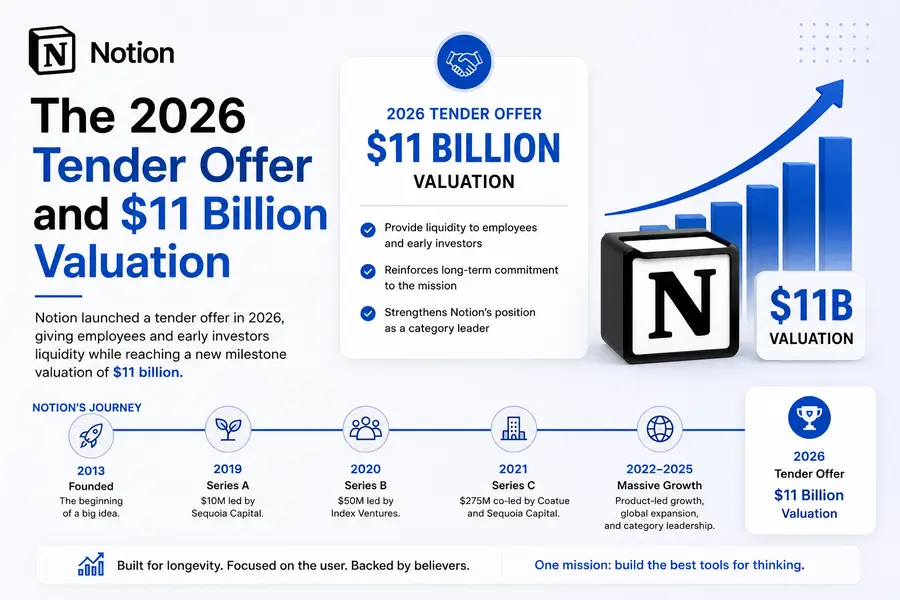
On January 26, 2026, Notion published a post on its official blog with an unusually direct headline: GIC, Sequoia, Index purchase Notion shares in private tender offer.
Returning investors Sequoia Capital and Index Ventures doubled down on their commitment to Notion, while GIC — a global institutional investor and Singapore’s sovereign wealth fund — joined as a new partner. These investors purchased shares directly from current and former Notion employees, for a total tender of around $270 million at an $11 billion valuation.
The structure mattered as much as the numbers. This was not a primary fundraising round — Notion was not issuing new shares or adding capital to its balance sheet. It was a secondary transaction: investors buying existing shares from employees, providing liquidity to the people who had built the company, without diluting existing shareholders or requiring a new price-setting round.
To include more people in this payout, Notion waived the usual one-year vesting rule, allowing nearly all current and former team members to participate.
The company stated that this acquisition aimed to provide financial liquidity for employees to support their long-term development and life planning.
The choice of GIC as a new investor was deliberate. Notion cited GIC’s long-term focus and Asia-Pacific expertise as key reasons for the partnership, which aligned with the company’s regional expansion following the opening of its Singapore office in 2025. The transaction wasn’t just a liquidity event — it was a strategic signal about where Notion was growing next.
The company reported that at the end of 2025, more than 50% of its annual recurring revenue came from AI-enabled customers — a proportion that more than doubled over the prior year. The $11 billion valuation wasn’t a bet on what Notion had been. It was a bet on what it was becoming.
How Notion Became More Than a Note-Taking App
The Notion that GIC invested in at $11 billion in January 2026 was not the same product that launched on Product Hunt in 2016. It shared a philosophy and an architecture. Almost everything else had grown.
The 2018 launch of Notion 2.0 added databases — tables, Kanban boards, calendars, galleries — transforming the platform from a flexible document editor into something that could genuinely replace project management software. Teams that had been using Notion for meeting notes started using it for product roadmaps. Design teams started using it for design systems. Engineering teams started using it for documentation, bug tracking, and sprint planning.
In January 2024, Notion acquired Cron, a calendar application, and relaunched it as Notion Calendar — the first step toward consolidating the time-management layer of work alongside the knowledge-management layer. In April 2025, Notion Mail launched, bringing email into the same ecosystem as notes, databases, and projects.
Notion AI, launched publicly in early 2023, integrated large language model capabilities directly into the workspace — not as a separate product requiring a new window or subscription, but as a layer within every document, database, and page. By the end of 2025, more than half of Notion’s paying customers were AI customers.
Zhao described the company’s AI vision as “AI teammates” — tools that increase productivity and support knowledge tasks without replacing human judgment. “Writing code is just another way of gluing together your process and workflows,” he said.
The arc from note-taking app to AI-powered all-in-one workspace didn’t happen by accident. It happened because Zhao had always described Notion as a platform, not a product — a set of building blocks that could be extended indefinitely as technology and user needs evolved.
What Investors Saw in Notion
The investors who backed Notion at each stage — from Naval Ravikant’s early angel check to GIC’s participation in the 2026 tender — were responding to different versions of the same underlying signal: a product that users didn’t just use, but cared about.
Most software is tolerated. Notion was advocated for. Users built tutorial businesses on top of it. They sold templates in Notion marketplaces. They converted their entire teams and companies. They wrote newsletters about how they used it. That kind of loyalty doesn’t emerge from marketing spend — it emerges from a product that genuinely improves how people work.
By 2024, over 50% of Fortune 500 companies had teams using Notion. That enterprise penetration — achieved almost entirely through bottom-up, user-driven adoption rather than top-down sales — was exactly what investors in product-led growth companies looked for.
Zhao kept the team lean and mission-focused, raising over $330 million with low dilution. That capital efficiency told investors something important: the growth was real, not manufactured. When a company can reach one million users with eighteen people and no sales team, the unit economics are telling a story that spreadsheets confirm but don’t create.
The January 2026 tender participation by GIC added a different dimension. Sovereign wealth funds invest for decades, not for the next fund cycle. GIC’s involvement signals strong institutional confidence in Notion’s business model and growth prospects, particularly in international markets. It’s a vote cast by an institution that doesn’t need a quick exit — and that kind of patient capital means something different from venture backing.
🚀 5 Startup Lessons From Notion’s Funding Journey
Actionable fundraising, growth, and leadership insights from Notion’s rise to an $11 billion valuation.
Notion became profitable after its 2016 Product Hunt launch and remained profitable for years before accepting major institutional funding. That financial independence allowed the company to reject investors, negotiate from a position of strength, and wait for partners who aligned with its long-term vision. The lesson is simple: founders who treat fundraising as optional often secure better terms than founders who treat it as an emergency.
Notion grew through passionate users, community-created templates, YouTube tutorials, and word-of-mouth recommendations rather than expensive marketing campaigns. This organic growth lowered customer acquisition costs while increasing investor confidence. A product people genuinely love can become the strongest fundraising asset a startup has.
By the time Notion raised its $10 million Series A in 2019, it had already reached one million users and profitability. That traction created extraordinary leverage, leading to rapid investor interest and an $800 million valuation. Founders who delay fundraising until they have meaningful proof points often preserve ownership and negotiate from a much stronger position.
Notion’s January 2026 tender offer was not about raising new capital. Instead, it provided liquidity to employees and early shareholders. By allowing broad employee participation and waiving certain restrictions, leadership reinforced the message that long-term contributors should share in the company’s success. Strong cultures are often built through decisions like these.
The most important part of Notion’s funding journey happened before the large valuations and headline-making rounds. The layoffs, the move to Kyoto, and the complete product rebuild created the foundation for everything that followed. Every investor, funding round, and valuation ultimately traces back to the founders’ decision to rebuild rather than quit when the company was at its lowest point.
Notion’s journey shows that fundraising is often the result of building a remarkable product, achieving sustainable growth, and surviving difficult periods—not the starting point. The company’s path from a small house in Kyoto to an $11 billion valuation demonstrates that resilience, product quality, and patience can become powerful competitive advantages.
Frequently Asked Questions
❓ Frequently Asked Questions About Notion
Common questions about Notion’s founders, funding, valuation, growth, and journey from near failure to an $11 billion company.
Who founded Notion?
Notion was founded by Ivan Zhao and Simon Last in 2013. Akshay Kothari, an early angel investor who later joined as COO, is widely recognized as a third co-founder.
When was Notion founded?
Notion Labs, Inc. was founded in San Francisco in 2013. The first public version launched on Product Hunt in March 2016 after the founders rebuilt the entire product from scratch.
How much funding has Notion raised?
Notion has raised approximately $418 million across multiple funding rounds. The January 2026 $270 million tender offer was a secondary transaction in which investors purchased shares from employees rather than providing new capital to the company.
Who invested in Notion?
Notion’s investors include Sequoia Capital, Index Ventures, Coatue Management, First Round Capital, SV Angel, Naval Ravikant, and GIC, Singapore’s sovereign wealth fund. These investors participated across different funding rounds and secondary transactions.
What is Notion’s valuation?
As of January 2026, Notion is valued at approximately $11 billion, based on the pricing established during the company’s employee tender offer.
How did Notion survive its early struggles?
The founders drastically reduced costs by moving to Kyoto, Japan, rebuilt the product from scratch, and relied on personal savings, including financial support from Ivan Zhao’s family, until the 2016 Product Hunt launch generated significant traction and profitability.
What happened in Japan?
Ivan Zhao and Simon Last spent about a year in Kyoto rebuilding Notion’s codebase from scratch. The lower living costs and distraction-free environment allowed them to focus entirely on creating the product that would later fuel Notion’s success.
Why is Notion successful?
Notion succeeded through product-led growth, strong user advocacy, disciplined fundraising, and excellent market timing. Its highly engaged community helped drive organic growth while the founders maintained a long-term focus on product quality and sustainability.
The Long Way Around
There is a shorter version of Notion’s funding story that skips the difficult parts: a startup founded in 2013 raised seed funding, struggled, rebuilt, achieved product-market fit, raised a Series A, then a Series B, then a Series C, and eventually hit $11 billion.
That version is accurate. It is also missing the part that makes it meaningful.
The funding story is inseparable from the survival story. The $800 million Series A was possible because Notion had reached one million users without spending on marketing — and Notion reached those users because the 2016 Product Hunt launch worked — and that launch worked because the rebuilt product was genuinely better — and the rebuilt product was built in a rented house in Kyoto — and Notion was in Kyoto because the company nearly died in San Francisco in 2015.
By the time of the 2026 tender, Notion’s growth rate had accelerated on the back of AI adoption. More than 50% of annual recurring revenue came from AI-enabled customers — a figure that more than doubled over the prior year. The company that borrowed money from a founder’s mother to survive through a product launch had become a company that Singapore’s sovereign wealth fund chose as a strategic long-term partner.
That arc — from near-bankruptcy in a foreign city to an $11 billion valuation backed by some of the world’s most sophisticated capital — didn’t happen because of lucky timing or perfect strategy. It happened because Ivan Zhao chose to rebuild instead of quit, kept building instead of selling, and raised money on his own terms instead of the market’s.
The investors who backed Notion didn’t make Notion possible. They recognized something that was already happening and asked to be part of it. That distinction matters — for how Notion operates, for how its founders retained control, and for the lesson it offers to every founder deciding whether to take the next meeting or wait until the product is truly ready. How Notion raised funding was never really about fundraising. It was about building something so undeniable that capital had no choice but to follow.
Disclaimer
This article is intended for informational purposes only. All information is based on publicly available sources including Notion’s official blog, verified press reports, and founder interviews. StartupOrigins is not affiliated with Notion Labs, Inc., its founders, investors, or partners. All trademarks and company names are the property of their respective owners.

Anup Kumar Yadav is the founder of StartupOrigins.xyz, where he researches and publishes detailed stories about the world’s most successful startups. His work explores founder journeys, funding milestones, growth strategies, and the lessons entrepreneurs can learn from them.