
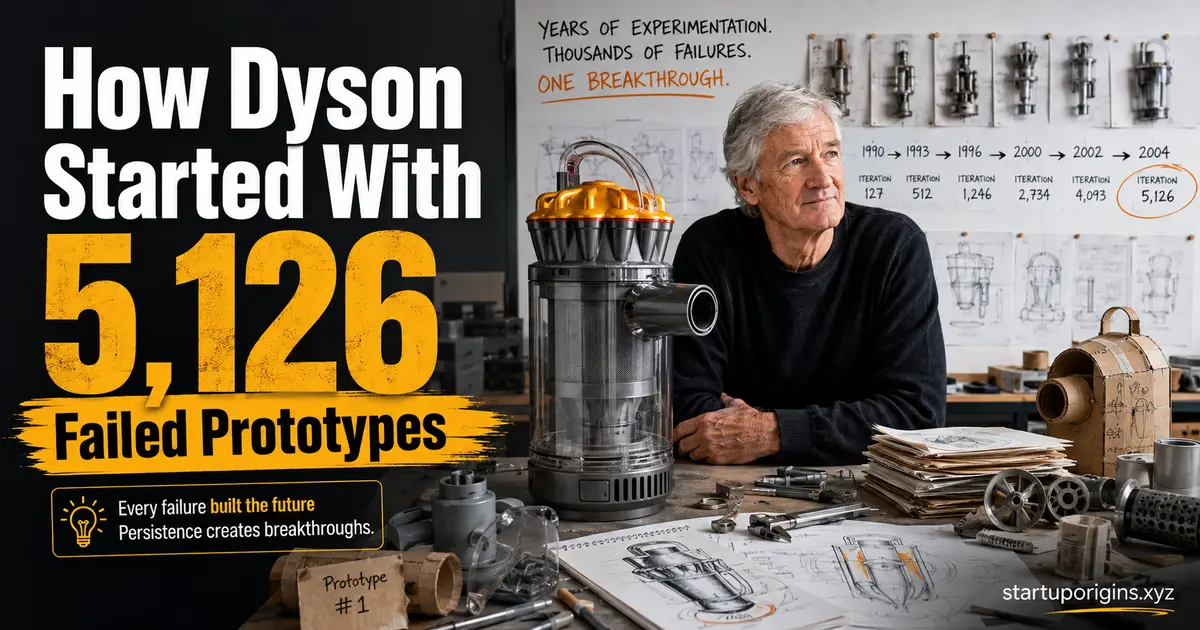
The bag was the problem, and nobody else seemed to think so.
In 1978, in a house in Gloucestershire, England, a young industrial designer named James Dyson was pushing a Hoover Junior across his carpet when he noticed what every vacuum owner has noticed at one point or another and mostly ignored: the machine was losing suction. He emptied the paper bag. The suction didn’t come back. He replaced the bag entirely. It still didn’t come back, not fully, not for long. Fine dust particles were clogging the pores of the bag from the inside, choking the airflow that the motor depended on, and no amount of emptying could undo it. This wasn’t a defect in his particular machine. It was how every bagged vacuum cleaner on the market worked, and had worked, more or less unchanged, for seventy years.
- The Problem James Dyson Couldn’t Ignore
- The Cyclone Idea
- 5,126 Prototypes and Years of Failure
- Why Established Vacuum Companies Didn’t Want the Idea
- Japan Gave Dyson Its First Real Break
- From Inventor to Manufacturer
- Why 5,126 Failures Were Not Really 5,126 Failures
- The Decision That Changed Dyson Forever
- The Market Gap Nobody Else Wanted to Fix
- The First Dyson Vacuum That Changed the Market
- How Dyson Expanded Beyond Vacuum Cleaners
- Dyson by August 2026
- Frequently Asked Questions
Most people shrug at a design flaw baked that deeply into a product category. Dyson didn’t. He had trained as a furniture and interior designer at the Royal College of Art, then drifted into engineering through a company called Rotork, where he’d helped develop a high-speed amphibious landing craft called the Sea Truck. By 1978 he was running his own business, manufacturing a wheelbarrow called the Ballbarrow that replaced the standard wheel with a large plastic ball for stability on soft ground. He had, in other words, already spent a decade solving mechanical problems other people considered settled. A vacuum cleaner that got worse the more you used it struck him as exactly that kind of problem — one nobody had actually tried to fix, because everybody had agreed, tacitly, to live with it.
That irritation is where the story of how Dyson started actually begins. Not with a company. Not with a patent. With a man taking a vacuum cleaner apart in frustration and asking a question the entire industry had stopped asking: why does this have to work badly?
Before going deeper into that story, it helps to see the whole arc at a glance — because the years between the clogged bag and the global brand aren’t a straight line from idea to success. They’re a long stretch of rejection, punctuated by a handful of decisions that mattered far more than the prototype count itself.
From 5,127 Prototypes to a Global Technology Company
James Dyson’s story was not an overnight success. These milestones show how years of experimentation, rejection, legal battles and persistence turned one engineering idea into a global brand.
| Year | Milestone | Why It Mattered |
|---|---|---|
| 1978 |
The suction problem becomes a project Dyson notices his Hoover Junior losing suction and begins experimenting with cyclone technology, including an early cardboard prototype. | An everyday frustration became the engineering problem that would eventually define Dyson’s career. |
| 1979–1983 |
5,126 prototypes fail Dyson spends years building and testing thousands of prototype vacuum designs in his coach-house workshop. | The long development process established Dyson’s method of repeated experimentation, testing and incremental improvement. |
| 1983 |
Breakthrough
Prototype No. 5,127 finally works After thousands of attempts, Dyson develops a working bagless vacuum design using cyclonic separation. | The technology had finally been proven. The challenge now shifted from engineering the product to finding a way to manufacture and sell it. |
| 1984 |
The Amway licensing agreement breaks down Dyson signs a licensing agreement with Amway, but the relationship later collapses into a dispute and legal battle. | It exposed the risks of relying on another company to control the commercialization of an invention. |
| 1986 |
G-Force launches in Japan The G-Force vacuum cleaner reaches consumers in Japan through licensee Apex Inc. | It became one of the first important commercial validations of Dyson’s cyclone technology and generated licensing income. |
| 1991 |
Design recognition and company formation G-Force receives major design recognition in Japan, while Dyson begins building the business that would eventually manufacture products under his own name. | Recognition, credibility and growing financial resources gave Dyson a path toward becoming an independent manufacturer. |
| 1993 |
Company Launch
DC01 launches in the United Kingdom Dyson introduces the DC01 under the Dyson name at a premium price compared with many conventional vacuum cleaners. | Dyson was no longer simply licensing technology. He was now building a consumer technology company around his own invention. |
| 1995 |
Market Validation
DC01 becomes Britain’s best-selling vacuum cleaner Dyson rapidly gains consumer recognition and establishes itself as a serious challenger to established vacuum brands. | Consumers demonstrated that they were willing to pay more for a product that offered clear engineering and performance advantages. |
| 2000 |
Dyson wins a major patent battle The UK High Court rules that Hoover infringed Dyson’s cyclone vacuum cleaner patents. | Legal protection helped defend the intellectual property behind the technology Dyson had spent years developing. |
| 2019–Present |
Dyson grows beyond vacuum cleaners With its global headquarters in Singapore, Dyson continues expanding across hair care, air treatment, lighting and other engineering-led product categories. | Dyson demonstrated that its biggest advantage was not one vacuum cleaner, but a repeatable approach to engineering, design and product innovation. |
The timeline shows why persistence became one of the defining themes of both James Dyson’s founder story and the company that followed.
The Problem James Dyson Couldn’t Ignore
To understand why Dyson became fixated on this, it helps to understand what a vacuum bag is actually doing. Air rushes in through the nozzle carrying dust, hair, and debris, and passes through a porous paper or cloth bag. The bag is supposed to trap solid particles while letting air pass through its pores and out through the exhaust. The trouble is that dust doesn’t stay on the surface of the bag — it works its way into the weave, and every particle that lodges in a pore reduces the surface area available for air to escape. The bag isn’t really a container so much as a filter, and like any filter, it clogs.
The vacuum industry knew this. It wasn’t a secret. It was, in fact, the foundation of a very profitable business model: companies like Hoover and Electrolux sold the machines at a modest margin and made recurring revenue selling replacement bags for the rest of the appliance’s life. A vacuum that never lost suction, that never needed a bag, was — from the standpoint of an incumbent manufacturer’s income statement — not an improvement. It was a threat to an entire category of aftermarket sales, one industry estimates at the time put at roughly $500 million a year in Europe alone.
Dyson wasn’t thinking about business models yet. He was thinking about airflow. What stuck with him was a memory from his own factory, where the Ballbarrows were sprayed with powder-coated paint. To keep the workshop air breathable, he’d installed an industrial cyclone tower — a thirty-foot cylindrical device that separated paint particles from air using centrifugal force, spinning the air fast enough that heavier particles flung outward and dropped, while cleaner air escaped from the center. It was a piece of equipment he’d installed for a completely unrelated reason. But standing under it, he began to wonder whether the same principle — separating dirt from air by spinning it, rather than filtering it through a clogging membrane — could work at the scale of a household vacuum cleaner.
The Cyclone Idea
The physics behind cyclonic separation is not exotic. Spin a mixture of air and particles fast enough in a cone-shaped chamber, and centrifugal force pushes the denser particles — dust, dirt, hair — toward the outer wall, where they lose momentum and fall, while the lighter air moves toward the center and exits through the top. No mesh. No membrane. Nothing to clog, because nothing is being filtered in the conventional sense — the separation happens through motion, not through a barrier.
What made the idea appealing to Dyson wasn’t just that it solved the clogging problem. It was that the same cyclone would, in theory, keep working at full strength no matter how much dust it had already separated, because there was no pore structure degrading with use. A bagged vacuum was strongest on day one and weakest right when you needed it most, with the bag nearly full. A cyclonic vacuum’s performance curve looked flat by comparison.
Translating a thirty-foot industrial cyclone into something that could sit inside a handheld appliance, however, was a different problem entirely — one of scale, airflow speed, and manufacturing tolerance, not of theory. Dyson’s first attempt was almost absurdly crude: he ripped the bag out of his own Hoover Junior, built a cardboard cone, and taped it in place of the bag. It worked, in the sense that the suction held. It also confirmed that everything from that point forward would be a matter of engineering, not inspiration — a long, unglamorous process of finding out exactly how small a cyclone could be made before it stopped separating dust properly.
5,126 Prototypes and Years of Failure
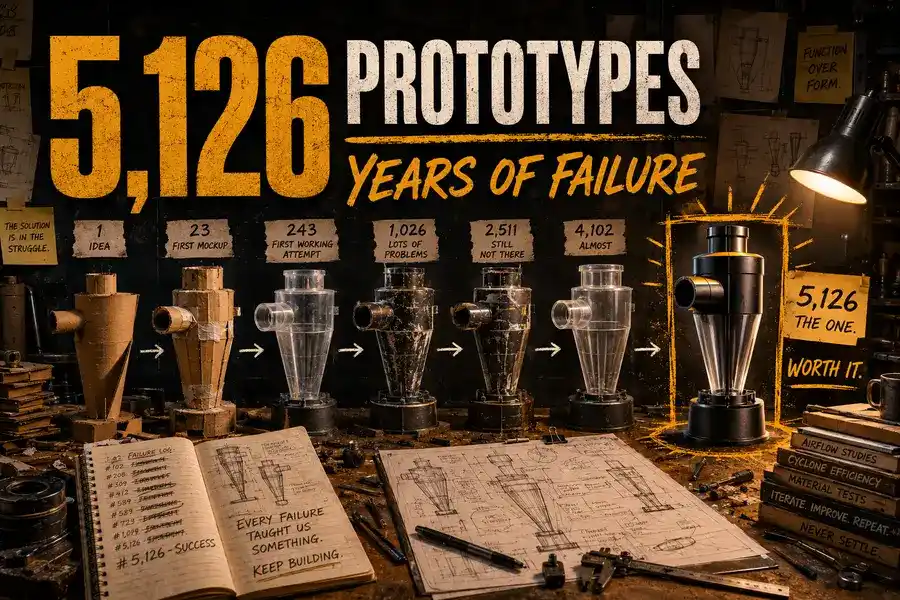
The number that attaches itself to every retelling of the Dyson story is 5,126 — sometimes rendered as 5,127, depending on whether the successful, final version is counted among the failures or set apart from them. Dyson’s own account of the invention, told in his words on Dyson’s official company history page, places the breakthrough four years and 5,127 prototypes after that first cardboard cyclone. He has described the process himself: “In 1983, after four years of building and testing 5,127 hand-made prototypes of my cyclonic vacuum, I finally cracked it.” The work ran from around 1979 into 1983 — closer to five years by some accountings, four by others, depending on when the clock starts. Either way, the arithmetic is not decoration: over roughly 1,500 days, that pace works out to more than three distinct prototypes a day, most of them built and tested alone, in a coach house workshop behind his home.
What’s easy to miss in the retelling is what those prototypes actually were. They weren’t 5,126 copies of the same failed idea. Each one changed something — the diameter of the cone, the angle of the intake, the speed of the airflow, the height-to-width ratio of the cylinder — and each change produced a result Dyson could measure and compare to the last. A cyclone that was too wide let large particles slip through with the air. One that was too narrow lost too much suction to friction. Get the geometry wrong by a few degrees and dust would recirculate instead of dropping out. This is, in essence, how engineering by trial and error is supposed to work: not a blind repetition of the same failed attempt, but a series of controlled experiments, each one eliminating a variable and narrowing the search.
The financial and personal cost of that process is where the story stops being an abstraction. Dyson has said he spent the early 1980s “getting further and further into debt,” and worried about losing the family home even as he insisted bankruptcy itself didn’t frighten him because, as he put it, he could always make things. His wife, Deirdre, sold paintings and taught art classes to help support the family; by his own account they grew their own vegetables and she made the children’s clothes while they borrowed against a shrinking margin of safety. There was no venture capital pipeline for a solo inventor building cardboard and plastic prototypes in a coach house in the early 1980s, and no institutional lender willing to bet on an idea the entire vacuum industry had already been shown and declined.
That’s the part of the number that a headline like “5,126 failures” tends to flatten. It wasn’t persistence for its own sake. It was persistence funded, materially, by a household running on very little margin for years, sustained by the belief that each failed prototype was producing information rather than simply proving the previous attempt wrong twice over.
Why Established Vacuum Companies Didn’t Want the Idea
By 1983, Dyson had a machine that worked. He assumed, reasonably, that a manufacturer would want it. What followed instead was a tour of rejection from nearly every major appliance company in Britain, continental Europe, and the United States, and the reasoning behind those rejections deserves more scrutiny than “they were shortsighted.”
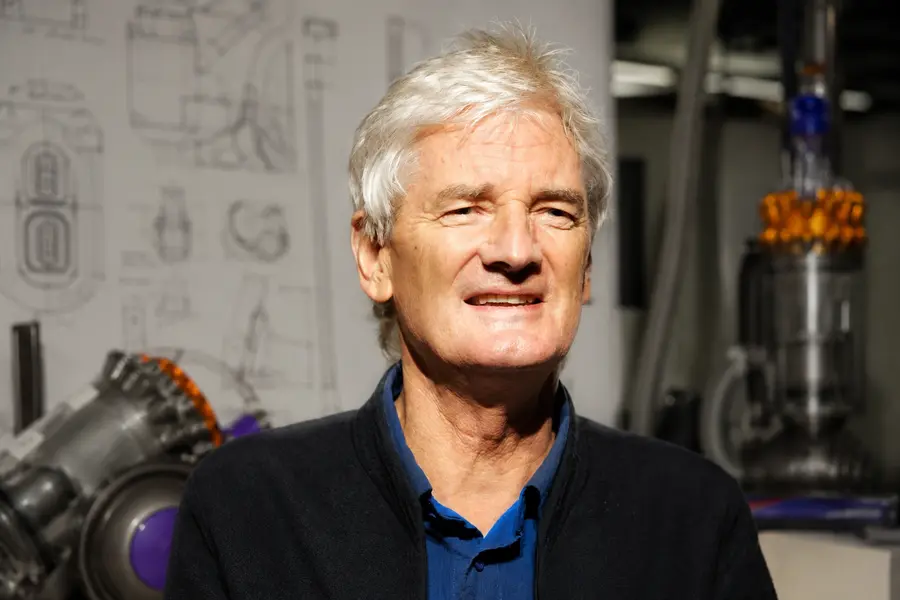
The companies Dyson approached were not irrational. Hoover, Electrolux, and other established manufacturers were deeply invested in a razor-and-blades business model, profiting from the recurring sale of replacement bags, and a genuinely bagless vacuum threatened to eliminate that revenue stream outright. From inside a company built around that model, an inventor showing up with a technology that would cannibalize an existing, profitable business line — with no guarantee that customers would pay a premium to get it — looked less like an opportunity and more like a liability. One frequently cited account has Electrolux telling Dyson plainly that it was not possible to sell a vacuum cleaner without a bag — a claim that reads, in hindsight, as a company mistaking its own business model for a law of physics. Encyclopaedia Britannica’s biographical entry on Dyson corroborates the broader pattern: traditional bagged-vacuum manufacturers showed no interest in his design, which is what eventually sent him looking for a partner outside the industry’s established players.
Dyson did eventually find a licensee, though the path was neither smooth nor especially lucrative. After roughly three years of trying to license the technology without success, he struck a deal with Amway Corporation in 1984, only for the American company to accuse him of fraud within months and for the arrangement to collapse into a lawsuit that dragged on for years before an eventual settlement in which Amway continued selling its own version and the two sides became, awkwardly, joint licensees. Dyson later described the episode as a formative failure — his second, after losing control of the Ballbarrow to his own co-investors — and pointed to it as the origin of his lifelong insistence on retaining tight control of his own intellectual property.
Japan Gave Dyson Its First Real Break
The turning point came from a country he hadn’t originally been targeting. In the mid-1980s, a small Japanese company called Apex Inc. contacted him after reading about his invention in a magazine, and agreed to manufacture and sell the cyclone vacuum through catalogue sales under the name G-Force. Launched in 1986, the G-Force was bright pink, cost roughly $2,000, and became something closer to a design object than an appliance — Japanese customers reportedly displayed it on tables when it wasn’t in use rather than tucking it away in a closet. It went on to win the 1991 International Design Fair Prize in Japan, a recognition that gave the machine — and by extension Dyson’s technology — a credibility that years of rejection letters from Hoover and Electrolux had failed to produce.
The commercial terms of the Japanese deal were modest. Because Apex sold through wholesalers and the royalty was structured around that chain, Dyson himself reportedly never saw more than about £60,000 a year from a product generating roughly £12 million in annual sales — a gap that taught him a lesson about the cost of intermediaries between an inventor and the end customer that would shape every decision he made afterward. Still, the royalties were real, and they were his. They gave him, for the first time, an income independent of any licensing partner’s goodwill, and proof — commercial, documented proof, not just conviction — that consumers would pay a premium for a vacuum cleaner that worked differently than the ones they already owned.
From Inventor to Manufacturer
Using the Japanese royalties, Dyson set up his own company, then called Dyson Appliances Limited, in 1991, and secured a bank loan of roughly $900,000 by putting his house up as collateral. The decision to become a manufacturer, rather than continue chasing licensing deals with established players, wasn’t obvious at the time and it wasn’t cheap. Licensing had offered a lower-risk path to some income with none of the capital burden of building a factory, hiring a workforce, or managing distribution. It had also, twice now — first with Amway, and in a separate near-miss with a Canadian company called Iona that fell through after Amway’s competing product appeared — shown Dyson that a licensing partner’s incentives and his own were not the same. A licensee wanted the invention on the cheapest possible terms and had every reason to walk away, copy the idea, or squeeze the royalty structure once a product was selling. Dyson wanted the invention to reach customers directly, at a quality and price he controlled, under a name that was his own.
Building the factory meant taking on debt with the family home as collateral, at a moment when venture capital firms and mainstream banks had already passed on him. By his own account, no bank would lend him the money he needed until 1993, when a Lloyds Bank manager named Mike Page personally advocated for the loan that funded the tooling for his first product — reportedly persuaded in part by the fact that Dyson’s protracted legal fight with Amway demonstrated he wasn’t the kind of person who walked away from a fight over what belonged to him.
Why 5,126 Failures Were Not Really 5,126 Failures
It’s worth pausing on the number itself, because the popular version of the Dyson story tends to use it as shorthand for stubbornness, and that undersells what actually happened.
Repetition means doing the same thing again and expecting a different result. Iteration means doing something slightly different each time, because the last attempt told you something specific about what to change. The distinction matters because it’s the difference between a story about willpower and a story about method. If Dyson had built the same cyclone 5,126 times, hoping that persistence alone would eventually produce a different outcome, that would indeed just be stubbornness — and it would also not have worked, because physics doesn’t reward repetition. What actually happened was closer to a controlled search through a design space: adjust the cone angle, test it, measure the result, adjust again. Each prototype closed off a set of possibilities and pointed toward the next test worth running.
This reframes the “never give up” reading of the story in a more useful way for anyone building something new. The lesson isn’t that persistence alone gets you there. It’s that persistence only compounds into progress when each attempt is instrumented — when you can tell, concretely, what a given failure ruled out. Dyson has said the words “failure” and “fail” appear more than fifty times in his memoir, and that he finds something close to satisfaction in failing, because each experiment tells him something usable. That framing — treating failure as information rather than as a verdict — is arguably the more transferable part of the story, more than the raw prototype count itself. A founder who runs 5,126 identical experiments learns nothing. A founder who runs 5,126 experiments that each isolate one variable has, in effect, run a five-year research program disguised as an act of stubbornness.
The Decision That Changed Dyson Forever
If there’s a single hinge point in this story, it isn’t the moment the cyclone first worked in 1983. It’s the moment, roughly a decade later, when Dyson stopped looking for an established company to sell his invention for him and decided to build the factory himself.
Licensing had been attractive for an obvious reason: it required no capital, no factory, no hiring, and no distribution infrastructure — all Dyson had to do was hand over the technology and collect a royalty. It let him keep inventing rather than learning how to run a manufacturing operation, a skill set entirely separate from industrial design. But by the early 1990s, that approach had shown its limits twice over. The Amway deal had collapsed into litigation. The Japanese arrangement, while validating, had left him with a fraction of the value his invention was generating, because a chain of wholesalers and licensees stood between him and the customer, each taking a cut and none of them accountable to him for how the product was priced, positioned, or protected.
The risk of building independently was substantial and personal: a mortgaged house, a bank loan secured against the family’s own asset base, and an entry into a business — manufacturing and retail distribution — where he had no track record and where every major incumbent had already declined to work with him. But the decision reshaped everything that followed. Manufacturing his own product meant Dyson controlled the engineering tolerances, the pricing, the branding, and — critically — the intellectual property, all in one place, with no licensee positioned to walk away and produce a near-identical machine under a different label. It is, in retrospect, the decision that turned a patent into a company.
The Market Gap Nobody Else Wanted to Fix
There’s a broader pattern in the Dyson story that goes beyond one inventor’s persistence: the vacuum industry’s problem wasn’t that nobody had noticed the bag was flawed. It’s that noticing wasn’t enough to motivate a fix, because the flaw was profitable. The established manufacturers were “so heavily invested in the ‘razor and blade’ business model, profiting heavily from selling replacement vacuum bags, that they failed to recognize the potential for a tectonic shift in the market if a key user preference for bagless technology could be realized.”
This is a recurring shape in startup history that’s easy to miss when the focus stays on the founder’s grit: the strongest opportunities often aren’t hidden. They’re visible, widely tolerated, and structurally inconvenient for the companies best positioned to fix them. Incumbents rarely fail to see a flaw in their own product category. They fail to act on it when acting on it would cannibalize existing revenue, require retraining a sales force, or introduce a product priced well outside what focus groups say customers expect to pay. Dyson wasn’t solving a problem nobody had identified. He was solving a problem everybody had identified and nobody with the means to fix it had any incentive to touch.
The First Dyson Vacuum That Changed the Market
The first DC01 rolled off the production line on 1 July 1993, manufactured in Chippenham before the company moved to a larger site in Malmesbury, Wiltshire, which remains associated with the brand today. It used the patented Dual Cyclone system and, in a decision that ran directly against the advice of Dyson’s own market research, featured a transparent dust bin that let customers watch the dirt they’d just vacuumed spinning inside the machine. Focus groups reportedly found the transparent bin off-putting; Dyson kept it anyway, betting that seeing the machine visibly working would build more trust than it would repel.
The DC01 launched at roughly £200 — about twice the average UK vacuum cleaner price, in a market where machines above £160 accounted for only a small single-digit share of total sales, and against a backdrop of economic recession. Industry analysts predicted it would struggle. Instead, by April 1994 the company was selling around 1,000 units a week on minimal advertising, and by early 1995 the DC01 had become the best-selling vacuum cleaner in the United Kingdom, eventually overtaking Hoover and Electrolux in unit sales by October 1996. Revenue is reported to have grown from roughly £3 million in 1993 to £55 million by 1995, driven overwhelmingly by word of mouth rather than a conventional advertising campaign.
The legal fight that followed the DC01’s success is its own coda to the story of industry rejection. Hoover responded to Dyson’s rise with its own bagless “Triple Vortex” machine, which closely resembled Dyson’s patented design; Dyson sued for patent infringement, and in 2000 a UK High Court judge ruled Hoover had infringed the patents, ordering Hoover to pay damages and costs. The company that had declined to license the cyclone technology a decade earlier ended up paying for having copied it instead.
How Dyson Expanded Beyond Vacuum Cleaners
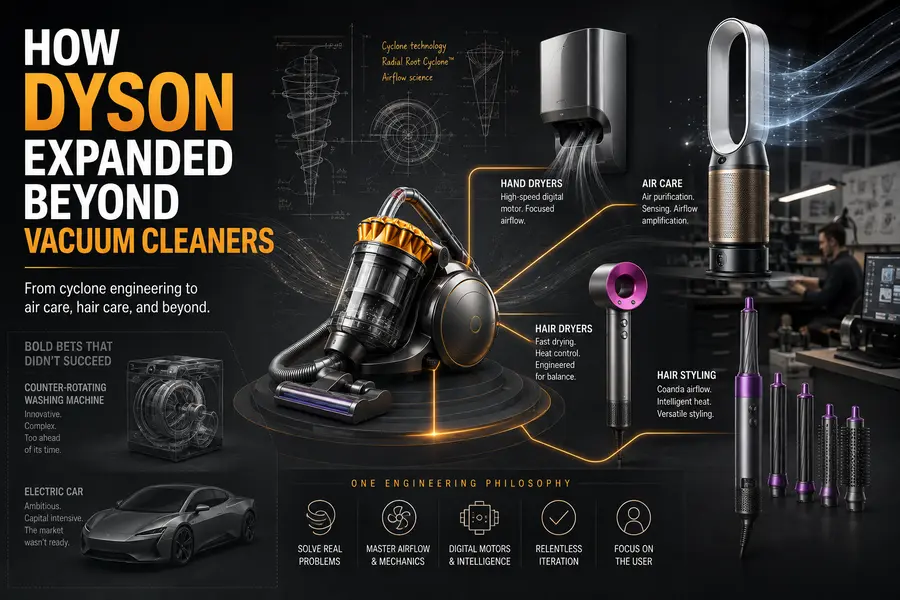
The engineering philosophy behind the cyclone — take a category everyone assumes is a solved problem and ask why it should keep working badly — didn’t stay confined to vacuum cleaners. Dyson moved into hand dryers with the Airblade, engineered around high-speed airflow rather than heat. It moved into bladeless fans and air purifiers built on the same fluid-dynamics expertise the company had spent two decades refining. It entered hair care with the Supersonic dryer and Airwrap styler, products built around a small, extremely high-speed digital motor originally developed for the vacuum line. Not every bet paid off — a counter-rotating washing machine called the Contrarotator was engineering-ambitious but commercially unsuccessful, and a battery-electric car project begun in 2014 was shelved in 2019 without reaching production. The company’s own account of its history treats those misses as part of the same philosophy that produced the cyclone: continued willingness to fail in public, on the theory that failure is simply where the next design lives. A fuller account of that expansion, category by category, belongs to a separate growth story rather than this one.
Dyson by August 2026
Nearly five decades after a clogged Hoover bag sent James Dyson looking for a better idea, the company that grew out of that irritation remains privately held and majority-owned by Dyson and his family, with no public shareholders to answer to. According to the company’s publicly compiled corporate profile, recent company figures put annual revenue in the neighborhood of £6.1 to £6.8 billion, with the business now selling across dozens of countries. The company has continued investing heavily in research and development, reportedly more than £2 billion since 2021, and the underlying engineering culture — extensive in-house prototyping, an unusually large internal patent portfolio, and a reluctance to outsource core component design — has remained consistent even as the product range has grown well beyond vacuum cleaners into air purification, hair care, and lighting.
The company’s global headquarters has been based in Singapore since 2019, a move that drew criticism in the UK given Dyson’s public support for Brexit, though manufacturing and research operations continue at sites in England as well as across Asia. James Dyson himself remains chairman and the company’s most visible public figure. The Bloomberg Billionaires Index profile of Dyson still lists the 5,127-prototype figure as the defining fact of his career, decades after the fact — a reminder of how thoroughly that early period of failure has come to define the public understanding of the company, not because the number 5,126 is inherently magical, but because it represents the clearest evidence the company has that its engineering culture works: iterate relentlessly, treat every failure as data, and don’t hand the result to someone else to sell.
Disclaimer: This article is a journalistic account compiled from Dyson’s official company materials, James Dyson’s own public statements, and independent reporting. Figures such as the “5,126 prototypes” count come from James Dyson’s own retelling and have not been independently audited.
Frequently Asked Questions
How did Dyson start?
Dyson began in 1978 when James Dyson, frustrated that his own vacuum cleaner kept losing suction as its bag clogged with dust, set out to build a bagless alternative using cyclonic separation — a principle he’d seen used in an industrial dust-extraction cyclone at his own factory.
Who founded Dyson?
Sir James Dyson founded the company. He is a British industrial designer and engineer who had previously developed the Ballbarrow wheelbarrow before turning his attention to vacuum cleaners.
Did James Dyson really make 5,126 failed prototypes?
Yes, by his own repeated account. Dyson has stated that his working cyclone vacuum came after “building and testing 5,127 hand-made prototypes” over roughly four to five years, with 5,126 of those attempts failing before the final design succeeded. The figure comes directly from Dyson’s own retelling, including in his memoir, rather than from independent verification of a prototype log, so it should be understood as the inventor’s own count rather than an audited figure.
What was James Dyson’s first vacuum cleaner?
The first commercialized version was the G-Force, licensed to the Japanese company Apex and sold from 1986, followed by the DC01, the first vacuum Dyson manufactured and sold under his own company, launched in the UK in 1993.
Why did James Dyson invent a bagless vacuum?
He was frustrated by the way conventional vacuum bags lost suction as dust clogged their pores, and believed the entire bagged-vacuum category had a fixable design flaw that manufacturers had simply learned to live with.
Why did manufacturers reject Dyson’s idea?
Established vacuum makers like Hoover and Electrolux relied on recurring revenue from selling replacement bags. A genuinely bagless vacuum threatened that business model, giving incumbents a financial disincentive to adopt the technology even after seeing it work.
When was Dyson founded?
Dyson Appliances Limited was established in 1991, funded by royalties from the Japanese G-Force license, with the first Dyson-branded product, the DC01, launching in the UK in 1993.
How did Dyson become successful?
Success came from a combination of factors: the cyclone technology itself, a decision to manufacture and sell the product independently rather than continue licensing it to others, an unconventional design choice (the transparent dust bin) that became a selling point rather than a liability, and a legal strategy that aggressively defended the resulting patents once competitors began copying the design.

Anup Kumar Yadav is the founder of StartupOrigins.xyz, where he researches and publishes detailed stories about the world’s most successful startups. His work explores founder journeys, funding milestones, growth strategies, and the lessons entrepreneurs can learn from them.