
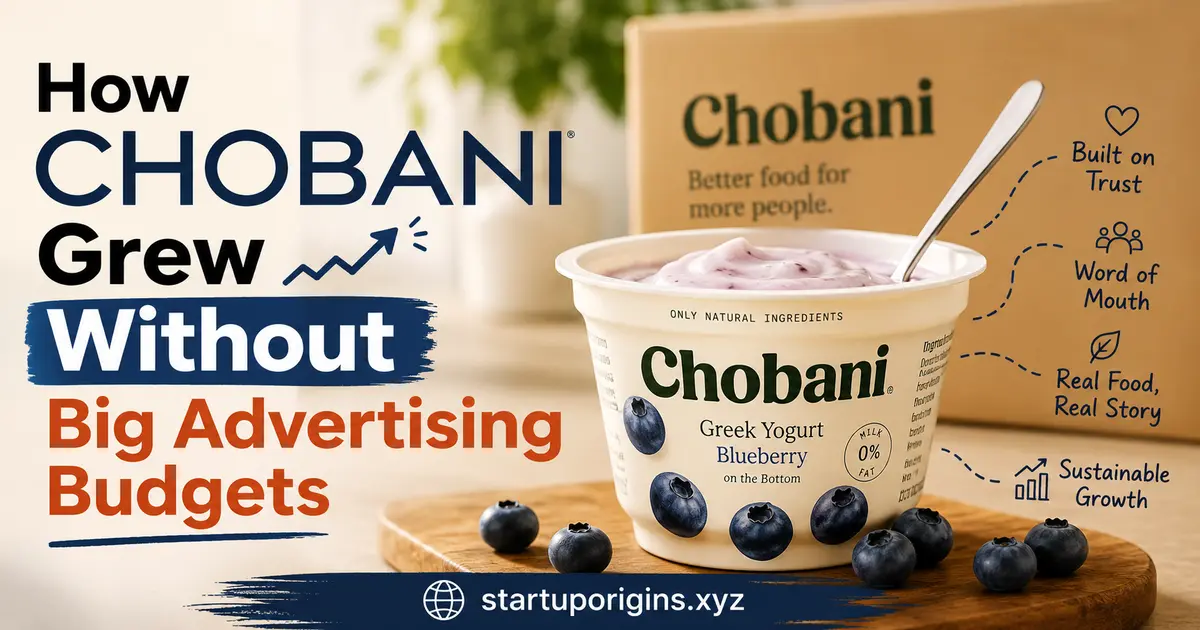
Most food companies spend enormous sums introducing new products to the public. Television spots, celebrity endorsements, coupon blitzes, in-store demo teams paid by the hour — the launch playbook for a new item in the American grocery aisle has, for decades, been a spending contest. Whoever could buy the most attention usually won the shelf.
Chobani did something different, and for the better part of its first four years on the market, it barely did any of that at all. Instead of trying to convince people through paid media, the company built a product that shoppers felt compelled to recommend to one another, and it spent its scarce cash convincing individual grocery store managers — one produce aisle, one dairy case, one region at a time — to give an unknown Turkish-style yogurt a chance next to Dannon and Yoplait.
That approach mattered because it inverted the usual order of operations. Most challenger brands try to manufacture demand first and hope distribution follows. Chobani secured distribution using almost nothing but the product itself, then let real demand — measured in reorders, not impressions — do the marketing. Within five years, the company that started in a shuttered Kraft plant in upstate New York was doing roughly a billion dollars in annual sales, and within seven, it had passed Yoplait to become one of the two biggest yogurt brands in America. In 2012, the yogurt upstart was on track to do $1 billion in sales, a 54 percent increase over the prior year’s roughly $650 million. It got there with a marketing budget that, for years, was a rounding error next to what General Mills and Danone spent defending their turf.
This is the story of how Chobani grew without big advertising budgets — not through a single clever campaign, but through a sequence of unglamorous decisions about product quality, shelf placement, pricing, and trust that were nearly impossible for larger competitors to copy quickly, even once they understood exactly what Chobani was doing.
The Greek Yogurt Market Before Chobani
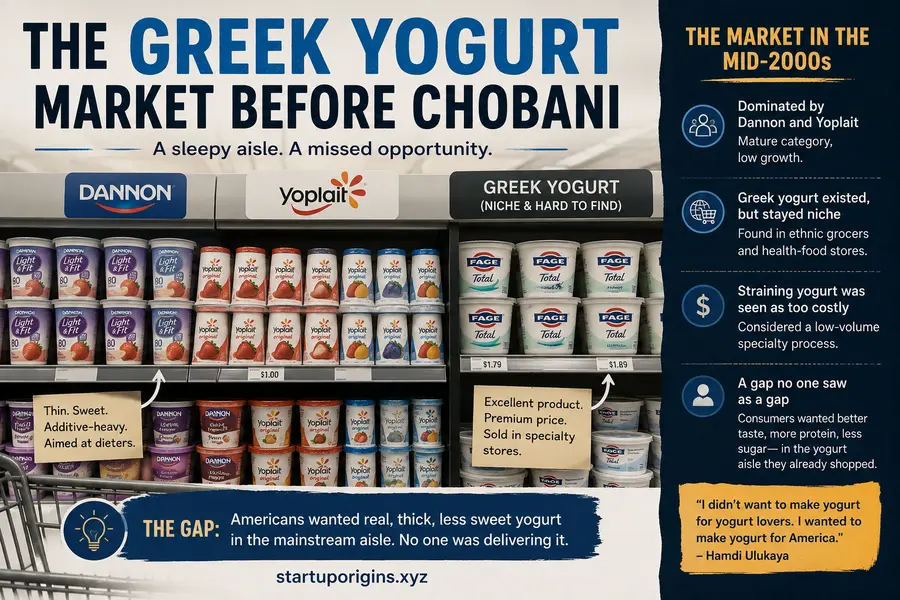
To understand why Chobani’s approach worked, it helps to understand how sleepy the yogurt aisle was before 2007.
American yogurt in the mid-2000s was dominated by two players — Dannon and General Mills’ Yoplait — selling thin, sweet, additive-heavy cups aimed mostly at women watching their weight. The category was mature, low-growth, and largely uncontested. Greek-style yogurt, the strained, thicker variety long popular in the Eastern Mediterranean, existed in the United States but lived almost entirely in ethnic grocers and specialty health-food stores. The dominant Greek brand, Fage, sold a genuinely excellent product but treated it as a premium, niche item — priced and positioned for a small audience willing to seek it out.
That left a gap that most of the industry didn’t see as a gap at all. Mainstream yogurt executives assumed Americans wanted their yogurt sweet, smooth, and cheap. Straining yogurt to remove the whey — the process that gives Greek yogurt its thickness and roughly doubles its protein content while cutting sugar and carbohydrates — was viewed as a costly, low-volume specialty process, not something to build a mass-market plant around.
Hamdi Ulukaya, an immigrant who found American yogurt too sweet and watery for his taste, saw the opposite. He had spent two years, after buying a shuttered Kraft yogurt factory in 2005, perfecting a Greek-style recipe with a master yogurt maker he hired from Turkey. The market opportunity wasn’t a new category so much as an underserved appetite: consumers who wanted something that tasted like real dairy, filled them up, and didn’t read like a candy bar’s ingredient list — sold not in a specialty aisle, but right where they already shopped for yogurt every week.
Building a Product People Wanted to Recommend
Before Chobani spent a dollar on distribution or marketing, it spent two years just getting the yogurt itself right. That sequencing turned out to be the foundation everything else was built on.
The product had three attributes that made it genuinely different from what was on the shelf. First, taste and texture: the straining process produced a thick, tangy yogurt that felt more like a food than a diet product. Second, nutrition: significantly more protein and less sugar than conventional yogurt, at a moment when American consumers were becoming newly attentive to protein content. Third, ingredients: Chobani used real fruit and natural ingredients rather than the artificial thickeners, colors, and preservatives common in the category at the time.
None of that would have mattered without a pricing decision that made trial easy. European-style strained yogurts of the era sold for $3 to $5 a cup in specialty stores, while ordinary American yogurt sold for under a dollar. Ulukaya set Chobani’s price at $1.50 — high enough to signal quality, low enough that a curious shopper would put it in the cart on impulse rather than treat it as a splurge. That single number did more marketing work than any ad campaign could have: it made the product’s superiority legible the moment someone tried it, without requiring a leap of faith on price.
The combination of a product that outperformed on first bite and a price that removed the risk of trying it created something rare in packaged food — a genuine reason to tell a friend. Chobani didn’t need to manufacture word of mouth. It needed to not get in its own way.
Winning Retail Shelves Before Winning Television
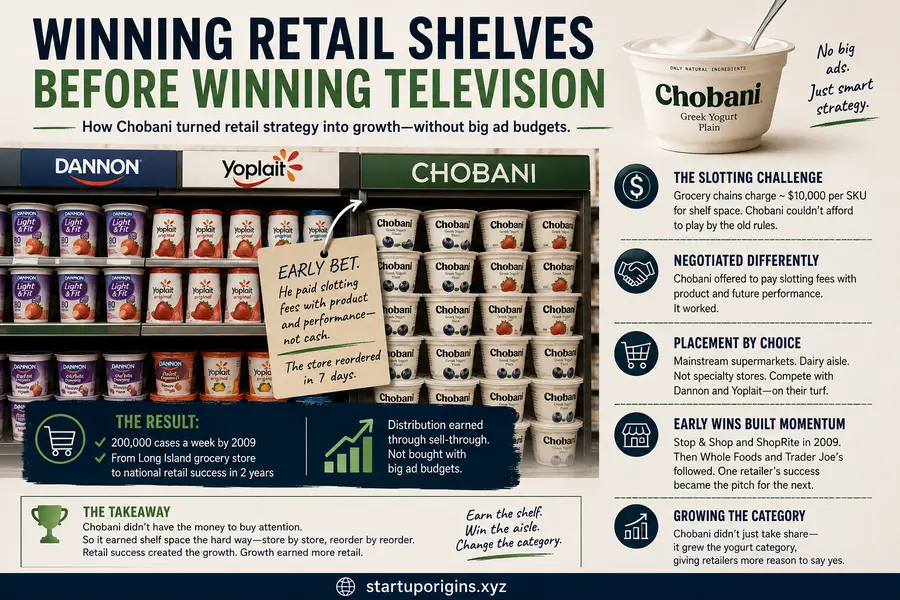
The harder problem was never convincing consumers. It was convincing retailers to put an unknown brand on a shelf that was already full.
Grocery chains charge “slotting fees” — payments from manufacturers for shelf space — and established brands with marketing budgets typically pay them upfront in cash. Shelf space was expensive, running around $10,000 per SKU, and Chobani could not afford to stock its product alongside more established competitors on those terms. Ulukaya’s solution was to negotiate differently rather than not at all. He shipped his first crates to a small grocery store on Long Island and offered to pay the placement fee not in cash he didn’t have, but effectively in product and future performance — betting the store that Chobani would sell. The store reordered within seven days.
That early bet illustrates the mechanism at the heart of Chobani’s retail strategy: it treated distribution as something to be earned store by store through sell-through, not something to be bought all at once through a national ad campaign. The company negotiated terms for slotting fees that it did not have to pay upfront, financing shelf space with velocity instead of cash. Within a few weeks of that first Long Island order, large reorders started coming in, and by 2009 — just two years after launch — Chobani was selling 200,000 cases of yogurt a week, a pace that turned the company’s problem from finding customers to finding enough capacity to supply them.
Just as consequential was where Chobani insisted on being placed. From the beginning, the company insisted its yogurt be sold in mainstream supermarkets rather than specialty grocery stores, and stocked in the regular dairy aisle rather than a gourmet or health-food section. Fage, by contrast, largely accepted specialty placement — treating itself as a premium import rather than a mass-market challenger. That one positioning choice meant Chobani was competing for the same eyeballs as Dannon and Yoplait from day one, rather than for a smaller pool of specialty shoppers who already sought out imported Greek products.
Small regional chains were the proving ground: Stop & Shop and ShopRite began carrying Chobani in 2009, just two years after the first cups hit shelves, and sales took off from there, pulling in Whole Foods and Trader Joe’s as the momentum built. Once a handful of chains saw reliable sell-through and reorders, the pitch to the next retailer became easier — not “trust us,” but “here’s what happened at the last store.”
Retailers had their own reason to say yes beyond charity toward a scrappy founder. Chobani was expanding the overall yogurt category and lifting total dairy-aisle sales, which gave grocers a reason to hand over more shelf space rather than less. A product that grows the pie is a much easier internal sell for a category manager than one that simply competes for existing share.
Word-of-Mouth Became Chobani’s Biggest Marketing Channel
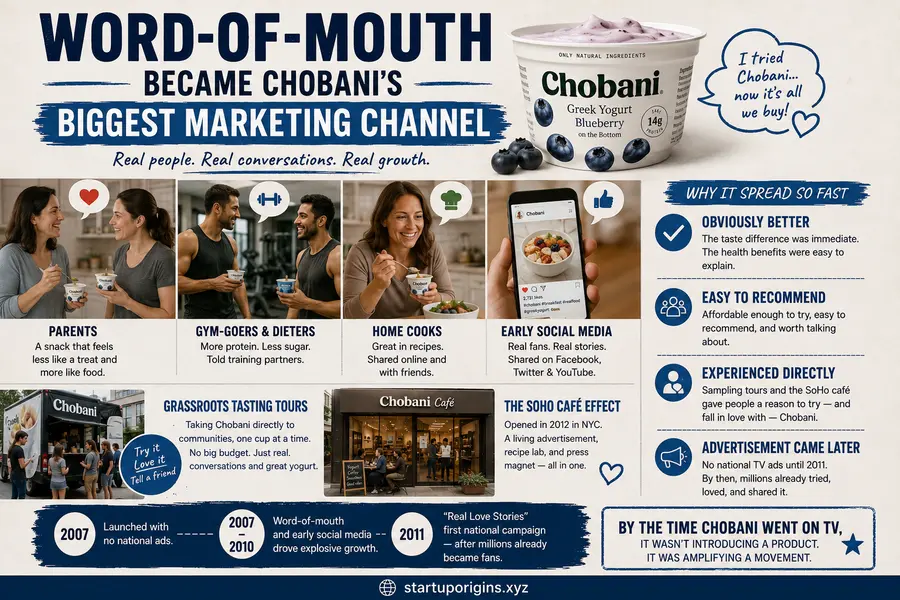
With the product on shelves and priced for trial, the job shifted from winning buyers to winning repeat buyers — and turning them into recruiters.
Because the taste difference was immediately obvious and the health story was easy to explain in one sentence — more protein, less sugar, real ingredients — Chobani was unusually well-suited to spread through ordinary conversation. Parents recommended it to other parents as a snack that felt less like a treat and more like food. Gym-goers and dieters, drawn by the protein content, told training partners. Home cooks folded it into recipes and posted about it. None of this required a media budget; it required a product worth talking about and a price low enough that recommending it didn’t feel like recommending a luxury.
Rather than heavy traditional advertising, Chobani relied on grassroots tasting tours and early social media activity to build loyalty in its first years. Chobani did not run a national advertising campaign at all until it debuted “Real Love Stories” in February 2011 — its first national push, built around real fans’ stories and social-media posts rather than a conventional product pitch. Until that point, essentially all of its marketing ran through word-of-mouth and early activity on channels like Twitter, Facebook, and YouTube — platforms that were themselves still young, and where an authentic, low-budget brand voice didn’t look out of place next to slicker, more heavily produced competitors.
The company also engineered opportunities for people to experience the product directly rather than just hear about it. In 2012 it opened a branded café in New York’s SoHo neighborhood, serving gourmet yogurt creations and smoothies that functioned as a living advertisement for the brand while doubling as a source of product ideas and press coverage. Sampling tours worked the same logic at a larger scale — get the product into someone’s mouth, and let the yogurt argue its own case.
By the time Chobani did start advertising on television, it wasn’t introducing an unknown product. It was amplifying a brand that millions of people had already tried, liked, and told someone else about — a fundamentally cheaper and more credible position to advertise from than a cold launch.
Expanding Without Losing the Brand
Growth created its own problem: how to add flavors, formats, and volume without diluting the thing that made the original product distinctive.
Manufacturing capacity became the binding constraint almost immediately. Chobani’s original plant sold out faster than it could expand, and the company had to scour the country for used equipment — buying a straining machine for $50,000 that would have cost roughly a million dollars new — just to keep pace with reorders. The South Edmeston, New York plant eventually maxed out entirely, forcing a decision that would have terrified a more cautious management team: build a second facility from scratch, at a scale the company had never attempted, before it had outside investors to cushion the bet.
Chobani chose Twin Falls, Idaho, and built what it called the world’s largest yogurt manufacturing plant — nearly a million square feet, completed in 326 days at a cost of roughly $450 million. The plant was sized to use up to 10 million pounds of milk a day, sourced entirely from local Magic Valley dairies through Dairy Farmers of America, a decision that also reshaped the regional dairy economy and gave Chobani negotiating leverage on raw milk costs that smaller rivals couldn’t match.
New products followed the same instinct that had guided the original launch: extend the line only where the extension reinforced the core promise rather than diluting it. Flavor expansion, then drinkable and Greek yogurt–based dips, then foodservice formats for schools and restaurants — each addition widened the audience without abandoning the thick texture, high protein, and natural ingredients that had made the original cup work. The Idaho plant was purpose-built with the flexibility to handle mix-ins like nuts and coconut and to run large-format foodservice packaging, letting Chobani chase new occasions for the product — as an ingredient, a snack, a breakfast — without opening a separate factory for every idea.
Growth wasn’t frictionless. In September 2013, consumer illness complaints tied to mold in yogurt produced at the Idaho plant led Chobani to move from a quiet market withdrawal to a formal, nationwide recall. Ulukaya said the contamination was “unacceptable to me and all of our yogurt makers,” and said the company had worked with retail partners to pull product from shelves before recalling the remainder out of caution. Chobani said fewer than 5 percent of its production was affected, and that 95 percent of the tainted cups had already been identified and removed by the time the formal recall was announced. The episode tested whether the trust the brand had spent years building could survive a real manufacturing failure. It did, in large part because the company’s response mirrored the same instinct that had built the brand in the first place: transparency and speed rather than spin.
Competing Against Industry Giants
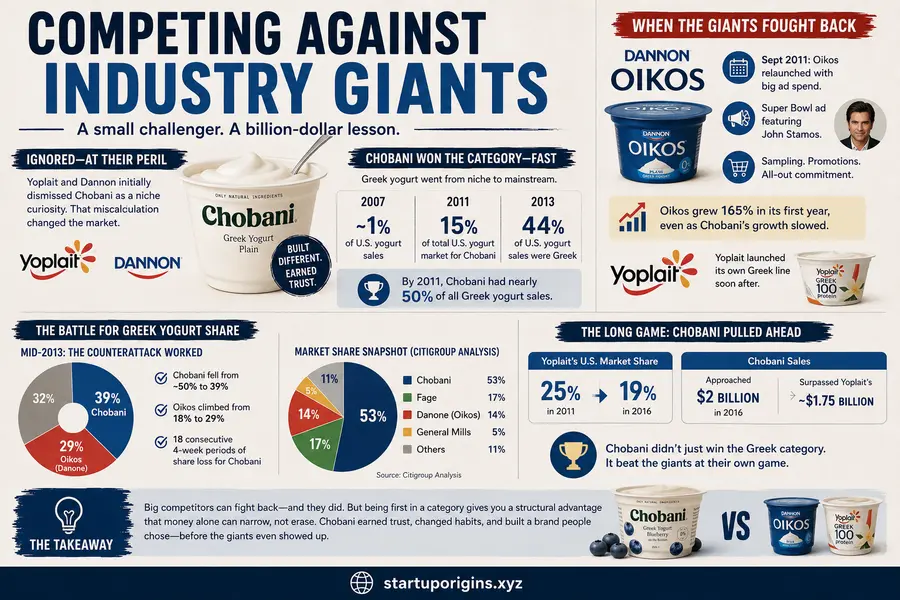
For the first several years, Yoplait and Dannon largely ignored Chobani, treating Greek yogurt as a niche curiosity rather than a threat. That was a costly miscalculation.
By 2011, Chobani held 15 percent of the entire U.S. yogurt market and nearly half of all Greek yogurt sales, while Danone’s overall yogurt market share fell from 40 percent in 2010 to 35 percent a year later. Greek yogurt had gone from roughly 1 percent of U.S. yogurt sales in 2007 to 44 percent of the market by 2013 — and Chobani had built that category almost single-handedly while the incumbents were still deciding whether to take it seriously.
Once they did react, the giants reacted hard. Danone relaunched its Dannon Greek line as Oikos in September 2011, shifting advertising dollars from other brands, adding in-store sampling and promotions, and running a Super Bowl commercial starring actor John Stamos to establish Greek credibility. Oikos grew 165 percent in the year that followed, even as Chobani’s own growth slowed and it lost share for eighteen consecutive four-week sales periods, according to industry analysts at the time. Yoplait launched its own Greek line soon after.
Chobani felt the pressure from that counterattack in the numbers before it recovered from it. By mid-2013, Chobani’s own share of the Greek yogurt category had fallen from almost half to 39 percent, according to Sanford C. Bernstein’s analysis, while Danone’s Oikos climbed from 18 percent to 29 percent over the same stretch — the sharpest evidence that a well-resourced incumbent, once it fully committed, could close ground quickly. Even so, Chobani never lost the lead. A Citigroup analysis around the same period still put Chobani at 53 percent of the Greek yogurt market, well ahead of Fage’s 17 percent, Danone’s 14 percent, and General Mills’ 5 percent. And the longer-run trend favored Chobani decisively: by 2016, Yoplait’s overall U.S. yogurt market share had fallen from 25 percent in 2011 to 19 percent, while Chobani’s sales approached $2 billion, surpassing Yoplait’s roughly $1.75 billion for the year — the moment Chobani passed its original mainstream target, not just its fellow Greek challengers.
The lesson embedded in those numbers is not that big competitors couldn’t fight back — they clearly could, and did, with real money and real results for their own new products. It’s that arriving second in a category you didn’t invent is a structural disadvantage that spending alone can narrow but rarely erase, especially against a brand that already has the trust of the people making the purchase.
The Growth Decision That Changed Chobani Forever
If one decision explains the arc of Chobani’s rise more than any other, it’s the choice to pour early, scarce resources into product quality and retailer relationships instead of a traditional advertising launch.
The alternative path was available and, on paper, more conventional. Chobani could have raised outside capital, hired an agency, and launched with a national ad campaign positioning itself as a premium import — following roughly the model Fage had already used. That path had lower execution risk in the sense that it followed a known playbook. It also had a ceiling: it would have positioned Chobani as a specialty product competing for a small pool of shoppers who already sought out Greek yogurt, rather than as a mass-market challenger to Dannon and Yoplait.
Instead, Ulukaya bet that if the product itself created its own demand, distribution and word-of-mouth would compound faster than any campaign could. That bet included insisting the yogurt be sold in mainstream grocery stores rather than specialty shops, stocked in the standard dairy aisle rather than a health-food section — a decision he later identified as one of the three most important calls that allowed him to finance the company’s growth without outside investors.
The risk in that decision was real and specific: a single bad batch, a slow month, or a retailer’s decision to pull the product could have ended the company before word-of-mouth had time to compound. Ulukaya managed that risk by prioritizing payments to milk suppliers and employees above all other vendors, sometimes letting other bills fall behind in order to protect the relationships the business actually depended on — a working-capital tightrope walk that a better-funded competitor following the conventional playbook wouldn’t have needed to attempt.
The payoff for taking that risk was structural, not just financial. By the time Chobani had the resources to advertise at scale, it wasn’t buying awareness for an unknown brand — it was reinforcing a reputation millions of shoppers already held. That reputation, combined with a 2011 Olympic sponsorship and its first major ad campaigns, helped push the company toward roughly $1 billion in annual sales by 2012 — a scale that gave it the leverage and cash flow to build the Idaho plant and compete with incumbents on manufacturing capacity, not just brand story.
Had Chobani launched the conventional way, it might still have succeeded. But it would have entered the market looking like every other new entrant asking to be believed. Instead, it entered looking like something shoppers had already decided, on their own, was worth telling a friend about.
Why Competitors Couldn’t Easily Copy Chobani’s Growth Strategy
The most striking fact about Chobani’s rise is not that it happened, but how long it took Dannon and General Mills — companies with vastly greater resources — to respond effectively, and how incomplete their response ultimately was even once they tried.
Manufacturing capability lagged behind marketing capability. Straining yogurt at scale required different equipment and processes than conventional yogurt production. Dannon had to add significant new capacity across its plants in Texas, Utah, and Ohio just to compete in Greek yogurt — a multi-year, capital-intensive undertaking that no advertising budget could shortcut. A rival can copy a recipe faster than it can retool a manufacturing footprint.
Speed of decision-making favored the smaller, privately held challenger. Chobani could decide to build a $450 million plant, break ground, and start production in under a year because one person controlled the decision. Large public companies with quarterly earnings pressure, layered approval processes, and existing brand portfolios to protect move more deliberately by design — a structural disadvantage that has nothing to do with talent or resources and everything to do with organizational size.
Culture and founder mindset were not transferable assets. A category-defining challenger brand run by a founder with a personal, immigrant-entrepreneur stake in the product’s authenticity is difficult for a decades-old public company to replicate convincingly, no matter how good its marketing department is. Consumers can generally tell the difference between a brand built around a genuine origin story and one built by a legacy company assigning “authentic” as a creative brief.
Product quality set a bar that took years to match, not months. Perfecting a straining process and flavor profile that consumers preferred over the established leader wasn’t something incumbents could simply greenlight and ship. Chobani itself spent two years developing its recipe before launch; competitors racing to catch up were working under public market pressure to show results immediately, a tension that shows up in taste and formulation shortcuts consumers can detect.
Retailer confidence, once earned, became a moat. Grocery chains had already watched Chobani grow their category and their dairy-case revenue for several years before competitors’ Greek lines arrived. That track record gave Chobani negotiating leverage and trust that a new entrant — even one backed by a household name — had to rebuild from scratch, product launch by product launch.
First-mover momentum compounded rather than faded. Every month Chobani spent as the only credible mass-market Greek yogurt option added more loyal repeat customers, more retail data proving sell-through, and more word-of-mouth reach. By the time Danone’s relaunched Oikos brand was growing at 165 percent, it was still growing off a much smaller base than the Chobani business it was chasing — a reminder that fast percentage growth against a small starting point is a different achievement than overtaking an entrenched leader.
None of this means the incumbents couldn’t compete — Dannon’s Oikos and General Mills’ Yoplait Greek both became large, legitimate businesses. It means they couldn’t simply outspend their way past a multi-year head start built on product, trust, and distribution. Money bought them entry into the category. It didn’t buy them the years Chobani had already spent earning shelf space and loyalty one store at a time.
What Modern Startups Can Learn From Chobani’s Growth
Chobani’s rise offers a set of lessons that generalize well beyond yogurt, precisely because none of them depend on a category-specific insight.
Solve a real problem before you promote anything. Chobani’s entire growth engine depended on the product being genuinely, noticeably better — not just differently marketed. No amount of clever positioning compensates for a product people don’t actually prefer once they’ve tried it.
Sequence product before promotion, deliberately. Spending two years perfecting a recipe before ever launching cost Chobani time it could have used to start selling sooner. That patience is what made the eventual launch self-sustaining rather than dependent on continuous ad spend to prop up an unproven product.
Design for advocacy, not just for sale. A pricing and quality combination that makes trial easy and satisfaction obvious turns customers into an unpaid sales force. That effect can’t be bought after the fact through referral programs or influencer partnerships nearly as cheaply as it can be built into the product and price from the start.
Treat distribution partners as stakeholders, not gatekeepers to be paid off. Chobani’s willingness to structure slotting fees around actual performance rather than upfront cash gave retailers a reason to actively champion the product, not merely tolerate its presence on a shelf.
Trust compounds, but slowly and unevenly — protect it accordingly. The 2013 recall showed that years of built-up trust could survive a real crisis, but only because the company’s response matched the values that built the trust in the first place. A brand that grows on authenticity has more to lose from a dishonest response to a failure than a brand that grew on advertising alone.
Scale infrastructure in step with real demand, not projected demand. Chobani expanded manufacturing capacity reactively — buying used equipment, then building an entirely new plant — in direct response to demand it could already see in reorders. That capital discipline, forced partly by limited access to outside funding, kept the company from overbuilding ahead of proof.
None of these lessons promise fast growth. They describe a slower, harder path that happens to be far more durable than a well-funded launch — and one that’s available to startups with far less capital than Chobani eventually raised, because the earliest and most important steps didn’t require capital at all.
Conclusion
Chobani’s growth wasn’t the result of one viral campaign or one expensive advertising push. It happened because customers believed the product was worth sharing, retailers believed it deserved shelf space, and the company spent its first, leanest years building trust before it ever tried to buy attention.
That combination proved more durable than a media budget, in part because it couldn’t simply be matched by writing a bigger check. By the time the industry’s biggest players understood what Chobani had built, they weren’t just competing against a yogurt. They were competing against years of reorders, word-of-mouth, and shelf space that had already been earned — one grocery store at a time.
Frequently Asked Questions
How did Chobani become successful without a big marketing budget?
Chobani built a product that was visibly better than mainstream yogurt — thicker, higher in protein, made with real ingredients — and priced it low enough for easy trial. That combination generated word-of-mouth and retailer reorders that functioned as marketing without requiring advertising spend.
Did Chobani spend heavily on advertising in its early years?
No. Chobani ran on social media, sampling, and word-of-mouth marketing until it debuted its first national advertising campaign in February 2011, “Real Love Stories” — roughly four years after its commercial launch.
What was Chobani’s core marketing strategy?
Earning retail placement through demonstrated sell-through rather than large upfront slotting-fee payments, insisting on mainstream supermarket dairy-aisle placement instead of specialty shelves, and letting product quality drive customer recommendations.
Why did Chobani grow so quickly compared to other yogurt brands?
It entered a category — Greek yogurt — that established players had written off as a low-growth niche, giving Chobani years of limited competition to build distribution and loyalty before Dannon and General Mills responded seriously.
Who were Chobani’s biggest competitors, and how did they respond?
Danone relaunched its Greek yogurt line as Oikos in 2011 with a Super Bowl ad and heavy promotional spending, while General Mills pushed its own Yoplait Greek line. Both grew, but neither displaced Chobani from category leadership.
Did Chobani’s growth strategy ever put the company at risk?
Yes. Tight cash flow in the early years forced difficult tradeoffs in which vendor payments to prioritize, and a 2013 manufacturing recall tested the trust the brand had built with consumers. The company’s transparent handling of that recall helped preserve the loyalty its growth depended on.
Disclaimer
This article is an independent editorial analysis and is not affiliated with, endorsed by, or sponsored by Chobani, LLC. It is based on publicly available reporting, company statements, and industry data; figures such as sales and market share are estimates from third-party sources and may vary by year and methodology.
Related reading: How Chobani Started in an Abandoned Factory · Hamdi Ulukaya: The Immigrant Founder Who Built Chobani · What Chobani Teaches Every Startup Founder

Anup Kumar Yadav is the founder of StartupOrigins.xyz, where he researches and publishes detailed stories about the world’s most successful startups. His work explores founder journeys, funding milestones, growth strategies, and the lessons entrepreneurs can learn from them.